Tunnel Washer (CBW)
ProductOverview
The continuous belt washer (CBW), commonly called a tunnel washer, is the workhorse of industrial laundries processing high volumes (500–800 kg/hour) without pause. Unlike batch washers, the tunnel washer advances fabric continuously through six rotating tunnels in sequence, each serving a distinct wash stage: pre-rinse, detergent wash, intermediate rinse, alkali treatment, final rinse, and softener dose.
The machine comprises six stainless steel rotating tunnels mounted horizontally on a welded steel frame. Fabric enters the first tunnel at one end and exits compressed at the opposite end via heated nip rollers. Between tunnels, pneumatic scoops flip and advance the load into the next chamber.
A single synchronized motor rotates all six tunnels at 120 rpm via flexible couplings. A counterflow circulation system pumps warm water through the tunnels while a separation tank removes lint and fiber waste, allowing 70% of wash water to be recirculated. The control system manages water temperature, level, and module rotation speed independently.
This design achieves 600 kg/hour throughput while consuming 8 L water per kg (batch washers use 20 L/kg), making it the standard for hotel and healthcare laundry operations globally.
How It Works
Soiled fabric is loaded onto the first tunnel module entrance chute by the operator. The PLC detects load arrival via photoelectric sensor and initiates the transfer sequence.
The Drive Motor continuously rotates the entire drive system at 120 rpm. As the first tunnel rotates, internal baffle blades lift and cascade the fabric load over itself, tumbling it within the wash chamber. The first stage is pre-rinse: hot water (30°C) from the circulation pump is diverted to the first tunnel inlet via the Flow Diverter Valve. Water exits through perforations in the tunnel wall, carrying away loose surface soil. Wash water is then separated and returned to the circulation loop.
After 30 seconds of rotation, the fabric occupies the bottom of the tunnel. The pneumatic cylinder signals the first Transfer Scoop, which slides under the load, lifts it as the tunnel rotates past, and flips it into the second tunnel entrance. The transfer motion is timed to the tunnel rotation, typically 1 second lift, 1 second flip.
The second tunnel begins detergent wash: heated water at 60°C is circulated from the Separator Tank through chemical dosing lines injecting detergent. The baffle action provides aggressive mechanical scrubbing for 60 seconds as the fabric tumbles. Detergent-laden water drains into the separator tank, where baffles settle lint and fibers to the bottom; clarified water overflows into the circulation loop.
Tunnels 3 and 4 are dedicated rinse stages: fresh water (at ambient temperature or slightly warm) cascades through the fabric without chemical additives. The internal baffles ensure complete water penetration. Between modules, the transfer scoops advance the load.
Tunnel 5 is the alkali treatment: a measured dose of acid rinse neutralizes residual detergent, improving fabric hand-feel and reducing yellowing. Tunnel 6 is the final rinse with optional fabric softener or optical brightener.
As the load exits tunnel 6, the fabric drops onto the entrance of the heated nip roller press. Two elastomer-covered rollers compress the load to 100 kPa, extracting residual moisture. The rollers are heated to 60°C, which softens the elastomer for better contact and begins drying the fabric surface. Residual water squeezes back into the separator tank drain. The pressed fabric exits onto a collection chute for transport to the dryer or folding station.
The entire transfer and wash sequence repeats every 30 seconds, advancing new loads continuously. At 30 seconds per load and assuming 8 kg average load weight, the machine processes 960 kg/hour (stated 600 kg/hour accounts for load variability and cycle stoppages).
Water and Energy Recovery
The counterflow circulation is the key efficiency: water used in tunnel 1 (pre-rinse) is redirected to tunnel 4 (second rinse) after settling. Water exiting tunnel 6 (final rinse) drains away. This reduces fresh water demand from 120 L per load (batch washers) to 8 L per load.
The separator tank is a 2.0 m³ vessel with internal baffles. Incoming wash water from tunnels 2–4 enters the top and flows downward, settling lint and soil solids to the bottom. Clarified water overflows into a secondary chamber and recirculates. Solids accumulate and are manually flushed via the Drain Solenoid Valve every 8 hours of operation.
The 30 kW heater maintains the circulation tank at 55–65°C, minimizing heat loss between tunnels. At full speed, the heater cycles on/off to maintain setpoint; the RTD probes provide feedback. Steam-heated variants use a heat exchanger instead, improving energy efficiency by 15%.
Construction and Durability
Each tunnel module is a sealed rotating assembly. The stainless steel shell (SS 316 in salt-water environments) is 1.2 m diameter with a 10 mm wall. Perforations (6 mm diameter, 25 mm pitch) cover 70% of the shell area. The shell is welded at both ends to bearing housings, creating a sealed drum.
Inside, the baffle system consists of four curved stainless steel blades welded to a central shaft, creating four separate wash chambers. As the drum rotates, fabric in each chamber is lifted by the baffle blade, tumbles over the baffle top, and drops into the next chamber, multiplying mixing and scrubbing action.
Front and rear deep-groove ball bearings (6309 size) support the drum shaft at 120 rpm. The rotating water seal (dual mechanical seal with stainless faces) prevents water from entering the bearing cavity. A labyrinth back-up seal provides secondary protection.
The high-pressure wash jet manifold is mounted on the drum's fixed center post. Six 8 mm jets direct 40 bar water tangentially onto the drum interior during the wash stage, creating additional impact cleaning and aiding water extraction during the rinse phases.
All six modules are driven synchronously by the main drive shaft through flexible couplings; if one module stalls, the PLC alarm signals maintenance but does not stop the machine, allowing partial operation.
The transfer scoops are actuated by a single pneumatic cylinder via a cam linkage. The scoop speed and stroke are adjustable via PLC control, accommodating different load weights and fabric types. Misfeeds trigger a proximity sensor, halting the next transfer and signaling an alarm.
Controls and Safety
The control system integrates three float-type level sensors (main tank, module 3, module 6) and three temperature probes (circulation tank, module 2, module 5). The PLC maintains water level within ±5 cm and temperature within ±2°C by modulating the Circulation Pump speed and Heating Coil output.
Chemical dosing pumps (not shown in the main BOM) are controlled proportionally to load weight (detected via sound-level microphone during the transfer phase). The HMI interface allows operators to program up to 50 custom recipes (cycle times, temperatures, chemical doses) and select by garment type at startup.
Emergency stop buttons are positioned on both sides of the machine; any e-stop halts the Drive Motor and closes all solenoid water valves within 500 ms. Guard rails surrounding the machine frame prevent operator contact with rotating tunnels.
Overload protection: if fabric jam occurs in any tunnel, the torque sensor on the drive shaft triggers an alarm and reverses the motor briefly to clear the jam. If jam persists, the PLC stops the machine and displays the error code.
Tunnel Washer (CBW) parts and their functions
7 top-level parts · 87 parts in total · full bill of materials below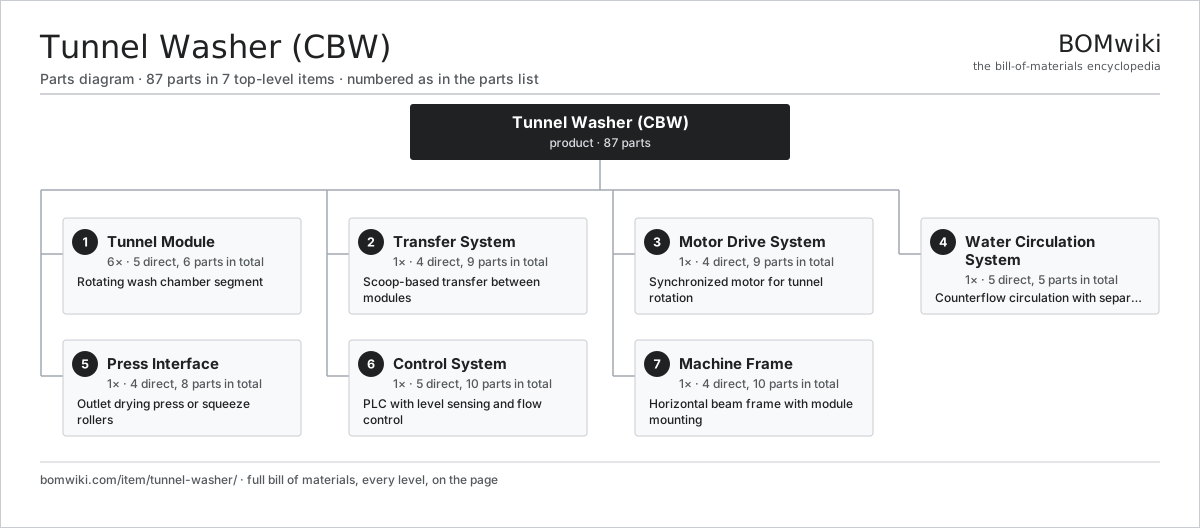
| # | Part | Qty | What it does |
|---|---|---|---|
| 1 | Tunnel Module 5 parts | 6× | Rotating wash chamber segment |
| 2 | Transfer System 4 parts | 1× | Scoop-based transfer between modules |
| 3 | Motor Drive System 4 parts | 1× | Synchronized motor for tunnel rotation |
| 4 | Water Circulation System 5 parts | 1× | Counterflow circulation with separation |
| 5 | Press Interface 4 parts | 1× | Outlet drying press or squeeze rollers |
| 6 | Control System 5 parts | 1× | PLC with level sensing and flow control |
| 7 | Machine Frame 4 parts | 1× | Horizontal beam frame with module mounting |
3D model
No 3D model yet. Have a CAD file of this? Add a 3D model. STL renders right on this page; STEP, FreeCAD, and OpenSCAD sources are welcome too (openly licensed, like all 3D models on BOMwiki).
Build & assembly graph
expand / collapse · shared sub-assemblies converge · links to related products · est. labourTap an assembly to expand/collapse · tap a part to open it · use “Open page” for any node · drag to pan, scroll to zoom.
Bill of materials for Tunnel Washer (CBW)
7 top-level lines · 38 rows shown · 87 parts total · indented to 3 levels| # | Item / sub-assembly | Part no. | Qty/assy | Ext. qty | Parts | Type |
|---|---|---|---|---|---|---|
| 1 | Tunnel Module 5 parts | tunnel-washer-tunnel-module | 6× | 6 | 6 | assembly |
| 1.1 | Tunnel Shell | tunnel-washer-module-shell | 1× | 6 | · | part |
| 1.2 | Internal Baffle | tunnel-washer-module-baffle | 1× | 6 | · | part |
| 1.3 | Module Bearing | tunnel-washer-module-bearing | 2× | 12 | · | part |
| 1.4 | Rotating Water Seal | tunnel-washer-module-seal | 1× | 6 | · | part |
| 1.5 | Wash Jet Manifold | tunnel-washer-module-jet-manifold | 1× | 6 | · | part |
| 2 | Transfer System 4 parts | tunnel-washer-transfer-system | 1× | 1 | 9 | assembly |
| 2.1 | Transfer Scoop | tunnel-washer-transfer-scoop | 6× | 6 | · | part |
| 2.2 | Transfer Linkage | tunnel-washer-transfer-linkage | 1× | 1 | · | part |
| 2.3 | Transfer Actuator | tunnel-washer-transfer-actuator | 1× | 1 | · | part |
| 2.4 | Transfer Proximity Sensor | tunnel-washer-transfer-sensor | 1× | 1 | · | part |
| 3 | Motor Drive System 4 parts | tunnel-washer-motor-drive | 1× | 1 | 9 | assembly |
| 3.1 | Drive Motor | tunnel-washer-drive-motor | 1× | 1 | · | part |
| 3.2 | Drive Gearbox | tunnel-washer-drive-gearbox | 1× | 1 | · | part |
| 3.3 | Drive Shaft | tunnel-washer-drive-shaft | 1× | 1 | · | part |
| 3.4 | Module Flexible Coupling | tunnel-washer-module-coupling | 6× | 6 | · | part |
| 4 | Water Circulation System 5 parts | tunnel-washer-water-circulation | 1× | 1 | 5 | assembly |
| 4.1 | Circulation Pump | tunnel-washer-circulation-pump | 1× | 1 | · | part |
| 4.2 | Separator Tank | tunnel-washer-separator-tank | 1× | 1 | · | part |
| 4.3 | Heating Coil | tunnel-washer-heating-element | 1× | 1 | · | part |
| 4.4 | Flow Diverter Valve | tunnel-washer-flow-diverter | 1× | 1 | · | part |
| 4.5 | Drain Solenoid Valve | tunnel-washer-drain-valve | 1× | 1 | · | part |
| 5 | Press Interface 4 parts | tunnel-washer-press-interface | 1× | 1 | 8 | assembly |
| 5.1 | Nip Roller | tunnel-washer-press-roller | 2× | 2 | · | part |
| 5.2 | Roller Bearing | tunnel-washer-press-bearing | 4× | 4 | · | part |
| 5.3 | Press Pressure Cylinder | tunnel-washer-press-pressure-cylinder | 1× | 1 | · | part |
| 5.4 | Roller Heating Band | tunnel-washer-press-heating | 1× | 1 | · | part |
| 6 | Control System 5 parts | tunnel-washer-control-system | 1× | 1 | 10 | assembly |
| 6.1 | Control PLC | tunnel-washer-plc-unit | 1× | 1 | · | part |
| 6.2 | HMI Touchscreen | tunnel-washer-hmi-touchscreen | 1× | 1 | · | part |
| 6.3 | Level Sensor | tunnel-washer-level-sensor | 3× | 3 | · | part |
| 6.4 | Temperature Probe | tunnel-washer-temperature-sensor | 3× | 3 | · | part |
| 6.5 | Pressure Transducer | tunnel-washer-pressure-transducer | 2× | 2 | · | part |
| 7 | Machine Frame 4 parts | tunnel-washer-frame | 1× | 1 | 10 | assembly |
| 7.1 | Frame Base | tunnel-washer-frame-base | 1× | 1 | · | part |
| 7.2 | Side Support Beam | tunnel-washer-frame-side-beams | 2× | 2 | · | part |
| 7.3 | Module Mounting Block | tunnel-washer-module-mounting-block | 6× | 6 | · | part |
| 7.4 | Guard Railing | tunnel-washer-frame-guard-rail | 1× | 1 | · | part |
Something wrong in this list? Report a problem with this BOM.
Sourcing: possible vendors
Browse the supplier directory → Prices, MOQ, and lead times are algorithmic estimates, not quotes, and not claims about these companies. Company mappings are curated by keyword; est. price band $150–$3k. How estimates work| Vendor | HQ | Specialty | MOQ | Lead time |
|---|---|---|---|---|
| whirlpoolcorp.com ↗ | Benton Harbor, US | Home appliances | 1,000 units | 8–14 wks |
| bsh-group.com ↗ | Munich, DE | Appliances (Bosch, Siemens) | 1,000 units | 8–14 wks |
| electroluxgroup.com ↗ | Stockholm, SE | Home appliances | 1,000 units | 8–14 wks |
| lg.com ↗ | Seoul, KR | Appliances & electronics | 1,000 units | 8–14 wks |
|
🇨🇳Haier
haier.com ↗
|
Qingdao, CN | Home appliances | 1,000 units | 8–14 wks |
1,385-word article