Omnidirectional VR Treadmill
ProductOverview
An omnidirectional VR treadmill is a locomotion interface that enables natural walking in any direction within a virtual environment while keeping the user stationary in physical space. Unlike traditional treadmills that move a belt beneath the user, omnidirectional systems use a low-friction floor surface (PTFE or marble) and specialized shoes to allow the user to slide naturally in any compass direction.
The core principle is "zero-resistance walking", a frictionless surface that the user's muscles work against naturally, generating proprioceptive cues that enhance VR immersion. The system detects foot pressure and position, converting movement intent into velocity vectors that drive the VR avatar forward, backward, or sidestep without active motorized assistance (passive variants) or with optional motorized belt help (active variants).
This is fundamentally different from hand-controller locomotion or teleportation, which lack vestibular and proprioceptive feedback. Omnidirectional treadmills are critical for medical rehabilitation, military training, and high-end entertainment where motion realism is essential.
How it works (Passive systems)
The user stands on the Deck Surface, wearing special Omnidirectional Shoes with PTFE soles that slide freely. An overhead Harness and Support Ring prevents falls but provides no support force.
Eight Pressure Sensor pads detect which regions of the floor the user is pressing, left foot forward-left, right foot forward-right, etc. A Sensor Fusion Board fuses pressure data with an Harness IMU (measuring user lean) to estimate the intended walking direction and speed.
The processor converts this into a locomotion vector, e.g., (0.8 m/s forward, 0.3 m/s rightward), and sends it to the VR application via VR Plugin. The game engine moves the virtual avatar accordingly.
The low friction of the deck is key: users exert sustained muscle force (plantarflexion, hip flexion) to push against the floor, even though they aren't translating. This generates natural proprioceptive cues, the nervous system feels walking effort and foot pressure, reinforcing the illusion of locomotion.
How it works (Active systems)
Variants with optional Active Motion System (Optional) use an omnidirectional belt or disk beneath the surface, actively translating the user to compensate for detected walking drift. As the user walks forward, the belt retracts them backward at the same speed, keeping them centered. This reduces user effort and enables backward walking (harder to achieve on a passive system).
Applications
Rehabilitation: Stroke patients relearning gait use omnidirectional treadmills to practice walking without therapist assistance, improving safety and task repetition.
Military training: Soldiers conducting room-clearance drills or casualty evacuation training benefit from proprioceptive feedback that shooting-range simulators cannot provide.
Research: Neuroscience labs use them to study balance, proprioception, and vestibular adaptation.
Entertainment: Premium VR arcades deploy them for high-end experiences (e.g., zombie survival games where natural running feels more immersive).
Friction and shoe design
The PTFE Sole Insert is critical. PTFE (polytetrafluoroethylene) has a coefficient of friction <0.05, meaning users can sustain muscle force (equivalent to walking uphill) without translating. Some systems use polished marble or epoxy coatings instead of PTFE.
Shoe design must prevent heel slip while allowing sliding. Special heel cups and ankle support keep feet stable during rotational movements.
Safety considerations
Falls are the primary risk. The overhead Harness and Support Ring uses a constant-tension reel (like rock-climbing auto-belays) to catch users immediately if they trip. The reel releases on pressure-sensitive Emergency Abort Bar contact, if the user crashes into the cage, the harness locks.
Emergency-stop buttons on the Emergency Pendant pendant trigger immediate harness lock and VR scene pause.
Latency and vestibular comfort
Critical for comfort: sensor-to-avatar latency must be <100 ms. Beyond that, users experience "simulator sickness", their inner ear signals mismatch between expected and actual acceleration.
The Sensor Fusion Board runs at 100 Hz, and the VR application updates at 90+ Hz, keeping total latency within tolerance.
Manufacturing challenges
Precision manufacturing of the ultra-low-friction deck is expensive. Passive systems are cost-effective (~€80,000) but lack backward-walking capability. Active omnidirectional belts are complex (ball-screw or omni-wheel drives) and cost €150,000+.
Lead times: 12–16 weeks for custom installations due to site-specific ceiling mounting requirements.
Standards
Safety compliance includes ISO 13852 (pressure-sensitive emergency stop), EN 61508 SIL 1 (functional safety), and ISO 11228 (manual handling guidance) for rehabilitation contexts.
Omnidirectional VR Treadmill parts and their functions
7 top-level parts · 43 parts in total · full bill of materials below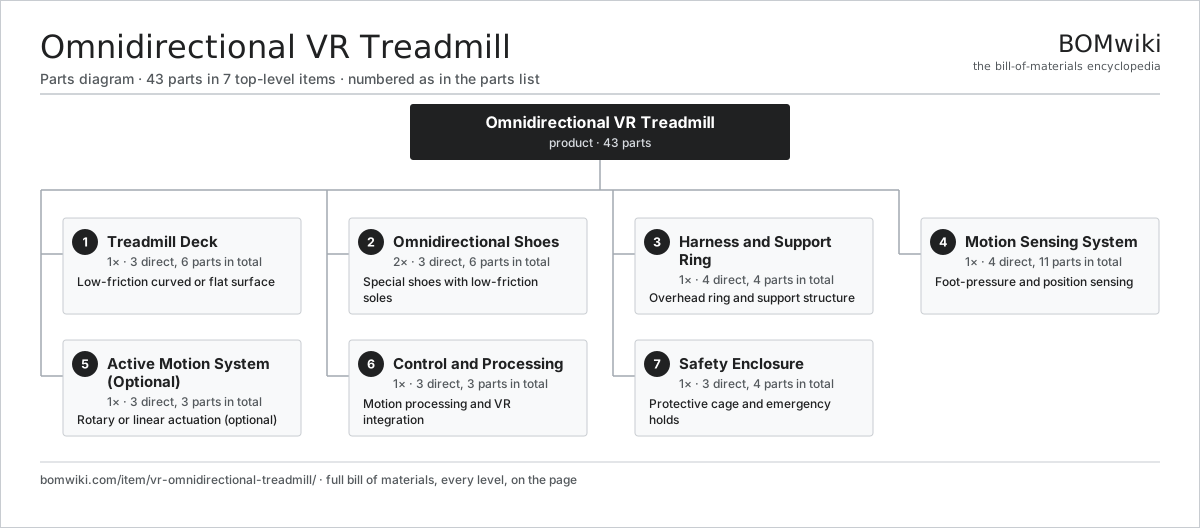
| # | Part | Qty | What it does |
|---|---|---|---|
| 1 | Treadmill Deck 3 parts | 1× | Low-friction curved or flat surface |
| 2 | Omnidirectional Shoes 3 parts | 2× | Special shoes with low-friction soles |
| 3 | Harness and Support Ring 4 parts | 1× | Overhead ring and support structure |
| 4 | Motion Sensing System 4 parts | 1× | Foot-pressure and position sensing |
| 5 | Active Motion System (Optional) 3 parts | 1× | Rotary or linear actuation (optional) |
| 6 | Control and Processing 3 parts | 1× | Motion processing and VR integration |
| 7 | Safety Enclosure 3 parts | 1× | Protective cage and emergency holds |
3D model
No 3D model yet. Have a CAD file of this? Add a 3D model. STL renders right on this page; STEP, FreeCAD, and OpenSCAD sources are welcome too (openly licensed, like all 3D models on BOMwiki).
Build & assembly graph
expand / collapse · shared sub-assemblies converge · links to related products · est. labourTap an assembly to expand/collapse · tap a part to open it · use “Open page” for any node · drag to pan, scroll to zoom.
Bill of materials for Omnidirectional VR Treadmill
7 top-level lines · 30 rows shown · 43 parts total · indented to 3 levels| # | Item / sub-assembly | Part no. | Qty/assy | Ext. qty | Parts | Type |
|---|---|---|---|---|---|---|
| 1 | Treadmill Deck 3 parts | vr-omnidirectional-treadmill-deck | 1× | 1 | 6 | assembly |
| 1.1 | Deck Surface | vr-omnidirectional-treadmill-deck-panel | 1× | 1 | · | part |
| 1.2 | Base Frame | vr-omnidirectional-treadmill-base-frame | 1× | 1 | · | part |
| 1.3 | Vibration Isolator | vr-omnidirectional-treadmill-shock-absorber | 4× | 4 | · | part |
| 2 | Omnidirectional Shoes 3 parts | vr-omnidirectional-treadmill-footwear | 2× | 2 | 6 | assembly |
| 2.1 | Shoe Base | vr-omnidirectional-treadmill-shoe-shell | 2× | 4 | · | part |
| 2.2 | PTFE Sole Insert | vr-omnidirectional-treadmill-ptfe-sole | 2× | 4 | · | part |
| 2.3 | Foot Position Marker | vr-omnidirectional-treadmill-foot-marker | 2× | 4 | · | part |
| 3 | Harness and Support Ring 4 parts | vr-omnidirectional-treadmill-harness | 1× | 1 | 4 | assembly |
| 3.1 | Support Ring | vr-omnidirectional-treadmill-ring-frame | 1× | 1 | · | part |
| 3.2 | Safety Harness | vr-omnidirectional-treadmill-harness-belt | 1× | 1 | · | part |
| 3.3 | Cable Management Reel | vr-omnidirectional-treadmill-cable-reel | 1× | 1 | · | part |
| 3.4 | Emergency Pendant | vr-omnidirectional-treadmill-emergency-cutoff | 1× | 1 | · | part |
| 4 | Motion Sensing System 4 parts | vr-omnidirectional-treadmill-sensor-array | 1× | 1 | 11 | assembly |
| 4.1 | Pressure Sensor | vr-omnidirectional-treadmill-pressure-sensor | 8× | 8 | · | part |
| 4.2 | Optical Tracker | vr-omnidirectional-treadmill-optical-tracker | 1× | 1 | · | part |
| 4.3 | Harness IMU | vr-omnidirectional-treadmill-imu-module | 1× | 1 | · | part |
| 4.4 | Sensor Fusion Board | vr-omnidirectional-treadmill-sensor-processor | 1× | 1 | · | part |
| 5 | Active Motion System (Optional) 3 parts | vr-omnidirectional-treadmill-motor-system | 1× | 1 | 3 | assembly |
| 5.1 | Omnidirectional Drive Motor | vr-omnidirectional-treadmill-motor | 1× | 1 | · | part |
| 5.2 | Omnidirectional Belt System | vr-omnidirectional-treadmill-belt-drive | 1× | 1 | · | part |
| 5.3 | Motor Driver | vr-omnidirectional-treadmill-motor-controller | 1× | 1 | · | part |
| 6 | Control and Processing 3 parts | vr-omnidirectional-treadmill-control-unit | 1× | 1 | 3 | assembly |
| 6.1 | Locomotion Processor | vr-omnidirectional-treadmill-processor-board | 1× | 1 | · | part |
| 6.2 | VR Plugin | vr-omnidirectional-treadmill-vr-interface | 1× | 1 | · | part |
| 6.3 | Power Supply | power-supply | 1× | 1 | · | part |
| 7 | Safety Enclosure 3 parts | vr-omnidirectional-treadmill-safety-rails | 1× | 1 | 4 | assembly |
| 7.1 | Protective Cage | vr-omnidirectional-treadmill-cage-frame | 1× | 1 | · | part |
| 7.2 | Emergency Abort Bar | vr-omnidirectional-treadmill-abort-bar | 2× | 2 | · | part |
| 7.3 | Impact Bumper | vr-omnidirectional-treadmill-bumper-padding | 1× | 1 | · | part |
Something wrong in this list? Report a problem with this BOM.
Related products
same domain, ranked by shared parts Amateur Radio Transceiver
295 parts · shares 1 with this page
Amateur Radio Transceiver
295 parts · shares 1 with this page
 Bone Conduction Headphones
34 parts · shares 1 with this page
Bone Conduction Headphones
34 parts · shares 1 with this page
 Car FM Transmitter
240 parts · shares 1 with this page
Car FM Transmitter
240 parts · shares 1 with this page
 CB Radio
228 parts · shares 1 with this page
CB Radio
228 parts · shares 1 with this page
 Digital Audio Player
267 parts · shares 1 with this page
Digital Audio Player
267 parts · shares 1 with this page
Sourcing: possible vendors
Browse the supplier directory → Prices, MOQ, and lead times are algorithmic estimates, not quotes, and not claims about these companies. Company mappings are curated by keyword; est. price band $50–$2k. How estimates work| Vendor | HQ | Specialty | MOQ | Lead time |
|---|---|---|---|---|
|
🇨🇳Foxconn
foxconn.com ↗
|
Shenzhen, CN | Electronics contract mfg | 1,000 units | 8–14 wks |
|
🇺🇸Jabil
jabil.com ↗
|
St. Petersburg, US | Electronics manufacturing | 1,000 units | 8–14 wks |
|
🇺🇸Flex
flex.com ↗
|
Austin, US | Electronics manufacturing | 1,000 units | 8–14 wks |
| celestica.com ↗ | Toronto, CA | Electronics manufacturing | 1,000 units | 8–14 wks |
|
🇺🇸Sanmina
sanmina.com ↗
|
San Jose, US | Electronics manufacturing | 1,000 units | 8–14 wks |
745-word article