Wireless Doorbell
ProductOverview
A wireless doorbell provides audible notification when a visitor presses a button outside the door, without requiring hardwired connections to the house electrical system. The system has two main units: a battery-powered outdoor transmitter button and a plug-in receiver chime. When the visitor presses the button, the transmitter sends a short radio signal (typically <100 ms); the receiver decodes it and plays a pre-selected chime tone through a built-in speaker.
The system operates on a license-free ISM frequency band, 868 MHz in Europe or 2.4 GHz worldwide. The transmitted signal carries a unique ID (often a rolling code for security against replay attacks) and passes through walls, metal, and other obstructions with typical ranges of 50–100 m indoors.
How it works
The transmitter button contains a simple circuit board with a single-chip RF transceiver or separate modulator and amplifier. Pressing the door button triggers a low-power microcontroller (often just a few discrete logic gates or an 8-pin MCU) to generate a short-duration RF packet. The packet includes:
- A preamble (sync pattern)
- A unique transmitter ID (fixed or rolling code)
- A checksum for error detection
- Control bits (e.g., button A, button B, or battery low flag)
This packet is modulated onto the RF carrier (either 868 MHz or 2.4 GHz depending on regional regulations). The modulator performs On-Off Keying (OOK, the simplest scheme) or Frequency Shift Keying (FSK), producing a modulated waveform. The power amplifier boosts the signal to 10 mW, compliant with regional limits, and couples it to the antenna. The antenna radiates the signal in an omnidirectional pattern.
The signal propagates through free space and into buildings, diffracting around obstacles. The receiver, plugged into a standard AC wall outlet, is always powered and listening. Its antenna picks up incoming RF signals and couples them into the low-noise amplifier. The LNA provides 15–20 dB of gain while minimizing added noise. The signal then passes through a bandpass filter tuned to the transmit frequency, rejecting out-of-band interference.
The filtered signal enters the demodulator IC, which recovers the baseband bitstream. For OOK, this is a simple envelope detector followed by a comparator. For FSK, a more sophisticated frequency discriminator or phase-locked loop (PLL) is used. The demodulated bits are fed to a microcontroller, which searches for the expected preamble pattern.
Once a valid preamble is found, the MCU checks the transmitter ID. If it matches a paired transmitter (stored in flash memory), the MCU verifies the checksum and processes the button code. Assuming all checks pass, the MCU enables the tone/melody generator, which outputs a digital waveform encoding the selected chime melody. The audio amplifier IC drives the speaker element, producing an audible tone at 90–100 dB.
Pairing (linking a new transmitter to a receiver) involves entering a pairing mode on the receiver (usually by holding a button for 5–10 seconds until an LED blinks), then pressing the new transmitter button within ~10 m. The receiver accepts the first valid transmission it receives during pairing and stores the transmitter ID in flash. This prevents unauthorized remote activation.
For enhanced security, many modern doorbells use a rolling code scheme: the transmitter increments a counter with each press, and the receiver checks that the received counter value is greater than the last valid value, rejecting retransmitted old packets.
The transmitter battery (typically 2–4 AAA cells) lasts 2–5 years because transmission is brief (~100 ms) and infrequent (a few presses per day). The receiver, powered by mains AC, consumes ~0.3 W in standby, mainly the LNA bias and MCU clock. Modern receivers use fast-shutdown circuits to reduce standby power further.
Volume and tone settings are adjusted via physical buttons on the receiver or, on smart variants, through a companion app. Some receivers support multiple transmitters (one per button or family member), allowing different chime tones to differentiate visitors.
Wireless Doorbell parts and their functions
9 top-level parts · 212 parts in total · full bill of materials below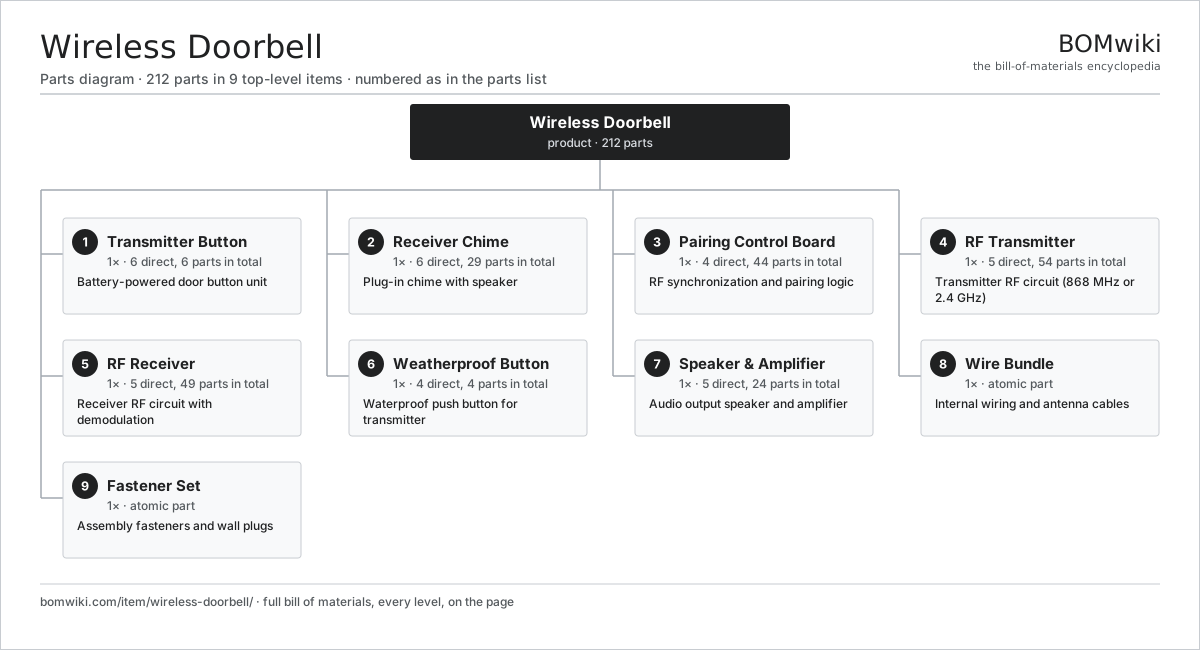
| # | Part | Qty | What it does |
|---|---|---|---|
| 1 | Transmitter Button 6 parts | 1× | Battery-powered door button unit |
| 2 | Receiver Chime 6 parts | 1× | Plug-in chime with speaker |
| 3 | Pairing Control Board 4 parts | 1× | RF synchronization and pairing logic |
| 4 | RF Transmitter 5 parts | 1× | Transmitter RF circuit (868 MHz or 2.4 GHz) |
| 5 | RF Receiver 5 parts | 1× | Receiver RF circuit with demodulation |
| 6 | Weatherproof Button 4 parts | 1× | Waterproof push button for transmitter |
| 7 | Speaker & Amplifier 5 parts | 1× | Audio output speaker and amplifier |
| 8 | Wire Bundle | 1× | Internal wiring and antenna cables |
| 9 | Fastener Set | 1× | Assembly fasteners and wall plugs |
3D model
No 3D model yet. Have a CAD file of this? Add a 3D model. STL renders right on this page; STEP, FreeCAD, and OpenSCAD sources are welcome too (openly licensed, like all 3D models on BOMwiki).
Build & assembly graph
expand / collapse · shared sub-assemblies converge · links to related products · est. labourTap an assembly to expand/collapse · tap a part to open it · use “Open page” for any node · drag to pan, scroll to zoom.
Bill of materials for Wireless Doorbell
9 top-level lines · 49 rows shown · 212 parts total · indented to 3 levels| # | Item / sub-assembly | Part no. | Qty/assy | Ext. qty | Parts | Type |
|---|---|---|---|---|---|---|
| 1 | Transmitter Button 6 parts | wireless-doorbell-transmitter | 1× | 1 | 6 | assembly |
| 1.1 | Transmitter Housing | wireless-doorbell-tx-housing | 1× | 1 | · | part |
| 1.2 | Door Button | wireless-doorbell-tx-button | 1× | 1 | · | part |
| 1.3 | Transmitter Board | wireless-doorbell-tx-board | 1× | 1 | · | part |
| 1.4 | Transmitter Battery | wireless-doorbell-tx-battery | 1× | 1 | · | part |
| 1.5 | Transmitter Antenna | wireless-doorbell-tx-antenna | 1× | 1 | · | part |
| 1.6 | Fastener Set | fastener-set | 1× | 1 | · | part |
| 2 | Receiver Chime 6 parts | wireless-doorbell-receiver | 1× | 1 | 29 | assembly |
| 2.1 | Receiver Housing | wireless-doorbell-rx-housing | 1× | 1 | · | part |
| 2.2 | Receiver Board | wireless-doorbell-rx-board | 1× | 1 | · | part |
| 2.3 | Receiver Antenna | wireless-doorbell-rx-antenna | 1× | 1 | · | part |
| 2.4 | AC Power Connector | wireless-doorbell-rx-power-input | 1× | 1 | · | part |
| 2.5 | Speaker & Amplifier 5 parts | wireless-doorbell-speaker-assy | 1× | 1 | 24 | assembly |
| 2.5.1 | Speaker | speaker | 1× | 1 | · | part |
| 2.5.2 | Audio Amplifier IC | wireless-doorbell-audio-amp | 1× | 1 | · | part |
| 2.5.3 | Tone/Melody Generator | wireless-doorbell-tone-generator | 1× | 1 | · | part |
| 2.5.4 | SMD Passive (R/C/L) | smd-passives | 20× | 20 | · | part |
| 2.5.5 | Connector | connector | 1× | 1 | · | part |
| 2.6 | Fastener Set | fastener-set | 1× | 1 | · | part |
| 3 | Pairing Control Board 4 parts | wireless-doorbell-pairing-board | 1× | 1 | 44 | assembly |
| 3.1 | Pairing MCU | wireless-doorbell-pairing-mcu | 1× | 1 | · | part |
| 3.2 | Pairing Flash Memory | wireless-doorbell-pairing-flash | 1× | 1 | · | part |
| 3.3 | SMD Passive (R/C/L) | smd-passives | 40× | 40 | · | part |
| 3.4 | Connector | connector | 2× | 2 | · | part |
| 4 | RF Transmitter 5 parts | wireless-doorbell-transmit-module | 1× | 1 | 54 | assembly |
| 4.1 | TX Oscillator | wireless-doorbell-tx-oscillator | 1× | 1 | · | part |
| 4.2 | TX Modulator | wireless-doorbell-tx-modulator | 1× | 1 | · | part |
| 4.3 | TX Power Amplifier | wireless-doorbell-tx-amplifier | 1× | 1 | · | part |
| 4.4 | SMD Passive (R/C/L) | smd-passives | 50× | 50 | · | part |
| 4.5 | Connector | connector | 1× | 1 | · | part |
| 5 | RF Receiver 5 parts | wireless-doorbell-receive-module | 1× | 1 | 49 | assembly |
| 5.1 | RX Low-Noise Amp | wireless-doorbell-rx-lna | 1× | 1 | · | part |
| 5.2 | RX Filter | wireless-doorbell-rx-filter | 1× | 1 | · | part |
| 5.3 | Demodulator IC | wireless-doorbell-rx-demod | 1× | 1 | · | part |
| 5.4 | SMD Passive (R/C/L) | smd-passives | 45× | 45 | · | part |
| 5.5 | Connector | connector | 1× | 1 | · | part |
| 6 | Weatherproof Button 4 parts | wireless-doorbell-button | 1× | 1 | 4 | assembly |
| 6.1 | Button Cap | wireless-doorbell-button-cap | 1× | 1 | · | part |
| 6.2 | Button Contact | wireless-doorbell-button-contact | 1× | 1 | · | part |
| 6.3 | O-Ring Set | oring-set | 1× | 1 | · | part |
| 6.4 | Fastener Set | fastener-set | 1× | 1 | · | part |
| 7 | Speaker & Amplifier 5 parts | wireless-doorbell-speaker-assy | 1× | 1 | 24 | assembly |
| 7.1 | Speaker | speaker | 1× | 1 | · | part |
| 7.2 | Audio Amplifier IC | wireless-doorbell-audio-amp | 1× | 1 | · | part |
| 7.3 | Tone/Melody Generator | wireless-doorbell-tone-generator | 1× | 1 | · | part |
| 7.4 | SMD Passive (R/C/L) | smd-passives | 20× | 20 | · | part |
| 7.5 | Connector | connector | 1× | 1 | · | part |
| 8 | Wire Bundle | wire-bundle | 1× | 1 | · | part |
| 9 | Fastener Set | fastener-set | 1× | 1 | · | part |
Something wrong in this list? Report a problem with this BOM.
Related products
same domain, ranked by shared parts Smart Speaker
379 parts · shares 3 with this page
Smart Speaker
379 parts · shares 3 with this page
 Walkie-Talkie (PMR Radio)
272 parts · shares 3 with this page
Walkie-Talkie (PMR Radio)
272 parts · shares 3 with this page
 Bluetooth Speaker
196 parts · shares 2 with this page
Bluetooth Speaker
196 parts · shares 2 with this page
 Bluetooth Tracker Tag
81 parts · shares 2 with this page
Bluetooth Tracker Tag
81 parts · shares 2 with this page
 Hobby Metal Detector
311 parts · shares 2 with this page
Hobby Metal Detector
311 parts · shares 2 with this page
 Satellite Phone
372 parts · shares 2 with this page
Satellite Phone
372 parts · shares 2 with this page
Sourcing: possible vendors
Browse the supplier directory → Prices, MOQ, and lead times are algorithmic estimates, not quotes, and not claims about these companies. Company mappings are curated by keyword; est. price band $50–$2k. How estimates work| Vendor | HQ | Specialty | MOQ | Lead time |
|---|---|---|---|---|
|
🇨🇳Foxconn
foxconn.com ↗
|
Shenzhen, CN | Electronics contract mfg | 1,000 units | 8–14 wks |
|
🇺🇸Jabil
jabil.com ↗
|
St. Petersburg, US | Electronics manufacturing | 1,000 units | 8–14 wks |
|
🇺🇸Flex
flex.com ↗
|
Austin, US | Electronics manufacturing | 1,000 units | 8–14 wks |
| celestica.com ↗ | Toronto, CA | Electronics manufacturing | 1,000 units | 8–14 wks |
|
🇺🇸Sanmina
sanmina.com ↗
|
San Jose, US | Electronics manufacturing | 1,000 units | 8–14 wks |
751-word article