AR Glasses
ProductOverview
AR glasses overlay computer graphics onto the real world while leaving it fully visible, unlike VR, the user still sees the room through transparent optics. The work happens in the Optics Engine, one per eye, where a tiny bright micro-display is coupled into a transparent Waveguide Combiner that pipes the image to the pupil. The Mainboard supplies the compute: an XR SoC, an always-on sensor co-processor, memory, and power management folded into the slim frame. To anchor graphics to real surfaces the glasses sense the world with the Camera Module and the IMU Module. Sound comes from the Audio Module open-ear speakers and microphone array, power from the Battery Pack cells split into the temples, and connectivity from the Radio Module. The Frame & Nose Pads holds it all in an eyewear form factor, and a Temple Touchpad strip handles input.
How it works
Each Optics Engine projects an image from its Micro-Display Projector into the edge of a Waveguide Combiner, a flat glass plate etched with diffraction gratings. The light bounces along the plate by total internal reflection, then a second grating diffracts it out toward the eye. Because the plate is otherwise clear, the projected image appears to float over whatever the wearer is actually looking at.
For the overlay to stay locked to the world, the glasses run inside-out tracking: the Camera Module cameras find features in the room, the Depth Sensor measures distance to surfaces, and the IMU Module reports head motion. Fusing these gives a six-degrees-of-freedom pose many times a second, so a label pinned to a real object holds its place as the head moves. The Mainboard SoC renders the graphics while the low-power co-processor keeps tracking alive between frames. Heavier tasks are offloaded to a phone over the Radio Module, keeping the on-glasses Battery Pack draw low.
AR Glasses parts and their functions
9 top-level parts · 242 parts in total · full bill of materials below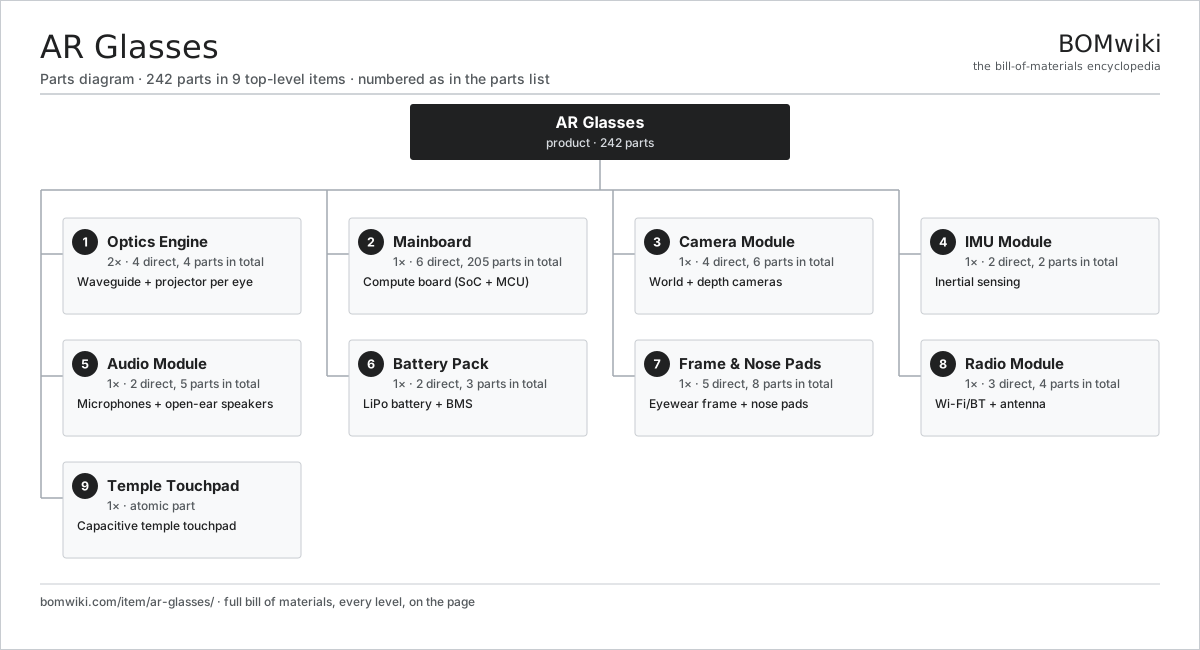
| # | Part | Qty | What it does |
|---|---|---|---|
| 1 | Optics Engine 4 parts | 2× | Waveguide + projector per eye |
| 2 | Mainboard 6 parts | 1× | Compute board (SoC + MCU) |
| 3 | Camera Module 4 parts | 1× | World + depth cameras |
| 4 | IMU Module 2 parts | 1× | Inertial sensing |
| 5 | Audio Module 2 parts | 1× | Microphones + open-ear speakers |
| 6 | Battery Pack 2 parts | 1× | LiPo battery + BMS |
| 7 | Frame & Nose Pads 5 parts | 1× | Eyewear frame + nose pads |
| 8 | Radio Module 3 parts | 1× | Wi-Fi/BT + antenna |
| 9 | Temple Touchpad | 1× | Capacitive temple touchpad |
3D model
No 3D model yet. Have a CAD file of this? Add a 3D model. STL renders right on this page; STEP, FreeCAD, and OpenSCAD sources are welcome too (openly licensed, like all 3D models on BOMwiki).
Build & assembly graph
expand / collapse · shared sub-assemblies converge · links to related products · est. labourTap an assembly to expand/collapse · tap a part to open it · use “Open page” for any node · drag to pan, scroll to zoom.
Bill of materials for AR Glasses
9 top-level lines · 37 rows shown · 242 parts total · indented to 3 levels| # | Item / sub-assembly | Part no. | Qty/assy | Ext. qty | Parts | Type |
|---|---|---|---|---|---|---|
| 1 | Optics Engine 4 parts | ar-optics-engine | 2× | 2 | 4 | assembly |
| 1.1 | Waveguide Combiner | ar-waveguide | 1× | 2 | · | part |
| 1.2 | Micro-Display Projector | ar-microdisplay | 1× | 2 | · | part |
| 1.3 | Projector Lens | ar-projector-lens | 1× | 2 | · | part |
| 1.4 | Display Driver IC | ar-display-driver | 1× | 2 | · | part |
| 2 | Mainboard 6 parts | ar-mainboard | 1× | 1 | 205 | assembly |
| 2.1 | Bare PCB | pcb-bare | 1× | 1 | · | part |
| 2.2 | Compute SoC Module | soc-module | 1× | 1 | · | part |
| 2.3 | Microcontroller | mcu | 1× | 1 | · | part |
| 2.4 | RAM + Flash Package | ar-ram-flash | 1× | 1 | · | part |
| 2.5 | PMIC | ar-pmic | 1× | 1 | · | part |
| 2.6 | SMD Passive (R/C/L) | smd-passives | 200× | 200 | · | part |
| 3 | Camera Module 4 parts | ar-camera-module | 1× | 1 | 6 | assembly |
| 3.1 | CMOS Image Sensor | image-sensor | 2× | 2 | · | part |
| 3.2 | Lens Assembly | camera-lens | 2× | 2 | · | part |
| 3.3 | Depth Sensor | ar-depth-sensor | 1× | 1 | · | part |
| 3.4 | Bare PCB | pcb-bare | 1× | 1 | · | part |
| 4 | IMU Module 2 parts | ar-imu-module | 1× | 1 | 2 | assembly |
| 4.1 | IMU (6-axis) | imu | 1× | 1 | · | part |
| 4.2 | Magnetometer | ar-magnetometer | 1× | 1 | · | part |
| 5 | Audio Module 2 parts | ar-audio | 1× | 1 | 5 | assembly |
| 5.1 | MEMS Microphone | ar-microphone | 3× | 3 | · | part |
| 5.2 | Speaker | speaker | 2× | 2 | · | part |
| 6 | Battery Pack 2 parts | ar-battery | 1× | 1 | 3 | assembly |
| 6.1 | LiPo Cell | lipo-cell | 2× | 2 | · | part |
| 6.2 | BMS Board | bms-board | 1× | 1 | · | part |
| 7 | Frame & Nose Pads 5 parts | ar-frame | 1× | 1 | 8 | assembly |
| 7.1 | Frame Front | ar-frame-front | 1× | 1 | · | part |
| 7.2 | Temple Arm | ar-temple-arm | 2× | 2 | · | part |
| 7.3 | Nose Pad | ar-nose-pad | 2× | 2 | · | part |
| 7.4 | Temple Hinge | ar-hinge | 2× | 2 | · | part |
| 7.5 | Fastener Set | fastener-set | 1× | 1 | · | part |
| 8 | Radio Module 3 parts | ar-radio-module | 1× | 1 | 4 | assembly |
| 8.1 | Wi-Fi/BT Combo IC | ar-wireless-combo | 1× | 1 | · | part |
| 8.2 | Antenna Flex | ar-antenna-flex | 2× | 2 | · | part |
| 8.3 | Connector | connector | 1× | 1 | · | part |
| 9 | Temple Touchpad | ar-touch-temple | 1× | 1 | · | part |
Something wrong in this list? Report a problem with this BOM.
Related products
same domain, ranked by shared parts VR Headset
457 parts · shares 7 with this page
VR Headset
457 parts · shares 7 with this page
 Video Baby Monitor
234 parts · shares 6 with this page
Video Baby Monitor
234 parts · shares 6 with this page
 Smartphone
1,418 parts · shares 5 with this page
Smartphone
1,418 parts · shares 5 with this page
 Smart Mirror
33 parts · shares 4 with this page
Smart Mirror
33 parts · shares 4 with this page
 Fitness Tracker Band
180 parts · shares 4 with this page
Fitness Tracker Band
180 parts · shares 4 with this page
 Handheld GPS
192 parts · shares 3 with this page
Handheld GPS
192 parts · shares 3 with this page
Sourcing: possible vendors
Browse the supplier directory → Prices, MOQ, and lead times are algorithmic estimates, not quotes, and not claims about these companies. Company mappings are curated by keyword; est. price band $50–$2k. How estimates work| Vendor | HQ | Specialty | MOQ | Lead time |
|---|---|---|---|---|
|
🇨🇳Foxconn
foxconn.com ↗
|
Shenzhen, CN | Electronics contract mfg | 1,000 units | 8–14 wks |
|
🇺🇸Jabil
jabil.com ↗
|
St. Petersburg, US | Electronics manufacturing | 1,000 units | 8–14 wks |
|
🇺🇸Flex
flex.com ↗
|
Austin, US | Electronics manufacturing | 1,000 units | 8–14 wks |
| celestica.com ↗ | Toronto, CA | Electronics manufacturing | 1,000 units | 8–14 wks |
|
🇺🇸Sanmina
sanmina.com ↗
|
San Jose, US | Electronics manufacturing | 1,000 units | 8–14 wks |
326-word article