Bug Zapper
ProductOverview
A bug zapper is an outdoor or patio insect control device that lures flying insects with ultraviolet light and electrocutes them on a high-voltage grid. The device consists of fluorescent lamps emitting UV-A wavelengths (around 365 nanometers) that attract mosquitoes, gnats, moths, and other flying insects. When an insect touches the electrocution grid, a 2,000–4,000 volt discharge occurs across the wires, incinerating the insect instantly and causing it to fall into a collection tray.
Bug zappers are passive, pesticide-free alternatives to chemical insecticides or repellents. They work continuously during summer evenings when insect activity peaks. The technology is straightforward: UV attraction plus electrical kill, with no complex sensors or moving parts beyond the ballast circuit.
How It Works
Mains AC power (120V or 240V) enters the Ballast & Switch Board, where a Relay routes current to the lamp Primary Coil and the Step-Up High-Voltage Transformer primary coil. The transformer's Secondary Coil, a high-turns-ratio coil, steps up the voltage to approximately 2,500V AC.
A pair of High-Voltage Rectifier Diode diodes convert this AC to direct current, smoothed by the High-Voltage Filter Capacitor. The result is a steady 2,000–4,000V DC potential applied across the High-Voltage Electrocution Grid. The grid consists of parallel wires or bars alternating between high voltage and ground, spaced 6–8 mm apart.
Simultaneously, the ballast circuit energizes the UV-A Fluorescent Tube lamps. UV-A phosphor coating inside each 8W or 13W tube fluoresces at 365 nm wavelength, invisible to humans but highly attractive to insects. The tubes are mounted inside a Protective Outer Cage that shields the lethal grid from accidental human contact while allowing insects to enter freely.
When an insect contacts two adjacent wires (one +HV, one ground), current flows through its body. The resistance of an insect body is typically 1–10 kΩ. With 2,500V across a 1 kΩ insect, the resulting 2.5 ampere impulse is instantaneous, the insect is ionized and vaporized. The resulting flash of light and faint crackling noise are audible proof of a kill.
Dead insects fall into the Ash Collection Drawer beneath the grid, which is pulled out periodically and emptied.
Power and Efficiency
Total power draw is 15–60W depending on grid size and lamp count. A typical two-lamp outdoor unit (16W UV + 8W ballast loss) costs less than USD 0.10 per month to operate continuously. Most users operate zappers on a timer, running from dusk to midnight during summer months.
The Step-Up High-Voltage Transformer and High-Voltage Filter Capacitor represent the highest-cost components; transformers are handwound and bulky. The voltage drop across the HV gap (grid spacing) is typically 500–1,000V per 1 mm gap, meaning at 2,500V and 6 mm spacing, the voltage gradient is roughly 416 V/mm, sufficient to ionize air and create a visible arc.
Effectiveness and Limitations
Lab studies show 85–95% kill rates for mosquitoes and flies within 2 meters of an active zapper. However, effectiveness depends heavily on environmental factors:
- Light competition: In bright dusk conditions or near porch lights, the zapper's relative attractiveness drops.
- Insect species: Many biting insects (especially certain mosquito species) are weakly attracted to UV and prefer CO₂ or heat cues.
- Location: Placement away from human activity increases interception of insects before they reach people.
- Wind: Air currents deflect insect flight paths away from the grid.
Contrary to marketing claims, zappers do not "eliminate all mosquitoes" in a yard, they reduce population only near the device.
Maintenance and Safety
The UV-A Fluorescent Tube lamps degrade over 6,000–8,000 operating hours, output dropping to 50% brightness by end-of-life. Replacement involves opening the Cage Cover and extracting old tubes; new ones simply bi-pin into the Tube Socket.
The Ash Collection Drawer should be emptied weekly during peak season to prevent odor and decomposition. The High-Voltage Electrocution Grid collects dead insect residue and dust, reducing conductivity; wiping wires with a dry brush restores performance.
Safety concerns: the high voltage stored in the High-Voltage Filter Capacitor persists briefly after power-off. Users should avoid touching the grid directly. Outdoor models are typically mounted 1.5–2 meters high, out of casual arm's reach. Some designs include a protective shroud or cage that makes accidental contact unlikely.
Variants
Handheld racquet-style zappers (15W, battery-powered) allow active hunting of insects; they are less powerful but more selective. Large commercial or industrial units reach 40–60W and can cover 100+ m². Some models add lure dispensers (octenol or pheromones) to increase attraction beyond UV alone. Smart-enabled zappers with WiFi timers exist but are uncommon in consumer markets.
Bug Zapper parts and their functions
8 top-level parts · 31 parts in total · full bill of materials below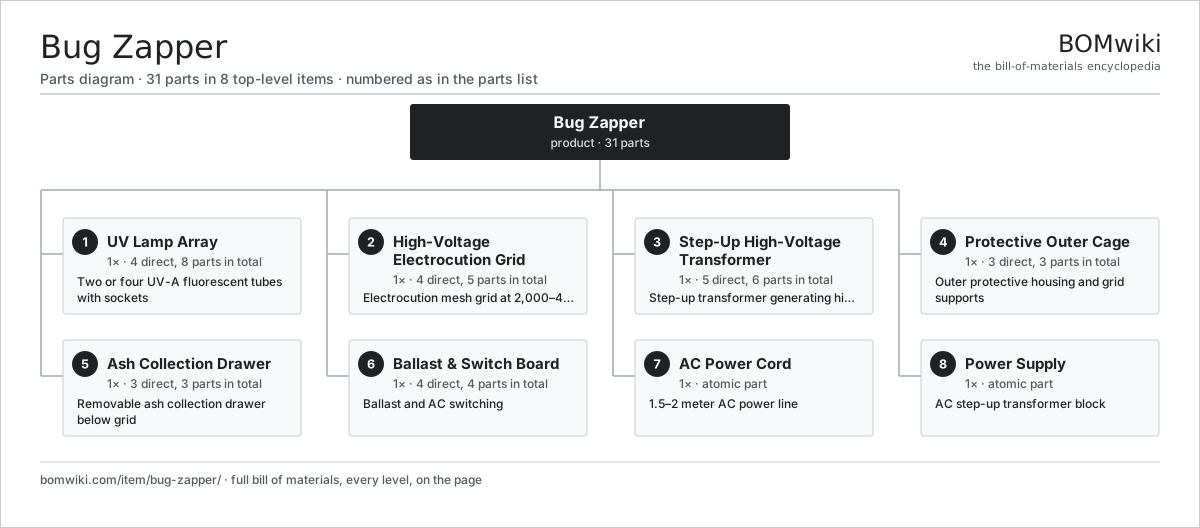
| # | Part | Qty | What it does |
|---|---|---|---|
| 1 | UV Lamp Array 4 parts | 1× | Two or four UV-A fluorescent tubes with sockets |
| 2 | High-Voltage Electrocution Grid 4 parts | 1× | Electrocution mesh grid at 2,000–4,000V |
| 3 | Step-Up High-Voltage Transformer 5 parts | 1× | Step-up transformer generating high voltage from AC mains |
| 4 | Protective Outer Cage 3 parts | 1× | Outer protective housing and grid supports |
| 5 | Ash Collection Drawer 3 parts | 1× | Removable ash collection drawer below grid |
| 6 | Ballast & Switch Board 4 parts | 1× | Ballast and AC switching |
| 7 | AC Power Cord | 1× | 1.5–2 meter AC power line |
| 8 | Power Supply | 1× | AC step-up transformer block |
3D model
No 3D model yet. Have a CAD file of this? Add a 3D model. STL renders right on this page; STEP, FreeCAD, and OpenSCAD sources are welcome too (openly licensed, like all 3D models on BOMwiki).
Build & assembly graph
expand / collapse · shared sub-assemblies converge · links to related products · est. labourTap an assembly to expand/collapse · tap a part to open it · use “Open page” for any node · drag to pan, scroll to zoom.
Bill of materials for Bug Zapper
8 top-level lines · 31 rows shown · 31 parts total · indented to 3 levels| # | Item / sub-assembly | Part no. | Qty/assy | Ext. qty | Parts | Type |
|---|---|---|---|---|---|---|
| 1 | UV Lamp Array 4 parts | bug-zapper-lamp-assembly | 1× | 1 | 8 | assembly |
| 1.1 | UV-A Fluorescent Tube | bug-zapper-fluorescent-tube | 2× | 2 | · | part |
| 1.2 | Tube Socket | bug-zapper-lamp-socket | 4× | 4 | · | part |
| 1.3 | Tube Mounting Rail | bug-zapper-tube-support | 1× | 1 | · | part |
| 1.4 | SMD Passive (R/C/L) | smd-passives | 1× | 1 | · | part |
| 2 | High-Voltage Electrocution Grid 4 parts | bug-zapper-hv-grid | 1× | 1 | 5 | assembly |
| 2.1 | Electrocution Wires | bug-zapper-grid-wires | 1× | 1 | · | part |
| 2.2 | Grid Support Frame | bug-zapper-grid-frame | 1× | 1 | · | part |
| 2.3 | High-Voltage Cable | bug-zapper-hv-output | 2× | 2 | · | part |
| 2.4 | Connector | connector | 1× | 1 | · | part |
| 3 | Step-Up High-Voltage Transformer 5 parts | bug-zapper-transformer | 1× | 1 | 6 | assembly |
| 3.1 | Transformer Core | bug-zapper-transformer-core | 1× | 1 | · | part |
| 3.2 | Primary Coil | bug-zapper-primary-winding | 1× | 1 | · | part |
| 3.3 | Secondary Coil | bug-zapper-secondary-winding | 1× | 1 | · | part |
| 3.4 | High-Voltage Rectifier Diode | bug-zapper-hv-rectifier | 2× | 2 | · | part |
| 3.5 | High-Voltage Filter Capacitor | bug-zapper-filter-capacitor | 1× | 1 | · | part |
| 4 | Protective Outer Cage 3 parts | bug-zapper-cage | 1× | 1 | 3 | assembly |
| 4.1 | Cage Housing | bug-zapper-cage-shell | 1× | 1 | · | part |
| 4.2 | Cage Cover | bug-zapper-cage-top | 1× | 1 | · | part |
| 4.3 | Fastener Set | fastener-set | 1× | 1 | · | part |
| 5 | Ash Collection Drawer 3 parts | bug-zapper-tray | 1× | 1 | 3 | assembly |
| 5.1 | Collection Pan | bug-zapper-tray-pan | 1× | 1 | · | part |
| 5.2 | Tray Handle | bug-zapper-tray-handle | 1× | 1 | · | part |
| 5.3 | Debris Mesh | bug-zapper-tray-grid | 1× | 1 | · | part |
| 6 | Ballast & Switch Board 4 parts | bug-zapper-control-board | 1× | 1 | 4 | assembly |
| 6.1 | Relay | relay | 1× | 1 | · | part |
| 6.2 | SMD Passive (R/C/L) | smd-passives | 1× | 1 | · | part |
| 6.3 | Bare PCB | pcb-bare | 1× | 1 | · | part |
| 6.4 | Primary Fuse | bug-zapper-fuse | 1× | 1 | · | part |
| 7 | AC Power Cord | bug-zapper-power-cord | 1× | 1 | · | part |
| 8 | Power Supply | power-supply | 1× | 1 | · | part |
Something wrong in this list? Report a problem with this BOM.
Related products
same domain, ranked by shared parts Bladeless Fan
64 parts · shares 2 with this page
Electronic Humidor Cabinet
54 parts · shares 2 with this page
Gas Clothes Dryer
99 parts · shares 2 with this page
Over-the-Range Microwave
169 parts · shares 2 with this page
Bladeless Fan
64 parts · shares 2 with this page
Electronic Humidor Cabinet
54 parts · shares 2 with this page
Gas Clothes Dryer
99 parts · shares 2 with this page
Over-the-Range Microwave
169 parts · shares 2 with this page
 Stand Fan
70 parts · shares 2 with this page
Stand Fan
70 parts · shares 2 with this page
 Tower Fan
30 parts · shares 2 with this page
Tower Fan
30 parts · shares 2 with this page
Sourcing: possible vendors
Browse the supplier directory → Prices, MOQ, and lead times are algorithmic estimates, not quotes, and not claims about these companies. Company mappings are curated by keyword; est. price band $150–$3k. How estimates work| Vendor | HQ | Specialty | MOQ | Lead time |
|---|---|---|---|---|
| whirlpoolcorp.com ↗ | Benton Harbor, US | Home appliances | 1,000 units | 8–14 wks |
| bsh-group.com ↗ | Munich, DE | Appliances (Bosch, Siemens) | 1,000 units | 8–14 wks |
| electroluxgroup.com ↗ | Stockholm, SE | Home appliances | 1,000 units | 8–14 wks |
| lg.com ↗ | Seoul, KR | Appliances & electronics | 1,000 units | 8–14 wks |
|
🇨🇳Haier
haier.com ↗
|
Qingdao, CN | Home appliances | 1,000 units | 8–14 wks |
798-word article