Central Vacuum System
ProductOverview
A central vacuum system moves the noisy, dusty half of a vacuum cleaner out of the living space. A permanently installed Power Unit hangs on a garage or basement wall, a network of 2-inch PVC tubing runs inside the walls to Inlet Valve fittings around the house, and the user carries only a lightweight hose and cleaning head. Because the motor is remote and unconstrained by portability, it can be far larger than a portable cleaner's, 550–700 air watts against the 100–250 of a typical upright, and because the exhaust vents outdoors, the fine dust that portable vacuums recirculate through their filters leaves the building entirely. One unit serves up to about 700 m² of floor, and the dirt canister needs emptying only a few times a year.
How it works
Suction comes from the Suction Motor, a universal bypass motor spinning two or three stacked Fan Stage impellers at close to 20,000 rpm. Each centrifugal stage adds pressure, so a two-stage motor develops 300 mbar or more of sealed vacuum while still flowing over 100 CFM through an open hose. "Bypass" means cooling air for the motor windings travels a separate path from the dirty working air, essential when the working air has not yet been fully filtered. The Carbon Brush pair on the commutator is the scheduled wear item, good for 600–800 running hours, which at normal household use is well over a decade.
Dirty air entering the unit hits the Separation Stage stage first. The Inlet Baffle sets the incoming flow spinning inside the Cyclone Cone; centrifugal action throws grit and hair outward and down into the Dirt Bucket, while the cleaner core of the airstream passes through the Inverted Filter on its way to the motor. This permanent fabric filter is the clever serviceless detail of modern units: under suction it billows upward into the airstream, and when the motor stops it falls inverted into the canister, shedding its dust cake. Two Canister Latch clamps and the Bucket Gasket keep the canister joint airtight; any leak there directly subtracts from suction at the hose.
The piping network
The in-wall network uses Vacuum PVC Pipe, a thin-wall 50.8 mm tubing specific to vacuum work, with smoother bores and tighter tolerances than plumbing PVC. Layout rules matter more than pipe length: every change of direction uses a long-radius Sweep Elbow rather than a plumbing 90, because a tight elbow is where a sock or toy lodges. Air velocity in the trunk runs near 30 m/s, fast enough to keep debris entrained vertically. Joints are dry-fitted then solvent-welded with Pipe Coupling sleeves, and a Wire Bundle of 24 V signal wire is stapled along the pipe as it goes in. On the outlet side, the Exhaust Muffler quiets the discharge before it exits through an outside wall vent.
Each Inlet Valve is a spring-door fitting flush with the wall, held shut against its gasket by a Coil Spring so that closed inlets do not bleed vacuum. Behind the faceplate, the Valve Mounting Plate aligns valve to pipe during rough-in. The Inlet Contact Set in the valve face carries the 24 VAC loop from the Control Transformer: when the metal ring on the Hose End Cuff bridges the contacts, the Relay on the Control Module board pulls in and the motor starts. The Soft-Start Module module ramps motor voltage over about a second, taming an inrush that would otherwise dim lights and hammer the brushes.
Hose and powerhead
The Vacuum Hose is the part the user actually handles: 9–12 m of wire-reinforced 35 mm hose with powerhead conductors molded into the wall. The Handle Switch on the Hose Handle offers off, suction-only, and suction-plus-brush positions; brush current comes either from a pigtail to a wall outlet or through current-carrying inlets. Through the telescopic Telescopic Wand, power reaches the Electric Powerhead, where a 100–200 W Brush Motor spins the Brush Roll at roughly 5,000 rpm via a toothed Drive Belt. The agitator does what remote suction cannot: it vibrates carpet pile to break dirt loose so the airflow can carry it 20 m back to the canister. The Powerhead Neck swivel and rear Wheel Assembly height adjusters handle steering and pile height.
Installation and standards
Retrofit installation exploits interior wall cavities, closets, and floor chases; a typical house needs five to seven inlets so a 9 m hose reaches every corner. Units in North America certify to UL 1017; the certification covers the bypass motor's thermal protection, the 24 V control isolation, and canister flame-resistance. The practical maintenance list is short: empty the Dirt Bucket, occasionally rinse the inverted filter, and replace motor brushes once in the unit's 15–20 year life.
Central Vacuum System parts and their functions
8 top-level parts · 180 parts in total · full bill of materials below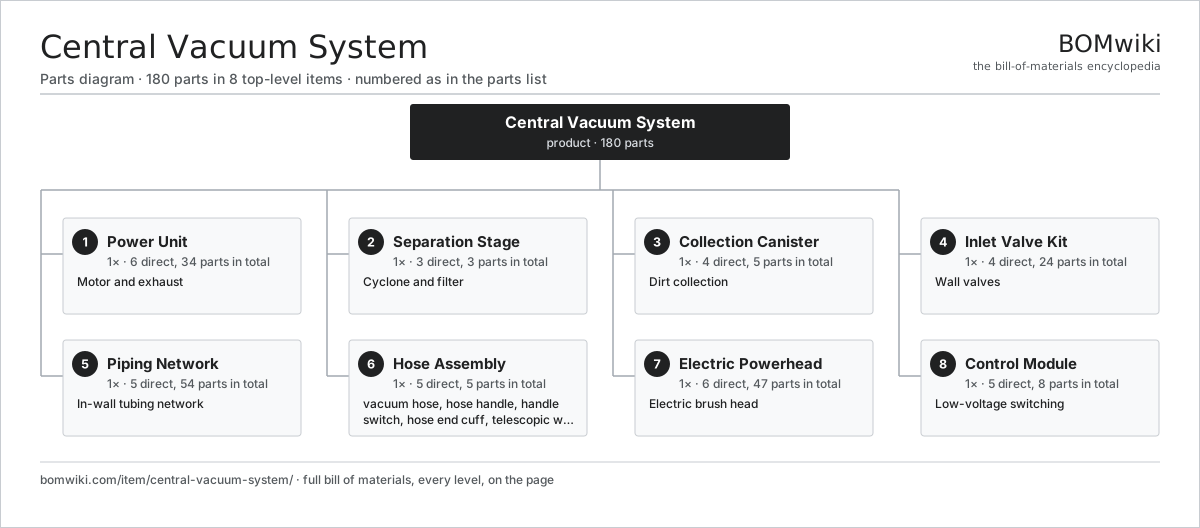
| # | Part | Qty | What it does |
|---|---|---|---|
| 1 | Power Unit 6 parts | 1× | Motor and exhaust |
| 2 | Separation Stage 3 parts | 1× | Cyclone and filter |
| 3 | Collection Canister 4 parts | 1× | Dirt collection |
| 4 | Inlet Valve Kit 4 parts | 1× | Wall valves |
| 5 | Piping Network 5 parts | 1× | In-wall tubing network |
| 6 | Hose Assembly 5 parts | 1× | 9–12 m crush-proof hose with switch handle that carries both suction and powerhead current. |
| 7 | Electric Powerhead 6 parts | 1× | Electric brush head |
| 8 | Control Module 5 parts | 1× | Low-voltage switching |
3D model
No 3D model yet. Have a CAD file of this? Add a 3D model. STL renders right on this page; STEP, FreeCAD, and OpenSCAD sources are welcome too (openly licensed, like all 3D models on BOMwiki).
Build & assembly graph
expand / collapse · shared sub-assemblies converge · links to related products · est. labourTap an assembly to expand/collapse · tap a part to open it · use “Open page” for any node · drag to pan, scroll to zoom.
Bill of materials for Central Vacuum System
8 top-level lines · 60 rows shown · 180 parts total · indented to 3 levels| # | Item / sub-assembly | Part no. | Qty/assy | Ext. qty | Parts | Type |
|---|---|---|---|---|---|---|
| 1 | Power Unit 6 parts | central-vacuum-system-power-unit | 1× | 1 | 34 | assembly |
| 1.1 | Suction Motor 5 parts | central-vacuum-system-vacuum-motor | 1× | 1 | 26 | assembly |
| 1.1.1 | Stator Assembly 3 parts + deeper › | stator-assembly | 1× | 1 | 3 | assembly |
| 1.1.2 | Rotor Assembly 4 parts + deeper › | rotor-assembly | 1× | 1 | 19 | assembly |
| 1.1.3 | Copper Winding | copper-winding | 1× | 1 | · | part |
| 1.1.4 | Ball Bearing | ball-bearing | 2× | 2 | · | part |
| 1.1.5 | Motor Housing | motor-housing | 1× | 1 | · | part |
| 1.2 | Fan Stage | central-vacuum-system-fan-stage | 2× | 2 | · | part |
| 1.3 | Carbon Brush | central-vacuum-system-carbon-brush | 2× | 2 | · | part |
| 1.4 | Motor Gasket | central-vacuum-system-motor-gasket | 1× | 1 | · | part |
| 1.5 | Mounting Bracket | central-vacuum-system-mounting-bracket | 1× | 1 | · | part |
| 1.6 | Sheet Metal Panel | sheet-panel | 2× | 2 | · | part |
| 2 | Separation Stage 3 parts | central-vacuum-system-separation | 1× | 1 | 3 | assembly |
| 2.1 | Cyclone Cone | central-vacuum-system-cyclone-cone | 1× | 1 | · | part |
| 2.2 | Inverted Filter | central-vacuum-system-inverted-filter | 1× | 1 | · | part |
| 2.3 | Inlet Baffle | central-vacuum-system-baffle | 1× | 1 | · | part |
| 3 | Collection Canister 4 parts | central-vacuum-system-canister | 1× | 1 | 5 | assembly |
| 3.1 | Dirt Bucket | central-vacuum-system-bucket | 1× | 1 | · | part |
| 3.2 | Canister Latch | central-vacuum-system-latch | 2× | 2 | · | part |
| 3.3 | Bucket Gasket | central-vacuum-system-bucket-gasket | 1× | 1 | · | part |
| 3.4 | Debris Screen | central-vacuum-system-debris-screen | 1× | 1 | · | part |
| 4 | Inlet Valve Kit 4 parts | central-vacuum-system-inlet-kit | 1× | 1 | 24 | assembly |
| 4.1 | Inlet Valve | central-vacuum-system-inlet-valve | 6× | 6 | · | part |
| 4.2 | Valve Mounting Plate | central-vacuum-system-mounting-plate | 6× | 6 | · | part |
| 4.3 | Inlet Contact Set | central-vacuum-system-contact-set | 6× | 6 | · | part |
| 4.4 | Coil Spring | coil-spring | 6× | 6 | · | part |
| 5 | Piping Network 5 parts | central-vacuum-system-piping | 1× | 1 | 54 | assembly |
| 5.1 | Vacuum PVC Pipe | central-vacuum-system-pvc-pipe | 30× | 30 | · | part |
| 5.2 | Sweep Elbow | central-vacuum-system-sweep-elbow | 12× | 12 | · | part |
| 5.3 | Pipe Coupling | central-vacuum-system-coupling | 10× | 10 | · | part |
| 5.4 | Exhaust Muffler | central-vacuum-system-exhaust-muffler | 1× | 1 | · | part |
| 5.5 | Wire Bundle | wire-bundle | 1× | 1 | · | part |
| 6 | Hose Assembly 5 parts | central-vacuum-system-hose-assembly | 1× | 1 | 5 | assembly |
| 6.1 | Vacuum Hose | central-vacuum-system-hose | 1× | 1 | · | part |
| 6.2 | Hose Handle | central-vacuum-system-hose-handle | 1× | 1 | · | part |
| 6.3 | Handle Switch | central-vacuum-system-handle-switch | 1× | 1 | · | part |
| 6.4 | Hose End Cuff | central-vacuum-system-hose-cuff | 1× | 1 | · | part |
| 6.5 | Telescopic Wand | central-vacuum-system-wand | 1× | 1 | · | part |
| 7 | Electric Powerhead 6 parts | central-vacuum-system-powerhead | 1× | 1 | 47 | assembly |
| 7.1 | Brush Roll | central-vacuum-system-brush-roll | 1× | 1 | · | part |
| 7.2 | Brush Motor 4 parts | central-vacuum-system-brush-motor | 1× | 1 | 25 | assembly |
| 7.2.1 | Stator Assembly 3 parts + deeper › | stator-assembly | 1× | 1 | 3 | assembly |
| 7.2.2 | Rotor Assembly 4 parts + deeper › | rotor-assembly | 1× | 1 | 19 | assembly |
| 7.2.3 | Ball Bearing | ball-bearing | 2× | 2 | · | part |
| 7.2.4 | Motor Housing | motor-housing | 1× | 1 | · | part |
| 7.3 | Drive Belt | drive-belt | 1× | 1 | · | part |
| 7.4 | Powerhead Housing | central-vacuum-system-powerhead-housing | 1× | 1 | · | part |
| 7.5 | Powerhead Neck | central-vacuum-system-powerhead-neck | 1× | 1 | · | part |
| 7.6 | Wheel Assembly 5 parts | wheel-assembly | 2× | 2 | 9 | assembly |
| 7.6.1 | Alloy Wheel | alloy-wheel | 1× | 2 | · | part |
| 7.6.2 | Tire | tire | 1× | 2 | · | part |
| 7.6.3 | TPMS Sensor | tpms-sensor | 1× | 2 | · | part |
| 7.6.4 | Lug Nut | lug-nut | 5× | 10 | · | part |
| 7.6.5 | Valve Stem | valve-stem | 1× | 2 | · | part |
| 8 | Control Module 5 parts | central-vacuum-system-control | 1× | 1 | 8 | assembly |
| 8.1 | Bare PCB | pcb-bare | 1× | 1 | · | part |
| 8.2 | Relay | relay | 1× | 1 | · | part |
| 8.3 | Control Transformer | central-vacuum-system-transformer | 1× | 1 | · | part |
| 8.4 | Soft-Start Module | central-vacuum-system-soft-start | 1× | 1 | · | part |
| 8.5 | Connector | connector | 4× | 4 | · | part |
Something wrong in this list? Report a problem with this BOM.
Related products
same domain, ranked by shared parts Patio Heater
45 parts · shares 7 with this page
Patio Heater
45 parts · shares 7 with this page
 Food Warming Trolley
75 parts · shares 6 with this page
Gas Clothes Dryer
99 parts · shares 12 with this page
Food Warming Trolley
75 parts · shares 6 with this page
Gas Clothes Dryer
99 parts · shares 12 with this page
 Portable Washing Machine
167 parts · shares 12 with this page
Portable Washing Machine
167 parts · shares 12 with this page
 Sewing Machine
75 parts · shares 12 with this page
Sewing Machine
75 parts · shares 12 with this page
 Clothes Dryer
240 parts · shares 11 with this page
Clothes Dryer
240 parts · shares 11 with this page
Sourcing: possible vendors
Browse the supplier directory → Prices, MOQ, and lead times are algorithmic estimates, not quotes, and not claims about these companies. Company mappings are curated by keyword; est. price band $150–$3k. How estimates work| Vendor | HQ | Specialty | MOQ | Lead time |
|---|---|---|---|---|
| whirlpoolcorp.com ↗ | Benton Harbor, US | Home appliances | 1,000 units | 8–14 wks |
| bsh-group.com ↗ | Munich, DE | Appliances (Bosch, Siemens) | 1,000 units | 8–14 wks |
| electroluxgroup.com ↗ | Stockholm, SE | Home appliances | 1,000 units | 8–14 wks |
| lg.com ↗ | Seoul, KR | Appliances & electronics | 1,000 units | 8–14 wks |
|
🇨🇳Haier
haier.com ↗
|
Qingdao, CN | Home appliances | 1,000 units | 8–14 wks |
890-word article