Digital Tape Measure
ProductOverview
A digital tape measure automatically tracks blade extension and displays the distance on an LED or LCD screen, eliminating mental math and penmanship errors. Unlike manual tape measures, which require the user to stop, hold position, read the closest imperial fraction or millimeter, and write down the value, a digital model continuously displays the length in real-time. Some versions include a laser rangefinder for inaccessible or long-distance measurements.
The key innovation is the Encoder Module embedded in or alongside the Blade & Encoder. As the blade pulls out, the encoder outputs a digital signal whose count proportional to distance. The Processor Board's Microcontroller counts encoder pulses, converts the count to a real-world distance (compensating for calibration offset), and updates the Display Module dozens of times per second.
How it works
The Blade & Encoder is a strip of tempered spring steel coiled around the Spool inside the housing. Imprinted or glued to the blade's top surface is an Encoder Track, either a series of printed black-and-white bars (optical) or embedded magnet cells (magnetic).
As the user pulls the blade out, the track moves past a stationary Encoder Sensor. For optical encoders, an Encoder Emitter LED shines on the track, and the sensor measures the reflected light. Each bar transition (black-to-white or vice versa) is a pulse; a high-resolution optical encoder outputs 1 pulse per 0.5 mm of blade travel, so a 1 m pull generates 2000 pulses.
For magnetic encoders, the track contains a row of neodymium magnets alternating in polarity. A Hall-effect sensor detects each pole transition, similarly generating a pulse train. Magnetic encoders are slightly less accurate but more robust against dust and moisture.
The Encoder PCB buffers and shapes these raw pulses into clean digital edges. The Processor Board's Microcontroller counts edges using the Counter IC, a dedicated frequency counter IC. The count is multiplied by the encoder resolution (0.5 mm per pulse) to yield distance in millimeters.
The user presses the Zero Button to set the reference point (e.g., at a floor corner). The Microcontroller clears its counter to 0. As the blade extends, the Display Module reads out the distance in real-time, 3 or 4 digit decimal. The Unit Button toggles between metric (mm) and imperial (inches, feet); an internal lookup table converts pulse count to feet and inches (divide by 304.8 pulses/foot, then extract integer and fractional feet).
The Hold Button freezes the display at the current reading, useful if the user needs to step away or compare two measurements without referring to notes.
When the blade is fully retracted, an internal stop prevents over-rotation of the spool. A Return Spring provides constant tension; the user feels a smooth, evenly-resisted pull when extending the blade.
Power & Battery Life
The Battery Module is a single AA or AAA alkaline cell (1.5 V nominal). Current consumption is low, the encoder sensor draws ~5 mA during measurement, and the Display Module LED or LCD multiplexing and Microcontroller total ~10 mA. Average use (10 measurements per day, each ~5 second reads) results in ~50 µAh per day idle quiescent current is negligible, so a AA cell lasts 30–50 hours of active use or 6–12 months of intermittent daily site work.
A Low Battery LED illuminates when supply voltage drops below ~1.2 V, warning the user to replace the cell before measurement accuracy degrades.
Optional Laser Module
Some models integrate a Laser Rangefinder Module rangefinder for measuring long spans or heights where a physical tape cannot be deployed. The Laser Emitter, a 650 nm red laser diode, projects a beam at the target surface. The Laser Receiver photodiode detects backscattered light. The Laser Processor measures time-of-flight, the round-trip delay from emission to return, and computes distance as distance = (speed of light × time-of-flight) / 2.
Typical laser rangefinders operate to 30–100 m (up to 200 m with large targets in low ambient light). Accuracy is ±(1–3 mm + 0.1% of distance). A Tilt Sensor (accelerometer) measures the angle between the device and vertical, allowing the user to correct for measurement-point height differences, useful for sloped terrain or vertical wall-to-ceiling spans.
Measurement Modes
Most digital tape measures support:
- Direct measurement: Zero at point A, extend to point B, read the distance.
- Add/subtract: Multiple consecutive measurements can be summed or subtracted, useful for calculating total perimeter or accounting for obstacles.
- Area mode (on advanced models): Input two lengths to compute area automatically.
Accuracy & Calibration
The encoder resolution determines minimum increment: 0.5 mm per pulse is typical, so displayed values jump by 0.5 mm as the blade extends. Hysteresis in the return spring and friction in the spool cause non-linearity: the same measured distance on pull-out may vary ±2–3 mm on pull-in. This is why digital tape measures are rated to ±2 mm overall accuracy.
At the factory, the Microcontroller is calibrated with a reference standard tape. The calibration factor (pulses per unit length) is stored in non-volatile memory and applied to every count-to-distance calculation. This value can drift slightly over time due to spring relaxation or wear in the spool bearing, but is stable to ±1 mm over the product's 5-year lifetime.
Common Failure Modes
Optical encoders are vulnerable to dust and moisture; a dirty sensor reduces pulse count and causes low-ball readings. Magnetic encoders are more robust but lose sensitivity if exposed to strong external magnetic fields (e.g., working near large motors or magnets).
The blade can bind if the Blade Guide becomes bent or the spool bearing seizes. The Return Spring mainspring can break after 10+ years of heavy daily use, causing the blade to fail to retract or retract too slowly.
LCD/LED segments can fade or fail, reducing readability. The Battery Contacts can corrode if exposed to salt water, increasing internal resistance and causing voltage sag during peak current draws (encoder sampling + display update).
Digital Tape Measure parts and their functions
8 top-level parts · 91 parts in total · full bill of materials below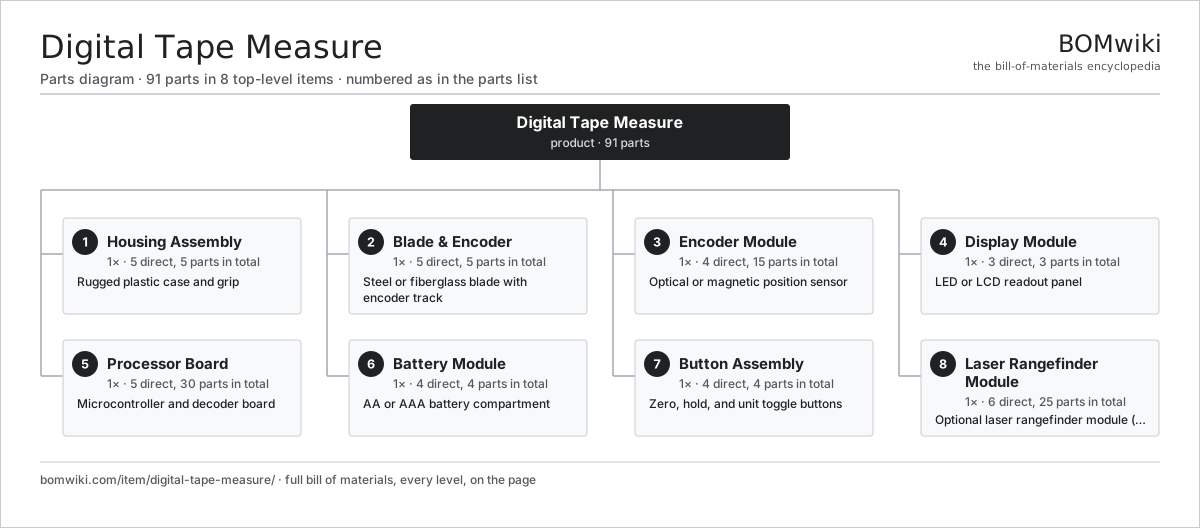
| # | Part | Qty | What it does |
|---|---|---|---|
| 1 | Housing Assembly 5 parts | 1× | Rugged plastic case and grip |
| 2 | Blade & Encoder 5 parts | 1× | Steel or fiberglass blade with encoder track |
| 3 | Encoder Module 4 parts | 1× | Optical or magnetic position sensor |
| 4 | Display Module 3 parts | 1× | LED or LCD readout panel |
| 5 | Processor Board 5 parts | 1× | Microcontroller and decoder board |
| 6 | Battery Module 4 parts | 1× | AA or AAA battery compartment |
| 7 | Button Assembly 4 parts | 1× | Zero, hold, and unit toggle buttons |
| 8 | Laser Rangefinder Module 6 parts | 1× | Optional laser rangefinder module (if equipped) |
3D model
No 3D model yet. Have a CAD file of this? Add a 3D model. STL renders right on this page; STEP, FreeCAD, and OpenSCAD sources are welcome too (openly licensed, like all 3D models on BOMwiki).
Build & assembly graph
expand / collapse · shared sub-assemblies converge · links to related products · est. labourTap an assembly to expand/collapse · tap a part to open it · use “Open page” for any node · drag to pan, scroll to zoom.
Bill of materials for Digital Tape Measure
8 top-level lines · 44 rows shown · 91 parts total · indented to 3 levels| # | Item / sub-assembly | Part no. | Qty/assy | Ext. qty | Parts | Type |
|---|---|---|---|---|---|---|
| 1 | Housing Assembly 5 parts | digital-tape-measure-housing | 1× | 1 | 5 | assembly |
| 1.1 | Top Cover | digital-tape-measure-top-cover | 1× | 1 | · | part |
| 1.2 | Bottom Cover | digital-tape-measure-bottom-cover | 1× | 1 | · | part |
| 1.3 | Grip Padding | digital-tape-measure-grip-padding | 1× | 1 | · | part |
| 1.4 | Blade Guide | digital-tape-measure-blade-guide | 1× | 1 | · | part |
| 1.5 | Fastener Set | fastener-set | 1× | 1 | · | part |
| 2 | Blade & Encoder 5 parts | digital-tape-measure-blade | 1× | 1 | 5 | assembly |
| 2.1 | Steel Blade | digital-tape-measure-steel-blade | 1× | 1 | · | part |
| 2.2 | Encoder Track | digital-tape-measure-encoder-track | 1× | 1 | · | part |
| 2.3 | Blade Hook | digital-tape-measure-blade-tip | 1× | 1 | · | part |
| 2.4 | Spool | digital-tape-measure-spool | 1× | 1 | · | part |
| 2.5 | Return Spring | digital-tape-measure-return-spring | 1× | 1 | · | part |
| 3 | Encoder Module 4 parts | digital-tape-measure-encoder | 1× | 1 | 15 | assembly |
| 3.1 | Encoder Sensor | digital-tape-measure-encoder-sensor | 1× | 1 | · | part |
| 3.2 | Encoder Emitter | digital-tape-measure-encoder-emitter | 1× | 1 | · | part |
| 3.3 | Encoder PCB | digital-tape-measure-encoder-pcb | 1× | 1 | · | part |
| 3.4 | SMD Passive (R/C/L) | smd-passives | 12× | 12 | · | part |
| 4 | Display Module 3 parts | digital-tape-measure-display | 1× | 1 | 3 | assembly |
| 4.1 | LED Display | digital-tape-measure-led-display | 1× | 1 | · | part |
| 4.2 | Display Driver | digital-tape-measure-display-driver | 1× | 1 | · | part |
| 4.3 | Bare PCB | pcb-bare | 1× | 1 | · | part |
| 5 | Processor Board 5 parts | digital-tape-measure-processor | 1× | 1 | 30 | assembly |
| 5.1 | Bare PCB | pcb-bare | 1× | 1 | · | part |
| 5.2 | Microcontroller | mcu | 1× | 1 | · | part |
| 5.3 | Counter IC | digital-tape-measure-counter-ic | 1× | 1 | · | part |
| 5.4 | SMD Passive (R/C/L) | smd-passives | 25× | 25 | · | part |
| 5.5 | Connector | connector | 2× | 2 | · | part |
| 6 | Battery Module 4 parts | digital-tape-measure-battery | 1× | 1 | 4 | assembly |
| 6.1 | Battery Holder | digital-tape-measure-battery-holder | 1× | 1 | · | part |
| 6.2 | Battery Contacts | digital-tape-measure-battery-contacts | 1× | 1 | · | part |
| 6.3 | Low Battery LED | digital-tape-measure-low-battery-led | 1× | 1 | · | part |
| 6.4 | Fastener Set | fastener-set | 1× | 1 | · | part |
| 7 | Button Assembly 4 parts | digital-tape-measure-buttons | 1× | 1 | 4 | assembly |
| 7.1 | Zero Button | digital-tape-measure-zero-button | 1× | 1 | · | part |
| 7.2 | Hold Button | digital-tape-measure-hold-button | 1× | 1 | · | part |
| 7.3 | Unit Button | digital-tape-measure-unit-button | 1× | 1 | · | part |
| 7.4 | Button PCB | digital-tape-measure-button-pcb | 1× | 1 | · | part |
| 8 | Laser Rangefinder Module 6 parts | digital-tape-measure-laser | 1× | 1 | 25 | assembly |
| 8.1 | Laser Emitter | digital-tape-measure-laser-emitter | 1× | 1 | · | part |
| 8.2 | Laser Receiver | digital-tape-measure-laser-receiver | 1× | 1 | · | part |
| 8.3 | Laser Processor | digital-tape-measure-laser-processor | 1× | 1 | · | part |
| 8.4 | Tilt Sensor | digital-tape-measure-tilt-sensor | 1× | 1 | · | part |
| 8.5 | Bare PCB | pcb-bare | 1× | 1 | · | part |
| 8.6 | SMD Passive (R/C/L) | smd-passives | 20× | 20 | · | part |
Something wrong in this list? Report a problem with this BOM.
Sourcing: possible vendors
Browse the supplier directory → Prices, MOQ, and lead times are algorithmic estimates, not quotes, and not claims about these companies. Company mappings are curated by keyword; est. price band $50–$2k. How estimates work| Vendor | HQ | Specialty | MOQ | Lead time |
|---|---|---|---|---|
|
🇨🇳Foxconn
foxconn.com ↗
|
Shenzhen, CN | Electronics contract mfg | 1,000 units | 8–14 wks |
|
🇺🇸Jabil
jabil.com ↗
|
St. Petersburg, US | Electronics manufacturing | 1,000 units | 8–14 wks |
|
🇺🇸Flex
flex.com ↗
|
Austin, US | Electronics manufacturing | 1,000 units | 8–14 wks |
| celestica.com ↗ | Toronto, CA | Electronics manufacturing | 1,000 units | 8–14 wks |
|
🇺🇸Sanmina
sanmina.com ↗
|
San Jose, US | Electronics manufacturing | 1,000 units | 8–14 wks |
1,085-word article