Electric Blanket
ProductOverview
An electric blanket is a bedding textile woven with a resistive heating wire matrix that converts electrical current into warmth. Commonly used in cold climates, by people with arthritis or circulation disorders, and during recovery from illness, the blanket provides localized or full-body warmth without raising the room temperature. Modern blankets incorporate automatic temperature control and multiple safety cutoffs to prevent burns or thermal runaway.
The Heating Wire Matrix of thin Nichrome Heating Wire is embedded throughout the Outer Fabric Layer and sandwiched between the outer fabric and the Inner Protective Lining. The wire is spaced at regular intervals (5–10 cm) and quilted in place with the outer layer. Electrical current flows through the nichrome, which has high resistivity and dissipates power as heat (Joule heating: P = I²R). The Safety & Thermal Control Unit sits on the nightstand or plugs into the wall, controlling voltage and current via a Relay, and monitoring temperature via the Thermostat Sensor Probe and Overheat Safety Sensors.
Heating principle and wire layout
Nichrome (nickel–chromium alloy) is chosen for its high resistivity (~1 Ω/meter for 1 mm diameter wire), high melting point (1400°C), and oxidation resistance. When current flows, the wire heats to 50–150°C depending on wire diameter and applied voltage. The quilted arrangement distributes heat evenly across the blanket surface, preventing hot spots and reducing burn risk.
Wires are arranged in parallel circuits, series chains, or a combination. Parallel circuits (more common in modern blankets) mean each zone can be controlled independently: if one heating element fails (open circuit), the others remain functional. Series circuits are simpler but more vulnerable to a single wire break.
The Wire Insulation Tube of silicone or PVC insulate the nichrome from the outer cotton weave, meeting electrical safety standards and preventing direct user contact with the hot wire.
Temperature regulation
The Safety & Thermal Control Unit monitors the blanket surface temperature using the Thermostat Sensor Probe, typically an NTC (negative temperature coefficient) thermistor mounted on the blanket's inner surface. When the blanket reaches the setpoint (low/medium/high dial setting: 37°C, 43°C, or 50°C), the Relay switches off. As the blanket cools, the relay re-energizes.
This on-off cycling maintains the target temperature with minimal overshoot. The Temperature Control Dial is a potentiometer dividing the desired voltage across the Relay; higher dial positions permit higher peak current, allowing faster heating and higher steady-state temperature.
Safety architecture
Modern electric blankets include redundant thermal protection:
Thermostat control loop: The Thermostat Sensor Probe limits sustained temperature, preventing runaway heating.
Overheat cutoff: The Overheat Safety Sensors (secondary thermistors) trigger a relay that instantly cuts all power if local temperature exceeds 65–70°C, protecting against thermostat failure or abnormal heating.
Thermal fuse: The Thermal Cutout Fuse (rated 70–75°C) is wired in series with the Relay; if temperature rises further, the fuse melts and breaks the circuit permanently. The blanket then requires service.
Auto-shutoff timer: The Auto-Shutoff Timer Knob allows users to set a maximum runtime (0–12 hours), ensuring the blanket does not run overnight unattended.
Electrical isolation: The power cord is typically ungrounded (2-conductor) or grounded through a double-insulation scheme, reducing shock risk. Modern cords meet IEC 60950 and EN 60950 safety standards.
Wiring harness and control flow
The Power Cord & Connector Assembly connects the wall AC socket to the Safety & Thermal Control Unit. Inside the controller, a Bare PCB rectifies the AC, filters it, and routes it through the Relay. When the relay is energized (thermostat setpoint not reached), current flows from the AC wall to the Blanket-to-Controller Connector, down the Power Cable inside the blanket, and through the Heating Wire Matrix. Current returns via the second conductor of the cord.
The Sensor Wiring Harness is low-voltage (< 24 V DC) and returns the thermistor signal to the controller PCB, which compares it to a reference voltage set by the Temperature Control Dial.
Maintenance and longevity
The nichrome wire is durable but not maintenance-free. Mechanical flex (folding the blanket repeatedly, washing) can eventually crack the Wire Insulation Tube or break a wire. Most electric blankets are rated for 5–10 years of normal use. Hand washing in cold water (not machine wash) extends lifespan; over-heating or puncturing the blanket should be avoided.
Replacement of the heating matrix is rarely economical; most users replace the entire blanket if wires fail. The controller PCB can sometimes be repaired if a relay fails, but replacement is standard practice.
Electric Blanket parts and their functions
7 top-level parts · 51 parts in total · full bill of materials below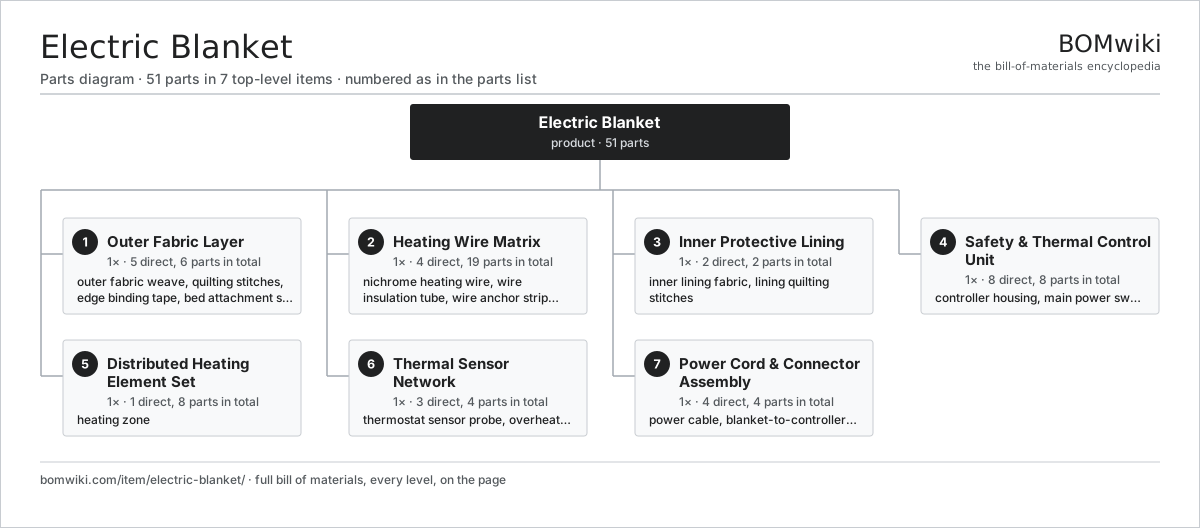
| # | Part | Qty | What it does |
|---|---|---|---|
| 1 | Outer Fabric Layer 5 parts | 1× | Quilted cotton, polyester, or fleece outer cover providing comfort and durability. |
| 2 | Heating Wire Matrix 4 parts | 1× | Thin resistive wire grid embedded throughout the blanket in a parallel or parallel-series pattern. |
| 3 | Inner Protective Lining 2 parts | 1× | Insulating fabric layer between the heating matrix and the person, reducing direct contact with wires. |
| 4 | Safety & Thermal Control Unit 8 parts | 1× | Plug-mounted or bedside controller with overheat cutoff, auto-shutoff timer, and temperature dial. |
| 5 | Distributed Heating Element Set 1 parts | 1× | Array of nichrome heating zones (20–30 independent elements) spread across the blanket. |
| 6 | Thermal Sensor Network 3 parts | 1× | Temperature sensors distributed across the blanket surface monitoring local temperature and preventing overheating. |
| 7 | Power Cord & Connector Assembly 4 parts | 1× | Grounded AC power cord connecting controller to blanket heating matrix. |
3D model
No 3D model yet. Have a CAD file of this? Add a 3D model. STL renders right on this page; STEP, FreeCAD, and OpenSCAD sources are welcome too (openly licensed, like all 3D models on BOMwiki).
Build & assembly graph
expand / collapse · shared sub-assemblies converge · links to related products · est. labourTap an assembly to expand/collapse · tap a part to open it · use “Open page” for any node · drag to pan, scroll to zoom.
Bill of materials for Electric Blanket
7 top-level lines · 34 rows shown · 51 parts total · indented to 3 levels| # | Item / sub-assembly | Part no. | Qty/assy | Ext. qty | Parts | Type |
|---|---|---|---|---|---|---|
| 1 | Outer Fabric Layer 5 parts | electric-blanket-fabric-shell | 1× | 1 | 6 | assembly |
| 1.1 | Outer Fabric Weave | electric-blanket-outer-fabric | 1× | 1 | · | part |
| 1.2 | Quilting Stitches | electric-blanket-fabric-quilting | 1× | 1 | · | part |
| 1.3 | Edge Binding Tape | electric-blanket-bias-binding | 1× | 1 | · | part |
| 1.4 | Bed Attachment Snap Loop | electric-blanket-snap-loops | 2× | 2 | · | part |
| 1.5 | Fastener Set | fastener-set | 1× | 1 | · | part |
| 2 | Heating Wire Matrix 4 parts | electric-blanket-heating-wire-matrix | 1× | 1 | 19 | assembly |
| 2.1 | Nichrome Heating Wire | electric-blanket-nichrome-wire | 1× | 1 | · | part |
| 2.2 | Wire Insulation Tube | electric-blanket-wire-isolation-tubes | 12× | 12 | · | part |
| 2.3 | Wire Anchor Strip | electric-blanket-wire-anchor-strips | 4× | 4 | · | part |
| 2.4 | Wire Junction Point | electric-blanket-wire-interconnect | 2× | 2 | · | part |
| 3 | Inner Protective Lining 2 parts | electric-blanket-inner-lining | 1× | 1 | 2 | assembly |
| 3.1 | Inner Lining Fabric | electric-blanket-inner-fabric | 1× | 1 | · | part |
| 3.2 | Lining Quilting Stitches | electric-blanket-lining-quilting | 1× | 1 | · | part |
| 4 | Safety & Thermal Control Unit 8 parts | electric-blanket-safety-controller | 1× | 1 | 8 | assembly |
| 4.1 | Controller Housing | electric-blanket-controller-housing | 1× | 1 | · | part |
| 4.2 | Main Power Switch | electric-blanket-power-switch | 1× | 1 | · | part |
| 4.3 | Temperature Control Dial | electric-blanket-temp-dial | 1× | 1 | · | part |
| 4.4 | Auto-Shutoff Timer Knob | electric-blanket-timer-knob | 1× | 1 | · | part |
| 4.5 | Thermal Cutout Fuse | electric-blanket-overheat-fuse | 1× | 1 | · | part |
| 4.6 | Relay | relay | 1× | 1 | · | part |
| 4.7 | Bare PCB | pcb-bare | 1× | 1 | · | part |
| 4.8 | Connector | connector | 1× | 1 | · | part |
| 5 | Distributed Heating Element Set 1 parts | electric-blanket-heating-elements | 1× | 1 | 8 | assembly |
| 5.1 | Heating Zone | electric-blanket-heating-zone | 8× | 8 | · | part |
| 6 | Thermal Sensor Network 3 parts | electric-blanket-thermal-sensors | 1× | 1 | 4 | assembly |
| 6.1 | Thermostat Sensor Probe | electric-blanket-thermostat-probe | 1× | 1 | · | part |
| 6.2 | Overheat Safety Sensor | electric-blanket-overheat-sensor | 2× | 2 | · | part |
| 6.3 | Sensor Wiring Harness | electric-blanket-sensor-wiring | 1× | 1 | · | part |
| 7 | Power Cord & Connector Assembly 4 parts | electric-blanket-power-cord | 1× | 1 | 4 | assembly |
| 7.1 | Power Cable | electric-blanket-cord-wire | 1× | 1 | · | part |
| 7.2 | Blanket-to-Controller Connector | electric-blanket-cord-connector | 1× | 1 | · | part |
| 7.3 | Cord Strain Relief Boot | electric-blanket-strain-relief | 1× | 1 | · | part |
| 7.4 | Cord Management Clip | electric-blanket-cord-clip | 1× | 1 | · | part |
Something wrong in this list? Report a problem with this BOM.
Sourcing: possible vendors
Browse the supplier directory → Prices, MOQ, and lead times are algorithmic estimates, not quotes, and not claims about these companies. Company mappings are curated by keyword; est. price band $150–$3k. How estimates work| Vendor | HQ | Specialty | MOQ | Lead time |
|---|---|---|---|---|
| whirlpoolcorp.com ↗ | Benton Harbor, US | Home appliances | 1,000 units | 8–14 wks |
| bsh-group.com ↗ | Munich, DE | Appliances (Bosch, Siemens) | 1,000 units | 8–14 wks |
| electroluxgroup.com ↗ | Stockholm, SE | Home appliances | 1,000 units | 8–14 wks |
| lg.com ↗ | Seoul, KR | Appliances & electronics | 1,000 units | 8–14 wks |
|
🇨🇳Haier
haier.com ↗
|
Qingdao, CN | Home appliances | 1,000 units | 8–14 wks |
785-word article