Electronic Shelf Label
ProductOverview
An electronic shelf label (ESL) is a wireless-networked e-ink display designed to replace paper price tags on retail shelves. Retailers deploy hundreds or thousands of these small displays across a store, updating prices centrally through a back-end system, eliminating manual label changes and enabling dynamic pricing or flash sales. The E-Ink Display Module uses electrophoretic e-ink, which consumes power only during a refresh and requires no backlight, resulting in years of operation on a single primary battery.
The Controller PCB houses a microcontroller, e-ink driver, and wireless transceiver that poll the store's network for price updates. When a price change is transmitted, the label wakes from sleep, receives the update, renders the new price on the E-Ink Display Module, and returns to sleep, drawing nearly zero current until the next update cycle.
How it works
The Battery Cell supplies 3.0 V (CR2032) or 1.5 V per cell (AAA) to the Power Distribution subsystem. A boost converter steps up the voltage to the 3.3 V logic level required by the Microcontroller and Compute SoC Module. In sleep mode, nearly all digital circuits are clock-gated, and the only current draw is the standby leakage of the wireless module and microcontroller, typically 1 µA or less. This ultralow idle current is why primary batteries are viable; if the label remained fully powered 24/7, they would be depleted in weeks.
When a price update is broadcast from the store's server (via Wireless Module, which is either BLE or WiFi), the Compute SoC Module wakes the Microcontroller. The MCU validates the update, decodes the new price, and instructs the E-Ink Driver IC to apply the new image to the E-Ink Panel.
E-ink works by suspending charged microspheres (red, white, and black) in a viscous oil within tiny capsules embedded in the paper. An electric field moves these particles to the surface to create text or images. Once drawn, the image is stable and requires no power to maintain (unlike LCD, which needs continuous backlight). A full refresh takes 8–10 seconds; the E-Ink Driver IC controls the timing and waveform, including the intermediate states needed to clear old pixels and prevent ghosting.
After the image has been rendered and confirmed, the Microcontroller returns to sleep mode, reducing the active current from 80–100 mA (during wireless and display activity) back to 1 µA. The Housing and Clip is designed for ease of installation: a clip on the back slides over a standard shelf edge, and the display faces outward toward customers.
Wireless updates are typically batched: the store server broadcasts price changes to all labels in a zone during off-peak hours (e.g., 2:00–3:00 AM) to avoid bandwidth congestion. Some systems update continuously, refreshing high-velocity items (grocery prices, fuel, stock quotes) every few minutes.
Design rationale
E-ink was chosen over LCD because:
- Power efficiency: no backlight; image stability with zero power.
- Readability: sunlight-readable (no glare, high contrast) in any lighting condition.
- Fast enough: 8–10 second refresh is acceptable for retail (prices don't need millisecond updates).
- Thin profile: e-ink is inherently thin, allowing labels to fit into tight shelf-edge spaces.
Primary batteries (CR2032, AAA) are chosen over rechargeable LiPo because:
- No charging infrastructure required in stores.
- Multi-year shelf life: labels can be pre-loaded and deployed immediately.
- Cost: primary battery plus 5-year warranty is cheaper than adding solar charging or a separate charger station.
- Reliability: primary cells have no charge-cycle degradation.
Wireless technology (BLE or WiFi) is preferred over wired because:
- No power supply cables running across the sales floor.
- Dynamic placement and repositioning of labels without rewiring.
- Ability to deploy labels in areas difficult to run cabling (upper shelves, mobile displays).
The Housing and Clip is designed to be slim and transparent so the price is clearly visible while the label sits compactly on the shelf edge, with a spring clip that allows quick insertion and removal.
Electronic Shelf Label parts and their functions
8 top-level parts · 159 parts in total · full bill of materials below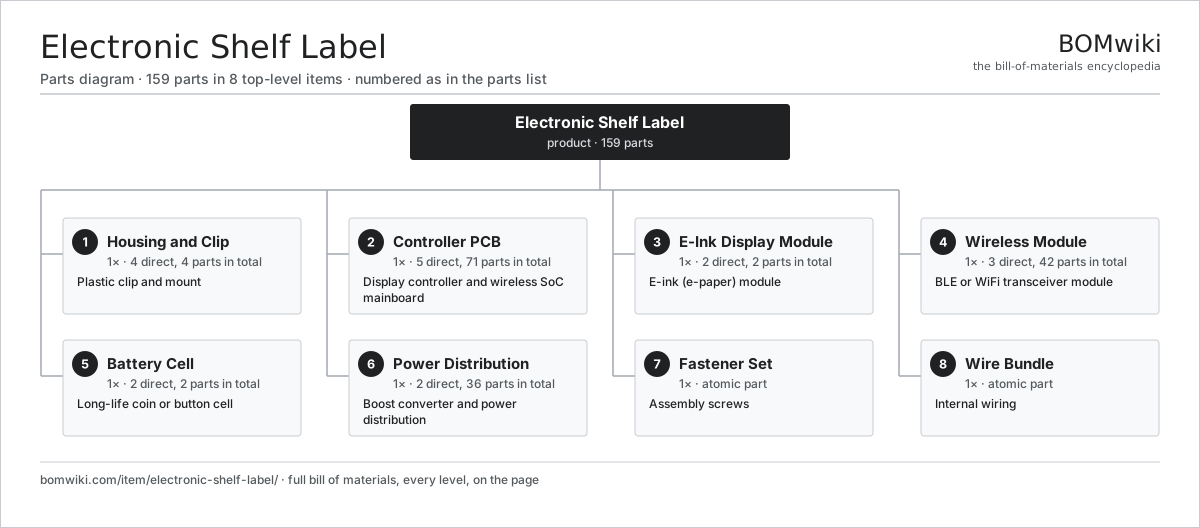
| # | Part | Qty | What it does |
|---|---|---|---|
| 1 | Housing and Clip 4 parts | 1× | Plastic clip and mount |
| 2 | Controller PCB 5 parts | 1× | Display controller and wireless SoC mainboard |
| 3 | E-Ink Display Module 2 parts | 1× | E-ink (e-paper) module |
| 4 | Wireless Module 3 parts | 1× | BLE or WiFi transceiver module |
| 5 | Battery Cell 2 parts | 1× | Long-life coin or button cell |
| 6 | Power Distribution 2 parts | 1× | Boost converter and power distribution |
| 7 | Fastener Set | 1× | Assembly screws |
| 8 | Wire Bundle | 1× | Internal wiring |
3D model
No 3D model yet. Have a CAD file of this? Add a 3D model. STL renders right on this page; STEP, FreeCAD, and OpenSCAD sources are welcome too (openly licensed, like all 3D models on BOMwiki).
Build & assembly graph
expand / collapse · shared sub-assemblies converge · links to related products · est. labourTap an assembly to expand/collapse · tap a part to open it · use “Open page” for any node · drag to pan, scroll to zoom.
Bill of materials for Electronic Shelf Label
8 top-level lines · 26 rows shown · 159 parts total · indented to 3 levels| # | Item / sub-assembly | Part no. | Qty/assy | Ext. qty | Parts | Type |
|---|---|---|---|---|---|---|
| 1 | Housing and Clip 4 parts | electronic-shelf-label-housing | 1× | 1 | 4 | assembly |
| 1.1 | Front Faceplate | electronic-shelf-label-front | 1× | 1 | · | part |
| 1.2 | Back Cover | electronic-shelf-label-back | 1× | 1 | · | part |
| 1.3 | Shelf Clip Spring | electronic-shelf-label-clip-spring | 1× | 1 | · | part |
| 1.4 | Fastener Set | fastener-set | 1× | 1 | · | part |
| 2 | Controller PCB 5 parts | electronic-shelf-label-pcb | 1× | 1 | 71 | assembly |
| 2.1 | Bare PCB | pcb-bare | 1× | 1 | · | part |
| 2.2 | Microcontroller | mcu | 1× | 1 | · | part |
| 2.3 | E-Ink Driver IC | electronic-shelf-label-eink-driver | 1× | 1 | · | part |
| 2.4 | SMD Passive (R/C/L) | smd-passives | 65× | 65 | · | part |
| 2.5 | Connector | connector | 3× | 3 | · | part |
| 3 | E-Ink Display Module 2 parts | electronic-shelf-label-display | 1× | 1 | 2 | assembly |
| 3.1 | E-Ink Panel | electronic-shelf-label-eink-panel | 1× | 1 | · | part |
| 3.2 | Display Connector | electronic-shelf-label-display-connector | 1× | 1 | · | part |
| 4 | Wireless Module 3 parts | electronic-shelf-label-wireless | 1× | 1 | 42 | assembly |
| 4.1 | Compute SoC Module | soc-module | 1× | 1 | · | part |
| 4.2 | Wireless Antenna | electronic-shelf-label-antenna | 1× | 1 | · | part |
| 4.3 | SMD Passive (R/C/L) | smd-passives | 40× | 40 | · | part |
| 5 | Battery Cell 2 parts | electronic-shelf-label-battery | 1× | 1 | 2 | assembly |
| 5.1 | Coin / Button Battery | electronic-shelf-label-battery-cell | 1× | 1 | · | part |
| 5.2 | Battery Holder | electronic-shelf-label-battery-holder | 1× | 1 | · | part |
| 6 | Power Distribution 2 parts | electronic-shelf-label-power-management | 1× | 1 | 36 | assembly |
| 6.1 | Power Supply | power-supply | 1× | 1 | · | part |
| 6.2 | SMD Passive (R/C/L) | smd-passives | 35× | 35 | · | part |
| 7 | Fastener Set | fastener-set | 1× | 1 | · | part |
| 8 | Wire Bundle | wire-bundle | 1× | 1 | · | part |
Something wrong in this list? Report a problem with this BOM.
Related products
same domain, ranked by shared parts Car FM Transmitter
240 parts · shares 3 with this page
Car FM Transmitter
240 parts · shares 3 with this page
 Digital Audio Player
267 parts · shares 3 with this page
Digital Audio Player
267 parts · shares 3 with this page
 Digital Photo Frame
31 parts · shares 3 with this page
Digital Photo Frame
31 parts · shares 3 with this page
 Game Console
114 parts · shares 3 with this page
Game Console
114 parts · shares 3 with this page
 LED Curtain Display
356 parts · shares 3 with this page
LED Curtain Display
356 parts · shares 3 with this page
 Smart Speaker
379 parts · shares 3 with this page
Smart Speaker
379 parts · shares 3 with this page
Sourcing: possible vendors
Browse the supplier directory → Prices, MOQ, and lead times are algorithmic estimates, not quotes, and not claims about these companies. Company mappings are curated by keyword; est. price band $50–$2k. How estimates work| Vendor | HQ | Specialty | MOQ | Lead time |
|---|---|---|---|---|
|
🇨🇳Foxconn
foxconn.com ↗
|
Shenzhen, CN | Electronics contract mfg | 1,000 units | 8–14 wks |
|
🇺🇸Jabil
jabil.com ↗
|
St. Petersburg, US | Electronics manufacturing | 1,000 units | 8–14 wks |
|
🇺🇸Flex
flex.com ↗
|
Austin, US | Electronics manufacturing | 1,000 units | 8–14 wks |
| celestica.com ↗ | Toronto, CA | Electronics manufacturing | 1,000 units | 8–14 wks |
|
🇺🇸Sanmina
sanmina.com ↗
|
San Jose, US | Electronics manufacturing | 1,000 units | 8–14 wks |
699-word article