Emergency Crank Radio
ProductOverview
An emergency crank radio is a battery-less multi-band radio receiver that derives its power from hand-cranking. Designed for disaster and emergency preparedness, it functions during power outages, in remote locations, or when commercial battery supply is depleted. The device receives AM, FM, and NOAA Weather Radio All Hazards (WEATHERADIO) broadcasts and doubles as a flashlight and mobile phone charger via USB output.
The key innovation is the Crank Generator, which mechanically couples through a planetary gearbox to a Generator that converts rotational energy to electrical current. A user can charge the internal Battery Module or power the radio directly while cranking, even if the battery is depleted.
How it works
The Crank Handle is rotated by hand. The crank axle meshes with the Sun Gear, which drives a set of Planet Gears orbiting around the sun gear. The Planet Gears mesh with the Ring Gear, which is mechanically fixed to the Rotor Magnet, a rotor magnet assembly.
The planetary gear train achieves a 50:1 speed multiplication: a 1 Hz crank rotation (60 RPM) outputs 50 Hz (3000 RPM) at the generator rotor. As the Rotor Magnet spins, its neodymium magnets pass by the stationary Stator Coil coil, inducing an AC voltage via Faraday's law. A typical design yields 3–6 V AC at 1 Hz crank speed.
The Rectifier Circuit bridge converts AC to DC, and a linear regulator stabilizes the voltage. This raw crank power can directly operate the radio tuner and speaker for intermittent listening (a few minutes of crank per hour), or charge the Battery Module, a Li-ion cell, via the Charger IC. Thirty seconds of continuous cranking at ~1 Hz typically stores enough energy to power the radio for 5–10 minutes of idle listening, or 10+ minutes of active volume-controlled playback.
The Radio Tuner Module is a receiver IC (commonly an RDA5807 or similar chip) that performs frequency synthesis. The user adjusts the frequency via buttons, and the Processor Board's Microcontroller commands the Frequency Synthesizer to tune to the desired band and frequency. The Demodulator IC extracts audio from the modulated RF signal, AM detection via envelope rectification, FM detection via phase-locked-loop discriminator, and the Audio Amplifier IC drives the Speaker Module.
In NOAA Weather band mode, the receiver is locked to one of seven NOAA frequencies (162.40–162.55 MHz), and an alert decoder can automatically wake the device and sound an alarm if a severe weather warning is broadcast. This feature has saved countless lives in tornado alleys and coastal regions.
Power & Battery
The Battery Module can be a single 3.7 V Li-ion cell (1000–2000 mAh) or three AA NiMH cells in series (3.6 V nominal). The Charger IC supports dual charging: from the crank generator and from USB wall power (with an external USB adapter). Typical battery life on a full charge is 15–30 hours of idle listening, less if the radio is played at high volume continuously.
In a true emergency, the crank generator can supply power indefinitely; a user can continuously listen if willing to crank for 1–2 minutes per 10 minutes of listening (roughly 10% crank duty cycle).
Flashlight & USB
The Flashlight Module LED can be powered from the crank generator or battery. A bright LED (200+ lumens) provides searchlight-level illumination. The USB Output Module module includes a USB DC-DC Converter buck converter that steps the 3.7 V battery down to 5 V and supplies up to 1 A for phone charging. In emergencies, users can trickle-charge a smartphone via USB while the radio listens to NOAA alerts.
Reception & Antenna
The Radio Tuner Module's RF Front End includes an antenna switch: for AM reception, an internal ferrite bar antenna in the body is used; for FM and NOAA, a telescoping radio-antenna-whip (external antenna) is extended. The ferrite bar is compact and needs no external component but offers lower sensitivity than a whip antenna. FM sensitivity of −90 dBm is good for strong stations within 20 km of the transmitter.
NOAA Weather Radio Integration
NOAA operates a network of radio transmitters on seven frequencies (162.40, 162.425, 162.45, 162.475, 162.5, 162.525, 162.55 MHz) that broadcast continuous updated weather information and emergency alerts. An emergency crank radio with NOAA capability can automatically wake and sound a siren tone when a warning (tornado, flash flood, tsunami, etc.) is issued for the user's county. This feature is invaluable in areas with limited cellular coverage or during prolonged outages.
Typical Scenario
During a hurricane, a user loses mains power. Their smartphone is at 5% battery. They grab the emergency crank radio from their disaster kit, extend the FM whip antenna, tune to local news (FM 88.5), and hear the latest weather updates while sitting in a safe interior room. Simultaneously, they use the USB output to charge their smartphone, powered by the radio's battery. If the battery drains, they crank for 2 minutes every 30 minutes to keep power flowing. The radio's Flashlight Module provides emergency lighting without depleting a flashlight's batteries.
Limitations & Quirks
Hand-cranking is fatiguing; continuous heavy cranking for hours is not practical. The output power (1–2 W) is modest, enough for the radio's low-power amplifier but not enough to power an external device demanding >1 W (e.g., a laptop charger). The radio is receive-only; it cannot transmit, unlike a two-way emergency transceiver or ham radio.
Crank generators are prone to fatigue failure in the gearbox if over-cranked too hard (exceeding rated RPM); users should crank at a steady, moderate pace (~1 Hz, as designed) rather than trying to crank as fast as possible.
The radio performs best in open air. Inside a reinforced concrete building or basement, reception may be poor; the antenna should be positioned near a window or door.
Maintenance
Periodically exercise the crank (monthly crank tests, 1–2 minutes) to keep the gears lubricated and ensure the mechanism doesn't seize. The battery should be charged via USB or crank every 6–12 months during storage to prevent deep discharge. The telescoping antenna should be extended and retracted a few times per year to prevent oxidation and sticking.
Emergency Crank Radio parts and their functions
9 top-level parts · 123 parts in total · full bill of materials below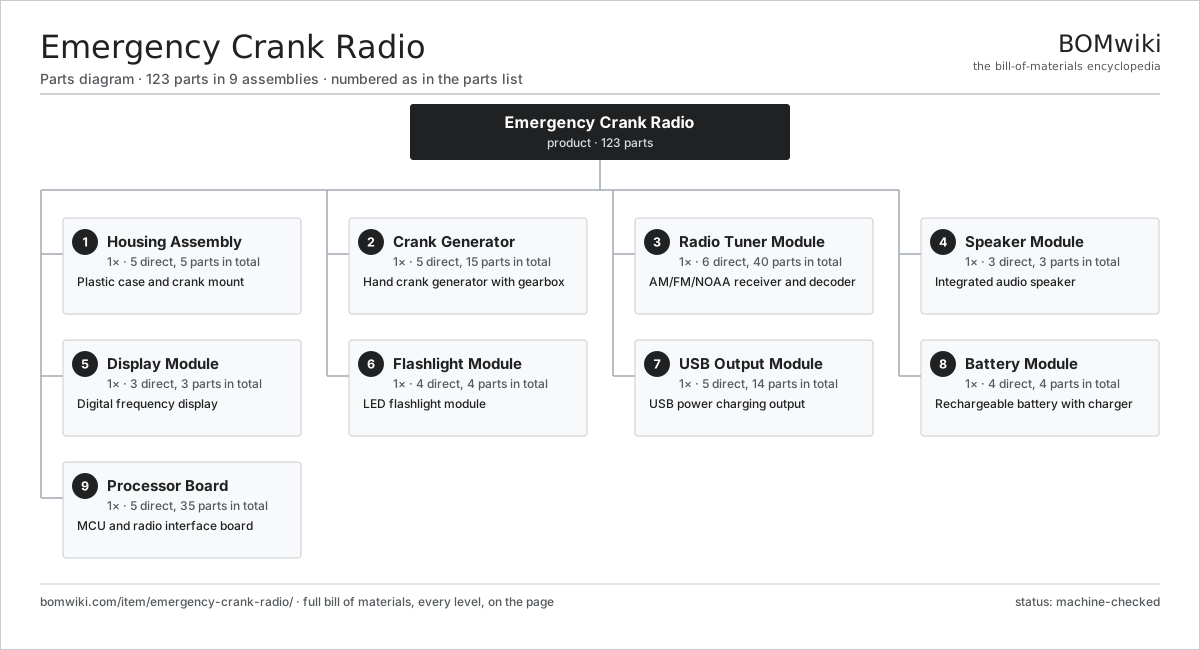
| # | Part | Qty | What it does |
|---|---|---|---|
| 1 | Housing Assembly 5 parts | 1× | Plastic case and crank mount |
| 2 | Crank Generator 5 parts | 1× | Hand crank generator with gearbox |
| 3 | Radio Tuner Module 6 parts | 1× | AM/FM/NOAA receiver and decoder |
| 4 | Speaker Module 3 parts | 1× | Integrated audio speaker |
| 5 | Display Module 3 parts | 1× | Digital frequency display |
| 6 | Flashlight Module 4 parts | 1× | LED flashlight module |
| 7 | USB Output Module 5 parts | 1× | USB power charging output |
| 8 | Battery Module 4 parts | 1× | Rechargeable battery with charger |
| 9 | Processor Board 5 parts | 1× | MCU and radio interface board |
3D model
No 3D model yet. Have a CAD file of this? Add a 3D model — STL renders right on this page; STEP, FreeCAD, and OpenSCAD sources are welcome too (openly licensed, like all 3D models on BOMwiki).
Build & assembly graph
expand / collapse · shared sub-assemblies converge · links to related products · est. labourTap an assembly to expand/collapse · tap a part to open it · use “Open page” for any node · drag to pan, scroll to zoom.
Bill of materials for Emergency Crank Radio
9 top-level lines · 58 rows shown · 123 parts total · indented to 3 levels| # | Item / sub-assembly | Part no. | Qty/assy | Ext. qty | Parts | Type |
|---|---|---|---|---|---|---|
| 1 | Housing Assembly 5 parts | emergency-crank-radio-housing | 1× | 1 | 5 | assembly |
| 1.1 | Top Case | emergency-crank-radio-top-case | 1× | 1 | · | part |
| 1.2 | Bottom Case | emergency-crank-radio-bottom-case | 1× | 1 | · | part |
| 1.3 | Crank Mount | emergency-crank-radio-crank-mount | 1× | 1 | · | part |
| 1.4 | O-Ring Set | oring-set | 1× | 1 | · | part |
| 1.5 | Fastener Set | fastener-set | 1× | 1 | · | part |
| 2 | Crank Generator 5 parts | emergency-crank-radio-crank | 1× | 1 | 15 | assembly |
| 2.1 | Crank Handle | emergency-crank-radio-crank-handle | 1× | 1 | · | part |
| 2.2 | Gear Assembly 6 parts | emergency-crank-radio-gear-assembly | 1× | 1 | 8 | assembly |
| 2.2.1 | Sun Gear | emergency-crank-radio-sun-gear | 1× | 1 | · | part |
| 2.2.2 | Planet Gears | emergency-crank-radio-planet-gears | 3× | 3 | · | part |
| 2.2.3 | Ring Gear | emergency-crank-radio-ring-gear | 1× | 1 | · | part |
| 2.2.4 | Carrier Plate | emergency-crank-radio-carrier | 1× | 1 | · | part |
| 2.2.5 | Motor Housing | motor-housing | 1× | 1 | · | part |
| 2.2.6 | Fastener Set | fastener-set | 1× | 1 | · | part |
| 2.3 | Generator 3 parts | emergency-crank-radio-generator | 1× | 1 | 4 | assembly |
| 2.3.1 | Stator Coil | emergency-crank-radio-stator | 1× | 1 | · | part |
| 2.3.2 | Rotor Magnet | emergency-crank-radio-rotor | 1× | 1 | · | part |
| 2.3.3 | Bearing | emergency-crank-radio-bearing | 2× | 2 | · | part |
| 2.4 | Rectifier Circuit | emergency-crank-radio-rectifier | 1× | 1 | · | part |
| 2.5 | Fastener Set | fastener-set | 1× | 1 | · | part |
| 3 | Radio Tuner Module 6 parts | emergency-crank-radio-tuner | 1× | 1 | 40 | assembly |
| 3.1 | RF Front End | emergency-crank-radio-rf-front-end | 1× | 1 | · | part |
| 3.2 | Frequency Synthesizer | emergency-crank-radio-synthesizer | 1× | 1 | · | part |
| 3.3 | Demodulator IC | emergency-crank-radio-demodulator | 1× | 1 | · | part |
| 3.4 | Audio Amplifier IC | emergency-crank-radio-audio-amp | 1× | 1 | · | part |
| 3.5 | Bare PCB | pcb-bare | 1× | 1 | · | part |
| 3.6 | SMD Passive (R/C/L) | smd-passives | 35× | 35 | · | part |
| 4 | Speaker Module 3 parts | emergency-crank-radio-speaker | 1× | 1 | 3 | assembly |
| 4.1 | Speaker Driver | emergency-crank-radio-speaker-driver | 1× | 1 | · | part |
| 4.2 | Speaker Enclosure | emergency-crank-radio-speaker-enclosure | 1× | 1 | · | part |
| 4.3 | Fastener Set | fastener-set | 1× | 1 | · | part |
| 5 | Display Module 3 parts | emergency-crank-radio-display | 1× | 1 | 3 | assembly |
| 5.1 | LCD Panel | lcd-panel | 1× | 1 | · | part |
| 5.2 | Display Driver | emergency-crank-radio-display-driver | 1× | 1 | · | part |
| 5.3 | Bare PCB | pcb-bare | 1× | 1 | · | part |
| 6 | Flashlight Module 4 parts | emergency-crank-radio-flashlight | 1× | 1 | 4 | assembly |
| 6.1 | LED Bulb | emergency-crank-radio-led-bulb | 1× | 1 | · | part |
| 6.2 | Reflector | emergency-crank-radio-flashlight-reflector | 1× | 1 | · | part |
| 6.3 | Flashlight Switch | emergency-crank-radio-flashlight-switch | 1× | 1 | · | part |
| 6.4 | Lens Cover | emergency-crank-radio-flashlight-lens | 1× | 1 | · | part |
| 7 | USB Output Module 5 parts | emergency-crank-radio-usb-out | 1× | 1 | 14 | assembly |
| 7.1 | USB Jack | emergency-crank-radio-usb-jack | 1× | 1 | · | part |
| 7.2 | USB DC-DC Converter | emergency-crank-radio-usb-dcdc | 1× | 1 | · | part |
| 7.3 | USB Protection | emergency-crank-radio-usb-protection | 1× | 1 | · | part |
| 7.4 | Bare PCB | pcb-bare | 1× | 1 | · | part |
| 7.5 | SMD Passive (R/C/L) | smd-passives | 10× | 10 | · | part |
| 8 | Battery Module 4 parts | emergency-crank-radio-battery | 1× | 1 | 4 | assembly |
| 8.1 | Battery Cell | emergency-crank-radio-battery-cell | 1× | 1 | · | part |
| 8.2 | BMS Board | bms-board | 1× | 1 | · | part |
| 8.3 | Charger IC | emergency-crank-radio-charger-ic | 1× | 1 | · | part |
| 8.4 | Fastener Set | fastener-set | 1× | 1 | · | part |
| 9 | Processor Board 5 parts | emergency-crank-radio-processor | 1× | 1 | 35 | assembly |
| 9.1 | Bare PCB | pcb-bare | 1× | 1 | · | part |
| 9.2 | Microcontroller | mcu | 1× | 1 | · | part |
| 9.3 | Power Management IC | emergency-crank-radio-power-mgmt | 1× | 1 | · | part |
| 9.4 | SMD Passive (R/C/L) | smd-passives | 30× | 30 | · | part |
| 9.5 | Connector | connector | 2× | 2 | · | part |
Related products
same domain, ranked by shared parts Handheld GPS
192 parts · shares 3 with this page
Handheld GPS
192 parts · shares 3 with this page
 Satellite Phone
372 parts · shares 3 with this page
Satellite Phone
372 parts · shares 3 with this page
 Smartwatch
269 parts · shares 3 with this page
Transit Passenger Display
46 parts · shares 3 with this page
Smartwatch
269 parts · shares 3 with this page
Transit Passenger Display
46 parts · shares 3 with this page
 Walkie-Talkie (PMR Radio)
272 parts · shares 3 with this page
Walkie-Talkie (PMR Radio)
272 parts · shares 3 with this page
 Bluetooth Speaker
196 parts · shares 2 with this page
Bluetooth Speaker
196 parts · shares 2 with this page
Sourcing: possible vendors
Prices, MOQ, and lead times are algorithmic estimates, not quotes, and not claims about these companies. Company mappings are curated by keyword; est. price band $50–$2k. How estimates work| Vendor | HQ | Specialty | MOQ | Lead time |
|---|---|---|---|---|
|
🇨🇳Foxconn
foxconn.com ↗
|
Shenzhen, CN | Electronics contract mfg | 1,000 units | 8–14 wks |
|
🇺🇸Jabil
jabil.com ↗
|
St. Petersburg, US | Electronics manufacturing | 1,000 units | 8–14 wks |
|
🇺🇸Flex
flex.com ↗
|
Austin, US | Electronics manufacturing | 1,000 units | 8–14 wks |
| celestica.com ↗ | Toronto, CA | Electronics manufacturing | 1,000 units | 8–14 wks |
|
🇺🇸Sanmina
sanmina.com ↗
|
San Jose, US | Electronics manufacturing | 1,000 units | 8–14 wks |
1,121-word article