FPV Goggles
ProductOverview
FPV goggles are head-mounted visual display systems designed for pilots of racing drones and remote-controlled aircraft. Unlike traditional screen-based piloting, FPV (first-person view) immersion provides a natural perspective of the aircraft's flight path, dramatically improving control precision during high-speed maneuvers. The FPV Goggles architecture combines two miniature OLED displays, integrated optics for magnification, an RF video receiver tuned to the drone's transmitter frequency, and a nine-axis inertial measurement unit that tracks the pilot's head movement to command the aircraft's camera gimbal.
The optical design uses Fresnel lenses, flat, diffractive elements with concentric grooves rather than continuous curvature, to achieve a 90-degree diagonal field of view while remaining compact enough to wear on the head. Each eye views a dedicated 1920×1080 OLED panel, creating a binocular image that fills most of the pilot's visual field. The fresnel lens removes cues of the goggles' edges, strengthening the immersion that makes precise flight control feel intuitive.
The RF receiver operates in the 5.8 GHz industrial, scientific, and medical (ISM) band, demodulating video from the drone's transmitter and converting the analog PAL/NTSC signal to the displays via a dedicated video decoder IC. The Head Tracker Module sends angular orientation data back to the drone at 2.4 GHz, allowing hands-off camera panning that follows natural head movements.
How it works
Power enters from the Battery Pack, a rechargeable 2200 mAh 3S LiPo cell delivering 11.1 V nominal. Onboard switching power supplies derived from the Power Regulator generate discrete rails for the RF receiver (typically 3.3 V digital and 5 V analog), the display OLED panels (9–12 V), and the head-tracker MCU (3.3 V).
The Video Receiver Module section begins with the Integrated Antenna, a simple linear dipole tuned for omnidirectional 5.8 GHz reception. The antenna output feeds into a low-noise amplifier (LNA) stage within the RF Frontend Stage, where weak signals from the distant drone are pre-amplified before mixing. The Tuner IC (5.8 GHz), a wideband RF receiver chip, heterodynes the 5.8 GHz signal down to an intermediate frequency through a local oscillator that can be programmed to any of 48 defined channels, allowing the pilot to switch transmit frequencies without changing hardware.
The mixed intermediate-frequency signal passes through a bandpass filter and a second amplification stage. A video demodulator in the Video Decoder Chip extracts the composite video baseband from the IF carrier, recovering the standard-definition PAL or NTSC signal. This baseband is then fed to a video processor that formats the image for the fpv-goggles-display-module, scaling, frame-buffering, and distributing pixel data to both OLED panels via MIPI DSI (Mobile Industry Processor Interface) parallel data paths.
The Head Tracker Module operates independently. Its 9-DOF IMU, a nine-axis unit integrating a 3-axis gyroscope, 3-axis accelerometer, and 3-axis magnetometer, samples at 200 Hz, feeding raw rotation and acceleration vectors into the Tracker MCU. The MCU runs a sensor-fusion algorithm (typically a Kalman filter) that combines gyroscope integration with accelerometer and compass data to compute a stable, drift-corrected orientation quaternion. This attitude information is encoded and transmitted at low power (≤20 mW) on the 2.4 GHz ISM band, where the remote drone receiver demodulates it and uses the angles to drive gimbal servo motors, making the camera pan and tilt follow the pilot's natural head motion.
Display latency, the delay between the drone capturing a video frame and the pilot seeing it on the OLED panel, is critical for flight stability. The entire pipeline, from RF antenna through video decode to pixel-on-OLED, must complete in under 50 milliseconds; longer delays cause pilots to over-correct, leading to oscillatory crashes. The Left OLED Display and Right OLED Display panels support 60 Hz refresh for smooth motion, and the video receiver is designed with minimal frame-buffering to maintain this tight timing budget.
Diopter adjustment via the Diopter Focus Dial allows customization for users with myopia or hyperopia. Rotating the dial shifts the fresnel lens axially by 2–3 mm, changing the focal length by ±4 diopters (a range covering approximately ±6 eyeglass prescription), eliminating the need for prescription lens inserts in most cases.
Typical flight scenario
A FPV pilot powers on the goggles, which automatically scan for a recognized drone transmitter. Once the video carrier is detected and the display locks, the pilot sees a live stream of the onboard camera. Banking the aircraft requires intuitive head-to-gimbal coordination: as the pilot's head turns, the drone camera tracks the motion, maintaining the visual center frame, which then guides stick inputs to execute the turn. At race speeds exceeding 150 km/h through obstacle courses, this closed-loop sensorimotor feel is impossible to achieve with conventional ground-station monitors.
Battery life typically extends 3–4 hours of continuous operation, sufficient for multiple racing heats or extended scouting flights. Runtime is primarily limited by the Left OLED Display and Right OLED Display power consumption (≈2 W per eye at typical brightness) and the RF receiver power draw (≈3 W); the head tracker adds negligible load due to its low-power 2.4 GHz transmission.
FPV Goggles parts and their functions
9 top-level parts · 33 parts in total · full bill of materials below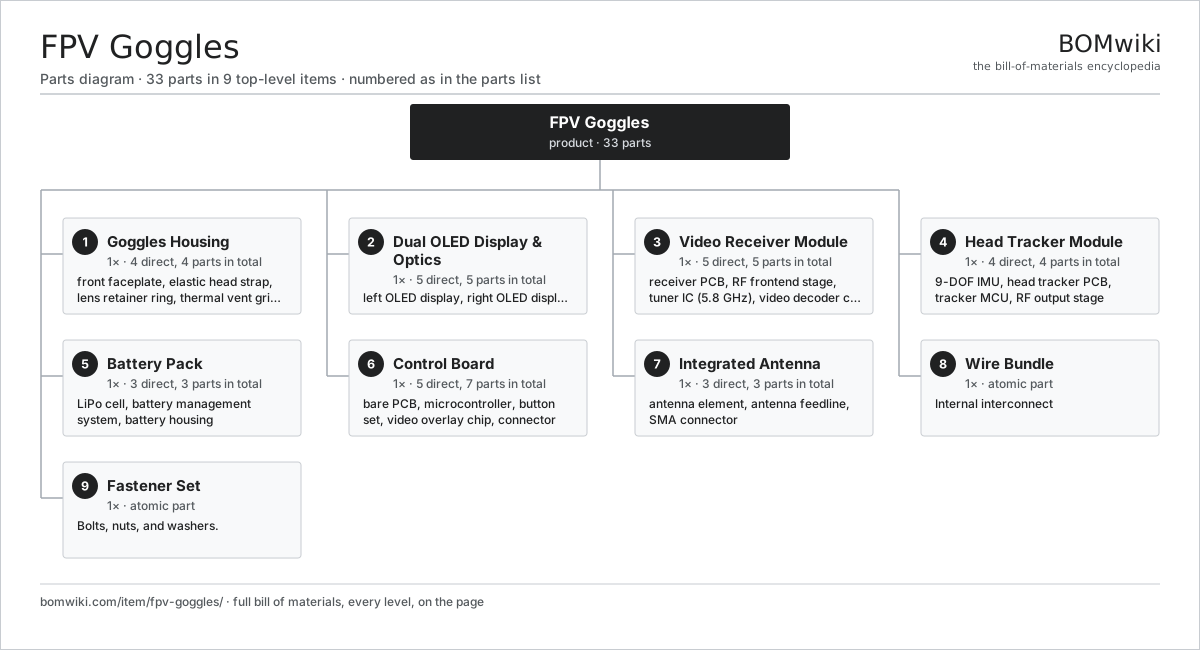
| # | Part | Qty | What it does |
|---|---|---|---|
| 1 | Goggles Housing 4 parts | 1× | Plastic head-mounted shell that holds display modules and optics. |
| 2 | Dual OLED Display & Optics 5 parts | 1× | Two miniature OLED screens and precision optics that magnify the image to fill the pilot's field of view. |
| 3 | Video Receiver Module 5 parts | 1× | RF receiver that demodulates 5.8 GHz video signal from the drone and pipes decoded video to the display. |
| 4 | Head Tracker Module 4 parts | 1× | Inertial measurement unit that senses head rotation for drone camera pan/tilt control. |
| 5 | Battery Pack 3 parts | 1× | High-discharge LiPo cell and protection board delivering sustained current for receiver and displays. |
| 6 | Control Board 5 parts | 1× | Main logic board managing menu navigation, channel selection, and video display formatting. |
| 7 | Integrated Antenna 3 parts | 1× | Tuned 5.8 GHz dipole array for omnidirectional RF reception. |
| 8 | Wire Bundle | 1× | Internal interconnect |
| 9 | Fastener Set | 1× | Bolts, nuts, and washers. |
3D model
No 3D model yet. Have a CAD file of this? Add a 3D model. STL renders right on this page; STEP, FreeCAD, and OpenSCAD sources are welcome too (openly licensed, like all 3D models on BOMwiki).
Build & assembly graph
expand / collapse · shared sub-assemblies converge · links to related products · est. labourTap an assembly to expand/collapse · tap a part to open it · use “Open page” for any node · drag to pan, scroll to zoom.
Bill of materials for FPV Goggles
9 top-level lines · 38 rows shown · 33 parts total · indented to 3 levels| # | Item / sub-assembly | Part no. | Qty/assy | Ext. qty | Parts | Type |
|---|---|---|---|---|---|---|
| 1 | Goggles Housing 4 parts | fpv-goggles-housing | 1× | 1 | 4 | assembly |
| 1.1 | Front Faceplate | fpv-goggles-faceplate | 1× | 1 | · | part |
| 1.2 | Elastic Head Strap | fpv-goggles-head-band | 1× | 1 | · | part |
| 1.3 | Lens Retainer Ring | fpv-goggles-lens-retainer | 1× | 1 | · | part |
| 1.4 | Thermal Vent Grille | fpv-goggles-vent-grille | 1× | 1 | · | part |
| 2 | Dual OLED Display & Optics 5 parts | fpv-goggles-display-optics | 1× | 1 | 5 | assembly |
| 2.1 | Left OLED Display | fpv-goggles-oled-left | 1× | 1 | · | part |
| 2.2 | Right OLED Display | fpv-goggles-oled-right | 1× | 1 | · | part |
| 2.3 | Left Fresnel Lens | fpv-goggles-fresnel-lens-left | 1× | 1 | · | part |
| 2.4 | Right Fresnel Lens | fpv-goggles-fresnel-lens-right | 1× | 1 | · | part |
| 2.5 | Diopter Focus Dial | fpv-goggles-focus-dial | 1× | 1 | · | part |
| 3 | Video Receiver Module 5 parts | fpv-goggles-video-receiver | 1× | 1 | 5 | assembly |
| 3.1 | Receiver PCB | fpv-goggles-receiver-pcb | 1× | 1 | · | part |
| 3.2 | RF Frontend Stage | fpv-goggles-rf-frontend | 1× | 1 | · | part |
| 3.3 | Tuner IC (5.8 GHz) | fpv-goggles-tuner-ic | 1× | 1 | · | part |
| 3.4 | Video Decoder Chip | fpv-goggles-video-decoder | 1× | 1 | · | part |
| 3.5 | Power Regulator | fpv-goggles-power-regulator | 1× | 1 | · | part |
| 4 | Head Tracker Module 4 parts | fpv-goggles-head-tracker | 1× | 1 | 4 | assembly |
| 4.1 | 9-DOF IMU | fpv-goggles-imu-sensor | 1× | 1 | · | part |
| 4.2 | Head Tracker PCB | fpv-goggles-tracker-pcb | 1× | 1 | · | part |
| 4.3 | Tracker MCU | fpv-goggles-tracker-mcu | 1× | 1 | · | part |
| 4.4 | RF Output Stage | fpv-goggles-rf-output-stage | 1× | 1 | · | part |
| 5 | Battery Pack 3 parts | fpv-goggles-battery-pack | 1× | 1 | 3 | assembly |
| 5.1 | LiPo Cell | lipo-cell | 1× | 1 | · | part |
| 5.2 | Battery Management System | fpv-goggles-bms | 1× | 1 | · | part |
| 5.3 | Battery Housing | fpv-goggles-battery-case | 1× | 1 | · | part |
| 6 | Control Board 5 parts | fpv-goggles-control-board | 1× | 1 | 7 | assembly |
| 6.1 | Bare PCB | pcb-bare | 1× | 1 | · | part |
| 6.2 | Microcontroller | mcu | 1× | 1 | · | part |
| 6.3 | Button Set | fpv-goggles-button-set | 1× | 1 | · | part |
| 6.4 | Video Overlay Chip | fpv-goggles-menu-ic | 1× | 1 | · | part |
| 6.5 | Connector | connector | 3× | 3 | · | part |
| 7 | Integrated Antenna 3 parts | fpv-goggles-antenna | 1× | 1 | 3 | assembly |
| 7.1 | Antenna Element | fpv-goggles-antenna-element | 1× | 1 | · | part |
| 7.2 | Antenna Feedline | fpv-goggles-antenna-cable | 1× | 1 | · | part |
| 7.3 | SMA Connector | fpv-goggles-antenna-connector | 1× | 1 | · | part |
| 8 | Wire Bundle | wire-bundle | 1× | 1 | · | part |
| 9 | Fastener Set | fastener-set | 1× | 1 | · | part |
Something wrong in this list? Report a problem with this BOM.
Related products
same domain, ranked by shared parts Bone Conduction Headphones
34 parts · shares 2 with this page
Bone Conduction Headphones
34 parts · shares 2 with this page
 Digital Audio Player
267 parts · shares 2 with this page
Digital Audio Player
267 parts · shares 2 with this page
 Electric Arc Lighter
113 parts · shares 2 with this page
Electric Arc Lighter
113 parts · shares 2 with this page
 Game Console
114 parts · shares 2 with this page
Game Console
114 parts · shares 2 with this page
 GPS Tracker
225 parts · shares 2 with this page
GPS Tracker
225 parts · shares 2 with this page
 Noise-Cancelling Headphones
165 parts · shares 2 with this page
Noise-Cancelling Headphones
165 parts · shares 2 with this page
Sourcing: possible vendors
Browse the supplier directory → Prices, MOQ, and lead times are algorithmic estimates, not quotes, and not claims about these companies. Company mappings are curated by keyword; est. price band $50–$2k. How estimates work| Vendor | HQ | Specialty | MOQ | Lead time |
|---|---|---|---|---|
|
🇨🇳Foxconn
foxconn.com ↗
|
Shenzhen, CN | Electronics contract mfg | 1,000 units | 8–14 wks |
|
🇺🇸Jabil
jabil.com ↗
|
St. Petersburg, US | Electronics manufacturing | 1,000 units | 8–14 wks |
|
🇺🇸Flex
flex.com ↗
|
Austin, US | Electronics manufacturing | 1,000 units | 8–14 wks |
| celestica.com ↗ | Toronto, CA | Electronics manufacturing | 1,000 units | 8–14 wks |
|
🇺🇸Sanmina
sanmina.com ↗
|
San Jose, US | Electronics manufacturing | 1,000 units | 8–14 wks |
899-word article