GPS Tracker
ProductOverview
A GPS tracker is a portable navigation device that logs its position using the Global Positioning System (or other satellite systems) and transmits it to a cloud server via cellular network, enabling users to monitor the location of vehicles, assets, or people in near real-time. This device combines a GNSS Receiver (which receives signals from orbiting satellites), a Cellular Modem (which sends position updates via LTE or 2G), and an Inertial Measurement Unit (which detects motion and impacts). The Sealed Case is potted in epoxy resin to survive harsh environments (rain, vibration, temperature extremes), and the Rechargeable Battery provides multi-day autonomy without external power.
How it works
The GNSS Receiver is a specialized receiver tuned to the weak signals broadcast by GPS, GLONASS, Galileo, and BeiDou satellites (1575 MHz, −125 dBm or weaker). The GPS Antenna is a multi-band patch antenna that efficiently captures these signals. The receiver correlates the incoming signals against locally generated replicas, extracting the satellite ephemeris (position) and clock offset. By receiving at least four satellites, the GNSS SoC IC solves a system of nonlinear equations to triangulate the tracker's position to within 2–10 meters.
Because cold-starting a position (TTFF, time to first fix) takes 30–45 seconds, the GNSS Receiver stores a copy of the satellite ephemeris in GNSS Aiding Flash for faster warm starts (5–10 seconds) on subsequent power-ups. This "aiding" technique is crucial for energy efficiency; a full cold start every minute would drain the battery in hours.
Once a position is obtained, the Control PCB sends it to the Cellular Modem, which opens a connection to the cellular network (using the Cellular Antenna and SIM card in the SIM Card Holder). The modem transmits the coordinates and timestamp to a cloud server via HTTP or MQTT. The entire process (GNSS fix + cellular transmission) typically takes 60–90 seconds and consumes 500–1000 mA, draining the battery noticeably if repeated every minute.
To extend battery life, the tracker uses intelligent scheduling:
- On initial power-up, it acquires a fix every 1–5 minutes.
- If the Inertial Measurement Unit (accelerometer) detects motion, it continues frequent updates (5–10 min intervals).
- If stationary, it backs off to hourly or even daily updates.
- If an impact is detected (high acceleration), it immediately acquires a fix and uploads.
This adaptive mode can extend battery life from 2–3 days (at 5-minute intervals) to 2–3 weeks (at hourly intervals).
The Inertial Measurement Unit continuously monitors the 3-axis Accelerometer Sensor, which measures gravitational and dynamic acceleration. By integrating acceleration over time, simple algorithms can infer velocity and travel distance, detect hard braking or collisions, and even classify motion type (idle, moving, vibrating hard). These features are useful for fleet management (alert if a truck is driven recklessly) and asset recovery (alert if an idle vehicle is being towed).
The Rechargeable Battery is either rechargeable lithium-ion (requiring USB-C charging every 7–14 days in typical use) or a long-life primary cell (AA or 9V, lasting months or years at low duty cycle). Rechargeable is preferred for vehicles that return to a depot; primary cells are preferred for assets left in the field (shipping containers, trailers, valuable equipment).
Power distribution from the Rechargeable Battery flows through the Control PCB, which acts as a sequencer: it powers up the GNSS Receiver, waits for a fix, powers up the Cellular Modem, transmits, and returns everything to sleep, all in software-controlled cycles.
Design rationale
Multi-constellation GNSS (GPS + GLONASS + Galileo) is essential for urban and canyon environments. GPS alone can be obstructed by buildings; adding GLONASS increases satellite availability by 30–50%, and Galileo adds more. With 20+ satellites visible at any moment (combined), position accuracy improves and cold-start time drops.
Cellular over WiFi is chosen because:
- Cellular coverage is available almost everywhere (cities, rural areas, highways).
- WiFi requires scanning and association (seconds), burning battery.
- Cellular networks tolerate high latency (100+ ms is fine for position uploads).
- No dependency on home/office WiFi; the device works immediately.
LTE-M over full LTE is chosen because LTE-M consumes 10× less power for equivalent data rates and works in areas where full LTE coverage is spotty (rural edges). 2G GSM is used as a fallback in regions where LTE-M is unavailable.
Epoxy potting (rather than conformal coating) is chosen for harsh environments: potting fully encapsulates the PCB, protecting against moisture, salt spray, vibration-induced solder cracks, and component movement.
Adaptive update intervals based on motion detection reduce false battery drainage: a stationary asset (parked car, shipping container) can update once daily and last weeks on a charge, while an active vehicle updates every few minutes and drains faster but still achieves multi-day battery life.
SIM card slot allows end-users to swap carriers or roaming plans without reflashing firmware, useful for international deployment.
GPS Tracker parts and their functions
11 top-level parts · 225 parts in total · full bill of materials below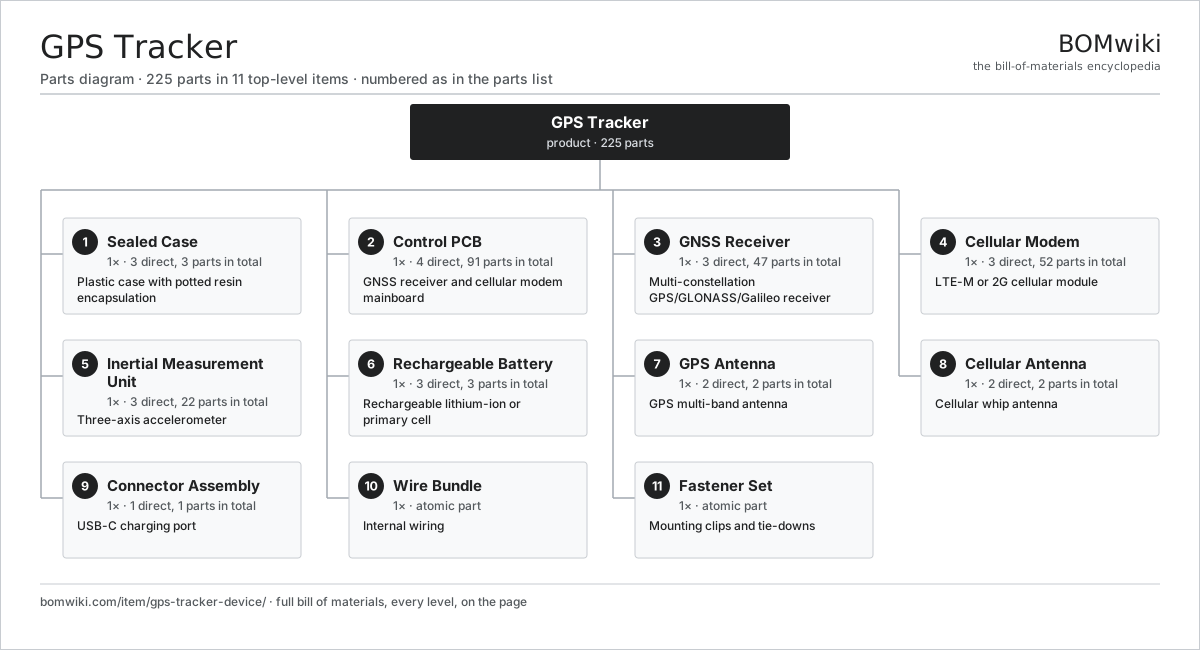
| # | Part | Qty | What it does |
|---|---|---|---|
| 1 | Sealed Case 3 parts | 1× | Plastic case with potted resin encapsulation |
| 2 | Control PCB 4 parts | 1× | GNSS receiver and cellular modem mainboard |
| 3 | GNSS Receiver 3 parts | 1× | Multi-constellation GPS/GLONASS/Galileo receiver |
| 4 | Cellular Modem 3 parts | 1× | LTE-M or 2G cellular module |
| 5 | Inertial Measurement Unit 3 parts | 1× | Three-axis accelerometer |
| 6 | Rechargeable Battery 3 parts | 1× | Rechargeable lithium-ion or primary cell |
| 7 | GPS Antenna 2 parts | 1× | GPS multi-band antenna |
| 8 | Cellular Antenna 2 parts | 1× | Cellular whip antenna |
| 9 | Connector Assembly 1 parts | 1× | USB-C charging port |
| 10 | Wire Bundle | 1× | Internal wiring |
| 11 | Fastener Set | 1× | Mounting clips and tie-downs |
3D model
No 3D model yet. Have a CAD file of this? Add a 3D model. STL renders right on this page; STEP, FreeCAD, and OpenSCAD sources are welcome too (openly licensed, like all 3D models on BOMwiki).
Build & assembly graph
expand / collapse · shared sub-assemblies converge · links to related products · est. labourTap an assembly to expand/collapse · tap a part to open it · use “Open page” for any node · drag to pan, scroll to zoom.
Bill of materials for GPS Tracker
11 top-level lines · 35 rows shown · 225 parts total · indented to 3 levels| # | Item / sub-assembly | Part no. | Qty/assy | Ext. qty | Parts | Type |
|---|---|---|---|---|---|---|
| 1 | Sealed Case 3 parts | gps-tracker-housing | 1× | 1 | 3 | assembly |
| 1.1 | Plastic Case Shell | gps-tracker-case-shell | 1× | 1 | · | part |
| 1.2 | Epoxy Potting Compound | gps-tracker-potting-resin | 1× | 1 | · | part |
| 1.3 | Cable Entry Gland | gps-tracker-cable-entry | 1× | 1 | · | part |
| 2 | Control PCB 4 parts | gps-tracker-main-pcb | 1× | 1 | 91 | assembly |
| 2.1 | Bare PCB | pcb-bare | 1× | 1 | · | part |
| 2.2 | Microcontroller | mcu | 1× | 1 | · | part |
| 2.3 | SMD Passive (R/C/L) | smd-passives | 85× | 85 | · | part |
| 2.4 | Connector | connector | 4× | 4 | · | part |
| 3 | GNSS Receiver 3 parts | gps-tracker-gnss-module | 1× | 1 | 47 | assembly |
| 3.1 | GNSS SoC IC | gps-tracker-gnss-chip | 1× | 1 | · | part |
| 3.2 | GNSS Aiding Flash | gps-tracker-gnss-flash | 1× | 1 | · | part |
| 3.3 | SMD Passive (R/C/L) | smd-passives | 45× | 45 | · | part |
| 4 | Cellular Modem 3 parts | gps-tracker-cellular-modem | 1× | 1 | 52 | assembly |
| 4.1 | Compute SoC Module | soc-module | 1× | 1 | · | part |
| 4.2 | SIM Card Holder | gps-tracker-sim-holder | 1× | 1 | · | part |
| 4.3 | SMD Passive (R/C/L) | smd-passives | 50× | 50 | · | part |
| 5 | Inertial Measurement Unit 3 parts | gps-tracker-imu | 1× | 1 | 22 | assembly |
| 5.1 | Accelerometer Sensor | gps-tracker-accelerometer | 1× | 1 | · | part |
| 5.2 | IMU Low-Pass Filter | gps-tracker-imu-filter | 1× | 1 | · | part |
| 5.3 | SMD Passive (R/C/L) | smd-passives | 20× | 20 | · | part |
| 6 | Rechargeable Battery 3 parts | gps-tracker-battery | 1× | 1 | 3 | assembly |
| 6.1 | LiPo Cell | lipo-cell | 1× | 1 | · | part |
| 6.2 | BMS Board | bms-board | 1× | 1 | · | part |
| 6.3 | Thermal Fuse | thermal-fuse | 1× | 1 | · | part |
| 7 | GPS Antenna 2 parts | gps-tracker-antenna-gnss | 1× | 1 | 2 | assembly |
| 7.1 | Antenna Element | gps-tracker-antenna-element | 1× | 1 | · | part |
| 7.2 | Antenna SMA Connector | gps-tracker-antenna-connector | 1× | 1 | · | part |
| 8 | Cellular Antenna 2 parts | gps-tracker-antenna-cellular | 1× | 1 | 2 | assembly |
| 8.1 | Cellular Whip Element | gps-tracker-cellular-antenna-element | 1× | 1 | · | part |
| 8.2 | Fastener Set | fastener-set | 1× | 1 | · | part |
| 9 | Connector Assembly 1 parts | gps-tracker-connectors | 1× | 1 | 1 | assembly |
| 9.1 | Connector | connector | 1× | 1 | · | part |
| 10 | Wire Bundle | wire-bundle | 1× | 1 | · | part |
| 11 | Fastener Set | fastener-set | 1× | 1 | · | part |
Something wrong in this list? Report a problem with this BOM.
Related products
same domain, ranked by shared parts Digital Audio Player
267 parts · shares 5 with this page
Digital Audio Player
267 parts · shares 5 with this page
 Noise-Cancelling Headphones
165 parts · shares 5 with this page
Pocket Translator Device
289 parts · shares 5 with this page
Noise-Cancelling Headphones
165 parts · shares 5 with this page
Pocket Translator Device
289 parts · shares 5 with this page
 Walkie-Talkie (PMR Radio)
272 parts · shares 3 with this page
Walkie-Talkie (PMR Radio)
272 parts · shares 3 with this page
 Satellite Phone
372 parts · shares 3 with this page
Satellite Phone
372 parts · shares 3 with this page
 Game Console
114 parts · shares 4 with this page
Game Console
114 parts · shares 4 with this page
Sourcing: possible vendors
Browse the supplier directory → Prices, MOQ, and lead times are algorithmic estimates, not quotes, and not claims about these companies. Company mappings are curated by keyword; est. price band $50–$2k. How estimates work| Vendor | HQ | Specialty | MOQ | Lead time |
|---|---|---|---|---|
|
🇨🇳Foxconn
foxconn.com ↗
|
Shenzhen, CN | Electronics contract mfg | 1,000 units | 8–14 wks |
|
🇺🇸Jabil
jabil.com ↗
|
St. Petersburg, US | Electronics manufacturing | 1,000 units | 8–14 wks |
|
🇺🇸Flex
flex.com ↗
|
Austin, US | Electronics manufacturing | 1,000 units | 8–14 wks |
| celestica.com ↗ | Toronto, CA | Electronics manufacturing | 1,000 units | 8–14 wks |
|
🇺🇸Sanmina
sanmina.com ↗
|
San Jose, US | Electronics manufacturing | 1,000 units | 8–14 wks |
855-word article