Handheld Anemometer
ProductOverview
A handheld anemometer measures wind speed at a single point in space. Unlike stationary weather station anemometers (which sit on rooftops for continuous monitoring), a portable anemometer is held in the hand and points at the wind source. Environmental consultants, HVAC technicians, and meteorologists use them to assess ventilation adequacy, wind loading on structures, and local weather patterns.
The device is dominated by the Rotor Assembly: three polystyrene cups on a Rotor Axle rotating around a low-friction Ball Bearing. Wind pushes the cups, spinning the rotor at a speed proportional to wind velocity. A Neodymium Magnet attached to the rotor passes by a Reed Switch once per revolution, generating a pulse. The Main Board MCU counts these pulses per second, applies a calibration factor (e.g., 0.5 m/s per pulse), and displays the wind speed on the Display Module. A Temperature Sensor measures air temperature, allowing the MCU to compute wind chill. The Data Logger records wind speed and temperature at user-selectable intervals (1–60 seconds), storing up to 10,000 samples for later playback or download.
The entire assembly fits in an ergonomic Housing Assembly (trigger-grip style) powered by two or four AA batteries for 30–50 hours of runtime.
How it works
As wind blows against the cups, each experiences a drag force. Because the cups are mounted asymmetrically (one side cups face the oncoming wind, the other side presents their concave backs), the net torque drives the Rotor Assembly clockwise or counterclockwise depending on wind direction. Cup anemometers are relatively omnidirectional: they measure wind speed regardless of the approach angle (unlike vane anemometers, which require precise alignment).
The rotor speed stabilizes quickly (within seconds of wind gust arrival) because cup drag produces viscous damping. Once steady, the rotation frequency is nearly proportional to wind speed across a wide range (0.4–30 m/s for this device).
The Neodymium Magnet embedded in the rotor hub passes by the Reed Switch (a magnetically activated electrical switch) once per revolution. Each pass closes the switch for a millisecond, generating a pulse. The Main Board MCU counts pulses in a fixed time window (e.g., 1 second), yielding revolutions per second (Hz). A calibration factor, typically provided by the manufacturer and stored in the MCU firmware, converts Hz to m/s:
wind speed (m/s) = pulses per second × calibration factor
For a typical 65 mm three-cup anemometer, the factor is ~0.4–0.5 m/s per Hz. The MCU displays the result on the Display Module in user-selectable units (m/s, km/h, mph, knots).
Simultaneously, the Thermistor Element measures the ambient air temperature via its resistance change. The MCU applies a Steinhart-Hart equation (a three-parameter fit) to convert resistance to temperature (−10 to +60 °C range, ±1 °C accuracy). Wind chill is computed from a standard formula: WC = 13.12 + 0.6215T − 11.37(V^0.16) + 0.3965T(V^0.16), where T is temperature (°C) and V is wind speed (km/h).
Every measurement cycle, the MCU updates the Display Module and records a timestamped entry to the Flash Memory IC. The memory logger stores up to 10,000 records (1 second × 10,000 = 2.8 hours at 1-second intervals, or 10,000 × 60 = 167 hours at 60-second intervals). Users can review max/min wind speed and time-stamped trends on the device itself, or download the log for analysis in a spreadsheet.
The Power System and Battery Pack are sized for 30–50 hours of continuous operation. At idle (display on, rotor still), the MCU consumes ~5 mA. During active measurement (rotor spinning, display updating, data logging), peak current rises to ~20–30 mA for brief LCD refresh bursts. This permits field use for multiple days on a fresh set of alkaline cells.
Handheld Anemometer parts and their functions
10 top-level parts · 141 parts in total · full bill of materials below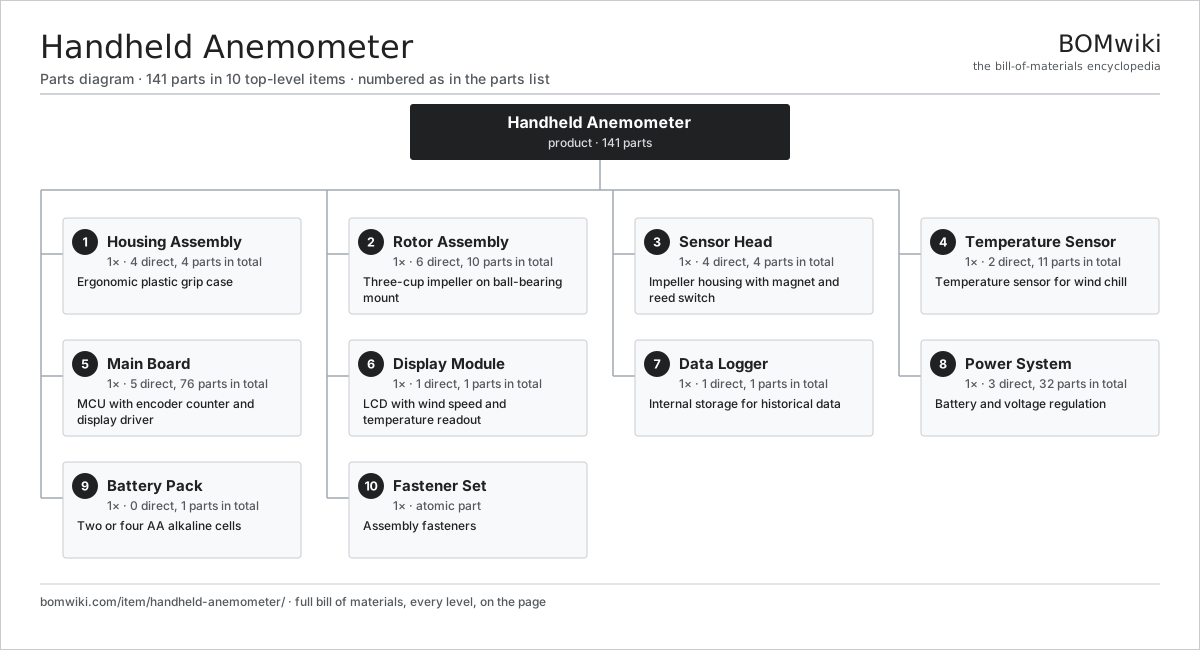
| # | Part | Qty | What it does |
|---|---|---|---|
| 1 | Housing Assembly 4 parts | 1× | Ergonomic plastic grip case |
| 2 | Rotor Assembly 6 parts | 1× | Three-cup impeller on ball-bearing mount |
| 3 | Sensor Head 4 parts | 1× | Impeller housing with magnet and reed switch |
| 4 | Temperature Sensor 2 parts | 1× | Temperature sensor for wind chill |
| 5 | Main Board 5 parts | 1× | MCU with encoder counter and display driver |
| 6 | Display Module 1 parts | 1× | LCD with wind speed and temperature readout |
| 7 | Data Logger 1 parts | 1× | Internal storage for historical data |
| 8 | Power System 3 parts | 1× | Battery and voltage regulation |
| 9 | Battery Pack | 1× | Two or four AA alkaline cells |
| 10 | Fastener Set | 1× | Assembly fasteners |
3D model
No 3D model yet. Have a CAD file of this? Add a 3D model. STL renders right on this page; STEP, FreeCAD, and OpenSCAD sources are welcome too (openly licensed, like all 3D models on BOMwiki).
Build & assembly graph
expand / collapse · shared sub-assemblies converge · links to related products · est. labourTap an assembly to expand/collapse · tap a part to open it · use “Open page” for any node · drag to pan, scroll to zoom.
Bill of materials for Handheld Anemometer
10 top-level lines · 36 rows shown · 141 parts total · indented to 3 levels| # | Item / sub-assembly | Part no. | Qty/assy | Ext. qty | Parts | Type |
|---|---|---|---|---|---|---|
| 1 | Housing Assembly 4 parts | handheld-anemometer-housing | 1× | 1 | 4 | assembly |
| 1.1 | Grip Upper | handheld-anemometer-grip-upper | 1× | 1 | · | part |
| 1.2 | Grip Lower | handheld-anemometer-grip-lower | 1× | 1 | · | part |
| 1.3 | Display Protector | handheld-anemometer-display-cover | 1× | 1 | · | part |
| 1.4 | Fastener Set | fastener-set | 1× | 1 | · | part |
| 2 | Rotor Assembly 6 parts | handheld-anemometer-rotor-assembly | 1× | 1 | 10 | assembly |
| 2.1 | Cup | handheld-anemometer-cup | 3× | 3 | · | part |
| 2.2 | Rotor Arm | handheld-anemometer-arm | 3× | 3 | · | part |
| 2.3 | Rotor Axle | handheld-anemometer-axle | 1× | 1 | · | part |
| 2.4 | Ball Bearing | ball-bearing | 1× | 1 | · | part |
| 2.5 | Rotor Hub | handheld-anemometer-rotor-hub | 1× | 1 | · | part |
| 2.6 | Fastener Set | fastener-set | 1× | 1 | · | part |
| 3 | Sensor Head 4 parts | handheld-anemometer-sensor-head | 1× | 1 | 4 | assembly |
| 3.1 | Sensor Housing | handheld-anemometer-head-housing | 1× | 1 | · | part |
| 3.2 | Neodymium Magnet | neodymium-magnet | 1× | 1 | · | part |
| 3.3 | Reed Switch | handheld-anemometer-reed-switch | 1× | 1 | · | part |
| 3.4 | Wind Vane | handheld-anemometer-wind-vane | 1× | 1 | · | part |
| 4 | Temperature Sensor 2 parts | handheld-anemometer-thermistor | 1× | 1 | 11 | assembly |
| 4.1 | Thermistor Element | handheld-anemometer-thermistor-element | 1× | 1 | · | part |
| 4.2 | SMD Passive (R/C/L) | smd-passives | 10× | 10 | · | part |
| 5 | Main Board 5 parts | handheld-anemometer-main-board | 1× | 1 | 76 | assembly |
| 5.1 | Bare PCB | pcb-bare | 1× | 1 | · | part |
| 5.2 | Microcontroller | mcu | 1× | 1 | · | part |
| 5.3 | Counter IC | handheld-anemometer-counter-ic | 1× | 1 | · | part |
| 5.4 | SMD Passive (R/C/L) | smd-passives | 70× | 70 | · | part |
| 5.5 | Connector | connector | 3× | 3 | · | part |
| 6 | Display Module 1 parts | handheld-anemometer-display | 1× | 1 | 1 | assembly |
| 6.1 | LCD Panel | lcd-panel | 1× | 1 | · | part |
| 7 | Data Logger 1 parts | handheld-anemometer-data-logger | 1× | 1 | 1 | assembly |
| 7.1 | Flash Memory IC | handheld-anemometer-flash-ic | 1× | 1 | · | part |
| 8 | Power System 3 parts | handheld-anemometer-power-system | 1× | 1 | 32 | assembly |
| 8.1 | Battery Holder | handheld-anemometer-battery-holder | 1× | 1 | · | part |
| 8.2 | Power Supply | power-supply | 1× | 1 | · | part |
| 8.3 | SMD Passive (R/C/L) | smd-passives | 30× | 30 | · | part |
| 9 | Battery Pack | handheld-anemometer-battery | 1× | 1 | 1 | assembly |
| 10 | Fastener Set | fastener-set | 1× | 1 | · | part |
Something wrong in this list? Report a problem with this BOM.
Related products
same domain, ranked by shared parts Game Console
114 parts · shares 2 with this page
Game Console
114 parts · shares 2 with this page
 Smart Speaker
379 parts · shares 2 with this page
Smart Speaker
379 parts · shares 2 with this page
 Smartwatch
269 parts · shares 2 with this page
Smartwatch
269 parts · shares 2 with this page
 Bluetooth Speaker
196 parts · shares 1 with this page
Bluetooth Speaker
196 parts · shares 1 with this page
 Wireless Charger
130 parts · shares 1 with this page
Wireless Earbuds
200 parts · shares 1 with this page
Wireless Charger
130 parts · shares 1 with this page
Wireless Earbuds
200 parts · shares 1 with this page
Sourcing: possible vendors
Browse the supplier directory → Prices, MOQ, and lead times are algorithmic estimates, not quotes, and not claims about these companies. Company mappings are curated by keyword; est. price band $50–$2k. How estimates work| Vendor | HQ | Specialty | MOQ | Lead time |
|---|---|---|---|---|
|
🇨🇳Foxconn
foxconn.com ↗
|
Shenzhen, CN | Electronics contract mfg | 1,000 units | 8–14 wks |
|
🇺🇸Jabil
jabil.com ↗
|
St. Petersburg, US | Electronics manufacturing | 1,000 units | 8–14 wks |
|
🇺🇸Flex
flex.com ↗
|
Austin, US | Electronics manufacturing | 1,000 units | 8–14 wks |
| celestica.com ↗ | Toronto, CA | Electronics manufacturing | 1,000 units | 8–14 wks |
|
🇺🇸Sanmina
sanmina.com ↗
|
San Jose, US | Electronics manufacturing | 1,000 units | 8–14 wks |
669-word article