LED Ticker Display
ProductOverview
LED ticker displays are long, narrow digital signs showing scrolling text, graphics, and animations. Common installations include:
- Stock tickers in financial offices and trading floors
- Traffic advisories on highways
- News crawls in airports and hotels
- Weather and temperature displays
- Promotional messages in retail storefronts
The display combines multiple full-color LED panel segments in a horizontal arrangement, driven by an ARM microcontroller that renders text from network feeds and animates it across the matrix at variable speed. Unlike billboard displays, tickers are designed for close viewing (within 10 meters) and show primarily text rather than photographic content.
How it works
The LED matrix is eight segments of 16×32 pixels arranged left-to-right, giving a total resolution of 128×32. The controller board receives text messages via RS-232, Ethernet, or RS-485 serial protocols. Each message includes font name, size, color, speed, and dwell time.
The microcontroller rasterizes incoming text using stored font bitmaps from NAND flash. It renders each character at the specified size (8, 12, 16, or 32 points) and color. The animation engine then scrolls the message from right edge to left edge at 1–10 pixels per frame, creating the familiar crawling effect.
Each frame is output to the LED panels at 1000 Hz refresh rate via daisy-chained shift registers. The controller distributes row data to all eight segments simultaneously using a demultiplexer, and the panel ICs handle local multiplexing (the 32 rows are scanned 30 times per second, too fast for flicker).
Data feeds
Feeds arrive over standard protocols:
- RS-232: Direct serial from a legacy server or terminal, 9600–115200 baud. Messages are framed with STX/ETX and include checksums.
- Ethernet: UDP or TCP from a modern CMS. The controller pulls updates every 10 seconds or receives push notifications.
- RS-485: Multidrop serial allowing up to 32 displays on a single twisted pair.
A real-time clock (RTC) with battery backup allows time-based scheduling, messages can be set to display only during business hours or between specific times.
Display features
Text can scroll at 1–30 pixels per second; typical speed is 5 px/s (25-character message takes 5 seconds to scroll). Multiple messages can queue and display in sequence with configurable dwell times (static display) and transition effects (wipe, fade, zoom).
Brightness is fixed at full output or can be modulated by ambient light (optional light sensor on controller). Outdoor tickers often run at reduced brightness at night to avoid glare.
Colors are full 24-bit RGB, allowing color gradients and highlighting (e.g., route numbers in yellow, status text in green). Custom bitmaps and small icons can be embedded in messages.
Physical design
The housing is a lightweight aluminum extrusion with integrated mounting slots. The front is a curved polycarbonate diffuser softening the individual LED pixels. At typical viewing distance (10+ meters), pixels blur together and text appears smooth. Closer viewing shows the pixel matrix.
The rear panel is steel for rigidity. All internal connectors are keyed to prevent polarity reversal. Power inlet is an IEC C13, standard on industrial equipment.
Cable routing is managed with spiral wrap and strain relief clamps. The display draws 120 W steadily and peaks at 180 W during full-white frames. Most installations are supplied from a dedicated 15 A circuit breaker.
Maintenance and updates
The controller accepts firmware updates via USB. New fonts can be uploaded to the NAND flash if storage permits. Individual LED panels are field-replaceable, connectors are quick-release, and swapping a panel takes 5 minutes.
LED brightness degrades at 5–10% per 50,000 hours. Panels typically last 7–10 years in continuous operation before replacement is cost-effective. Diffuser panels yellow slightly with UV exposure and can be replaced without opening the cabinet.
Installation
Tickers are typically ceiling-mounted in hallways or above trading floors, with cable runs to a nearby Ethernet switch or RS-232 serial port. Installation involves bolting the mounting arms to structural framing, running power and data cables, and tuning brightness and color settings via the web interface or serial console.
LED Ticker Display parts and their functions
6 top-level parts · 163 parts in total · full bill of materials below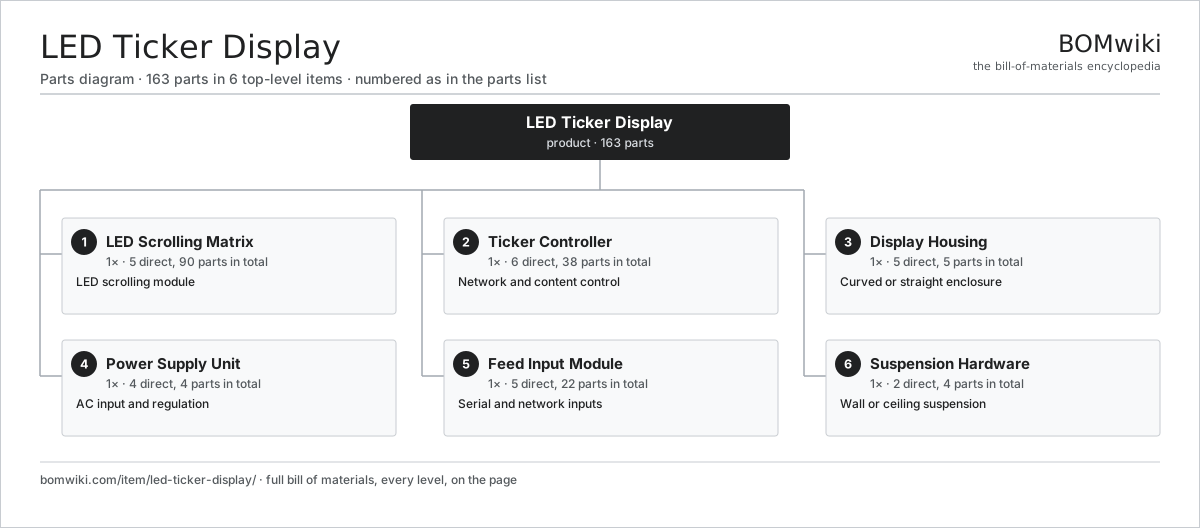
| # | Part | Qty | What it does |
|---|---|---|---|
| 1 | LED Scrolling Matrix 5 parts | 1× | LED scrolling module |
| 2 | Ticker Controller 6 parts | 1× | Network and content control |
| 3 | Display Housing 5 parts | 1× | Curved or straight enclosure |
| 4 | Power Supply Unit 4 parts | 1× | AC input and regulation |
| 5 | Feed Input Module 5 parts | 1× | Serial and network inputs |
| 6 | Suspension Hardware 2 parts | 1× | Wall or ceiling suspension |
3D model
No 3D model yet. Have a CAD file of this? Add a 3D model. STL renders right on this page; STEP, FreeCAD, and OpenSCAD sources are welcome too (openly licensed, like all 3D models on BOMwiki).
Build & assembly graph
expand / collapse · shared sub-assemblies converge · links to related products · est. labourTap an assembly to expand/collapse · tap a part to open it · use “Open page” for any node · drag to pan, scroll to zoom.
Bill of materials for LED Ticker Display
6 top-level lines · 33 rows shown · 163 parts total · indented to 3 levels| # | Item / sub-assembly | Part no. | Qty/assy | Ext. qty | Parts | Type |
|---|---|---|---|---|---|---|
| 1 | LED Scrolling Matrix 5 parts | led-ticker-display-pixel-matrix | 1× | 1 | 90 | assembly |
| 1.1 | LED Panel Segment | led-ticker-display-panel-segment | 8× | 8 | · | part |
| 1.2 | Data Distributor IC | led-ticker-display-data-distributor | 1× | 1 | · | part |
| 1.3 | Power Distribution Strip | led-ticker-display-power-connector-strip | 1× | 1 | · | part |
| 1.4 | Connector | connector | 16× | 16 | · | part |
| 1.5 | SMD Passive (R/C/L) | smd-passives | 64× | 64 | · | part |
| 2 | Ticker Controller 6 parts | led-ticker-display-controller-board | 1× | 1 | 38 | assembly |
| 2.1 | Microcontroller | mcu | 1× | 1 | · | part |
| 2.2 | Font Storage | led-ticker-display-font-flash | 1× | 1 | · | part |
| 2.3 | Real-Time Clock | led-ticker-display-rtc-module | 1× | 1 | · | part |
| 2.4 | Connector | connector | 2× | 2 | · | part |
| 2.5 | Bare PCB | pcb-bare | 1× | 1 | · | part |
| 2.6 | SMD Passive (R/C/L) | smd-passives | 32× | 32 | · | part |
| 3 | Display Housing 5 parts | led-ticker-display-housing-frame | 1× | 1 | 5 | assembly |
| 3.1 | Aluminum Profile | led-ticker-display-profile-extrusion | 1× | 1 | · | part |
| 3.2 | Front Diffuser | led-ticker-display-diffuser-panel | 1× | 1 | · | part |
| 3.3 | Rear Plate | led-ticker-display-rear-panel | 1× | 1 | · | part |
| 3.4 | Fastener Set | fastener-set | 1× | 1 | · | part |
| 3.5 | O-Ring Set | oring-set | 1× | 1 | · | part |
| 4 | Power Supply Unit 4 parts | led-ticker-display-power-supply | 1× | 1 | 4 | assembly |
| 4.1 | Power Supply | power-supply | 1× | 1 | · | part |
| 4.2 | 5V Buck Converter | led-ticker-display-5v-buck | 1× | 1 | · | part |
| 4.3 | AC Power Inlet | led-ticker-display-ac-inlet | 1× | 1 | · | part |
| 4.4 | Fastener Set | fastener-set | 1× | 1 | · | part |
| 5 | Feed Input Module 5 parts | led-ticker-display-feed-interface | 1× | 1 | 22 | assembly |
| 5.1 | Connector | connector | 3× | 3 | · | part |
| 5.2 | RS-232 Transceiver | led-ticker-display-rs232-driver | 1× | 1 | · | part |
| 5.3 | Ethernet PHY | led-ticker-display-ethernet-phy | 1× | 1 | · | part |
| 5.4 | Bare PCB | pcb-bare | 1× | 1 | · | part |
| 5.5 | SMD Passive (R/C/L) | smd-passives | 16× | 16 | · | part |
| 6 | Suspension Hardware 2 parts | led-ticker-display-mounting-rails | 1× | 1 | 4 | assembly |
| 6.1 | Mount Arm | led-ticker-display-rail-arm | 2× | 2 | · | part |
| 6.2 | Fastener Set | fastener-set | 2× | 2 | · | part |
Something wrong in this list? Report a problem with this BOM.
Related products
same domain, ranked by shared parts Digital Billboard
131 parts · shares 2 with this page
Digital Menu Board
60 parts · shares 2 with this page
Digital Billboard
131 parts · shares 2 with this page
Digital Menu Board
60 parts · shares 2 with this page
 Hobby Metal Detector
311 parts · shares 2 with this page
Holographic Fan Display
53 parts · shares 2 with this page
Hobby Metal Detector
311 parts · shares 2 with this page
Holographic Fan Display
53 parts · shares 2 with this page
 LED Curtain Display
356 parts · shares 2 with this page
LED Curtain Display
356 parts · shares 2 with this page
Sourcing: possible vendors
Browse the supplier directory → Prices, MOQ, and lead times are algorithmic estimates, not quotes, and not claims about these companies. Company mappings are curated by keyword; est. price band $50–$2k. How estimates work| Vendor | HQ | Specialty | MOQ | Lead time |
|---|---|---|---|---|
|
🇨🇳Foxconn
foxconn.com ↗
|
Shenzhen, CN | Electronics contract mfg | 1,000 units | 8–14 wks |
|
🇺🇸Jabil
jabil.com ↗
|
St. Petersburg, US | Electronics manufacturing | 1,000 units | 8–14 wks |
|
🇺🇸Flex
flex.com ↗
|
Austin, US | Electronics manufacturing | 1,000 units | 8–14 wks |
| celestica.com ↗ | Toronto, CA | Electronics manufacturing | 1,000 units | 8–14 wks |
|
🇺🇸Sanmina
sanmina.com ↗
|
San Jose, US | Electronics manufacturing | 1,000 units | 8–14 wks |
682-word article