Motorized Projection Screen
ProductOverview
Motorized projection screens are retractable displays designed for home theater and conference rooms where aesthetic concealment is desired. The screen retracts into a motor-driven roller tube mounted behind a casing, remaining hidden when not in use. On command via wall switch or remote control, the motor extends the screen downward, tensioning the fabric and presenting a flat, wrinkle-free display surface ready for projection. After use, the screen retracts back into the casing.
Unlike fixed screens that dominate visual space, motorized screens preserve interior aesthetics. They also protect the fabric from dust accumulation and UV degradation when retracted, extending screen life from 5 years (fixed) to 10+ years (motorized).
Motor and drive system architecture
The Tube Motor is typically a 50–150 W motor (120 V AC or 24 V DC) paired with a Gearbox providing 30:1 to 60:1 speed reduction. This yields an output of approximately 10–30 N·m (7–22 lbf·ft) of torque, sufficient to extend the screen against its own weight (typically 30–60 lbs for a 100" screen) and internal spring tension.
The motor is coupled to the Roller Tube via a Motor Coupling (flexible elastomer joint absorbing vibration and minor misalignment). The roller tube itself is a seamless aluminum 6061-T6 extrusion, 2"–3" outer diameter, carefully balanced to <0.05 gram imbalance. Any imbalance at full speed causes vibration transmitted through the mounting structure to walls and ceiling, creating audible noise (typically 50+ dB(A) for unbalanced tubes).
A Brake (spring-set, 10–20 N·m holding torque) engages when the motor de-energizes, holding the screen at any position during power loss. The brake is sized such that motor inrush current pulse energizes the solenoid for 2–3 seconds during acceleration, after which continuous motor current maintains release. If power is interrupted, the spring re-engages the brake within 100 ms, preventing drift.
Fabric assembly and tensioning
The Projection Fabric is typically a PVC or vinyl material with a reflectance gain of 1.0–1.5. Gain refers to the ratio of light reflected perpendicular to the screen surface compared to a perfect matte white diffuser. A 1.0 gain fabric reflects light equally in all directions (Lambertian). A 1.5 gain fabric concentrates light perpendicular to the surface, brightening the central viewing area but narrowing the usable viewing angle.
Fabric gain trade-offs:
- 1.0 gain (matte white): Uniform brightness across ~160° horizontal viewing angle, but lower peak brightness. Best for multi-viewer setups or bright room conditions.
- 1.3 gain: Slightly peaked brightness, ~140° usable angle. Common compromise for home theater.
- 1.5+ gain (grey or silver fabric): Peak brightness, ~100° usable angle. Best for dark theater rooms with centered seating.
The fabric is attached to the Roller Tube via adhesive or mechanical fastening along a full seam. As the tube rotates, the fabric winds and unwinds. Two Tension Spring (typically coil springs providing 20–50 lbs preload) are mounted at the fabric side edges. Reinforced Tension Tab tabs sewn or glued to the fabric bottom edges attach to these springs. As the screen extends, the springs pull downward on the bottom tabs, creating tension across the fabric width and preventing wrinkles or sagging.
When fully extended, the tension is approximately 30–50 lbs distributed across the fabric width. This is enough to keep the surface flat and smooth but not so high as to overstress the fabric seams (which typically have a break strength of 100+ lbs).
Roller tube design and bearing support
The Roller Tube is a seamless aluminum tube chosen for:
- Low mass: Minimizes motor load and enables faster extension (faster = more responsive).
- High stiffness: Prevents deflection under distributed fabric tension, avoiding non-uniform wrinkles.
- Thermal stability: Aluminum thermal coefficient is stable across typical room temperatures (65–80 °F), preventing expansion-induced binding.
The tube is supported by Tube Bearing at both ends (typically deep-groove ball bearings rated 40,000+ hours L10 life). Sealed bearings prevent dust ingress common in dusty theater rooms where projection systems operate continuously.
Dynamic balancing of the assembled tube + fabric rotor is performed during manufacturing. A residual imbalance of <0.05 grams is typical; anything larger produces audible vibration when the tube rotates. Balancing machines spin the rotor and measure imbalance via accelerometers, then shave weight from high points or add weight to low points.
Casing and structural mounting
The Casing is an aluminum extrusion or welded steel box, 4"–8" diameter, that conceals the rotating tube and motor. The casing is typically mounted horizontally above the screen projection area (ceiling mount) or, less commonly, horizontally to a wall (wall mount). The casing trim or Casing Trim provides a finished appearance, matching the interior décor (white, black, or silver powder coat typical).
The Bracket System secures the casing to structural members:
- Ceiling mount: Bolted to joists via a Joist Bracket. Ceiling mounting minimizes visible supports and is standard for home theater installations.
- Wall mount: Bolted to wall studs via a Wall Bracket. Less common but used in confined spaces.
Vibration Isolator elastomer pads (10–20 Hz natural frequency) decouple vibration from the structure, reducing audible transmission to ceiling/walls. Without isolation, motor vibration couples directly into the building envelope, radiating as audible noise (typically 50–60 dB(A) at 1 m).
Control electronics and limit detection
The Control Module uses a microcontroller to manage motor speed and direction, limit-switch detection, and safety interlocks. Control methods include:
- Hardwired wall switch: Up/Down buttons connected directly to relays. Simple, reliable, no wireless issues.
- RF remote (433 MHz): Wireless handheld control. Requires a RF Receiver module. Most common for consumer installations.
- Smart integration: Wi-Fi or Zigbee enabling app-based or voice-assistant control.
The Limit Switch Assembly assembly detects fully-extended and fully-retracted positions. A Switch Actuator (cam or lever on the motor output shaft) mechanically triggers the limit switches:
- Extended limit: Activated when the screen fabric bottom reaches full extension (2–3 feet below the casing). Motor stops automatically.
- Retracted limit: Activated when the tube has rotated sufficiently to wind the entire fabric onto the tube. Motor stops and the brake engages.
Dead-time logic prevents motor over-run: the microcontroller ignores extend commands when already extended, and retract commands when already retracted. Some premium systems include intermediate "stop" positions, allowing the user to pause the screen at custom heights.
Fabric gain and projection considerations
Screen gain directly affects projector brightness requirements. Using the standard 100 ANSI lumens as a reference:
- A 1.0 gain screen at 100 lumens input produces 100 lumens output perpendicular to the surface.
- A 1.5 gain screen at 100 lumens input produces 150 lumens output perpendicular (30% brighter central image), but ~75 lumens at 45° off-axis (narrower usable angle).
For a 120" diagonal screen in a dark 15' × 20' home theater, a 1.3–1.5 gain screen is optimal if the projector is mounted on-axis (center ceiling). For living-room projectors where viewing angles are wider (side seats), a 1.0 gain fabric is preferred.
Installation and setup
Installation involves:
- Framing and mounting: Secure casing to structural members (joists or studs) using lag bolts and vibration isolators. Casing must be level (within 1/4" over 12 ft) to prevent uneven fabric winding.
- Motor coupling: Connect motor output shaft to roller tube via flexible coupling. Ensure alignment to within 0.1" radial runout.
- Fabric attachment: Adhere or mechanically fasten fabric to tube seam. Ensure no wrinkles or buckling.
- Tensioning tab adjustment: Mount tension springs and tabs such that fabric is pre-tensioned (30–50 lbs) when fully extended. Adjustment is typically done by trial and error; over-tensioning causes fabric fraying at seams; under-tensioning causes sagging.
- Limit switch calibration: Adjust switch actuator position so extended and retracted limits are at desired heights.
- Electrical connection: Hardwire 120 V AC (or 24 V DC supply) to control module. Ensure proper grounding.
- Test cycle: Run screen through full extension/retraction cycles several times under no-load, then with fabric, to verify smooth operation and no binding.
Maintenance and lifespan
Annual:
- Inspect fabric for tears, stains, or discoloration. Clean with mild soap and soft cloth if needed.
- Check tension springs for signs of rust or fatigue (permanent set, reduced preload).
- Verify motor operates smoothly and extends/retracts in <60 seconds; slower cycles indicate motor wear or load increase (possibly buildup on tube).
- Test limit switches by triggering them manually while motor is off; listen for audible click.
Fabric lifespan: PVC fabric typically lasts 10–15 years if kept clean and in a non-smoking environment. UV exposure (from windows or projector heat) can degrade fabric, reducing life to 5–8 years. Smoke and dust accumulation can reduce reflectance gain by 10–20% over time.
Motor lifespan: Electric motors typically sustain 20,000+ operating hours before bearing wear becomes noticeable. For an average screen run-time of 30 min/day, 5 days/week, this corresponds to ~40 years. In reality, motor replacement is rarely needed; most screens are upgraded or retired for other reasons within 10–15 years.
Brake and spring replacement: The brake solenoid and return springs are wear items with 5,000–10,000 cycle lifespans. At 30 cycles/week, a brake might last 4–5 years before replacement ($100–200 parts).
Motorized Projection Screen parts and their functions
8 top-level parts · 45 parts in total · full bill of materials below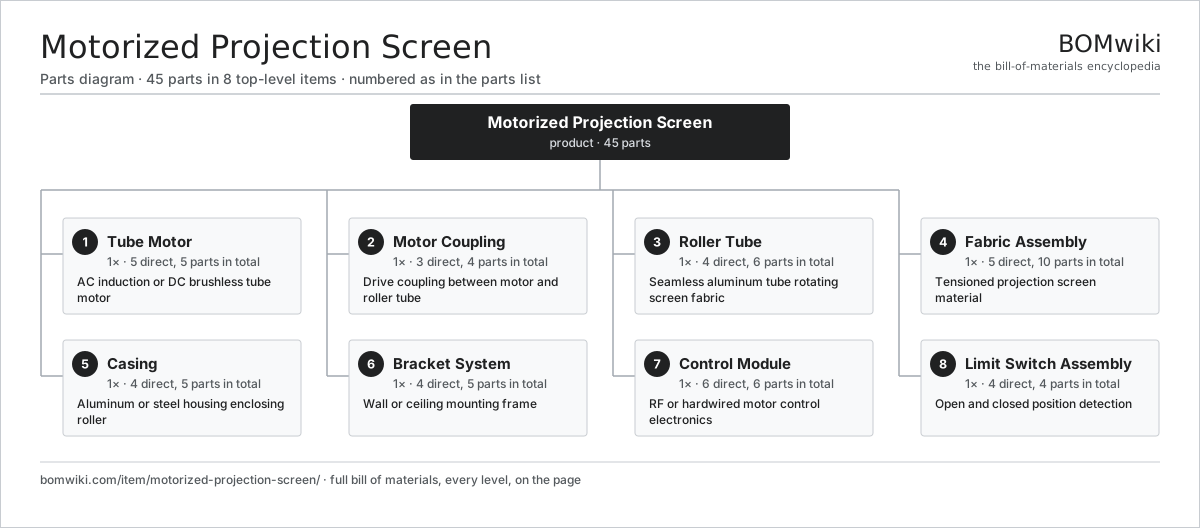
| # | Part | Qty | What it does |
|---|---|---|---|
| 1 | Tube Motor 5 parts | 1× | AC induction or DC brushless tube motor |
| 2 | Motor Coupling 3 parts | 1× | Drive coupling between motor and roller tube |
| 3 | Roller Tube 4 parts | 1× | Seamless aluminum tube rotating screen fabric |
| 4 | Fabric Assembly 5 parts | 1× | Tensioned projection screen material |
| 5 | Casing 4 parts | 1× | Aluminum or steel housing enclosing roller |
| 6 | Bracket System 4 parts | 1× | Wall or ceiling mounting frame |
| 7 | Control Module 6 parts | 1× | RF or hardwired motor control electronics |
| 8 | Limit Switch Assembly 4 parts | 1× | Open and closed position detection |
3D model
No 3D model yet. Have a CAD file of this? Add a 3D model. STL renders right on this page; STEP, FreeCAD, and OpenSCAD sources are welcome too (openly licensed, like all 3D models on BOMwiki).
Build & assembly graph
expand / collapse · shared sub-assemblies converge · links to related products · est. labourTap an assembly to expand/collapse · tap a part to open it · use “Open page” for any node · drag to pan, scroll to zoom.
Bill of materials for Motorized Projection Screen
8 top-level lines · 43 rows shown · 45 parts total · indented to 3 levels| # | Item / sub-assembly | Part no. | Qty/assy | Ext. qty | Parts | Type |
|---|---|---|---|---|---|---|
| 1 | Tube Motor 5 parts | motorized-projection-screen-tube-motor | 1× | 1 | 5 | assembly |
| 1.1 | Motor | motorized-projection-screen-motor | 1× | 1 | · | part |
| 1.2 | Gearbox | motorized-projection-screen-gearbox | 1× | 1 | · | part |
| 1.3 | Brake | motorized-projection-screen-brake | 1× | 1 | · | part |
| 1.4 | Motor Housing | motorized-projection-screen-motor-housing | 1× | 1 | · | part |
| 1.5 | Fastener Set | fastener-set | 1× | 1 | · | part |
| 2 | Motor Coupling 3 parts | motorized-projection-screen-motor-coupling | 1× | 1 | 4 | assembly |
| 2.1 | Coupling Hub | motorized-projection-screen-coupling-hub | 2× | 2 | · | part |
| 2.2 | Coupling Element | motorized-projection-screen-coupling-element | 1× | 1 | · | part |
| 2.3 | Fastener Set | fastener-set | 1× | 1 | · | part |
| 3 | Roller Tube 4 parts | motorized-projection-screen-roller-tube | 1× | 1 | 6 | assembly |
| 3.1 | Aluminum Tube | motorized-projection-screen-aluminum-tube | 1× | 1 | · | part |
| 3.2 | Tube Bearing | motorized-projection-screen-tube-bearing | 2× | 2 | · | part |
| 3.3 | Fabric Attachment | motorized-projection-screen-fabric-attachment | 1× | 1 | · | part |
| 3.4 | Tube End Cap | motorized-projection-screen-tube-end-cap | 2× | 2 | · | part |
| 4 | Fabric Assembly 5 parts | motorized-projection-screen-fabric-assembly | 1× | 1 | 10 | assembly |
| 4.1 | Projection Fabric | motorized-projection-screen-fabric | 1× | 1 | · | part |
| 4.2 | Tension Spring | motorized-projection-screen-tension-spring | 2× | 2 | · | part |
| 4.3 | Tension Tab | motorized-projection-screen-tension-tab | 4× | 4 | · | part |
| 4.4 | Edge Bracket | motorized-projection-screen-edge-bracket | 2× | 2 | · | part |
| 4.5 | Fastener Set | fastener-set | 1× | 1 | · | part |
| 5 | Casing 4 parts | motorized-projection-screen-casing | 1× | 1 | 5 | assembly |
| 5.1 | Casing Box | motorized-projection-screen-casing-box | 1× | 1 | · | part |
| 5.2 | Casing Trim | motorized-projection-screen-casing-trim | 1× | 1 | · | part |
| 5.3 | Casing End Cap | motorized-projection-screen-casing-end-cap | 2× | 2 | · | part |
| 5.4 | Fastener Set | fastener-set | 1× | 1 | · | part |
| 6 | Bracket System 4 parts | motorized-projection-screen-bracket-system | 1× | 1 | 5 | assembly |
| 6.1 | Wall Bracket | motorized-projection-screen-wall-bracket | 1× | 1 | · | part |
| 6.2 | Joist Bracket | motorized-projection-screen-joist-bracket | 1× | 1 | · | part |
| 6.3 | Vibration Isolator | motorized-projection-screen-vibration-isolator | 2× | 2 | · | part |
| 6.4 | Fastener Set | fastener-set | 1× | 1 | · | part |
| 7 | Control Module 6 parts | motorized-projection-screen-control-module | 1× | 1 | 6 | assembly |
| 7.1 | Microcontroller | mcu | 1× | 1 | · | part |
| 7.2 | Motor Driver | motorized-projection-screen-motor-driver | 1× | 1 | · | part |
| 7.3 | RF Receiver | motorized-projection-screen-rf-receiver | 1× | 1 | · | part |
| 7.4 | Bare PCB | pcb-bare | 1× | 1 | · | part |
| 7.5 | Wall Control | motorized-projection-screen-wall-control | 1× | 1 | · | part |
| 7.6 | Relay | relay | 1× | 1 | · | part |
| 8 | Limit Switch Assembly 4 parts | motorized-projection-screen-limit-switch | 1× | 1 | 4 | assembly |
| 8.1 | Switch Extended | motorized-projection-screen-switch-extended | 1× | 1 | · | part |
| 8.2 | Switch Retracted | motorized-projection-screen-switch-retracted | 1× | 1 | · | part |
| 8.3 | Switch Actuator | motorized-projection-screen-switch-actuator | 1× | 1 | · | part |
| 8.4 | Connector | connector | 1× | 1 | · | part |
Something wrong in this list? Report a problem with this BOM.
Related products
same domain, ranked by shared parts


Sourcing: possible vendors
Browse the supplier directory → Prices, MOQ, and lead times are algorithmic estimates, not quotes, and not claims about these companies. Company mappings are curated by keyword; est. price band $50–$3k. How estimates work| Vendor | HQ | Specialty | MOQ | Lead time |
|---|---|---|---|---|
|
🇯🇵Sony
sony.com ↗
|
Tokyo, JP | Consumer electronics | 1,000 units | 8–12 wks |
| samsung.com ↗ | Suwon, KR | Electronics & displays | 1,000 units | 8–12 wks |
|
🇺🇸Harman
harman.com ↗
|
Stamford, US | Audio (JBL, AKG) | 1,000 units | 8–12 wks |
|
🇺🇸Bose
bose.com ↗
|
Framingham, US | Audio | 1,000 units | 8–12 wks |
| yamaha.com ↗ | Hamamatsu, JP | Audio & instruments | 1,000 units | 8–12 wks |
1,625-word article