Satellite Phone
ProductOverview
A satellite phone bypasses terrestrial networks entirely: its radio link runs straight from the handset to a communication satellite, which relays the call down to a gateway earth station and into the public telephone network. Coverage is therefore defined by sky visibility rather than tower placement, mid-ocean, polar ice, and desert all work, while a building interior or deep canyon does not. Two architectures dominate. Low-earth-orbit constellations such as Iridium fly 66 satellites at 780 km, each visible for only a few minutes before the call hands off to the next; geostationary systems such as Inmarsat use a handful of satellites parked at 35 786 km, fixed in the sky but absent above roughly 70° latitude and with a noticeable ~270 ms one-way delay.
Both operate in L-band around 1.5–1.6 GHz, chosen because it penetrates rain and needs no precise dish pointing. The handset is organised around that link: the Satellite RF Front End closes it, the Baseband Processor Board runs the air interface and call logic, the Extendable Antenna Assembly gives the required sky-facing pattern, and the Display and Keypad, Audio Assembly, and Battery Pack make it usable as a phone.
The link budget problem
A handset transmitting a few watts must be heard by a receiver hundreds to tens of thousands of kilometres away, which makes every dB count. The Quadrifilar Helix Element is the first answer: a four-arm helix radiates circular polarisation in a broad pattern covering the upper hemisphere, so the phone works whether the satellite is overhead or near the horizon, and polarisation stays matched as the handset rotates. It must be extended and roughly vertical with open sky, the single most common cause of dropped satellite calls is a stowed or obstructed antenna. The Antenna Hinge Mechanism lets it deploy upright while the body sits at the ear, and the Antenna Coax Feed carries the signal through the joint.
On receive, the downlink arrives at around −150 dBm-class levels, so the Receive LNA sits as close to the antenna as possible behind the Duplexer Filter, setting the noise figure for the whole chain. On transmit, the Transmit PA Module produces burst peaks near 7 W within a TDMA time slot, average power is well under a watt, but the Power Management IC and battery must source ampere-scale pulses without sagging. The second answer to the budget is bandwidth frugality: the Vocoder DSP compresses speech to roughly 2.4 kbit/s with an AMBE-class vocoder, which is why satellite voice has its characteristic slightly synthetic timbre.
How a call proceeds
At power-on the phone reads its credentials from the SIM Card Holder, acquires a satellite, and registers; the GPS Receiver Module supplies position, used for routing, beam selection, and the dedicated SOS function. The TCXO Reference matters more than in a cellular phone: an Iridium satellite passes at 7.5 km/s, imposing Doppler shifts of tens of kHz that the L-Band Transceiver IC must track and pre-correct continuously. During a LEO call the link hands off between spot beams and between satellites every few minutes, invisibly when the sky is open.
Audio follows a conventional path, Microphone and Earpiece Receiver through the Audio Codec IC into the vocoder, and the Compute SoC Module on the baseband board runs the phonebook, SMS, and low-rate data services from Flash / RAM Memory.
Field engineering
These phones are bought for places where failure is expensive, so the mechanical design is closer to land-mobile radio than to a smartphone. The Front Housing and Rear Housing are glass-filled polymer over a stiff Internal Chassis Frame, sealed with an O-Ring Set and Sealed Port Covers to IP65, and rated for drops and −20 °C operation. The LCD Panel is transflective so it stays readable in direct sun, with a Display / Keypad Backlight for night use, and the Keypad Key Set uses large hard keys over a Keypad Dome Sheet for gloved operation. The two-cell Li-ion Cell, 18650 pack with its BMS Board delivers around five hours of talk time and is field-swappable, since recharging may be days away.
Satellite Phone parts and their functions
9 top-level parts · 372 parts in total · full bill of materials below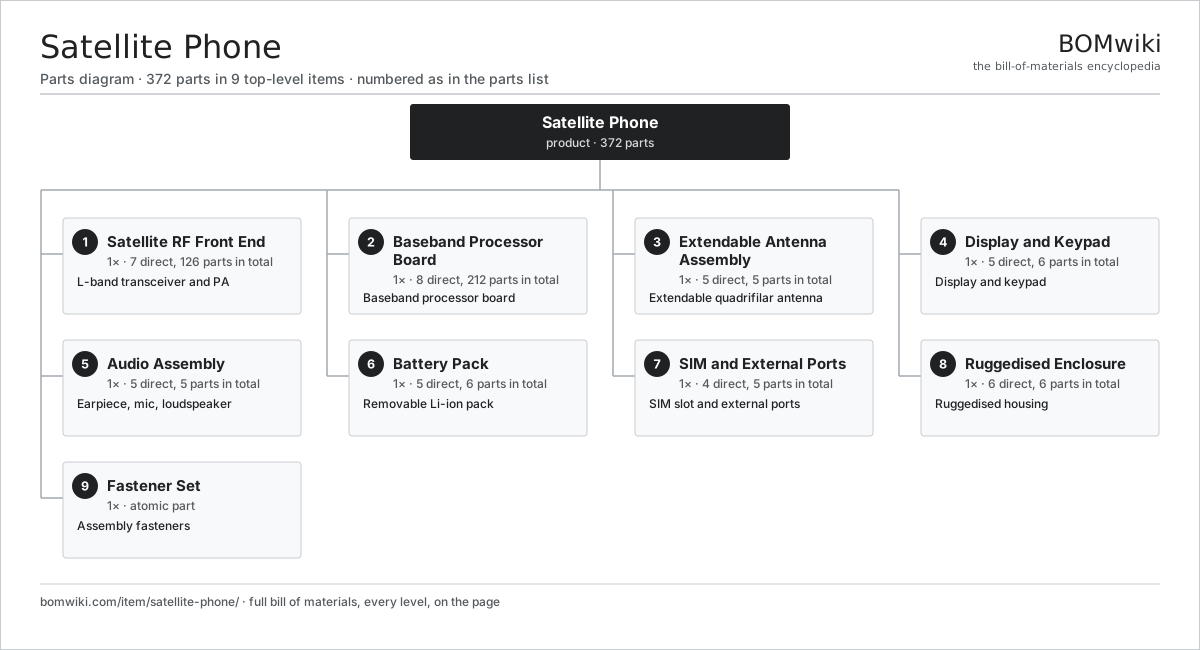
| # | Part | Qty | What it does |
|---|---|---|---|
| 1 | Satellite RF Front End 7 parts | 1× | L-band transceiver and PA |
| 2 | Baseband Processor Board 8 parts | 1× | Baseband processor board |
| 3 | Extendable Antenna Assembly 5 parts | 1× | Extendable quadrifilar antenna |
| 4 | Display and Keypad 5 parts | 1× | Display and keypad |
| 5 | Audio Assembly 5 parts | 1× | Earpiece, mic, loudspeaker |
| 6 | Battery Pack 5 parts | 1× | Removable Li-ion pack |
| 7 | SIM and External Ports 4 parts | 1× | SIM slot and external ports |
| 8 | Ruggedised Enclosure 6 parts | 1× | Ruggedised housing |
| 9 | Fastener Set | 1× | Assembly fasteners |
3D model
No 3D model yet. Have a CAD file of this? Add a 3D model. STL renders right on this page; STEP, FreeCAD, and OpenSCAD sources are welcome too (openly licensed, like all 3D models on BOMwiki).
Build & assembly graph
expand / collapse · shared sub-assemblies converge · links to related products · est. labourTap an assembly to expand/collapse · tap a part to open it · use “Open page” for any node · drag to pan, scroll to zoom.
Bill of materials for Satellite Phone
9 top-level lines · 54 rows shown · 372 parts total · indented to 3 levels| # | Item / sub-assembly | Part no. | Qty/assy | Ext. qty | Parts | Type |
|---|---|---|---|---|---|---|
| 1 | Satellite RF Front End 7 parts | satellite-phone-rf-front-end | 1× | 1 | 126 | assembly |
| 1.1 | L-Band Transceiver IC | satellite-phone-rf-transceiver | 1× | 1 | · | part |
| 1.2 | Transmit PA Module | satellite-phone-pa-module | 1× | 1 | · | part |
| 1.3 | Receive LNA | satellite-phone-lna | 1× | 1 | · | part |
| 1.4 | Duplexer Filter | satellite-phone-duplexer | 1× | 1 | · | part |
| 1.5 | TCXO Reference | satellite-phone-tcxo | 1× | 1 | · | part |
| 1.6 | GPS Receiver Module | satellite-phone-gps-receiver | 1× | 1 | · | part |
| 1.7 | SMD Passive (R/C/L) | smd-passives | 120× | 120 | · | part |
| 2 | Baseband Processor Board 8 parts | satellite-phone-baseband | 1× | 1 | 212 | assembly |
| 2.1 | Bare PCB | pcb-bare | 1× | 1 | · | part |
| 2.2 | Compute SoC Module | soc-module | 1× | 1 | · | part |
| 2.3 | Vocoder DSP | satellite-phone-dsp | 1× | 1 | · | part |
| 2.4 | Flash / RAM Memory | satellite-phone-memory | 1× | 1 | · | part |
| 2.5 | Power Management IC | satellite-phone-pmic | 1× | 1 | · | part |
| 2.6 | Microcontroller | mcu | 1× | 1 | · | part |
| 2.7 | SMD Passive (R/C/L) | smd-passives | 200× | 200 | · | part |
| 2.8 | Connector | connector | 6× | 6 | · | part |
| 3 | Extendable Antenna Assembly 5 parts | satellite-phone-antenna | 1× | 1 | 5 | assembly |
| 3.1 | Quadrifilar Helix Element | satellite-phone-qfh-element | 1× | 1 | · | part |
| 3.2 | Antenna Housing | satellite-phone-antenna-housing | 1× | 1 | · | part |
| 3.3 | Antenna Hinge Mechanism | satellite-phone-hinge | 1× | 1 | · | part |
| 3.4 | Antenna Coax Feed | satellite-phone-rf-coax | 1× | 1 | · | part |
| 3.5 | Connector | connector | 1× | 1 | · | part |
| 4 | Display and Keypad 5 parts | satellite-phone-ui | 1× | 1 | 6 | assembly |
| 4.1 | LCD Panel | lcd-panel | 1× | 1 | · | part |
| 4.2 | Keypad Key Set | satellite-phone-keypad-assy | 1× | 1 | · | part |
| 4.3 | Keypad Dome Sheet | satellite-phone-keypad-dome-sheet | 1× | 1 | · | part |
| 4.4 | Display / Keypad Backlight | satellite-phone-backlight | 1× | 1 | · | part |
| 4.5 | Connector | connector | 2× | 2 | · | part |
| 5 | Audio Assembly 5 parts | satellite-phone-audio | 1× | 1 | 5 | assembly |
| 5.1 | Earpiece Receiver | satellite-phone-earpiece | 1× | 1 | · | part |
| 5.2 | Microphone | satellite-phone-mic | 1× | 1 | · | part |
| 5.3 | Speaker | speaker | 1× | 1 | · | part |
| 5.4 | Audio Codec IC | satellite-phone-audio-codec | 1× | 1 | · | part |
| 5.5 | Connector | connector | 1× | 1 | · | part |
| 6 | Battery Pack 5 parts | satellite-phone-battery | 1× | 1 | 6 | assembly |
| 6.1 | Li-ion Cell, 18650 | li-cell-18650 | 2× | 2 | · | part |
| 6.2 | BMS Board | bms-board | 1× | 1 | · | part |
| 6.3 | Thermal Fuse | thermal-fuse | 1× | 1 | · | part |
| 6.4 | Battery Pack Shell | satellite-phone-battery-shell | 1× | 1 | · | part |
| 6.5 | Connector | connector | 1× | 1 | · | part |
| 7 | SIM and External Ports 4 parts | satellite-phone-sim-io | 1× | 1 | 5 | assembly |
| 7.1 | SIM Card Holder | satellite-phone-sim-holder | 1× | 1 | · | part |
| 7.2 | Connector | connector | 2× | 2 | · | part |
| 7.3 | Sealed Port Covers | satellite-phone-port-covers | 1× | 1 | · | part |
| 7.4 | Bare PCB | pcb-bare | 1× | 1 | · | part |
| 8 | Ruggedised Enclosure 6 parts | satellite-phone-enclosure | 1× | 1 | 6 | assembly |
| 8.1 | Front Housing | satellite-phone-front-housing | 1× | 1 | · | part |
| 8.2 | Rear Housing | satellite-phone-rear-housing | 1× | 1 | · | part |
| 8.3 | O-Ring Set | oring-set | 1× | 1 | · | part |
| 8.4 | Display Window | satellite-phone-display-window | 1× | 1 | · | part |
| 8.5 | Internal Chassis Frame | satellite-phone-chassis-frame | 1× | 1 | · | part |
| 8.6 | Fastener Set | fastener-set | 1× | 1 | · | part |
| 9 | Fastener Set | fastener-set | 1× | 1 | · | part |
Something wrong in this list? Report a problem with this BOM.
Related products
same domain, ranked by shared parts Walkie-Talkie (PMR Radio)
272 parts · shares 6 with this page
Walkie-Talkie (PMR Radio)
272 parts · shares 6 with this page
 Handheld GPS
192 parts · shares 5 with this page
Pocket Translator Device
289 parts · shares 5 with this page
Power Bank
32 parts · shares 2 with this page
Handheld GPS
192 parts · shares 5 with this page
Pocket Translator Device
289 parts · shares 5 with this page
Power Bank
32 parts · shares 2 with this page
 Digital Audio Player
267 parts · shares 3 with this page
Digital Audio Player
267 parts · shares 3 with this page
 GPS Tracker
225 parts · shares 3 with this page
GPS Tracker
225 parts · shares 3 with this page
Sourcing: possible vendors
Browse the supplier directory → Prices, MOQ, and lead times are algorithmic estimates, not quotes, and not claims about these companies. Company mappings are curated by keyword; est. price band $50–$2k. How estimates work| Vendor | HQ | Specialty | MOQ | Lead time |
|---|---|---|---|---|
|
🇨🇳Foxconn
foxconn.com ↗
|
Shenzhen, CN | Electronics contract mfg | 1,000 units | 8–14 wks |
|
🇺🇸Jabil
jabil.com ↗
|
St. Petersburg, US | Electronics manufacturing | 1,000 units | 8–14 wks |
|
🇺🇸Flex
flex.com ↗
|
Austin, US | Electronics manufacturing | 1,000 units | 8–14 wks |
| celestica.com ↗ | Toronto, CA | Electronics manufacturing | 1,000 units | 8–14 wks |
|
🇺🇸Sanmina
sanmina.com ↗
|
San Jose, US | Electronics manufacturing | 1,000 units | 8–14 wks |
723-word article