Smart Thermostat
ProductOverview
A smart thermostat is a networked heating and cooling controller that maintains room temperature while allowing remote adjustment via smartphone or voice assistant. Unlike a conventional programmable thermostat, which operates on a fixed schedule, a smart thermostat learns occupancy patterns (via the Passive IR Occupancy Sensor), can be adjusted remotely when schedules change, and may integrate with weather data and utility pricing to optimize energy use. The LED Ring Display provides immediate feedback on setpoint and heating/cooling state, while the Control PCB connects to home WiFi for cloud-based scheduling and alerts.
The device is wired to the HVAC system's 24 V control circuit. Its Relay Control Module switches the furnace/heat pump heating contactor, cooling compressor contactor, and blower fan relay. Multiple Relays provide independent control of up to three zones (heat, cool, fan). The Sensor Array reads ambient temperature and humidity, and its occupancy sensor can trigger automatic setback when the house is empty.
How it works
Wired into the HVAC system, the smart thermostat draws 24 V AC from a transformer on the furnace. The Power Supply Module converts this to 5 V and 12 V DC for logic circuits.
The Temperature Sensor is typically a thermistor or integrated sensor IC (like an LM75 or BME280) that measures the air temperature passing the thermostat body. The Humidity Sensor measures relative humidity, which some systems use to prevent short-cycling the compressor when humidity is high. The Passive IR Occupancy Sensor is a passive infrared (PIR) sensor that detects human motion; when no motion is detected for a set period, the thermostat can lower the heating setpoint or raise the cooling setpoint to save energy.
These analog sensor readings are digitized by the Control PCB's onboard ADC. The Compute SoC Module runs firmware that compares the current temperature against the stored setpoint. If the temperature falls below the setpoint (in heating mode) by a deadband (typically 0.5 °C), the firmware signals the Relay Driver IC to pull in the heat relay. When temperature exceeds the setpoint by the deadband, the relay is de-energized. The same logic applies to cooling and fan control.
The LED Ring Display LED pixels are driven by the LED Driver IC to show the current mode (red for heat, blue for cool, green for fan, yellow for idle). The ring brightness and color can be customized via the mobile app.
Connectivity is achieved through the Compute SoC Module's built-in WiFi transceiver. On initial setup, the thermostat broadcasts a Bluetooth LE beacon, allowing the user to scan it with a smartphone app. The app transmits the home WiFi SSID and password over a secure BLE link, and the thermostat connects. Once on the network, the thermostat periodically reports temperature, humidity, and relay state to a cloud server. When the user adjusts the setpoint via the app or voice assistant (Alexa, Google Home), the cloud sends a command back to the thermostat to update the setpoint variable.
The Wall Mount Base Plate mounts to the wall and provides a Terminal Block that accepts the HVAC control wires (R for power, W for heat, Y for cool, G for fan, C for common). Standard color coding follows industry conventions so any licensed HVAC technician can wire it.
Design rationale
Occupancy sensing (via PIR) is a key feature: residential thermostats spend much of their time in unoccupied houses, so automatically reducing the setpoint when no motion is detected for 30–60 minutes can reduce heating/cooling energy by 10–20% with minimal user intervention.
WiFi over cellular or proprietary radio is chosen because most homes have WiFi, and the monthly cost of connectivity is already included in the internet bill. The tradeoff is that WiFi can be less reliable than cellular, but for a thermostat (which tolerate a few minutes of unresponsiveness), WiFi latency is acceptable.
Dual relay outputs (heat and cool) allow the thermostat to work with both traditional gas furnaces and heat pumps, which require different control logic:
- Gas furnace: relay energizes the gas valve on heat demand; compressor shut off during heating.
- Heat pump: same reversing valve drives both heating and cooling; auxiliary relay may energize electric backup heat at extreme cold.
- Hybrid / dual fuel: automatic switchover between furnace and heat pump based on outdoor temperature.
Programmable schedules offload routine operation: set the house to 20 °C at 11 PM, 16 °C at 8 AM, 21 °C at 6 PM, and the thermostat maintains this without user interaction, wasting zero energy on manual adjustments.
Cloud logging of setpoint and temperature history enables the mobile app to display weekly/monthly trends, alert the user if the furnace failed (temperature dropped despite heat demand), and integrate with utility pricing programs that offer discounts during off-peak hours.
Smart Thermostat parts and their functions
9 top-level parts · 227 parts in total · full bill of materials below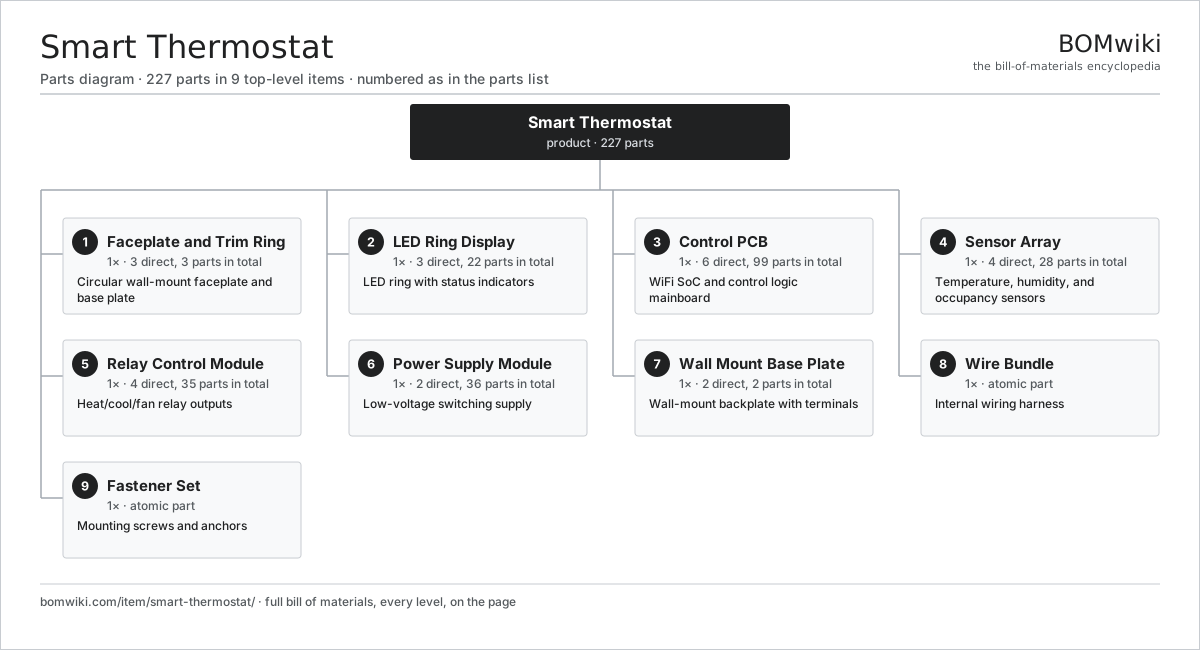
| # | Part | Qty | What it does |
|---|---|---|---|
| 1 | Faceplate and Trim Ring 3 parts | 1× | Circular wall-mount faceplate and base plate |
| 2 | LED Ring Display 3 parts | 1× | LED ring with status indicators |
| 3 | Control PCB 6 parts | 1× | WiFi SoC and control logic mainboard |
| 4 | Sensor Array 4 parts | 1× | Temperature, humidity, and occupancy sensors |
| 5 | Relay Control Module 4 parts | 1× | Heat/cool/fan relay outputs |
| 6 | Power Supply Module 2 parts | 1× | Low-voltage switching supply |
| 7 | Wall Mount Base Plate 2 parts | 1× | Wall-mount backplate with terminals |
| 8 | Wire Bundle | 1× | Internal wiring harness |
| 9 | Fastener Set | 1× | Mounting screws and anchors |
3D model
No 3D model yet. Have a CAD file of this? Add a 3D model. STL renders right on this page; STEP, FreeCAD, and OpenSCAD sources are welcome too (openly licensed, like all 3D models on BOMwiki).
Build & assembly graph
expand / collapse · shared sub-assemblies converge · links to related products · est. labourTap an assembly to expand/collapse · tap a part to open it · use “Open page” for any node · drag to pan, scroll to zoom.
Bill of materials for Smart Thermostat
9 top-level lines · 33 rows shown · 227 parts total · indented to 3 levels| # | Item / sub-assembly | Part no. | Qty/assy | Ext. qty | Parts | Type |
|---|---|---|---|---|---|---|
| 1 | Faceplate and Trim Ring 3 parts | smart-thermostat-housing | 1× | 1 | 3 | assembly |
| 1.1 | Main Faceplate | smart-thermostat-faceplate | 1× | 1 | · | part |
| 1.2 | Ring Bezel | smart-thermostat-ring-bezel | 1× | 1 | · | part |
| 1.3 | Fastener Set | fastener-set | 1× | 1 | · | part |
| 2 | LED Ring Display 3 parts | smart-thermostat-display-ring | 1× | 1 | 22 | assembly |
| 2.1 | RGB LED Pixels | smart-thermostat-ring-leds | 1× | 1 | · | part |
| 2.2 | LED Driver IC | smart-thermostat-ring-driver | 1× | 1 | · | part |
| 2.3 | SMD Passive (R/C/L) | smd-passives | 20× | 20 | · | part |
| 3 | Control PCB 6 parts | smart-thermostat-main-pcb | 1× | 1 | 99 | assembly |
| 3.1 | Bare PCB | pcb-bare | 1× | 1 | · | part |
| 3.2 | Compute SoC Module | soc-module | 1× | 1 | · | part |
| 3.3 | Microcontroller | mcu | 1× | 1 | · | part |
| 3.4 | Firmware Flash Memory | smart-thermostat-firmware-flash | 1× | 1 | · | part |
| 3.5 | SMD Passive (R/C/L) | smd-passives | 90× | 90 | · | part |
| 3.6 | Connector | connector | 5× | 5 | · | part |
| 4 | Sensor Array 4 parts | smart-thermostat-sensor-board | 1× | 1 | 28 | assembly |
| 4.1 | Temperature Sensor | smart-thermostat-temp-sensor | 1× | 1 | · | part |
| 4.2 | Humidity Sensor | smart-thermostat-humidity-sensor | 1× | 1 | · | part |
| 4.3 | Passive IR Occupancy Sensor | smart-thermostat-occupancy-sensor | 1× | 1 | · | part |
| 4.4 | SMD Passive (R/C/L) | smd-passives | 25× | 25 | · | part |
| 5 | Relay Control Module 4 parts | smart-thermostat-relay-module | 1× | 1 | 35 | assembly |
| 5.1 | Relay | relay | 2× | 2 | · | part |
| 5.2 | Relay Driver IC | smart-thermostat-relay-driver | 1× | 1 | · | part |
| 5.3 | Flyback Diode | smart-thermostat-diode-snubber | 2× | 2 | · | part |
| 5.4 | SMD Passive (R/C/L) | smd-passives | 30× | 30 | · | part |
| 6 | Power Supply Module 2 parts | smart-thermostat-power-supply | 1× | 1 | 36 | assembly |
| 6.1 | Power Supply | power-supply | 1× | 1 | · | part |
| 6.2 | SMD Passive (R/C/L) | smd-passives | 35× | 35 | · | part |
| 7 | Wall Mount Base Plate 2 parts | smart-thermostat-base-plate | 1× | 1 | 2 | assembly |
| 7.1 | Terminal Block | smart-thermostat-terminal-block | 1× | 1 | · | part |
| 7.2 | Fastener Set | fastener-set | 1× | 1 | · | part |
| 8 | Wire Bundle | wire-bundle | 1× | 1 | · | part |
| 9 | Fastener Set | fastener-set | 1× | 1 | · | part |
Something wrong in this list? Report a problem with this BOM.
Related products
same domain, ranked by shared parts Car FM Transmitter
240 parts · shares 3 with this page
Car FM Transmitter
240 parts · shares 3 with this page
 Digital Audio Player
267 parts · shares 3 with this page
Digital Audio Player
267 parts · shares 3 with this page
 Digital Photo Frame
31 parts · shares 3 with this page
Digital Photo Frame
31 parts · shares 3 with this page
 Electronic Shelf Label
159 parts · shares 3 with this page
Electronic Shelf Label
159 parts · shares 3 with this page
 Game Console
114 parts · shares 3 with this page
Game Console
114 parts · shares 3 with this page
 LED Curtain Display
356 parts · shares 3 with this page
LED Curtain Display
356 parts · shares 3 with this page
Sourcing: possible vendors
Browse the supplier directory → Prices, MOQ, and lead times are algorithmic estimates, not quotes, and not claims about these companies. Company mappings are curated by keyword; est. price band $50–$2k. How estimates work| Vendor | HQ | Specialty | MOQ | Lead time |
|---|---|---|---|---|
|
🇨🇳Foxconn
foxconn.com ↗
|
Shenzhen, CN | Electronics contract mfg | 1,000 units | 8–14 wks |
|
🇺🇸Jabil
jabil.com ↗
|
St. Petersburg, US | Electronics manufacturing | 1,000 units | 8–14 wks |
|
🇺🇸Flex
flex.com ↗
|
Austin, US | Electronics manufacturing | 1,000 units | 8–14 wks |
| celestica.com ↗ | Toronto, CA | Electronics manufacturing | 1,000 units | 8–14 wks |
|
🇺🇸Sanmina
sanmina.com ↗
|
San Jose, US | Electronics manufacturing | 1,000 units | 8–14 wks |
815-word article