Taxi Top Display
ProductOverview
Taxi top displays are LED signs mounted on the roof of taxis and rideshare vehicles, serving as moving billboards. The display shows advertisements that are dynamically selected based on the vehicle's GPS location. A taxi driving through downtown shows different ads than one on the highway or in a residential neighborhood.
This geo-targeted advertising is more valuable to advertisers than static billboards, because the audience (pedestrians and drivers) can be correlated with location. An ad for a coffee shop only appears on taxis passing within 500 meters of that coffee shop.
System architecture
A taxi top display consists of:
- Dual LED faces: Two identical P5 LED matrices (front and rear), 960×640 pixels each
- GPS/LTE modem: Continuously transmits vehicle location to an ad server
- Local controller: Caches ads and renders them based on GPS coordinates
- Vehicle power supply: Converts 12V vehicle battery to 24V for LEDs and 5V for logic
The display is completely autonomous, it does not require a smartphone or internet connection to the driver. Location data and ad scheduling are handled entirely by the embedded system.
GPS-based ad targeting
The modem reports GPS coordinates every 10 seconds to an ad server. The server queries a geo-database: "What ads should appear at coordinates 37.7749, -122.4194?" and returns a JSON response with ad image URLs and dwell times.
The controller downloads ads in the background (typically 100 KB image files) and caches them in 64 GB eMMC storage. If the vehicle loses LTE (tunnels, remote areas), it continues displaying cached ads based on the last-known location.
Ad targeting can be:
- Geofence-based: "Show this ad within 500m of location X"
- Route-based: "Show this ad only on taxi routes between downtown and the airport"
- Time-based: "Show breakfast ads 6–10 AM, lunch ads 11 AM–2 PM"
- Behavior-based: "Show this ad only after 5 PM on weekdays"
Installation and power
The display uses a magnetic mount, allowing installation and removal without drilling holes or applying adhesive. Four neodymium magnets (each rated 50 lbs pull) hold the 15 kg unit securely on the steel roof.
A single 12V power cable runs from the roof mount through the roof (or weatherproof grommet) to the vehicle's positive and ground terminals. The power supply inside the display converts 12V to 24V for LEDs and 5V for the modem and controller.
A soft-start module prevents the vehicle battery from sagging when the display first powers on. Without this, turning on the display might dim the headlights or interfere with the engine ignition.
Display life cycle
When the taxi is parked and off, the display powers down to <1W standby (only the watchdog timer runs). When the engine starts, 12V power is applied and the display boots in 2–3 seconds.
The display shows:
- Initialization: "Loading ads..." for 2 seconds
- Ad rotation: Each ad displays for 5–30 seconds, then transitions to the next
- Fallback: If no ads are available for the current location, a default "Taxi" logo is shown
At night, the ambient light sensor dims the display to 400 nits (from 1200 nits in daylight) to avoid glare and reduce power draw.
Ad rendering
Ads are cached as PNG or JPEG images (typically 960×640 pixels to match the display resolution). When an ad needs to be shown, the controller decompresses it and pushes pixel data to the LED drivers at 1920 Hz refresh rate.
Transitions between ads use simple crossfades or wipes, rendered in real time.
Simple text ads (e.g., "Eat at Joe's Pizza") are stored as templates, with the controller rendering the text using a built-in font library at runtime. This reduces storage and allows quick updates (text changes without re-downloading images).
Revenue model
The taxi owner shares revenue with the advertising network:
- Taxi owner receives $X per 1000 ad impressions
- Advertising network sells impressions to brands
- Ad targeting ensures impressions are valuable (shown to relevant audiences)
Revenue depends on location (high-traffic urban areas command higher CPM, cost per 1000 impressions, than rural areas) and dwell time (longer dwell time = more impressions).
Data privacy
GPS location is transmitted to the ad server, which is a privacy concern. Drivers are typically notified that location data is collected for ad targeting. Some implementations use differential privacy, location is quantized to grid cells (e.g., 500m × 500m) rather than exact coordinates, limiting personal tracking while enabling geofencing.
Ad servers can be hosted on-premise (by the taxi fleet) or in the cloud (by the advertising network). On-premise reduces data exposure but requires fleet IT infrastructure.
Maintenance
LED panels degrade at 5% per 50,000 hours. A taxi top display running 12 hours per day will show noticeable dimming after 3 years. Individual panels are user-replaceable (they are plugged into the frame, not soldered).
The modem SIM card can be swapped if the carrier changes or if a new plan is needed. No tools required, just eject the SIM and replace it.
Power supply is a sealed unit rated for automotive vibration and temperature swings. If it fails, it is replaced as a complete module.
Challenges and limitations
Network dependency: The display relies on LTE to fetch new ads. In areas with poor coverage, ads become stale. LTE-M (lower bandwidth, longer range) is a potential upgrade for rural areas.
Battery drain: At 50W continuous power draw, a Prius battery (50 Ah) would be drained in 24 hours of continuous operation. Most taxis run the display only while carrying passengers or waiting for pickups (turning it off at night), limiting discharge.
Weather durability: The display is sealed to IP65, but extreme heat (Death Valley) or cold (Alaska) can degrade LEDs or freeze the modem. Operating range is -10°C to +50°C; outside this range, the display shuts down to prevent damage.
Theft and vandalism: A magnetic mount can be removed by a determined thief. Anti-theft locks (bolted mount) are available but require drilling the roof.
Taxi Top Display parts and their functions
5 top-level parts · 129 parts in total · full bill of materials below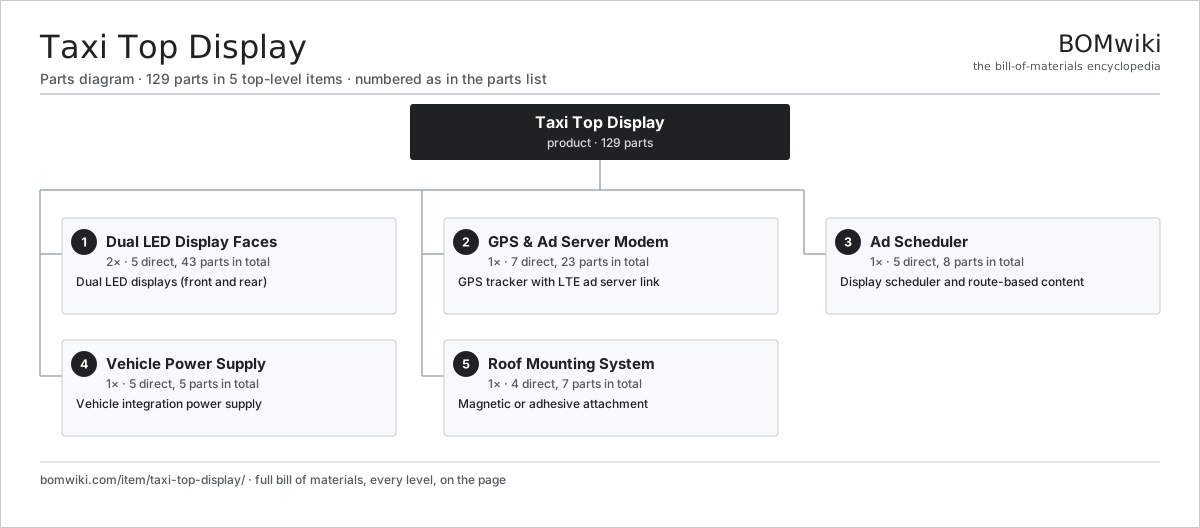
| # | Part | Qty | What it does |
|---|---|---|---|
| 1 | Dual LED Display Faces 5 parts | 2× | Dual LED displays (front and rear) |
| 2 | GPS & Ad Server Modem 7 parts | 1× | GPS tracker with LTE ad server link |
| 3 | Ad Scheduler 5 parts | 1× | Display scheduler and route-based content |
| 4 | Vehicle Power Supply 5 parts | 1× | Vehicle integration power supply |
| 5 | Roof Mounting System 4 parts | 1× | Magnetic or adhesive attachment |
3D model
No 3D model yet. Have a CAD file of this? Add a 3D model. STL renders right on this page; STEP, FreeCAD, and OpenSCAD sources are welcome too (openly licensed, like all 3D models on BOMwiki).
Build & assembly graph
expand / collapse · shared sub-assemblies converge · links to related products · est. labourTap an assembly to expand/collapse · tap a part to open it · use “Open page” for any node · drag to pan, scroll to zoom.
Bill of materials for Taxi Top Display
5 top-level lines · 31 rows shown · 129 parts total · indented to 3 levels| # | Item / sub-assembly | Part no. | Qty/assy | Ext. qty | Parts | Type |
|---|---|---|---|---|---|---|
| 1 | Dual LED Display Faces 5 parts | taxi-top-display-face-array | 2× | 2 | 43 | assembly |
| 1.1 | LED Display Panel | taxi-top-display-led-panel | 4× | 8 | · | part |
| 1.2 | Dual-Face Frame | taxi-top-display-frame-assembly | 1× | 2 | · | part |
| 1.3 | Light Sensor | taxi-top-display-brightness-sensor | 2× | 4 | · | part |
| 1.4 | Connector | connector | 4× | 8 | · | part |
| 1.5 | SMD Passive (R/C/L) | smd-passives | 32× | 64 | · | part |
| 2 | GPS & Ad Server Modem 7 parts | taxi-top-display-gps-modem | 1× | 1 | 23 | assembly |
| 2.1 | GNSS Receiver | taxi-top-display-gps-module | 1× | 1 | · | part |
| 2.2 | LTE Modem | taxi-top-display-lte-modem-module | 1× | 1 | · | part |
| 2.3 | SIM Card Holder | taxi-top-display-sim-slot | 1× | 1 | · | part |
| 2.4 | Combined Antenna | taxi-top-display-antenna-combo | 1× | 1 | · | part |
| 2.5 | Bare PCB | pcb-bare | 1× | 1 | · | part |
| 2.6 | Connector | connector | 2× | 2 | · | part |
| 2.7 | SMD Passive (R/C/L) | smd-passives | 16× | 16 | · | part |
| 3 | Ad Scheduler 5 parts | taxi-top-display-controller | 1× | 1 | 8 | assembly |
| 3.1 | Microcontroller | mcu | 2× | 2 | · | part |
| 3.2 | LED Driver IC | taxi-top-display-driver-ic | 2× | 2 | · | part |
| 3.3 | Ad Cache Storage | taxi-top-display-ad-cache | 1× | 1 | · | part |
| 3.4 | Connector | connector | 2× | 2 | · | part |
| 3.5 | Bare PCB | pcb-bare | 1× | 1 | · | part |
| 4 | Vehicle Power Supply 5 parts | taxi-top-display-power-unit | 1× | 1 | 5 | assembly |
| 4.1 | Battery Connector | taxi-top-display-12v-input-connector | 1× | 1 | · | part |
| 4.2 | Main DC-DC Converter | taxi-top-display-main-dcdc | 1× | 1 | · | part |
| 4.3 | 5V Regulator | taxi-top-display-5v-buck | 1× | 1 | · | part |
| 4.4 | Soft-Start Module | taxi-top-display-inrush-limiter | 1× | 1 | · | part |
| 4.5 | Fastener Set | fastener-set | 1× | 1 | · | part |
| 5 | Roof Mounting System 4 parts | taxi-top-display-roof-mount | 1× | 1 | 7 | assembly |
| 5.1 | Mount Baseplate | taxi-top-display-mounting-base | 1× | 1 | · | part |
| 5.2 | Magnetic Mount | taxi-top-display-magnetic-feet | 4× | 4 | · | part |
| 5.3 | Wire Bundle | wire-bundle | 1× | 1 | · | part |
| 5.4 | Fastener Set | fastener-set | 1× | 1 | · | part |
Something wrong in this list? Report a problem with this BOM.
Related products
same domain, ranked by shared parts Amateur Radio Transceiver
295 parts · shares 1 with this page
Amateur Radio Transceiver
295 parts · shares 1 with this page
 Bone Conduction Headphones
34 parts · shares 1 with this page
Bone Conduction Headphones
34 parts · shares 1 with this page
 Car FM Transmitter
240 parts · shares 1 with this page
Car FM Transmitter
240 parts · shares 1 with this page
 CB Radio
228 parts · shares 1 with this page
CB Radio
228 parts · shares 1 with this page
 Clamp Meter
27 parts · shares 1 with this page
Clamp Meter
27 parts · shares 1 with this page
 Digital Audio Player
267 parts · shares 1 with this page
Digital Audio Player
267 parts · shares 1 with this page
Sourcing: possible vendors
Browse the supplier directory → Prices, MOQ, and lead times are algorithmic estimates, not quotes, and not claims about these companies. Company mappings are curated by keyword; est. price band $50–$2k. How estimates work| Vendor | HQ | Specialty | MOQ | Lead time |
|---|---|---|---|---|
|
🇨🇳Foxconn
foxconn.com ↗
|
Shenzhen, CN | Electronics contract mfg | 1,000 units | 8–14 wks |
|
🇺🇸Jabil
jabil.com ↗
|
St. Petersburg, US | Electronics manufacturing | 1,000 units | 8–14 wks |
|
🇺🇸Flex
flex.com ↗
|
Austin, US | Electronics manufacturing | 1,000 units | 8–14 wks |
| celestica.com ↗ | Toronto, CA | Electronics manufacturing | 1,000 units | 8–14 wks |
|
🇺🇸Sanmina
sanmina.com ↗
|
San Jose, US | Electronics manufacturing | 1,000 units | 8–14 wks |
1,005-word article