Electric Towel Warmer
ProductOverview
An electric towel warmer is a ladder of hollow metal rails mounted on a bathroom wall, heated to 45–65 °C so that towels hung over it dry between uses and are warm when taken down. At 60–150 W it draws about as much power as an old incandescent bulb, which makes it practical to run on a timer for a few hours each morning and evening. Beyond comfort, the appliance has a hygiene function: a towel that dries within a few hours does not develop the mildew and odor that a damp towel on a hook does, and the gentle convection from the rails helps dry the room itself.
The body is the Rail Frame: two Vertical Collector Tube collectors joined by ten or more horizontal Cross Rail bars, welded into a single sealed structure in stainless or powder-coated mild steel. Ladder widths around 500 mm and heights of 800–1,200 mm are standard, sized so a folded bath towel drapes over two or three rails.
How it works
Two heating architectures share the same external form.
Fluid-filled models are sealed hydronic loops in miniature. A cartridge Heating Element screws into the Element Housing at the base of one vertical tube, immersed in a Thermal Fluid charge, water with glycol to prevent freezing and corrosion, that fills about 85–90 % of the internal volume. The Fill Plug is closed after filling, leaving an air cushion that absorbs thermal expansion; without it, heating the sealed liquid would raise internal pressure dangerously. Heated fluid rises through the vertical, spreads along each cross rail, cools against the towel, and sinks back to the element, a natural convection loop with no pump. Fluid models heat slowly (30–60 minutes to full temperature) but hold heat evenly across every rail and retain warmth after switch-off.
Dry models instead run a resistance cable element along the inside of the tubes, or bond a heating cable to the rail walls. They reach temperature in 15–25 minutes and weigh less, but rail temperature varies more between the bars nearest and farthest from the element.
In both designs the steady-state physics is the same: the frame loses heat to the room by convection and radiation, and a 100 W input settles the rail surface at roughly 50–60 °C in a 20 °C bathroom. Hanging a wet towel over the rails increases the load, the rails cool slightly and the Controller increases duty cycle until the towel dries.
Control and protection
Basic units are simple on/off resistive loads, but most current models carry an electronic Controller. An NTC Rail Sensor clipped to the lower collector reports rail temperature to the Microcontroller, which switches the element through a Relay to hold the setpoint chosen on the Control Knob; the LED Indicator shows heating and timer state. The 2/4/8-hour timer is the most used feature, since running continuously wastes most of the energy for a towel that dries in two hours.
Protection is layered. The electronic loop regulates normally; a bimetal Safety Thermostat opens at about 75 °C if the loop fails; and a one-shot Thermal Fuse in series with the element is the last resort against a stuck relay or a dry-fired fluid model. IEC 60335-2-43 (the towel-rail appliance standard) sets the limits on accessible surface temperature and requires the appliance to survive being fully covered by towels without hazard, which is the failure mode the layered cutoffs address.
Installation
The Wall Mounting Kit kit carries the frame on four Wall Bracket clamps, with Standoff Spacer spacers holding the ladder 55–70 mm off the wall so towels slide behind the rails. The Anchor Kit supplies fixings for masonry or studs, and Bracket Cover Cap trims hide the screws.
Electrical connection depends on bathroom wiring rules. Where a socket exists outside the splash zones, the factory-fitted Power Cord and Mains Plug are used. Inside the bathroom, most codes require a permanent connection: the cord terminates in a Hardwire Connection Box (a fused flex-outlet plate) on a switched spur, with RCD/GFCI protection on the circuit. The IP44 rating that bathroom zone 2 demands is achieved by sealing the element gland with the O-Ring Set and anchoring the cord entry with the Strain Relief Grommet. Fluid models must be mounted with the element at the bottom; the convection loop only works with the heat source below the rails.
Electric Towel Warmer parts and their functions
6 top-level parts · 49 parts in total · full bill of materials below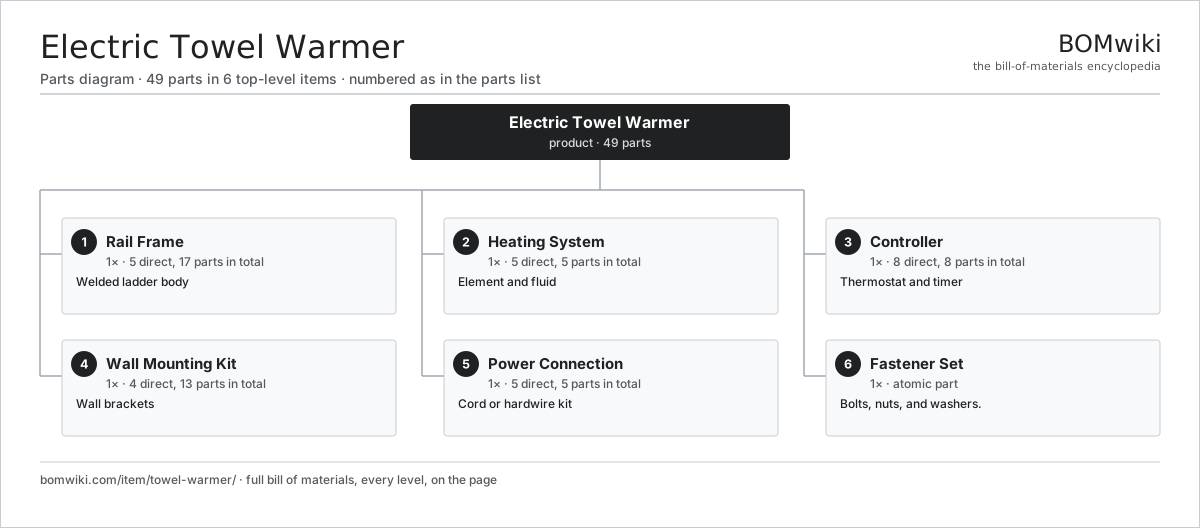
| # | Part | Qty | What it does |
|---|---|---|---|
| 1 | Rail Frame 5 parts | 1× | Welded ladder body |
| 2 | Heating System 5 parts | 1× | Element and fluid |
| 3 | Controller 8 parts | 1× | Thermostat and timer |
| 4 | Wall Mounting Kit 4 parts | 1× | Wall brackets |
| 5 | Power Connection 5 parts | 1× | Cord or hardwire kit |
| 6 | Fastener Set | 1× | Bolts, nuts, and washers. |
3D model
No 3D model yet. Have a CAD file of this? Add a 3D model. STL renders right on this page; STEP, FreeCAD, and OpenSCAD sources are welcome too (openly licensed, like all 3D models on BOMwiki).
Build & assembly graph
expand / collapse · shared sub-assemblies converge · links to related products · est. labourTap an assembly to expand/collapse · tap a part to open it · use “Open page” for any node · drag to pan, scroll to zoom.
Bill of materials for Electric Towel Warmer
6 top-level lines · 33 rows shown · 49 parts total · indented to 3 levels| # | Item / sub-assembly | Part no. | Qty/assy | Ext. qty | Parts | Type |
|---|---|---|---|---|---|---|
| 1 | Rail Frame 5 parts | towel-warmer-rail-frame | 1× | 1 | 17 | assembly |
| 1.1 | Cross Rail | towel-warmer-cross-rail | 10× | 10 | · | part |
| 1.2 | Vertical Collector Tube | towel-warmer-vertical-tube | 2× | 2 | · | part |
| 1.3 | End Cap | towel-warmer-end-cap | 2× | 2 | · | part |
| 1.4 | Fill Plug | towel-warmer-fill-plug | 1× | 1 | · | part |
| 1.5 | Robe Hook | towel-warmer-robe-hook | 2× | 2 | · | part |
| 2 | Heating System 5 parts | towel-warmer-heating | 1× | 1 | 5 | assembly |
| 2.1 | Heating Element | heating-element | 1× | 1 | · | part |
| 2.2 | Thermal Fluid | towel-warmer-thermal-fluid | 1× | 1 | · | part |
| 2.3 | Element Housing | towel-warmer-element-housing | 1× | 1 | · | part |
| 2.4 | Thermal Fuse | thermal-fuse | 1× | 1 | · | part |
| 2.5 | O-Ring Set | oring-set | 1× | 1 | · | part |
| 3 | Controller 8 parts | towel-warmer-controller | 1× | 1 | 8 | assembly |
| 3.1 | Bare PCB | pcb-bare | 1× | 1 | · | part |
| 3.2 | Microcontroller | mcu | 1× | 1 | · | part |
| 3.3 | Safety Thermostat | towel-warmer-thermostat | 1× | 1 | · | part |
| 3.4 | NTC Rail Sensor | towel-warmer-ntc-sensor | 1× | 1 | · | part |
| 3.5 | Control Knob | towel-warmer-control-knob | 1× | 1 | · | part |
| 3.6 | LED Indicator | towel-warmer-led-indicator | 1× | 1 | · | part |
| 3.7 | Relay | relay | 1× | 1 | · | part |
| 3.8 | SMD Passive (R/C/L) | smd-passives | 1× | 1 | · | part |
| 4 | Wall Mounting Kit 4 parts | towel-warmer-mounting | 1× | 1 | 13 | assembly |
| 4.1 | Wall Bracket | towel-warmer-wall-bracket | 4× | 4 | · | part |
| 4.2 | Standoff Spacer | towel-warmer-standoff | 4× | 4 | · | part |
| 4.3 | Anchor Kit | towel-warmer-anchor-kit | 1× | 1 | · | part |
| 4.4 | Bracket Cover Cap | towel-warmer-cover-cap | 4× | 4 | · | part |
| 5 | Power Connection 5 parts | towel-warmer-power | 1× | 1 | 5 | assembly |
| 5.1 | Power Cord | towel-warmer-power-cord | 1× | 1 | · | part |
| 5.2 | Mains Plug | towel-warmer-plug | 1× | 1 | · | part |
| 5.3 | Hardwire Connection Box | towel-warmer-hardwire-box | 1× | 1 | · | part |
| 5.4 | Strain Relief Grommet | towel-warmer-strain-relief | 1× | 1 | · | part |
| 5.5 | Wire Bundle | wire-bundle | 1× | 1 | · | part |
| 6 | Fastener Set | fastener-set | 1× | 1 | · | part |
Something wrong in this list? Report a problem with this BOM.
Related products
same domain, ranked by shared parts Bottled Water Cooler
119 parts · shares 4 with this page
Built-In Steam Oven
79 parts · shares 4 with this page
Bottled Water Cooler
119 parts · shares 4 with this page
Built-In Steam Oven
79 parts · shares 4 with this page
 Countertop Dishwasher
176 parts · shares 4 with this page
Garment Steamer
57 parts · shares 4 with this page
Countertop Dishwasher
176 parts · shares 4 with this page
Garment Steamer
57 parts · shares 4 with this page
 Ironing Press
56 parts · shares 4 with this page
Ironing Press
56 parts · shares 4 with this page
 Upright Freezer
176 parts · shares 4 with this page
Upright Freezer
176 parts · shares 4 with this page
Sourcing: possible vendors
Browse the supplier directory → Prices, MOQ, and lead times are algorithmic estimates, not quotes, and not claims about these companies. Company mappings are curated by keyword; est. price band $150–$3k. How estimates work| Vendor | HQ | Specialty | MOQ | Lead time |
|---|---|---|---|---|
| whirlpoolcorp.com ↗ | Benton Harbor, US | Home appliances | 1,000 units | 8–14 wks |
| bsh-group.com ↗ | Munich, DE | Appliances (Bosch, Siemens) | 1,000 units | 8–14 wks |
| electroluxgroup.com ↗ | Stockholm, SE | Home appliances | 1,000 units | 8–14 wks |
| lg.com ↗ | Seoul, KR | Appliances & electronics | 1,000 units | 8–14 wks |
|
🇨🇳Haier
haier.com ↗
|
Qingdao, CN | Home appliances | 1,000 units | 8–14 wks |
779-word article