Tower Fan
ProductOverview
A tower fan is a pedestal-mounted floor fan with a tall, slender column housing an electric motor and stacked impeller wheels. Unlike traditional blade fans with moving blades visible in front, tower fans use a brushless motor to spin a cross-flow impeller array inside a sealed column, expelling air horizontally through side and front vents. The column oscillates left and right on a timer, distributing air evenly across a room. This design combines compact footprint, safety (no exposed blades), and quiet operation.
The key innovation is the cross-flow impeller, multiple narrow wheels stacked along a vertical shaft, each blade oriented to push air perpendicular to the axis of rotation. This geometry allows efficient use of space: a 150 mm diameter column can achieve airflow equivalent to larger traditional fans. Tower fans are particularly popular in bedrooms and offices where aesthetics and noise matter.
How It Works
Air enters at the base through the Front Intake Mesh, drawn downward by the Cross-Flow Impeller rotating at 1,500–3,000 RPM. The BLDC Motor is powered by the Power & Timer Board, which converts AC mains power to 24V DC via a Power Supply module. The motor shaft carries four to six stacked polycarbonate wheels, each ≈80 mm in diameter with backward-curved blades.
As the impeller spins, air is drawn in and compressed, then ejected horizontally through the Discharge Vanes and top discharge vents. The Outer Casing serves as a plenum, smoothing turbulence with internal Airflow Straighteners. Airflow exits at 8–15 m³/min, sufficient to cool a 20 m² bedroom.
The oscillation mechanism is driven by a separate Oscillation Motor, a small 3–5W AC synchronous motor that turns a Speed Reduction Gearbox at 1–2 Hz. The gearbox output shaft is eccentrically mounted as a Cam Drive Shaft, which rocks the entire motor column back and forth through a Pivot Thrust Bearing at the base. Mechanical linkage limits swing to ±45°, providing wide room coverage without excessive motion.
A weighted Pedestal Base (2–4 kg of lead or concrete) prevents tipping when the swaying column reaches maximum deflection. The Vibration Feet decouple motor vibration, reducing noise transmission to the floor.
Speed and Control
Most tower fans offer 1–3 discrete speed settings via resistor switching in the Power & Timer Board. The Microcontroller toggles Relay coils to supply different voltage fractions to the motor, either via AC phase-cutting (if a TRIAC Module is fitted) or DC voltage dividers. Variable-speed models use PWM (pulse-width modulation) to dim the effective voltage, smooth across a continuous range.
Timer modes, typically 30 min, 60 min, or manual, are managed by the microcontroller, which de-energizes the relays after the set interval. Some models include a remote control via infrared, though most use front-panel push buttons.
Acoustic and Efficiency
Tower fans are quieter than blade fans because the cross-flow geometry distributes air acceleration over a longer path, reducing local velocity gradients that generate noise. At low speed, output is typically 45–50 dB (conversational speech volume); at maximum, 50–55 dB. The absence of visible blade motion also creates a psychological perception of quietness.
Power consumption is moderate: 30–60W during operation, making them energy-efficient for continuous summer cooling. A tower fan running 8 hours daily costs roughly USD 0.08 per day at typical electricity rates.
Durability and Maintenance
The BLDC Motor eliminates carbon brushes, extending lifespan to 3,000–5,000 operating hours (10+ years at typical use). The Ball Bearing supports are sealed, requiring no lubrication. The oscillation mechanism's O-Ring Set seals can degrade after 5 years in dry conditions, leading to friction and noise in the pivot; this is not easily field-replaceable in consumer units.
The Front Intake Mesh collects dust over time, reducing intake flow. Vacuuming the exterior mesh every 2–4 weeks maintains airflow. The column interior is not designed for user disassembly, so internal dust accumulation (if any) requires professional service.
Variants and Upgrades
Premium models add air purification filters or ionizers inside the column. Some include remote controls or smart WiFi via upgraded Microcontroller boards. Outdoor tower fans exist with weather-sealed motors and stainless-steel components but are uncommon. Height variations range from 600 mm (compact) to 1,000 mm (room-filling); wider bases and heavier weights stabilize taller units against wind load.
Tower Fan parts and their functions
8 top-level parts · 30 parts in total · full bill of materials below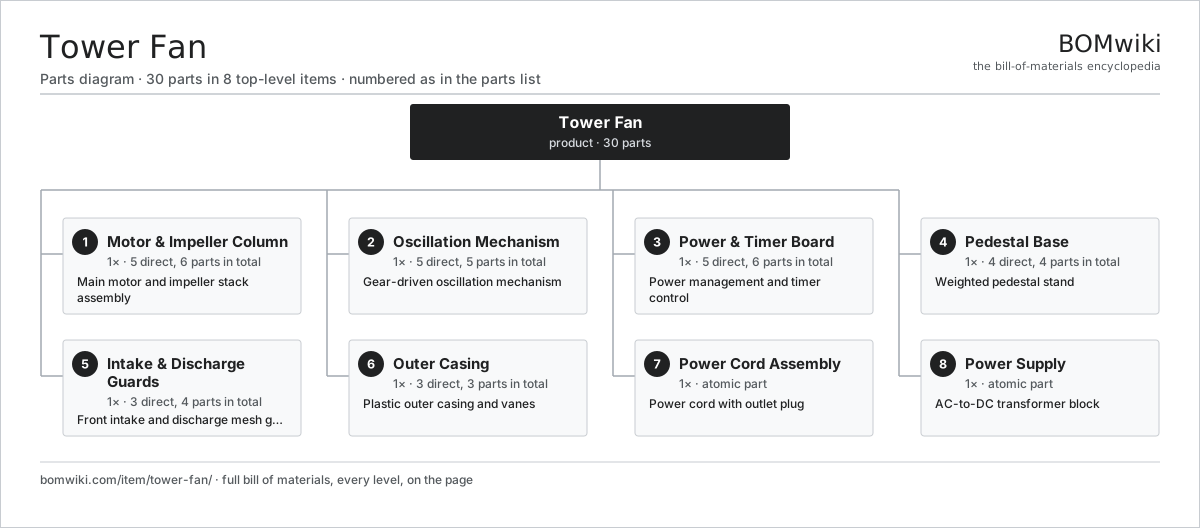
| # | Part | Qty | What it does |
|---|---|---|---|
| 1 | Motor & Impeller Column 5 parts | 1× | Main motor and impeller stack assembly |
| 2 | Oscillation Mechanism 5 parts | 1× | Gear-driven oscillation mechanism |
| 3 | Power & Timer Board 5 parts | 1× | Power management and timer control |
| 4 | Pedestal Base 4 parts | 1× | Weighted pedestal stand |
| 5 | Intake & Discharge Guards 3 parts | 1× | Front intake and discharge mesh guards |
| 6 | Outer Casing 3 parts | 1× | Plastic outer casing and vanes |
| 7 | Power Cord Assembly | 1× | Power cord with outlet plug |
| 8 | Power Supply | 1× | AC-to-DC transformer block |
3D model
No 3D model yet. Have a CAD file of this? Add a 3D model. STL renders right on this page; STEP, FreeCAD, and OpenSCAD sources are welcome too (openly licensed, like all 3D models on BOMwiki).
Build & assembly graph
expand / collapse · shared sub-assemblies converge · links to related products · est. labourTap an assembly to expand/collapse · tap a part to open it · use “Open page” for any node · drag to pan, scroll to zoom.
Bill of materials for Tower Fan
8 top-level lines · 33 rows shown · 30 parts total · indented to 3 levels| # | Item / sub-assembly | Part no. | Qty/assy | Ext. qty | Parts | Type |
|---|---|---|---|---|---|---|
| 1 | Motor & Impeller Column 5 parts | tower-fan-motor-column | 1× | 1 | 6 | assembly |
| 1.1 | BLDC Motor | tower-fan-brushless-motor | 1× | 1 | · | part |
| 1.2 | Cross-Flow Impeller | tower-fan-impeller-stack | 1× | 1 | · | part |
| 1.3 | Motor Housing | motor-housing | 1× | 1 | · | part |
| 1.4 | Ball Bearing | ball-bearing | 2× | 2 | · | part |
| 1.5 | Motor Shaft | tower-fan-motor-shaft | 1× | 1 | · | part |
| 2 | Oscillation Mechanism 5 parts | tower-fan-oscillation-drive | 1× | 1 | 5 | assembly |
| 2.1 | Oscillation Motor | tower-fan-osc-motor | 1× | 1 | · | part |
| 2.2 | Speed Reduction Gearbox | tower-fan-gear-train | 1× | 1 | · | part |
| 2.3 | Cam Drive Shaft | tower-fan-cam-shaft | 1× | 1 | · | part |
| 2.4 | Pivot Thrust Bearing | tower-fan-pivot-bearing | 1× | 1 | · | part |
| 2.5 | O-Ring Set | oring-set | 1× | 1 | · | part |
| 3 | Power & Timer Board 5 parts | tower-fan-control-board | 1× | 1 | 6 | assembly |
| 3.1 | Microcontroller | mcu | 1× | 1 | · | part |
| 3.2 | Relay | relay | 2× | 2 | · | part |
| 3.3 | SMD Passive (R/C/L) | smd-passives | 1× | 1 | · | part |
| 3.4 | Bare PCB | pcb-bare | 1× | 1 | · | part |
| 3.5 | TRIAC Module | tower-fan-triac | 1× | 1 | · | part |
| 4 | Pedestal Base 4 parts | tower-fan-base | 1× | 1 | 4 | assembly |
| 4.1 | Base Housing | tower-fan-base-shell | 1× | 1 | · | part |
| 4.2 | Stabilizing Weight | tower-fan-weight-insert | 1× | 1 | · | part |
| 4.3 | Vibration Feet | tower-fan-feet | 1× | 1 | · | part |
| 4.4 | Fastener Set | fastener-set | 1× | 1 | · | part |
| 5 | Intake & Discharge Guards 3 parts | tower-fan-grille | 1× | 1 | 4 | assembly |
| 5.1 | Front Intake Mesh | tower-fan-front-grille | 1× | 1 | · | part |
| 5.2 | Discharge Vanes | tower-fan-side-vanes | 2× | 2 | · | part |
| 5.3 | Fastener Set | fastener-set | 1× | 1 | · | part |
| 6 | Outer Casing 3 parts | tower-fan-housing | 1× | 1 | 3 | assembly |
| 6.1 | Column Housing | tower-fan-outer-shell | 1× | 1 | · | part |
| 6.2 | Airflow Straighteners | tower-fan-vane-inserts | 1× | 1 | · | part |
| 6.3 | Fastener Set | fastener-set | 1× | 1 | · | part |
| 7 | Power Cord Assembly | tower-fan-fan-cord | 1× | 1 | · | part |
| 8 | Power Supply | power-supply | 1× | 1 | · | part |
Something wrong in this list? Report a problem with this BOM.
Related products
same domain, ranked by shared parts Ultrasonic Humidifier
23 parts · shares 4 with this page
Dual-Fuel Range
93 parts · shares 3 with this page
Ultrasonic Humidifier
23 parts · shares 4 with this page
Dual-Fuel Range
93 parts · shares 3 with this page
 Wine Cellar Cooling Unit
39 parts · shares 3 with this page
Wine Cellar Cooling Unit
39 parts · shares 3 with this page
 Bladeless Fan
64 parts · shares 3 with this page
Gas Clothes Dryer
99 parts · shares 3 with this page
Bladeless Fan
64 parts · shares 3 with this page
Gas Clothes Dryer
99 parts · shares 3 with this page
 Stand Fan
70 parts · shares 3 with this page
Stand Fan
70 parts · shares 3 with this page
Sourcing: possible vendors
Browse the supplier directory → Prices, MOQ, and lead times are algorithmic estimates, not quotes, and not claims about these companies. Company mappings are curated by keyword; est. price band $150–$3k. How estimates work| Vendor | HQ | Specialty | MOQ | Lead time |
|---|---|---|---|---|
| whirlpoolcorp.com ↗ | Benton Harbor, US | Home appliances | 1,000 units | 8–14 wks |
| bsh-group.com ↗ | Munich, DE | Appliances (Bosch, Siemens) | 1,000 units | 8–14 wks |
| electroluxgroup.com ↗ | Stockholm, SE | Home appliances | 1,000 units | 8–14 wks |
| lg.com ↗ | Seoul, KR | Appliances & electronics | 1,000 units | 8–14 wks |
|
🇨🇳Haier
haier.com ↗
|
Qingdao, CN | Home appliances | 1,000 units | 8–14 wks |
751-word article