Transit Passenger Display
ProductOverview
Transit passenger displays are information screens installed in bus shelters, train stations, and ferry terminals to show real-time vehicle arrivals, service alerts, and journey planning information. These displays pull data from the transit agency's GTFS (General Transit Feed Specification) server via LTE/GPS, updating arrivals every 30 seconds. Unlike traditional static route maps, the display is dynamic and live, showing which buses are delayed, rerouted, or canceled.
The display combines a sunlight-readable LCD panel with an embedded Linux computer, LTE modem, backup battery, and heater to handle outdoor temperature extremes and power outages. Shelters are often unheated and have no dedicated power, so the display must be self-contained and resilient.
How it works
The display controller (an ARM Cortex-A72 computer) boots from eMMC storage and fetches the transit agency's GTFS feed over LTE. This includes vehicle positions, scheduled arrivals, service advisories, and real-time delay estimates. The controller parses this feed and renders a list of the next 4–6 arrivals on the LCD, sorted by time, color-coded by route.
LTE connectivity is primary; GPS is used for time-keeping and geofencing (ensuring the display shows only routes serving the current stop). Ethernet port allows hardwired connectivity in fixed shelters with power outlets.
The LCD panel is edge-lit with four white LEDs along its edges. A brightness controller reads an ambient light sensor and modulates the backlight PWM to 80% in daylight (1500 nits) and 20% at night (300 nits). This prevents washout and reduces power draw by 60% at night.
The power system accepts 120 VAC from shelter mains or a dedicated circuit. A 30 A charger converts this to 48 VDC and floats the battery at full charge. The 48V 12 Ah LiFePO4 battery provides 4+ hours of runtime if mains is lost. An inverter can supply backup AC if needed for heated shelters.
The heater is critical in cold climates. Liquid crystal displays become sluggish below 0°C and inoperable below -20°C. A 500 W electric heater with thermostat maintains the cabinet interior at 5°C minimum. In -20°C weather, this consumes about 150 W continuously, within the battery runtime budget.
Outdoor durability
The cabinet is sealed to IP66 (complete dust protection, water jets at any angle). Seals are gaskets around the door and cable ports. A desiccant breather vent allows pressure equalization without admitting moisture, silica gel absorbs condensation from air entering during temperature cycling.
The antenna is mounted atop the cabinet on a ±5 dBi MIMO array tuned for LTE (700–800 MHz) and GPS (1575 MHz). In dense urban canyons, LTE-M and NB-IoT provide fallback connectivity with lower bandwidth and longer range.
The tempered glass window has anti-reflective (AR) coating to reduce glare. Uncoated glass reflects 4% at the air-glass interface; AR coating brings this to 0.5%, allowing the 1500 nit display to be readable even in bright sunlight without excessive reflection of the sky.
Data sources
Feeds are pulled from the GTFS server, typically hosted by the transit agency on a private network or cloud. The display controller caches GTFS data locally and refreshes every 30–60 seconds. If LTE is lost, the display falls back to showing cached data (arrivals from the previous fetch) for up to 30 minutes. A status icon alerts riders that information may be stale.
Custom APIs can feed service alerts, emergency announcements, and wayfinding directions alongside the GTFS arrivals. Some installations integrate passenger counting sensors to show occupancy ("Bus 42 arriving, high capacity").
Maintenance
Displays are field-upgradeable via USB. The controller accepts a thumb drive with new OS images or firmware updates. SIM cards are removable, allowing carrier changes or plan upgrades without opening the cabinet. Battery packs are modular and can be swapped in 5 minutes if degradation occurs (after 3–5 years of daily cycles).
Brightness degradation is typically 10–15% after 50,000 operating hours (5+ years). Backlight LEDs can be replaced by removing the bezel.
Transit Passenger Display parts and their functions
6 top-level parts · 46 parts in total · full bill of materials below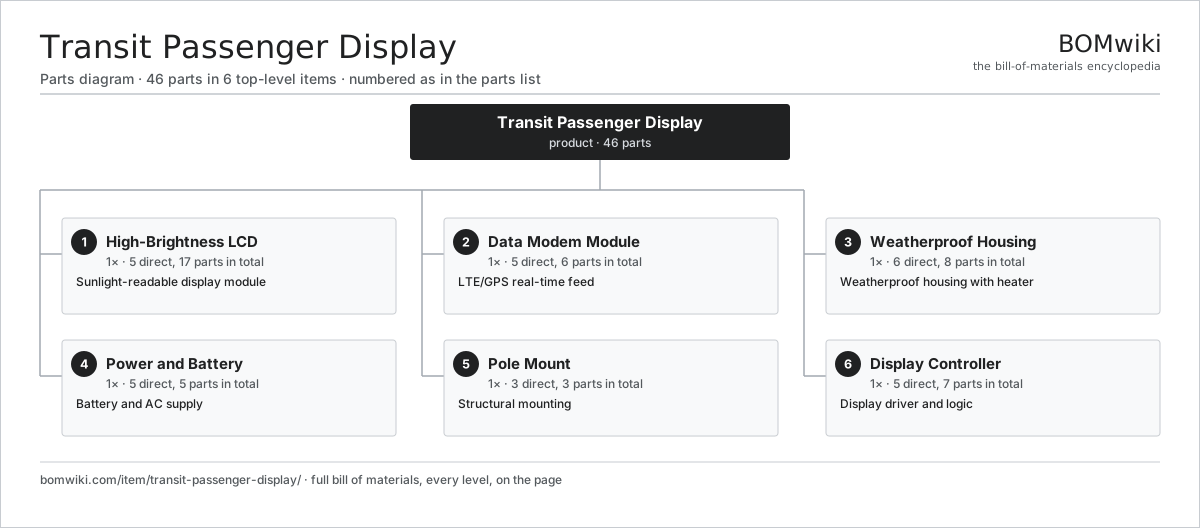
| # | Part | Qty | What it does |
|---|---|---|---|
| 1 | High-Brightness LCD 5 parts | 1× | Sunlight-readable display module |
| 2 | Data Modem Module 5 parts | 1× | LTE/GPS real-time feed |
| 3 | Weatherproof Housing 6 parts | 1× | Weatherproof housing with heater |
| 4 | Power and Battery 5 parts | 1× | Battery and AC supply |
| 5 | Pole Mount 3 parts | 1× | Structural mounting |
| 6 | Display Controller 5 parts | 1× | Display driver and logic |
3D model
No 3D model yet. Have a CAD file of this? Add a 3D model. STL renders right on this page; STEP, FreeCAD, and OpenSCAD sources are welcome too (openly licensed, like all 3D models on BOMwiki).
Build & assembly graph
expand / collapse · shared sub-assemblies converge · links to related products · est. labourTap an assembly to expand/collapse · tap a part to open it · use “Open page” for any node · drag to pan, scroll to zoom.
Bill of materials for Transit Passenger Display
6 top-level lines · 35 rows shown · 46 parts total · indented to 3 levels| # | Item / sub-assembly | Part no. | Qty/assy | Ext. qty | Parts | Type |
|---|---|---|---|---|---|---|
| 1 | High-Brightness LCD 5 parts | transit-passenger-display-screen | 1× | 1 | 17 | assembly |
| 1.1 | LCD Panel | lcd-panel | 1× | 1 | · | part |
| 1.2 | LED Backlight | transit-passenger-display-backlight-array | 1× | 1 | · | part |
| 1.3 | Backlight Controller | transit-passenger-display-brightness-controller | 1× | 1 | · | part |
| 1.4 | Connector | connector | 2× | 2 | · | part |
| 1.5 | SMD Passive (R/C/L) | smd-passives | 12× | 12 | · | part |
| 2 | Data Modem Module 5 parts | transit-passenger-display-data-modem | 1× | 1 | 6 | assembly |
| 2.1 | LTE/GPS SoC | transit-passenger-display-lte-modem | 1× | 1 | · | part |
| 2.2 | Dual-Band Antenna | transit-passenger-display-antenna-assembly | 1× | 1 | · | part |
| 2.3 | SIM Card Holder | transit-passenger-display-sim-holder | 1× | 1 | · | part |
| 2.4 | Bare PCB | pcb-bare | 1× | 1 | · | part |
| 2.5 | Connector | connector | 2× | 2 | · | part |
| 3 | Weatherproof Housing 6 parts | transit-passenger-display-enclosure | 1× | 1 | 8 | assembly |
| 3.1 | Cabinet Frame | transit-passenger-display-aluminum-frame | 1× | 1 | · | part |
| 3.2 | Display Window | transit-passenger-display-tempered-glass | 1× | 1 | · | part |
| 3.3 | Cabinet Heater | transit-passenger-display-heater-unit | 1× | 1 | · | part |
| 3.4 | Moisture Vent | transit-passenger-display-vent-filter | 1× | 1 | · | part |
| 3.5 | O-Ring Set | oring-set | 3× | 3 | · | part |
| 3.6 | Fastener Set | fastener-set | 1× | 1 | · | part |
| 4 | Power and Battery 5 parts | transit-passenger-display-power-subsystem | 1× | 1 | 5 | assembly |
| 4.1 | Backup Battery | transit-passenger-display-battery-pack | 1× | 1 | · | part |
| 4.2 | AC Battery Charger | transit-passenger-display-charger | 1× | 1 | · | part |
| 4.3 | Backup Inverter | transit-passenger-display-inverter | 1× | 1 | · | part |
| 4.4 | Power Supply | power-supply | 1× | 1 | · | part |
| 4.5 | BMS Board | bms-board | 1× | 1 | · | part |
| 5 | Pole Mount 3 parts | transit-passenger-display-mounting-bracket | 1× | 1 | 3 | assembly |
| 5.1 | Mount Arm | transit-passenger-display-bracket-arm | 1× | 1 | · | part |
| 5.2 | Fastener Set | fastener-set | 1× | 1 | · | part |
| 5.3 | O-Ring Set | oring-set | 1× | 1 | · | part |
| 6 | Display Controller 5 parts | transit-passenger-display-control-board | 1× | 1 | 7 | assembly |
| 6.1 | Compute SoC Module | soc-module | 1× | 1 | · | part |
| 6.2 | System Storage | transit-passenger-display-storage | 1× | 1 | · | part |
| 6.3 | Connector | connector | 3× | 3 | · | part |
| 6.4 | Bare PCB | pcb-bare | 1× | 1 | · | part |
| 6.5 | Microcontroller | mcu | 1× | 1 | · | part |
Something wrong in this list? Report a problem with this BOM.
Related products
same domain, ranked by shared parts Handheld GPS
192 parts · shares 4 with this page
Handheld GPS
192 parts · shares 4 with this page
 Satellite Phone
372 parts · shares 4 with this page
Satellite Phone
372 parts · shares 4 with this page
 Smartwatch
269 parts · shares 4 with this page
Air Quality Monitor
365 parts · shares 4 with this page
Smartwatch
269 parts · shares 4 with this page
Air Quality Monitor
365 parts · shares 4 with this page
 Emergency Crank Radio
123 parts · shares 3 with this page
Emergency Crank Radio
123 parts · shares 3 with this page
 Walkie-Talkie (PMR Radio)
272 parts · shares 3 with this page
Walkie-Talkie (PMR Radio)
272 parts · shares 3 with this page
Sourcing: possible vendors
Browse the supplier directory → Prices, MOQ, and lead times are algorithmic estimates, not quotes, and not claims about these companies. Company mappings are curated by keyword; est. price band $50–$2k. How estimates work| Vendor | HQ | Specialty | MOQ | Lead time |
|---|---|---|---|---|
|
🇨🇳Foxconn
foxconn.com ↗
|
Shenzhen, CN | Electronics contract mfg | 1,000 units | 8–14 wks |
|
🇺🇸Jabil
jabil.com ↗
|
St. Petersburg, US | Electronics manufacturing | 1,000 units | 8–14 wks |
|
🇺🇸Flex
flex.com ↗
|
Austin, US | Electronics manufacturing | 1,000 units | 8–14 wks |
| celestica.com ↗ | Toronto, CA | Electronics manufacturing | 1,000 units | 8–14 wks |
|
🇺🇸Sanmina
sanmina.com ↗
|
San Jose, US | Electronics manufacturing | 1,000 units | 8–14 wks |
669-word article