UV Phone Sanitizer
ProductOverview
A UV-C phone sanitizer exploits germicidal ultraviolet radiation (UV-C, 200–280 nm wavelength) to inactivate microbes on device surfaces. Unlike chemical disinfectants, UV-C does not leave residue and works passively. The user places their phone in the sealed chamber, closes the lid, presses a button to start a timed cycle, and walks away. After 5–15 minutes, the device beeps; the phone is sterilized and ready to use.
Inside the chamber, an array of UV-C LEDs is mounted on an aluminum heatsink. The walls are coated with a highly reflective material to bounce UV-C photons multiple times, saturating the chamber with germicidal radiation. A magnetic lid sensor kills the LEDs instantly when the cover is opened, protecting the user's eyes and skin from UV-C burn.
The main MCU counts down the selected timer, regulates LED current to maintain stable irradiance, and stops the cycle when time expires. A rechargeable lithium battery powers the whole unit, charged via USB-C.
How it works
UV-C photons at 254 nm are strongly absorbed by nucleotides (DNA and RNA). When a photon is absorbed by the purine or pyrimidine bases, it excites electrons to unstable states. As they relax, they form thymine dimers and other photoproducts that distort the double helix. This prevents replication and transcription, effectively killing the organism (bacteriostatic and bactericidal depending on dose and repair capacity).
The germicidal effectiveness is quantified in joules per square centimeter (J/cm²). Most bacteria and enveloped viruses (including coronaviruses) are inactivated by 5–10 J/cm². A typical phone sanitizer delivers 20–50 J/cm² over a 10-minute cycle, ensuring robust kill rates even for resistant spores (which require 50–100 J/cm²).
The four UV-C LEDs are mounted on the heatsink positioned above and to the sides of the chamber. Each LED is powered by a regulated current source set to 1–2 A. The current limiting IC monitors total power draw and backs off if the LEDs overheat, protecting the battery from excessive discharge current.
The MCU firmware counts down from the user-selected duration (5, 10, or 15 minutes) on the display LED. Meanwhile, the reed switch is continuously monitored. If the magnet on the lid moves away (i.e., the lid is opened), the reed contact opens, and the MCU immediately disables the LED driver, cutting power to all four LEDs. This fail-safe mechanism prevents accidental UV-C exposure.
The interior reflective coating, typically titanium dioxide or aluminum oxide paint rated for UV-C reflectance, bounces photons that don't hit the phone on first incidence. This multi-bounce scattering ensures uniform irradiance across the chamber and increases the total dose without dramatically increasing LED power or duration. The chamber walls are at a shallow angle relative to the LED axis, concentrating light toward the center where the phone sits.
When the timer reaches zero, the MCU emits a beep (via a small piezo speaker) and flashes the status LED. The user can then open the lid, remove their phone, and carry on. The device waits for either a button press to start a new cycle or automatically enters a low-power sleep state after a few minutes of inactivity.
The lithium battery is rated for high-current discharge (up to 5 A) to power four LEDs simultaneously. A protection circuit prevents over-discharge (<2.5 V cell voltage) and over-charge (>4.2 V). The USB charging IC accepts 5 V input and charges at 1 A, achieving a full charge in roughly 2 hours. A fuel-gauge IC (integrated into the BMS) reports remaining capacity to the MCU, which can display low-battery warnings if needed.
The plastic enclosure is opaque or translucent; translucent versions allow users to see their phone's position inside without opening the lid. The lid hinge uses a torsion spring to keep the cover firmly closed during operation, reducing stray UV-C escape.
UV Phone Sanitizer parts and their functions
10 top-level parts · 129 parts in total · full bill of materials below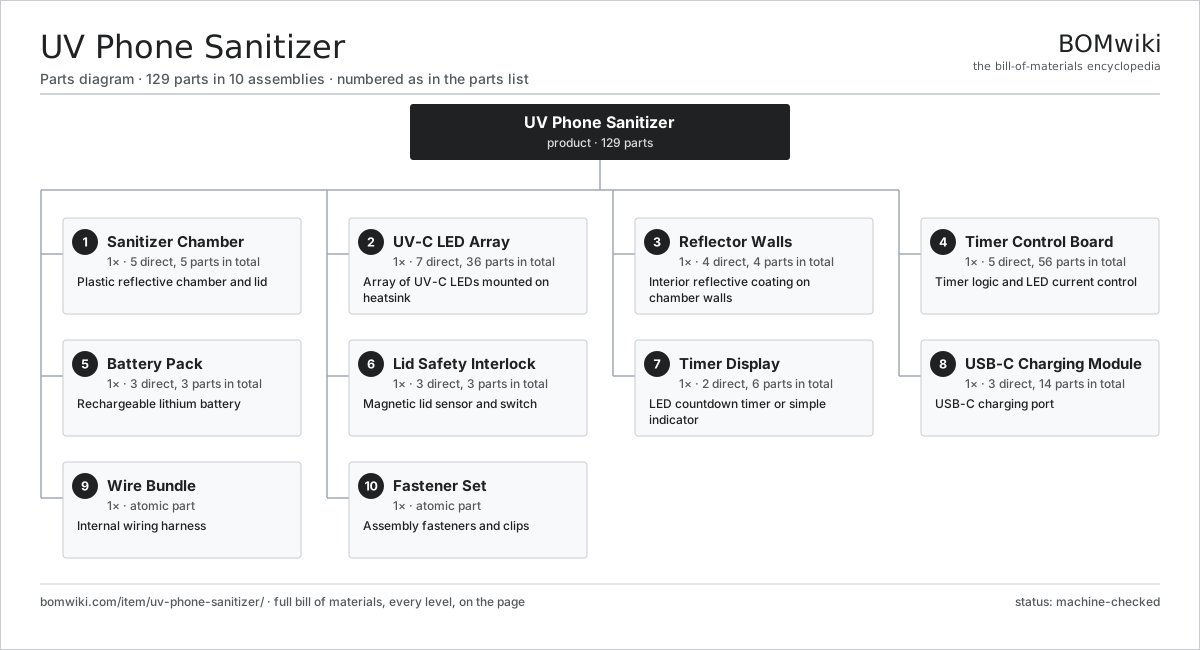
| # | Part | Qty | What it does |
|---|---|---|---|
| 1 | Sanitizer Chamber 5 parts | 1× | Plastic reflective chamber and lid |
| 2 | UV-C LED Array 7 parts | 1× | Array of UV-C LEDs mounted on heatsink |
| 3 | Reflector Walls 4 parts | 1× | Interior reflective coating on chamber walls |
| 4 | Timer Control Board 5 parts | 1× | Timer logic and LED current control |
| 5 | Battery Pack 3 parts | 1× | Rechargeable lithium battery |
| 6 | Lid Safety Interlock 3 parts | 1× | Magnetic lid sensor and switch |
| 7 | Timer Display 2 parts | 1× | LED countdown timer or simple indicator |
| 8 | USB-C Charging Module 3 parts | 1× | USB-C charging port |
| 9 | Wire Bundle | 1× | Internal wiring harness |
| 10 | Fastener Set | 1× | Assembly fasteners and clips |
3D model
No 3D model yet. Have a CAD file of this? Add a 3D model. STL renders right on this page; STEP, FreeCAD, and OpenSCAD sources are welcome too (openly licensed, like all 3D models on BOMwiki).
Build & assembly graph
expand / collapse · shared sub-assemblies converge · links to related products · est. labourTap an assembly to expand/collapse · tap a part to open it · use “Open page” for any node · drag to pan, scroll to zoom.
Bill of materials for UV Phone Sanitizer
10 top-level lines · 42 rows shown · 129 parts total · indented to 3 levels| # | Item / sub-assembly | Part no. | Qty/assy | Ext. qty | Parts | Type |
|---|---|---|---|---|---|---|
| 1 | Sanitizer Chamber 5 parts | uv-phone-sanitizer-housing | 1× | 1 | 5 | assembly |
| 1.1 | Base Chamber | uv-phone-sanitizer-base-chamber | 1× | 1 | · | part |
| 1.2 | Lid Cover | uv-phone-sanitizer-lid-cover | 1× | 1 | · | part |
| 1.3 | Reflective Interior Coating | uv-phone-sanitizer-reflective-coating | 1× | 1 | · | part |
| 1.4 | Lid Hinge | uv-phone-sanitizer-hinge | 1× | 1 | · | part |
| 1.5 | Fastener Set | fastener-set | 1× | 1 | · | part |
| 2 | UV-C LED Array 7 parts | uv-phone-sanitizer-led-array | 1× | 1 | 36 | assembly |
| 2.1 | UV-C LED | uv-phone-sanitizer-uvc-led-1 | 1× | 1 | · | part |
| 2.2 | UV-C LED | uv-phone-sanitizer-uvc-led-2 | 1× | 1 | · | part |
| 2.3 | UV-C LED | uv-phone-sanitizer-uvc-led-3 | 1× | 1 | · | part |
| 2.4 | UV-C LED | uv-phone-sanitizer-uvc-led-4 | 1× | 1 | · | part |
| 2.5 | Aluminum Heatsink | uv-phone-sanitizer-heatsink | 1× | 1 | · | part |
| 2.6 | LED Driver IC | uv-phone-sanitizer-led-driver-ic | 1× | 1 | · | part |
| 2.7 | SMD Passive (R/C/L) | smd-passives | 30× | 30 | · | part |
| 3 | Reflector Walls 4 parts | uv-phone-sanitizer-reflector-walls | 1× | 1 | 4 | assembly |
| 3.1 | Side Panel 1 | uv-phone-sanitizer-side-panel-1 | 1× | 1 | · | part |
| 3.2 | Side Panel 2 | uv-phone-sanitizer-side-panel-2 | 1× | 1 | · | part |
| 3.3 | Back Panel | uv-phone-sanitizer-back-panel | 1× | 1 | · | part |
| 3.4 | Fastener Set | fastener-set | 1× | 1 | · | part |
| 4 | Timer Control Board 5 parts | uv-phone-sanitizer-control-board | 1× | 1 | 56 | assembly |
| 4.1 | Bare PCB | pcb-bare | 1× | 1 | · | part |
| 4.2 | Timer MCU | uv-phone-sanitizer-timer-mcu | 1× | 1 | · | part |
| 4.3 | Current Limiting IC | uv-phone-sanitizer-current-limiter | 1× | 1 | · | part |
| 4.4 | SMD Passive (R/C/L) | smd-passives | 50× | 50 | · | part |
| 4.5 | Connector | connector | 3× | 3 | · | part |
| 5 | Battery Pack 3 parts | uv-phone-sanitizer-battery-pack | 1× | 1 | 3 | assembly |
| 5.1 | LiPo Cell | lipo-cell | 1× | 1 | · | part |
| 5.2 | BMS Board | bms-board | 1× | 1 | · | part |
| 5.3 | Battery Contact Block | uv-phone-sanitizer-battery-contact | 1× | 1 | · | part |
| 6 | Lid Safety Interlock 3 parts | uv-phone-sanitizer-safety-interlock | 1× | 1 | 3 | assembly |
| 6.1 | Magnetic Sensor | uv-phone-sanitizer-magnet | 1× | 1 | · | part |
| 6.2 | Reed Switch | uv-phone-sanitizer-reed-switch | 1× | 1 | · | part |
| 6.3 | Fastener Set | fastener-set | 1× | 1 | · | part |
| 7 | Timer Display 2 parts | uv-phone-sanitizer-timer-display | 1× | 1 | 6 | assembly |
| 7.1 | Display LED | uv-phone-sanitizer-display-led | 1× | 1 | · | part |
| 7.2 | SMD Passive (R/C/L) | smd-passives | 5× | 5 | · | part |
| 8 | USB-C Charging Module 3 parts | uv-phone-sanitizer-usb-charger | 1× | 1 | 14 | assembly |
| 8.1 | Connector | connector | 1× | 1 | · | part |
| 8.2 | USB Charging IC | uv-phone-sanitizer-charging-ic | 1× | 1 | · | part |
| 8.3 | SMD Passive (R/C/L) | smd-passives | 12× | 12 | · | part |
| 9 | Wire Bundle | wire-bundle | 1× | 1 | · | part |
| 10 | Fastener Set | fastener-set | 1× | 1 | · | part |
Something wrong in this list? Report a problem with this BOM.
Related products
same domain, ranked by shared parts Digital Audio Player
267 parts · shares 3 with this page
 Electric Arc Lighter
113 parts · shares 3 with this page
 Game Console
114 parts · shares 3 with this page
 GPS Tracker
225 parts · shares 3 with this page
 Noise-Cancelling Headphones
165 parts · shares 3 with this page
Pocket Translator Device
289 parts · shares 3 with this page
Sourcing: possible vendors
Browse the supplier directory → Prices, MOQ, and lead times are algorithmic estimates, not quotes, and not claims about these companies. Company mappings are curated by keyword; est. price band $50–$2k. How estimates work| Vendor | HQ | Specialty | MOQ | Lead time |
|---|---|---|---|---|
|
🇨🇳Foxconn
foxconn.com ↗
|
Shenzhen, CN | Electronics contract mfg | 1,000 units | 8–14 wks |
|
🇺🇸Jabil
jabil.com ↗
|
St. Petersburg, US | Electronics manufacturing | 1,000 units | 8–14 wks |
|
🇺🇸Flex
flex.com ↗
|
Austin, US | Electronics manufacturing | 1,000 units | 8–14 wks |
| celestica.com ↗ | Toronto, CA | Electronics manufacturing | 1,000 units | 8–14 wks |
|
🇺🇸Sanmina
sanmina.com ↗
|
San Jose, US | Electronics manufacturing | 1,000 units | 8–14 wks |
805-word article