Highway Variable Message Sign
ProductOverview
Variable message signs (VMS) are large roadside displays used by traffic agencies to inform drivers of road conditions, hazards, speed restrictions, and route guidance. They are standard equipment on major highways, expressways, and urban arterials in North America, Europe, and Asia.
A typical VMS shows 3 rows × 20 characters (60 characters total) using 250 mm tall amber LEDs readable from 300+ meters. Messages are approved by traffic engineers and pre-loaded into the sign's memory. A central traffic management center (TMC) can activate or change messages via NTCIP protocol over LTE or Ethernet.
How it works
The LED matrix consists of 60 individual character modules, each a 7-segment (numeric and select alphanumeric) or 5×7 dot-matrix (full ASCII) display. All characters are driven in multiplexed fashion: the controller rapidly scans through each character, energizing the segments for 1 millisecond before moving to the next. At 60 Hz refresh, the human eye sees all characters as continuously illuminated.
Messages are stored as ASCII text in the controller's eMMC storage. When the TMC sends a command to display "REDUCE SPEED AHEAD", the controller:
- Looks up the message in local memory
- Scans its validity (pre-approved by traffic engineers)
- Activates the corresponding LED segments
- Updates the display in <2 seconds
The controller maintains a message queue, allowing the TMC to schedule multiple messages with time-based activation. For example:
- 7:00 AM: "MORNING COMMUTE", reduce speed, left lane closed
- 9:00 AM: Clear the message
- 4:00 PM: "EVENING COMMUTE", reduce speed
NTCIP protocol
NTCIP (National Transportation Communications for ITS Protocol) is a standardized language for traffic devices. It defines how:
- A message is transmitted ("REDUCE SPEED AHEAD")
- Priorities are set (alert overrides scheduled message)
- Blanking is handled (sign goes dark in extreme weather)
- Malfunction reporting occurs (LED failure detection)
The sign reports status every 60 seconds: character modules functioning, power supply health, and communication link status. If the TMC loses connectivity for 30 minutes, the sign can continue displaying the last-known message or switch to a failsafe message (e.g., "MESSAGE NOT AVAILABLE").
Deployment scenarios
Speed reduction: When a traffic incident occurs upstream, the TMC activates: ''' INCIDENT AHEAD REDUCE SPEED USE CAUTION '''
Drivers see this and reduce speed 1–2 km ahead of the incident. Studies show this reduces secondary crashes by 30–40%.
Lane closure: When a lane is closed, the sign reads: ''' RIGHT LANE CLOSED MERGE LEFT 1 MILE AHEAD '''
Weather warnings: ''' FOG AHEAD HEADLIGHTS ON REDUCE SPEED '''
Route guidance: ''' EXIT 22 OPEN EXIT 23 CLOSED USE ROUTE 101 '''
Outdoor durability
The cabinet is made of welded steel, epoxy-primed, and finished with polyurethane topcoat. It is designed to be sealed (IP66) against rain and dust. The roof is sloped and includes integrated gutter drains to shed water quickly.
The gantry frame that supports the cabinet spans the roadway (typically 30–40 meters wide, covering all lanes). Vertical posts are driven 6+ meters into the ground. Lateral guy cables resist wind up to 130 mph. The structure is designed per AASHTO standards for highway loading and wind (equivalent to a truck passing below at speed while a horizontal gust hits the sign).
LED modules are rated for 100,000 hours (10+ years) in outdoor conditions with minimal brightness degradation. Modules are field-replaceable, requiring only a quick-disconnect plug, no soldering needed.
Maintenance
Traffic agencies maintain a regional inventory of spare character modules. If one fails (e.g., multiple segments burn out), a technician can replace it on-site in 10 minutes. The sign continues operating during maintenance.
The cabinet door is insulated and sealed, maintaining an internal temperature 10–20°C higher than ambient (heat from LEDs and controller). This prevents condensation in cold weather. A thermostat-controlled heater maintains a minimum of 5°C on extreme days.
Integration with traffic management
A central TMC (traffic management center) operates all VMS in a region from a control room. Traffic engineers monitor incident reports (from cameras, sensors, and incident reports), and activate pre-approved messages on signs in the affected area. Messages typically cascade:
- Incident detected on I-405 northbound
- TMC activates VMS 500m upstream: "INCIDENT AHEAD"
- 1 min later, TMC activates VMS 1km upstream: "EXPECT DELAYS"
- When incident clears, messages are deactivated
Messages are always pre-approved text (not free-form). This ensures consistency, prevents errors, and keeps drivers focused on essential information.
Performance metrics
Studies show that VMS reduce travel delays during incidents by 15–25% compared to passive signage. They also improve safety by encouraging drivers to:
- Maintain awareness of changing conditions
- Reduce speed before reaching hazards
- Merge in advance of lane closures
Some agencies report 30–40% reduction in secondary crashes (collisions caused by the initial incident) when VMS are present.
Highway Variable Message Sign parts and their functions
5 top-level parts · 208 parts in total · full bill of materials below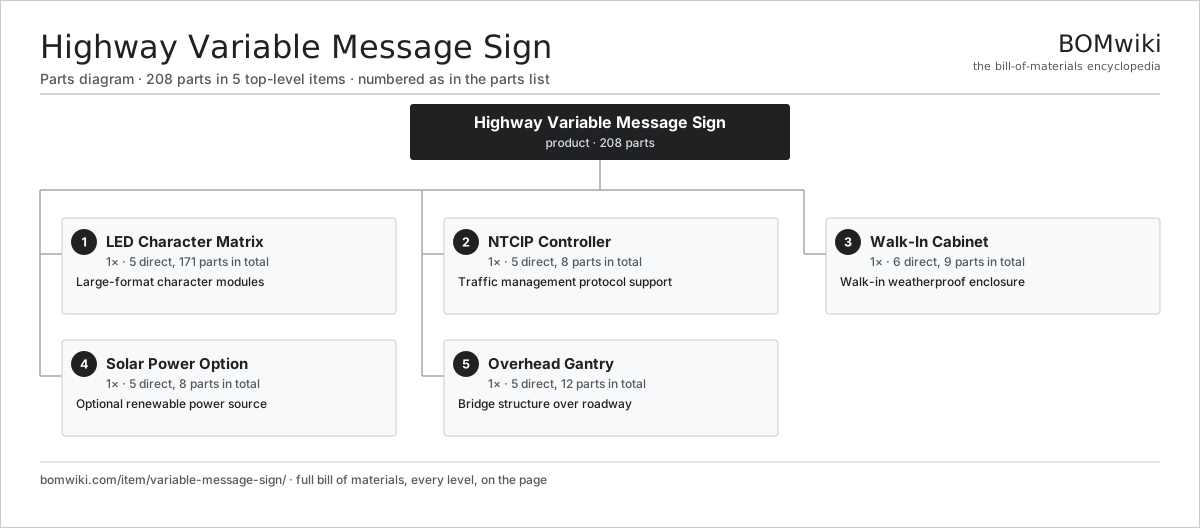
| # | Part | Qty | What it does |
|---|---|---|---|
| 1 | LED Character Matrix 5 parts | 1× | Large-format character modules |
| 2 | NTCIP Controller 5 parts | 1× | Traffic management protocol support |
| 3 | Walk-In Cabinet 6 parts | 1× | Walk-in weatherproof enclosure |
| 4 | Solar Power Option 5 parts | 1× | Optional renewable power source |
| 5 | Overhead Gantry 5 parts | 1× | Bridge structure over roadway |
3D model
No 3D model yet. Have a CAD file of this? Add a 3D model. STL renders right on this page; STEP, FreeCAD, and OpenSCAD sources are welcome too (openly licensed, like all 3D models on BOMwiki).
Build & assembly graph
expand / collapse · shared sub-assemblies converge · links to related products · est. labourTap an assembly to expand/collapse · tap a part to open it · use “Open page” for any node · drag to pan, scroll to zoom.
Bill of materials for Highway Variable Message Sign
5 top-level lines · 31 rows shown · 208 parts total · indented to 3 levels| # | Item / sub-assembly | Part no. | Qty/assy | Ext. qty | Parts | Type |
|---|---|---|---|---|---|---|
| 1 | LED Character Matrix 5 parts | variable-message-sign-led-matrix | 1× | 1 | 171 | assembly |
| 1.1 | LED Character Module | variable-message-sign-led-module | 20× | 20 | · | part |
| 1.2 | Matrix Driver PCB | variable-message-sign-module-pcb | 1× | 1 | · | part |
| 1.3 | Character Multiplexer | variable-message-sign-multiplexer-ic | 10× | 10 | · | part |
| 1.4 | Connector | connector | 40× | 40 | · | part |
| 1.5 | SMD Passive (R/C/L) | smd-passives | 100× | 100 | · | part |
| 2 | NTCIP Controller 5 parts | variable-message-sign-ntcip-controller | 1× | 1 | 8 | assembly |
| 2.1 | Microcontroller | mcu | 2× | 2 | · | part |
| 2.2 | Cellular Modem | variable-message-sign-modem | 1× | 1 | · | part |
| 2.3 | Message Storage | variable-message-sign-controller-storage | 1× | 1 | · | part |
| 2.4 | Connector | connector | 3× | 3 | · | part |
| 2.5 | Bare PCB | pcb-bare | 1× | 1 | · | part |
| 3 | Walk-In Cabinet 6 parts | variable-message-sign-cabinet | 1× | 1 | 9 | assembly |
| 3.1 | Cabinet Shell | variable-message-sign-cabinet-frame | 1× | 1 | · | part |
| 3.2 | Roof Assembly | variable-message-sign-roof-panel | 1× | 1 | · | part |
| 3.3 | Access Door | variable-message-sign-door-assembly | 1× | 1 | · | part |
| 3.4 | AC Power Inlet | variable-message-sign-ac-inlet | 1× | 1 | · | part |
| 3.5 | Fastener Set | fastener-set | 2× | 2 | · | part |
| 3.6 | O-Ring Set | oring-set | 3× | 3 | · | part |
| 4 | Solar Power Option 5 parts | variable-message-sign-solar-panel | 1× | 1 | 8 | assembly |
| 4.1 | Solar Panel | variable-message-sign-solar-module | 4× | 4 | · | part |
| 4.2 | MPPT Charger | variable-message-sign-charge-controller | 1× | 1 | · | part |
| 4.3 | Battery Bank | variable-message-sign-battery-bank | 1× | 1 | · | part |
| 4.4 | Power Inverter | variable-message-sign-inverter | 1× | 1 | · | part |
| 4.5 | Fastener Set | fastener-set | 1× | 1 | · | part |
| 5 | Overhead Gantry 5 parts | variable-message-sign-gantry-frame | 1× | 1 | 12 | assembly |
| 5.1 | Main Truss Span | variable-message-sign-main-truss | 2× | 2 | · | part |
| 5.2 | Support Post | variable-message-sign-vertical-post | 2× | 2 | · | part |
| 5.3 | Guy Cable | variable-message-sign-cable-guy | 4× | 4 | · | part |
| 5.4 | Fastener Set | fastener-set | 3× | 3 | · | part |
| 5.5 | Sheet Metal Panel | sheet-panel | 1× | 1 | · | part |
Something wrong in this list? Report a problem with this BOM.
Related products
same domain, ranked by shared parts Digital Billboard
131 parts · shares 2 with this page
Digital Billboard
131 parts · shares 2 with this page
 LED Curtain Display
356 parts · shares 2 with this page
LED Curtain Display
356 parts · shares 2 with this page
 Interactive Touch Table
130 parts · shares 1 with this page
Interactive Touch Table
130 parts · shares 1 with this page
 LED Television
737 parts · shares 1 with this page
Stadium Ribbon Display
1,326 parts · shares 1 with this page
Air Quality Monitor
365 parts · shares 1 with this page
LED Television
737 parts · shares 1 with this page
Stadium Ribbon Display
1,326 parts · shares 1 with this page
Air Quality Monitor
365 parts · shares 1 with this page
Sourcing: possible vendors
Browse the supplier directory → Prices, MOQ, and lead times are algorithmic estimates, not quotes, and not claims about these companies. Company mappings are curated by keyword; est. price band $50–$2k. How estimates work| Vendor | HQ | Specialty | MOQ | Lead time |
|---|---|---|---|---|
|
🇨🇳Foxconn
foxconn.com ↗
|
Shenzhen, CN | Electronics contract mfg | 1,000 units | 8–14 wks |
|
🇺🇸Jabil
jabil.com ↗
|
St. Petersburg, US | Electronics manufacturing | 1,000 units | 8–14 wks |
|
🇺🇸Flex
flex.com ↗
|
Austin, US | Electronics manufacturing | 1,000 units | 8–14 wks |
| celestica.com ↗ | Toronto, CA | Electronics manufacturing | 1,000 units | 8–14 wks |
|
🇺🇸Sanmina
sanmina.com ↗
|
San Jose, US | Electronics manufacturing | 1,000 units | 8–14 wks |
799-word article