Portable Voice Amplifier
ProductOverview
A portable voice amplifier is a personal public address system used by teachers, tour guides, coaches, fitness instructors, and outdoor event coordinators to amplify their voice for a small to medium audience (20–50 people). The system consists of a battery-powered amplifier unit worn on the waist, a headset with boom microphone and sidetone earpiece, and an external speaker that sits on a stand or tripod.
The user speaks into the Headset Assembly's boom mic; the signal is amplified by 20–40 dB and sent to the External Speaker, which projects it to the audience at conversational volume without straining the speaker's voice. The sidetone earpiece allows the user to hear their own amplified voice with ~30 ms latency, providing feedback for natural speech pacing.
Unlike high-power PA systems, a portable amplifier is self-contained, battery-powered, and light enough to wear for 8+ hours.
How it works
The Boom Microphone, a cardioid condenser microphone, sits ~5–10 cm in front of the user's mouth on a flexible gooseneck. When the user speaks, the Mic Capsule vibrates and outputs an analog voltage proportional to the acoustic pressure. The Input Preamp's Mic Amp IC amplifies this signal by ~40 dB and bandpass-filters it (80 Hz – 12 kHz) to remove wind noise and DC offsets.
The signal then splits into two paths:
Main output path: The signal feeds the Tone & EQ Module module, where three potentiometers control bass, mid, and treble shelving. A user can brighten the sound (lift treble) for improved intelligibility in a noisy outdoor setting, or roll off bass to reduce microphone handling rumble. The filtered signal then enters the Power Amplifier Module's Output Amp IC, a Class-AB output stage supplying 2–5 W of audio power. This drives the External Speaker, a 3–5 inch woofer in a vented enclosure, to 100+ dB SPL.
Sidetone path: A small portion of the post-preamp signal is sent to the Monitor Earpiece's Monitor Speaker, so the user hears their own voice delayed by ~30 ms. This feedback is crucial: without it, speakers unconsciously increase loudness to compensate, defeating the amplifier.
The Main PCB's Microcontroller routes audio through an ADC IC (input) and DAC IC (output) to enable digital control of gain, EQ recall, and muting. The user adjusts overall volume via the Volume Potentiometer, a physical rotary potentiometer that modulates the preamp gain in real-time.
Power Supply
The Battery Module is a 3.7 V or 7.4 V li-ion cell with a BMS Board for overcurrent and over-discharge protection. The Power Amplifier Module draws ~1–2 A at full output, so endurance at moderate volume (50% output, ~50 mW average draw) is 8–10 hours. A Battery Indicator LED shows battery state; when the voltage drops below ~3.0 V per cell, an audible alarm warns the user.
USB charging via USB Charger restores a full charge in 2–3 hours.
Microphone Technique
Cardioid mics have a null at the rear (180°), so the boom is positioned just below the mouth rather than on the lip. This rejects audience chatter and feedback from the speaker behind the user. Wind noise from breath is mitigated by the Wind Screen, a foam ball that reduces plosive bursts and sibilance artifacts.
The Phantom Power Supply supply is optional; it supplies 48 V for condenser mics that require it. Most portable systems use simpler electret condensers (self-biased, no phantom needed) to reduce power consumption.
Typical Use Case
An instructor wears the Processor Unit on a belt clip. The Headset Assembly boom sits in front of the mouth, and the earpiece sits in one ear. The External Speaker stands on a tripod in the center or front of the classroom. As the instructor moves around the room, the wireless signal from the mic to the amplifier is uninterrupted (the cable is routed under clothing or over the shoulder). The instructor adjusts volume with the Volume Potentiometer knob, and if the room is very noisy, they engage the Tone Mode Switch to boost the "clarity" EQ preset (lifting 2–4 kHz).
Feedback Prevention
If the speaker points the External Speaker toward the Boom Microphone, acoustic feedback occurs: the amplified signal from the speaker re-enters the mic, is re-amplified, and oscillates. The cardioid pickup pattern of the boom mic provides natural feedback rejection (speaker behind user's mouth). If feedback starts (a ringing tone), the user rotates the speaker to the side or lowers volume. Some amplifiers include phase-reverse switches to add another 180° of cancellation.
Maintenance
The Mic Capsule can clog with saliva or dust; it should be cleaned with a soft brush or replaced yearly in high-use environments. Headset cables develop intermittent shorts from repeated flexing; the Mic Cable and Earphone Cable should be strain-relieved or replaced every 1–2 years. Speaker drivers can blow if exposed to excessive volume spikes; a protective Speaker Grille helps, but operation above 105 dB SPL is not recommended.
Portable Voice Amplifier parts and their functions
7 top-level parts · 144 parts in total · full bill of materials below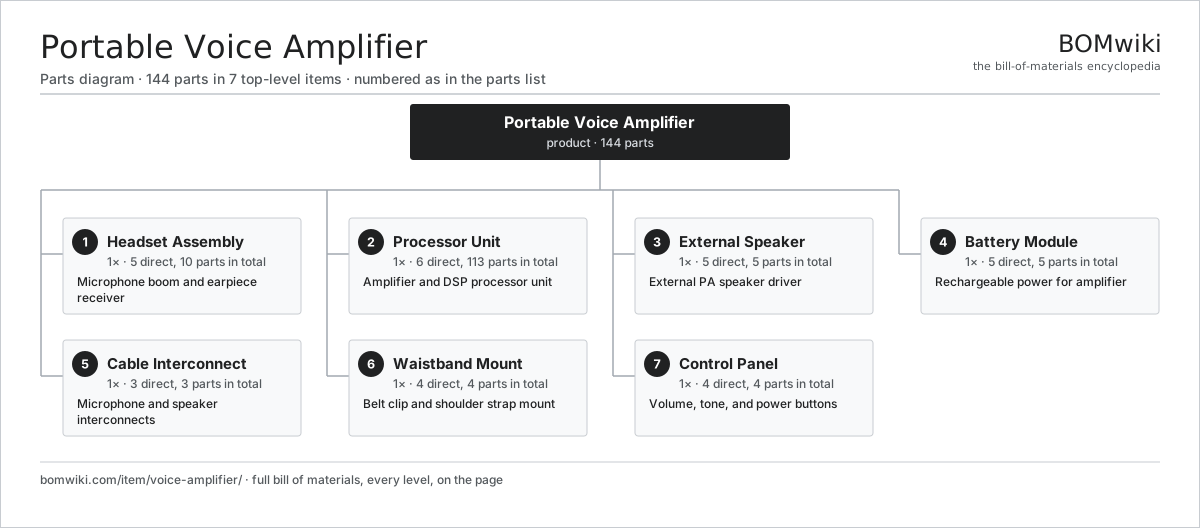
| # | Part | Qty | What it does |
|---|---|---|---|
| 1 | Headset Assembly 5 parts | 1× | Microphone boom and earpiece receiver |
| 2 | Processor Unit 6 parts | 1× | Amplifier and DSP processor unit |
| 3 | External Speaker 5 parts | 1× | External PA speaker driver |
| 4 | Battery Module 5 parts | 1× | Rechargeable power for amplifier |
| 5 | Cable Interconnect 3 parts | 1× | Microphone and speaker interconnects |
| 6 | Waistband Mount 4 parts | 1× | Belt clip and shoulder strap mount |
| 7 | Control Panel 4 parts | 1× | Volume, tone, and power buttons |
3D model
No 3D model yet. Have a CAD file of this? Add a 3D model. STL renders right on this page; STEP, FreeCAD, and OpenSCAD sources are welcome too (openly licensed, like all 3D models on BOMwiki).
Build & assembly graph
expand / collapse · shared sub-assemblies converge · links to related products · est. labourTap an assembly to expand/collapse · tap a part to open it · use “Open page” for any node · drag to pan, scroll to zoom.
Bill of materials for Portable Voice Amplifier
7 top-level lines · 65 rows shown · 144 parts total · indented to 3 levels| # | Item / sub-assembly | Part no. | Qty/assy | Ext. qty | Parts | Type |
|---|---|---|---|---|---|---|
| 1 | Headset Assembly 5 parts | voice-amplifier-headset | 1× | 1 | 10 | assembly |
| 1.1 | Boom Microphone 4 parts | voice-amplifier-boom-mic | 1× | 1 | 4 | assembly |
| 1.1.1 | Mic Capsule | voice-amplifier-mic-capsule | 1× | 1 | · | part |
| 1.1.2 | Boom Arm | voice-amplifier-boom-arm | 1× | 1 | · | part |
| 1.1.3 | Mic Connector | voice-amplifier-mic-connector | 1× | 1 | · | part |
| 1.1.4 | Mic Cable | voice-amplifier-mic-cable | 1× | 1 | · | part |
| 1.2 | Monitor Earpiece 3 parts | voice-amplifier-earpiece-monitor | 1× | 1 | 3 | assembly |
| 1.2.1 | Monitor Speaker | voice-amplifier-earpiece-speaker | 1× | 1 | · | part |
| 1.2.2 | Earpiece Housing | voice-amplifier-earpiece-housing | 1× | 1 | · | part |
| 1.2.3 | Earphone Cable | voice-amplifier-earphone-cable | 1× | 1 | · | part |
| 1.3 | Head Frame | voice-amplifier-head-frame | 1× | 1 | · | part |
| 1.4 | Wind Screen | voice-amplifier-wind-screen | 1× | 1 | · | part |
| 1.5 | Fastener Set | fastener-set | 1× | 1 | · | part |
| 2 | Processor Unit 6 parts | voice-amplifier-processor | 1× | 1 | 113 | assembly |
| 2.1 | Main PCB 5 parts | voice-amplifier-main-pcb | 1× | 1 | 44 | assembly |
| 2.1.1 | Bare PCB | pcb-bare | 1× | 1 | · | part |
| 2.1.2 | Microcontroller | mcu | 1× | 1 | · | part |
| 2.1.3 | DAC IC | voice-amplifier-dac | 1× | 1 | · | part |
| 2.1.4 | ADC IC | voice-amplifier-adc | 1× | 1 | · | part |
| 2.1.5 | SMD Passive (R/C/L) | smd-passives | 40× | 40 | · | part |
| 2.2 | Power Amplifier Module 4 parts | voice-amplifier-power-amp | 1× | 1 | 23 | assembly |
| 2.2.1 | Output Amp IC | voice-amplifier-output-amp-ic | 1× | 1 | · | part |
| 2.2.2 | Output Transformer | voice-amplifier-output-transformer | 1× | 1 | · | part |
| 2.2.3 | Speaker Protection | voice-amplifier-speaker-protection | 1× | 1 | · | part |
| 2.2.4 | SMD Passive (R/C/L) | smd-passives | 20× | 20 | · | part |
| 2.3 | Tone & EQ Module 3 parts | voice-amplifier-tone-eq | 1× | 1 | 24 | assembly |
| 2.3.1 | Tone Potentiometer | voice-amplifier-tone-potentiometer | 3× | 3 | · | part |
| 2.3.2 | Tone Network | voice-amplifier-tone-network | 1× | 1 | · | part |
| 2.3.3 | SMD Passive (R/C/L) | smd-passives | 20× | 20 | · | part |
| 2.4 | Input Preamp 4 parts | voice-amplifier-input-preamp | 1× | 1 | 18 | assembly |
| 2.4.1 | Mic Amp IC | voice-amplifier-mic-amp-ic | 1× | 1 | · | part |
| 2.4.2 | Phantom Power Supply | voice-amplifier-phantom-power | 1× | 1 | · | part |
| 2.4.3 | Input Filter | voice-amplifier-input-filter | 1× | 1 | · | part |
| 2.4.4 | SMD Passive (R/C/L) | smd-passives | 15× | 15 | · | part |
| 2.5 | Output Stage 3 parts | voice-amplifier-output-stage | 1× | 1 | 3 | assembly |
| 2.5.1 | Speaker Jack | voice-amplifier-speaker-jack | 1× | 1 | · | part |
| 2.5.2 | Output Coupling Cap | voice-amplifier-output-coupling | 1× | 1 | · | part |
| 2.5.3 | Fastener Set | fastener-set | 1× | 1 | · | part |
| 2.6 | Fastener Set | fastener-set | 1× | 1 | · | part |
| 3 | External Speaker 5 parts | voice-amplifier-speaker | 1× | 1 | 5 | assembly |
| 3.1 | Speaker Driver | voice-amplifier-speaker-driver | 1× | 1 | · | part |
| 3.2 | Speaker Enclosure | voice-amplifier-speaker-enclosure | 1× | 1 | · | part |
| 3.3 | Speaker Grille | voice-amplifier-speaker-grille | 1× | 1 | · | part |
| 3.4 | Speaker Bracket | voice-amplifier-speaker-bracket | 1× | 1 | · | part |
| 3.5 | Speaker Cable | voice-amplifier-speaker-cable | 1× | 1 | · | part |
| 4 | Battery Module 5 parts | voice-amplifier-battery | 1× | 1 | 5 | assembly |
| 4.1 | Li-Ion Cell | voice-amplifier-li-ion-cell | 1× | 1 | · | part |
| 4.2 | BMS Board | bms-board | 1× | 1 | · | part |
| 4.3 | USB Charger | voice-amplifier-usb-charger | 1× | 1 | · | part |
| 4.4 | Battery Indicator | voice-amplifier-battery-indicator | 1× | 1 | · | part |
| 4.5 | Fastener Set | fastener-set | 1× | 1 | · | part |
| 5 | Cable Interconnect 3 parts | voice-amplifier-cables | 1× | 1 | 3 | assembly |
| 5.1 | Mic Cable | voice-amplifier-mic-cable | 1× | 1 | · | part |
| 5.2 | Earphone Cable | voice-amplifier-earphone-cable | 1× | 1 | · | part |
| 5.3 | Speaker Cable | voice-amplifier-speaker-cable | 1× | 1 | · | part |
| 6 | Waistband Mount 4 parts | voice-amplifier-waistband | 1× | 1 | 4 | assembly |
| 6.1 | Belt Clip | voice-amplifier-belt-clip | 1× | 1 | · | part |
| 6.2 | Shoulder Strap | voice-amplifier-shoulder-strap | 1× | 1 | · | part |
| 6.3 | Adjustment Straps | voice-amplifier-adjustment-straps | 1× | 1 | · | part |
| 6.4 | Fastener Set | fastener-set | 1× | 1 | · | part |
| 7 | Control Panel 4 parts | voice-amplifier-controls | 1× | 1 | 4 | assembly |
| 7.1 | Volume Potentiometer | voice-amplifier-volume-pot | 1× | 1 | · | part |
| 7.2 | Power Button | voice-amplifier-power-button | 1× | 1 | · | part |
| 7.3 | Tone Mode Switch | voice-amplifier-tone-switch | 1× | 1 | · | part |
| 7.4 | Control PCB | voice-amplifier-control-pcb | 1× | 1 | · | part |
Something wrong in this list? Report a problem with this BOM.
Related products
same domain, ranked by shared parts AR Glasses
242 parts · shares 1 with this page
AR Glasses
242 parts · shares 1 with this page
 Bluetooth Speaker
196 parts · shares 1 with this page
Bluetooth Speaker
196 parts · shares 1 with this page
 Digital Audio Player
267 parts · shares 1 with this page
Digital Voice Recorder
154 parts · shares 1 with this page
E-Ink Writing Device
375 parts · shares 1 with this page
Digital Audio Player
267 parts · shares 1 with this page
Digital Voice Recorder
154 parts · shares 1 with this page
E-Ink Writing Device
375 parts · shares 1 with this page
 E-Ink Writing Tablet
245 parts · shares 1 with this page
E-Ink Writing Tablet
245 parts · shares 1 with this page
Sourcing: possible vendors
Browse the supplier directory → Prices, MOQ, and lead times are algorithmic estimates, not quotes, and not claims about these companies. Company mappings are curated by keyword; est. price band $50–$2k. How estimates work| Vendor | HQ | Specialty | MOQ | Lead time |
|---|---|---|---|---|
|
🇨🇳Foxconn
foxconn.com ↗
|
Shenzhen, CN | Electronics contract mfg | 1,000 units | 8–14 wks |
|
🇺🇸Jabil
jabil.com ↗
|
St. Petersburg, US | Electronics manufacturing | 1,000 units | 8–14 wks |
|
🇺🇸Flex
flex.com ↗
|
Austin, US | Electronics manufacturing | 1,000 units | 8–14 wks |
| celestica.com ↗ | Toronto, CA | Electronics manufacturing | 1,000 units | 8–14 wks |
|
🇺🇸Sanmina
sanmina.com ↗
|
San Jose, US | Electronics manufacturing | 1,000 units | 8–14 wks |
899-word article