Walkie-Talkie (PMR Radio)
ProductOverview
A walkie-talkie is a self-contained handheld radio that connects directly to other radios on the same channel, with no tower, base station, or subscription in between. The consumer version is built around the licence-free PMR446 allocation in Europe (sixteen FM channels between 446.0 and 446.2 MHz) or FRS in North America, both capped at 0.5 W of radiated power. That cap fixes the character of the product: a kilometre or three of range in open ground, much less among buildings, and tens of kilometres only with clear line of sight from hilltops.
Operation is half-duplex. Both radios sit on the same frequency, and the PTT Switch decides direction: press to transmit, release to listen. There is no channel arbitration beyond courtesy, which is why the Status LED shows a busy indication when the channel is occupied.
The electronics divide into the RF Transceiver Section that creates and recovers the FM signal, the Control / Baseband Board that controls it, the Audio Section chain, the Antenna Assembly, and a removable Battery Pack, all inside a gasketed Enclosure.
How it works
On transmit, speech from the Electret Microphone is band-limited to roughly 300–3000 Hz, pre-emphasised, and fed to the FM Transceiver IC, where it frequency-modulates a carrier synthesised by a PLL locked to the TCXO Reference. Narrowband channels are only 12.5 kHz wide, so deviation is held to ±2.5 kHz and the reference must stay within a few ppm over temperature or the signal drifts into the adjacent channel. The modulated carrier passes through the Transmit Power Amplifier, which raises it to the 0.5 W limit, then through the TX Low-Pass Filter to strip harmonics, and out via the TX/RX Switch to the antenna.
On receive, the same antenna feeds the SAW Band Filter pair, which reject signals outside the band before the transceiver IC mixes the carrier down to an intermediate frequency, limits it, and demodulates the FM. A carrier-squelch circuit mutes the Audio Amplifier IC unless a signal exceeds threshold, so the radio is silent between transmissions rather than hissing.
Because sixteen channels are shared by every user in radio range, radios layer sub-audible signalling on top. The CTCSS Tone Codec adds a continuous tone between 67 and 250 Hz under the voice on transmit and opens the receiver squelch only when the matching tone is present. Two groups can then share a channel without hearing each other, though they still cannot transmit simultaneously. Channel and tone settings persist in the Channel EEPROM, and an optional VOX Detector Circuit keys the transmitter automatically from voice level for hands-free use with a headset on the accessory jack.
Antenna and range
The Helical Antenna Element is the radio's biggest compromise. A full quarter-wave whip at 446 MHz would be about 16 cm; coiling the element into a helix shortens it to a pocketable stub inside the Antenna Rubber Sheath at the cost of a few dB of efficiency. Regulations for licence-free radios additionally require the antenna to be non-removable, which the Antenna Base Mount enforces. With only 0.5 W behind a shortened antenna held at head height, the link budget is dominated by terrain: range estimates printed on packaging assume unobstructed line of sight and rarely survive a forest or a row of houses.
Power and packaging
The Battery Pack clips onto the radio back and typically holds one Li-ion Cell, 18650 cell with a BMS Board for over-charge and over-discharge protection and a Thermal Fuse as a last-resort cutout. Runtime is quoted at a 5/5/90 duty cycle, 5 % transmit, 5 % receive, 90 % standby, under which an 1800 mAh cell lasts a working day or more; continuous transmit drains it in a few hours because the PA draws around an ampere. The Battery Contact Set double as charging terminals for a drop-in cradle.
The Front Shell and Rear Chassis are moulded polycarbonate, sealed with an O-Ring Set at the seams and ports; professional models reach IP67 and survive 1 m drops to concrete. The rear chassis often incorporates a metal spreader plate that sinks heat from the power amplifier during long transmissions. Controls stay deliberately simple, a detented Rotary Channel Encoder for channel and volume, a Keypad for menus, and a segment LCD Panel showing channel, tone code, and battery state, because the radio must be operable by feel, with gloves, without looking at it.
Walkie-Talkie (PMR Radio) parts and their functions
9 top-level parts · 272 parts in total · full bill of materials below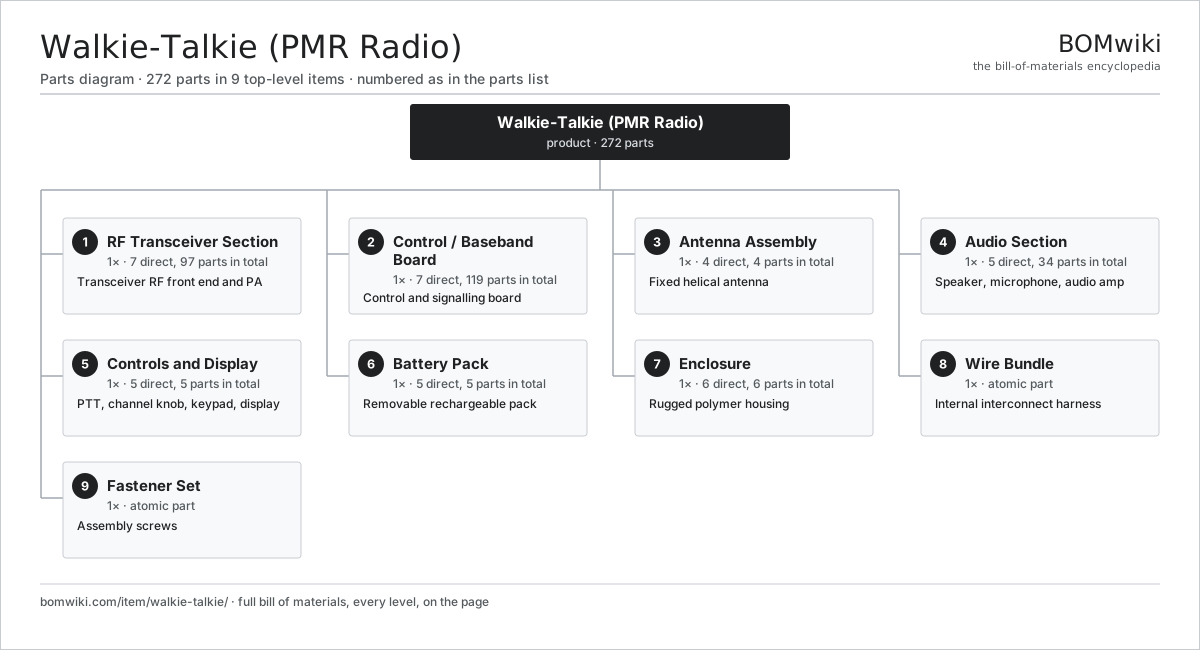
| # | Part | Qty | What it does |
|---|---|---|---|
| 1 | RF Transceiver Section 7 parts | 1× | Transceiver RF front end and PA |
| 2 | Control / Baseband Board 7 parts | 1× | Control and signalling board |
| 3 | Antenna Assembly 4 parts | 1× | Fixed helical antenna |
| 4 | Audio Section 5 parts | 1× | Speaker, microphone, audio amp |
| 5 | Controls and Display 5 parts | 1× | PTT, channel knob, keypad, display |
| 6 | Battery Pack 5 parts | 1× | Removable rechargeable pack |
| 7 | Enclosure 6 parts | 1× | Rugged polymer housing |
| 8 | Wire Bundle | 1× | Internal interconnect harness |
| 9 | Fastener Set | 1× | Assembly screws |
3D model
No 3D model yet. Have a CAD file of this? Add a 3D model. STL renders right on this page; STEP, FreeCAD, and OpenSCAD sources are welcome too (openly licensed, like all 3D models on BOMwiki).
Build & assembly graph
expand / collapse · shared sub-assemblies converge · links to related products · est. labourTap an assembly to expand/collapse · tap a part to open it · use “Open page” for any node · drag to pan, scroll to zoom.
Bill of materials for Walkie-Talkie (PMR Radio)
9 top-level lines · 48 rows shown · 272 parts total · indented to 3 levels| # | Item / sub-assembly | Part no. | Qty/assy | Ext. qty | Parts | Type |
|---|---|---|---|---|---|---|
| 1 | RF Transceiver Section 7 parts | walkie-talkie-rf-section | 1× | 1 | 97 | assembly |
| 1.1 | FM Transceiver IC | walkie-talkie-transceiver-ic | 1× | 1 | · | part |
| 1.2 | Transmit Power Amplifier | walkie-talkie-pa | 1× | 1 | · | part |
| 1.3 | TX/RX Switch | walkie-talkie-tr-switch | 1× | 1 | · | part |
| 1.4 | SAW Band Filter | walkie-talkie-saw-filter | 2× | 2 | · | part |
| 1.5 | TCXO Reference | walkie-talkie-tcxo | 1× | 1 | · | part |
| 1.6 | TX Low-Pass Filter | walkie-talkie-lpf | 1× | 1 | · | part |
| 1.7 | SMD Passive (R/C/L) | smd-passives | 90× | 90 | · | part |
| 2 | Control / Baseband Board 7 parts | walkie-talkie-baseband | 1× | 1 | 119 | assembly |
| 2.1 | Bare PCB | pcb-bare | 1× | 1 | · | part |
| 2.2 | Microcontroller | mcu | 1× | 1 | · | part |
| 2.3 | CTCSS Tone Codec | walkie-talkie-ctcss-codec | 1× | 1 | · | part |
| 2.4 | Channel EEPROM | walkie-talkie-eeprom | 1× | 1 | · | part |
| 2.5 | VOX Detector Circuit | walkie-talkie-vox-circuit | 1× | 1 | · | part |
| 2.6 | SMD Passive (R/C/L) | smd-passives | 110× | 110 | · | part |
| 2.7 | Connector | connector | 4× | 4 | · | part |
| 3 | Antenna Assembly 4 parts | walkie-talkie-antenna-assy | 1× | 1 | 4 | assembly |
| 3.1 | Helical Antenna Element | walkie-talkie-helical-element | 1× | 1 | · | part |
| 3.2 | Antenna Rubber Sheath | walkie-talkie-antenna-sheath | 1× | 1 | · | part |
| 3.3 | Antenna Base Mount | walkie-talkie-antenna-base | 1× | 1 | · | part |
| 3.4 | Connector | connector | 1× | 1 | · | part |
| 4 | Audio Section 5 parts | walkie-talkie-audio | 1× | 1 | 34 | assembly |
| 4.1 | Electret Microphone | walkie-talkie-mic | 1× | 1 | · | part |
| 4.2 | Audio Amplifier IC | walkie-talkie-audio-amp | 1× | 1 | · | part |
| 4.3 | Speaker | speaker | 1× | 1 | · | part |
| 4.4 | Connector | connector | 1× | 1 | · | part |
| 4.5 | SMD Passive (R/C/L) | smd-passives | 30× | 30 | · | part |
| 5 | Controls and Display 5 parts | walkie-talkie-controls | 1× | 1 | 5 | assembly |
| 5.1 | PTT Switch | walkie-talkie-ptt-switch | 1× | 1 | · | part |
| 5.2 | Rotary Channel Encoder | walkie-talkie-rotary-encoder | 1× | 1 | · | part |
| 5.3 | Keypad | walkie-talkie-keypad | 1× | 1 | · | part |
| 5.4 | LCD Panel | lcd-panel | 1× | 1 | · | part |
| 5.5 | Status LED | walkie-talkie-led | 1× | 1 | · | part |
| 6 | Battery Pack 5 parts | walkie-talkie-battery-pack | 1× | 1 | 5 | assembly |
| 6.1 | Li-ion Cell, 18650 | li-cell-18650 | 1× | 1 | · | part |
| 6.2 | BMS Board | bms-board | 1× | 1 | · | part |
| 6.3 | Battery Contact Set | walkie-talkie-battery-contacts | 1× | 1 | · | part |
| 6.4 | Battery Pack Case | walkie-talkie-battery-case | 1× | 1 | · | part |
| 6.5 | Thermal Fuse | thermal-fuse | 1× | 1 | · | part |
| 7 | Enclosure 6 parts | walkie-talkie-enclosure | 1× | 1 | 6 | assembly |
| 7.1 | Front Shell | walkie-talkie-front-shell | 1× | 1 | · | part |
| 7.2 | Rear Chassis | walkie-talkie-rear-chassis | 1× | 1 | · | part |
| 7.3 | O-Ring Set | oring-set | 1× | 1 | · | part |
| 7.4 | Belt Clip | walkie-talkie-belt-clip | 1× | 1 | · | part |
| 7.5 | Speaker Grille | walkie-talkie-speaker-grille | 1× | 1 | · | part |
| 7.6 | Fastener Set | fastener-set | 1× | 1 | · | part |
| 8 | Wire Bundle | wire-bundle | 1× | 1 | · | part |
| 9 | Fastener Set | fastener-set | 1× | 1 | · | part |
Something wrong in this list? Report a problem with this BOM.
Related products
same domain, ranked by shared parts Satellite Phone
372 parts · shares 6 with this page
Satellite Phone
372 parts · shares 6 with this page
 Handheld GPS
192 parts · shares 4 with this page
Power Bank
32 parts · shares 3 with this page
Pocket Translator Device
289 parts · shares 5 with this page
Handheld GPS
192 parts · shares 4 with this page
Power Bank
32 parts · shares 3 with this page
Pocket Translator Device
289 parts · shares 5 with this page
 Digital Audio Player
267 parts · shares 3 with this page
Digital Audio Player
267 parts · shares 3 with this page
 GPS Tracker
225 parts · shares 3 with this page
GPS Tracker
225 parts · shares 3 with this page
Sourcing: possible vendors
Browse the supplier directory → Prices, MOQ, and lead times are algorithmic estimates, not quotes, and not claims about these companies. Company mappings are curated by keyword; est. price band $50–$2k. How estimates work| Vendor | HQ | Specialty | MOQ | Lead time |
|---|---|---|---|---|
|
🇨🇳Foxconn
foxconn.com ↗
|
Shenzhen, CN | Electronics contract mfg | 1,000 units | 8–14 wks |
|
🇺🇸Jabil
jabil.com ↗
|
St. Petersburg, US | Electronics manufacturing | 1,000 units | 8–14 wks |
|
🇺🇸Flex
flex.com ↗
|
Austin, US | Electronics manufacturing | 1,000 units | 8–14 wks |
| celestica.com ↗ | Toronto, CA | Electronics manufacturing | 1,000 units | 8–14 wks |
|
🇺🇸Sanmina
sanmina.com ↗
|
San Jose, US | Electronics manufacturing | 1,000 units | 8–14 wks |
785-word article