Wine Cellar Cooling Unit
ProductOverview
Wine cellar cooling units are precision refrigeration systems engineered to maintain constant temperature and humidity within wine storage cabinets. Unlike conventional air conditioning, which cycles on temperature alone, wine cooling integrates thermostatic and humidistatic control to protect bottles from thermal shock and cork drying. The system draws heat from the cabinet interior, rejects it outdoors via an external condenser, and returns cooled, dehumidified air through insulated ducting.
Sealed compressor systems are preferred over window units or portable coolers because they integrate seamlessly into cabinet architecture, operate silently, and avoid condensation buildup on external surfaces. The refrigeration cycle follows standard HVAC principles: a compressor pressurizes refrigerant gas, an outdoor condenser coil rejects heat to ambient air via forced convection, an expansion device meters liquid refrigerant into the evaporator, and the evaporator coil absorbs heat from cabinet air while a humidity sensor modulates fan speed to balance temperature and moisture.
How it works
The Compressor Circuit is the heart of the system. A hermetic scroll or rotary compressor draws low-pressure vapor from the evaporator outlet and discharges high-pressure gas (~400 psig) to the Condenser Unit. The condenser is mounted outdoors or in an adjacent mechanical space; its fan forces ambient air across refrigerant-filled tubes, condensing the high-pressure vapor into liquid. This liquid flows back through the Ducting Kit to the cabinet.
Upon entering the cabinet, the liquid passes through a Filter Drier to remove trace moisture and contaminants, then through a thermostatic expansion valve (TXV) that reduces pressure and temperature before the Evaporator Assembly. The evaporator coil sits in the return air stream; as warm cabinet air passes over its cold fins, heat transfers to the refrigerant, which evaporates back into a low-pressure gas and returns to the compressor intake.
The Control Board monitors both a Temperature Sensor (typically an NTC thermistor at the cabinet setpoint) and a Humidity Sensor (capacitive hygrometer). The controller implements PID logic: if temperature rises above setpoint, it energizes the Compressor contactor; if it falls below setpoint, the compressor idles. The evaporator Blower Motor runs continuously or stages based on humidity: if RH exceeds 70%, the fan runs at full speed to drive more air across the cold coil, increasing dehumidification; if RH is satisfied, the fan slows to reduce noise and energy use.
Insulation is critical. The Ducting Kit wraps refrigerant lines in closed-cell foam (typically 1" polyethylene) to minimize heat gain in transit and prevent condensation on exterior surfaces. Ductwork returns warm, humid air from the cabinet to the evaporator intake; flexible or rigid ducts sized for <300 fpm velocity keep noise below 40 dB(A).
Vibration isolation prevents compressor rattle from transmitting to cabinet walls. Cabinet Integration uses spring mounts (typically 10–20 Hz natural frequency) under the compressor assembly and elastomeric pads under ducting connections. The Wire Bundle carrying compressor power is routed away from audio or temperature sensors to minimize electrical noise.
Maintenance and diagnostics
Wine cooling systems typically require annual maintenance: cleaning the outdoor condenser coil, inspecting refrigerant lines for oil seepage, and verifying the filter-drier cartridge for color change (silica turns pink when saturated). The Humidity Sensor and Temperature Sensor should be recalibrated every 2–3 years against a calibrated psychrometer.
A saturated desiccant cartridge (indicating it has absorbed its rated moisture capacity) must be replaced to prevent liquid refrigerant slugging into the compressor, which causes mechanical failure. Pressure sensors monitor both high and low sides; abnormal pressures (e.g., >500 psig high-side at idle) indicate a clogged filter, while low pressures suggest refrigerant leakage.
The Thermal Fuse in the compressor circuit opens if oil temperature exceeds ~150 °C, protecting against motor winding burnout from slugging or electrical overcurrent. Once a thermal fuse trips, the compressor must be manually replaced.
Ducted vs. split-system designs
Interior-mounted cooling (non-ducted) places both evaporator and compressor inside the cabinet, limiting capacity and trapping compressor heat. Ducted systems separate the compressor and condenser outdoors, doubling cooling efficiency and eliminating indoor heat rejection. External refrigerant lines are sized per EPA regulations (typically 3/8" suction, 1/2" discharge) and insulated to R-6 minimum; each 25 ft of uninsulated line adds ~5% capacity penalty.
Some systems use a thermostatic expansion valve (TXV) instead of a fixed orifice, allowing the evaporator superheat to track load automatically. Others employ electronic expansion valves (EEV) controlled by the Control Board, enabling variable capacity modulation and adaptive humidity control.
Capacity selection
Cabinet volume and ambient temperature determine required cooling capacity. A 500 ft³ wine cabinet in a 75 °F ambient requires ~400–600 BTU/h continuous cooling if insulation is R-20 and target is 55 °F. Capacity should be 1.5–2× this base load to ensure rapid pull-down from room temperature and margin for door-open cycles.
Oversizing risks short-cycling (compressor on/off every 2–3 min), which stresses components and allows temperature drift. Undersizing causes failure to reach setpoint on hot days. Modern controllers include compressor minimum-run timers (typically 5 min) and maximum-run limits (60 min) to protect equipment life.
Wine Cellar Cooling Unit parts and their functions
8 top-level parts · 39 parts in total · full bill of materials below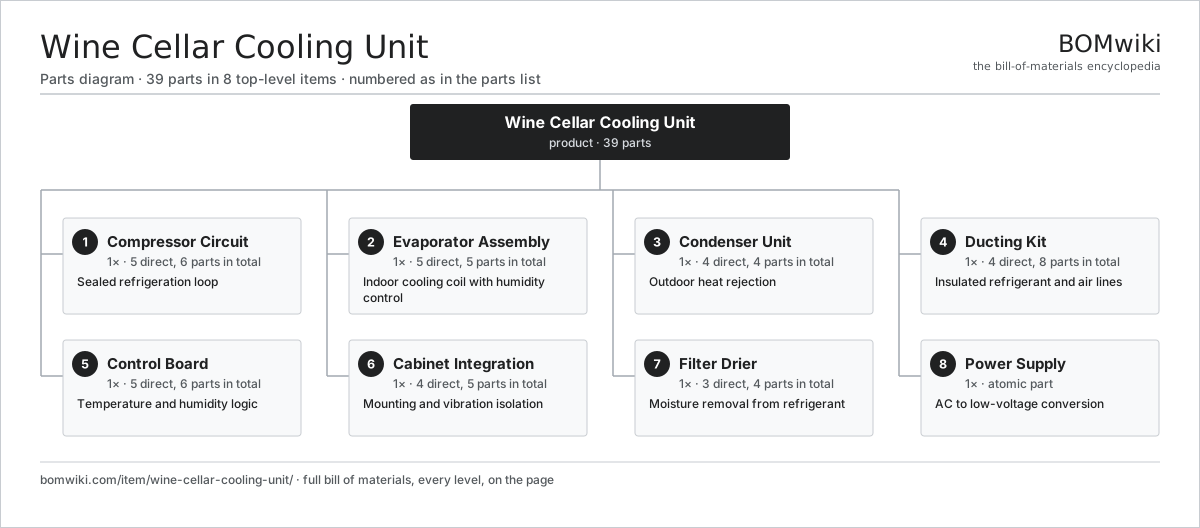
| # | Part | Qty | What it does |
|---|---|---|---|
| 1 | Compressor Circuit 5 parts | 1× | Sealed refrigeration loop |
| 2 | Evaporator Assembly 5 parts | 1× | Indoor cooling coil with humidity control |
| 3 | Condenser Unit 4 parts | 1× | Outdoor heat rejection |
| 4 | Ducting Kit 4 parts | 1× | Insulated refrigerant and air lines |
| 5 | Control Board 5 parts | 1× | Temperature and humidity logic |
| 6 | Cabinet Integration 4 parts | 1× | Mounting and vibration isolation |
| 7 | Filter Drier 3 parts | 1× | Moisture removal from refrigerant |
| 8 | Power Supply | 1× | AC to low-voltage conversion |
3D model
No 3D model yet. Have a CAD file of this? Add a 3D model. STL renders right on this page; STEP, FreeCAD, and OpenSCAD sources are welcome too (openly licensed, like all 3D models on BOMwiki).
Build & assembly graph
expand / collapse · shared sub-assemblies converge · links to related products · est. labourTap an assembly to expand/collapse · tap a part to open it · use “Open page” for any node · drag to pan, scroll to zoom.
Bill of materials for Wine Cellar Cooling Unit
8 top-level lines · 38 rows shown · 39 parts total · indented to 3 levels| # | Item / sub-assembly | Part no. | Qty/assy | Ext. qty | Parts | Type |
|---|---|---|---|---|---|---|
| 1 | Compressor Circuit 5 parts | wine-cellar-cooling-unit-compressor-circuit | 1× | 1 | 6 | assembly |
| 1.1 | Compressor | wine-cellar-cooling-unit-compressor | 1× | 1 | · | part |
| 1.2 | Wire Bundle | wire-bundle | 1× | 1 | · | part |
| 1.3 | Fastener Set | fastener-set | 1× | 1 | · | part |
| 1.4 | Thermal Fuse | thermal-fuse | 1× | 1 | · | part |
| 1.5 | Pressure Sensor | pressure-sensor | 2× | 2 | · | part |
| 2 | Evaporator Assembly 5 parts | wine-cellar-cooling-unit-evaporator-assembly | 1× | 1 | 5 | assembly |
| 2.1 | Evaporator Coil | wine-cellar-cooling-unit-evaporator-coil | 1× | 1 | · | part |
| 2.2 | Blower Motor | blower-motor | 1× | 1 | · | part |
| 2.3 | Humidity Sensor | wine-cellar-cooling-unit-humidity-sensor | 1× | 1 | · | part |
| 2.4 | O-Ring Set | oring-set | 1× | 1 | · | part |
| 2.5 | Fastener Set | fastener-set | 1× | 1 | · | part |
| 3 | Condenser Unit 4 parts | wine-cellar-cooling-unit-condenser-unit | 1× | 1 | 4 | assembly |
| 3.1 | Condenser Coil | wine-cellar-cooling-unit-condenser-coil | 1× | 1 | · | part |
| 3.2 | Condenser Fan | wine-cellar-cooling-unit-condenser-fan | 1× | 1 | · | part |
| 3.3 | Fastener Set | fastener-set | 1× | 1 | · | part |
| 3.4 | Sheet Metal Panel | sheet-panel | 1× | 1 | · | part |
| 4 | Ducting Kit 4 parts | wine-cellar-cooling-unit-ducting-kit | 1× | 1 | 8 | assembly |
| 4.1 | Refrigerant Line | wine-cellar-cooling-unit-refrigerant-line | 2× | 2 | · | part |
| 4.2 | Foam Insulation | wine-cellar-cooling-unit-foam-insulation | 2× | 2 | · | part |
| 4.3 | Ductwork | wine-cellar-cooling-unit-ductwork | 1× | 1 | · | part |
| 4.4 | Connector | connector | 3× | 3 | · | part |
| 5 | Control Board 5 parts | wine-cellar-cooling-unit-control-board | 1× | 1 | 6 | assembly |
| 5.1 | Microcontroller | mcu | 1× | 1 | · | part |
| 5.2 | SMD Passive (R/C/L) | smd-passives | 1× | 1 | · | part |
| 5.3 | Temperature Sensor | wine-cellar-cooling-unit-temperature-sensor | 1× | 1 | · | part |
| 5.4 | Relay | relay | 2× | 2 | · | part |
| 5.5 | Bare PCB | pcb-bare | 1× | 1 | · | part |
| 6 | Cabinet Integration 4 parts | wine-cellar-cooling-unit-cabinet-integration | 1× | 1 | 5 | assembly |
| 6.1 | Fastener Set | fastener-set | 1× | 1 | · | part |
| 6.2 | Coil Spring | coil-spring | 2× | 2 | · | part |
| 6.3 | Sheet Metal Panel | sheet-panel | 1× | 1 | · | part |
| 6.4 | Vibration Pad | wine-cellar-cooling-unit-vibration-pad | 1× | 1 | · | part |
| 7 | Filter Drier 3 parts | wine-cellar-cooling-unit-filter-drier | 1× | 1 | 4 | assembly |
| 7.1 | Silica Cartridge | wine-cellar-cooling-unit-silica-cartridge | 1× | 1 | · | part |
| 7.2 | Inlet Screen | wine-cellar-cooling-unit-inlet-screen | 1× | 1 | · | part |
| 7.3 | Connector | connector | 2× | 2 | · | part |
| 8 | Power Supply | power-supply | 1× | 1 | · | part |
Something wrong in this list? Report a problem with this BOM.
Related products
same domain, ranked by shared parts Automatic Pet Feeder
51 parts · shares 2 with this page
Gas Clothes Dryer
99 parts · shares 5 with this page
Automatic Pet Feeder
51 parts · shares 2 with this page
Gas Clothes Dryer
99 parts · shares 5 with this page
 Ironing Press
56 parts · shares 5 with this page
Built-In Steam Oven
79 parts · shares 5 with this page
Ironing Press
56 parts · shares 5 with this page
Built-In Steam Oven
79 parts · shares 5 with this page
 Ultrasonic Humidifier
23 parts · shares 4 with this page
Ultrasonic Humidifier
23 parts · shares 4 with this page
Sourcing: possible vendors
Browse the supplier directory → Prices, MOQ, and lead times are algorithmic estimates, not quotes, and not claims about these companies. Company mappings are curated by keyword; est. price band $150–$3k. How estimates work| Vendor | HQ | Specialty | MOQ | Lead time |
|---|---|---|---|---|
| whirlpoolcorp.com ↗ | Benton Harbor, US | Home appliances | 1,000 units | 8–14 wks |
| bsh-group.com ↗ | Munich, DE | Appliances (Bosch, Siemens) | 1,000 units | 8–14 wks |
| electroluxgroup.com ↗ | Stockholm, SE | Home appliances | 1,000 units | 8–14 wks |
| lg.com ↗ | Seoul, KR | Appliances & electronics | 1,000 units | 8–14 wks |
|
🇨🇳Haier
haier.com ↗
|
Qingdao, CN | Home appliances | 1,000 units | 8–14 wks |
904-word article