Tank Inspection Robot
ProductOverview
Tank inspection robots are specialized platforms designed for navigating and measuring internal surfaces of confined spaces, storage tanks, pressure vessels, boilers, heat exchangers, where human entry is dangerous or impossible due to hazardous atmospheres, high temperature, or tight geometry. These robots combine visual documentation (HD camera) with quantitative wall-thickness measurement (ultrasonic testing), enabling rapid assessment of corrosion severity and remaining safe life.
The platform uses magnetic track adhesion to climb vertical tank walls without mechanical fastening. An articulated arm extends the UT probe independently from the robot body, allowing the probe to be pressed firmly against the wall (for optimal acoustic coupling) while the robot itself maintains magnetic grip at a different location. This separation of probe and body adhesion points prevents probe deformation artifacts and improves measurement repeatability.
A dual-display topside console shows real-time A-scan (ultrasonic waveform) on one screen and camera video on the adjacent screen. As the operator drives the robot up the tank wall, they watch the A-scan thickness readout in real-time, annotating anomalies visually on the camera feed. Post-mission, digital data (A-scans + video) are analyzed to generate a corrosion map and remaining-life assessment.
Magnetic Track Adhesion & Climbing
The chassis features two independent electromagnetic track drives, each capable of 250 kg holding force on vertical steel surfaces. The solenoid coils are energized by proportional PWM signals, allowing field strength adjustment without full energization, a critical feature for extending battery life and reducing electromagnetic interference near sensitive sensors.
Each track is driven by a 50W brushless motor with a 30:1 gearbox, yielding approximately 0.5 m/s maximum travel speed on a horizontal surface. On a 45° incline (the maximum climbing angle for which safe operation is specified), the effective gravity component perpendicular to the surface is reduced; the robot slows but maintains grip. Steeper angles (60°+) are unsafe because the gravitational load component (parallel to the surface) exceeds the frictional contact between the track and the pipe, causing slipping.
The magnetic hold-down force (250 kg per track) is designed to exceed the maximum static friction load by a factor of 2×, ensuring that no single vibration or shock can cause sudden disengagement. The solenoid circuit includes fail-safe logic: if power is lost, the solenoid coils de-energize and internal spring-loaded plungers lock the magnetic path, maintaining minimum adhesion until power is restored.
Surface cleanliness is essential for reliable adhesion. Pre-deployment, the tank interior is assessed: loose scale or rust is removed mechanically (wire brush, scraper), and the surface is cleaned of oil or moisture with a cloth. A microscopic contamination layer (paint, scale) does not significantly affect adhesion, but heavy corrosion products or grease can reduce holding force by 50% or more.
Articulated Probe Arm & Independent Positioning
The 1m articulated arm extends forward from the robot body, terminating in a magnetic adhesion foot (separate from the body magnetic tracks). This foot provides an independent 200 kg hold point, allowing the robot to "walk" along the tank wall by alternating magnetic contact: move robot body forward, extend arm to new position and magnetically anchor, then release robot and pull forward.
Alternatively, the arm can position the UT probe perpendicular to the wall surface while the robot body remains in full magnetic contact, ensuring the probe tip makes firm contact for acoustic coupling. A pressure-feedback sensor at the probe tip monitors contact force and communicates to the topside operator via telemetry; when pressure exceeds a setpoint (typically 2 kg force), the UT measurement begins automatically.
Two servo motors on the arm provide pan-tilt articulation: one servo rotates the arm horizontally (±90° from forward), and the other tilts the probe vertically (±45°). This two-axis motion allows the probe to approach the wall at varying incidence angles, a feature useful for detecting flaws oriented at shallow angles to the wall surface (cracks parallel to the tank wall are harder to detect than those perpendicular to it).
Ultrasonic Measurement & Data Logging
The onboard UT system comprises a 50V pulser, 100 MS/s 12-bit ADC receiver, and ARM microcontroller with USB telemetry. The UT transducer is a small phased-array or single-element 2 MHz piezoelectric element, matched to the frequency range where both penetration and resolution are optimal for 5–100mm steel thickness measurements.
Measurement procedure: The operator positions the probe tip against the wall and engages magnetic contact (monitored by pressure sensor). The microcontroller fires a UT pulse; the ultrasonic wave propagates through the steel, reflects from the inner surface (back wall), and returns. The round-trip time-of-flight directly converts to wall thickness using the known sound velocity of steel (5900 m/s). Measurement latency is typically 100–500 microseconds, so 10 measurements per second are routinely logged.
Thickness resolution is approximately ±0.1mm over the 5–100mm range. If an intermediate echo is detected (indicating a flaw within the wall), the microcontroller records the echo time-of-flight (depth) and amplitude. The amplitude is converted to an equivalent flat-bottom hole (EFBH) size using calibration data; a flaw >1 mm EFBH is reliably detected.
All A-scan waveforms and measurements are timestamped and stored to the onboard data logger (1MB flash memory, sufficient for ~5,000 A-scans). Encoder data from the robot position sensors are simultaneously logged, allowing post-processing software to spatially register each measurement to a 3D tank geometry model.
Camera & Visual Documentation
An onboard 5MP color camera with a 20mm lens provides a 60° horizontal field of view, standard for tank inspection. The global-shutter sensor captures frames at 30 fps, eliminating rolling-shutter artifacts. An autofocus servo ring allows close-focus down to 10cm, enabling macro views of surface texture and corrosion morphology.
A ring of eight warm-white LEDs (300 total lumens) illuminates the tank interior. The operator can independently dim the LEDs via PWM if working near an existing light source (e.g., a manhole opening above) to reduce glare. Video frames are optionally recorded to the topside SSD, creating a visual archive of the inspection.
The camera feed is overlaid with real-time A-scan thickness data and robot position information, allowing the operator to mentally associate visual defects with precise thickness measurements. For example, a visually apparent corrosion pit can be annotated with its measured depth, enabling root-cause analysis (e.g., "pitting at the 2.0 mm depth indicates localized galvanic attack").
Topside Control System
The dual-display console positions the A-scan (UT thickness/flaw) waveform on the left screen and video on the right screen. The A-scan display includes a numerical readout of wall thickness, a graph of the full echo waveform, and a time-gate overlay showing which portion of the waveform is being used for thickness calculation.
The operator controls the robot via a dual-joystick gamepad: the left joystick drives forward/backward and steers (left/right track speed differential); the right joystick controls the probe arm pan-tilt. Buttons allow toggling magnetic field strength (useful for reducing power draw during slow inspection phases), initiating A-scan captures, and marking defect locations.
All topside control and sensor data flow through a USB hub and Windows PC, providing flexibility for custom measurement software, data export, and real-time graphing. Standard practice involves importing A-scan data post-mission into specialized ultrasonic analysis software (e.g., OmniScan, Phased Array software) for creation of C-scans (thickness maps) and flaw location plots.
Deployment Workflow & Safety
Pre-deployment planning includes mapping the tank interior (dimensions, internals like pipes or baffles, corrosion hot spots). The robot is physically transported into the tank or hoisted on a cable if the tank has a top manhole access. Once inside, the robot is positioned and powered up; the operator verifies video and UT signal quality via the topside console before beginning the inspection.
Inspection strategy depends on the tank purpose: storage tanks are typically inspected from bottom up (corrosion is worst at the waterline and bottom), while process vessels are scanned section-by-section (top, middle, bottom sections inspected separately). A typical 5m diameter storage tank is fully inspected in 4–8 hours, depending on corrosion severity (more anomalies = more time for measurement annotation).
Safety protocols are critical: the tether is secured to prevent accidental slack, and a secondary tag line may be attached in case magnetic adhesion is lost (allowing manual pull-recovery). The robot is never left unattended within the tank. Atmospheric monitoring (for confined spaces) is performed prior to and during deployment to ensure safe air quality for topside operators if human entry becomes necessary.
Post-inspection, the robot is extracted and cleaned of any residual tank contents. The tether is spooled and stored in a dry environment to prevent corrosion of the electrical contacts. Data are downloaded and backed up immediately.
Interpretation & Remaining Life Assessment
Corrosion loss is quantified as the reduction in wall thickness from nominal. For a tank with 6mm nominal wall thickness, if measurements show 5.2 mm average thickness, corrosion loss is 0.8mm. Given a known corrosion rate (e.g., 0.2 mm/year), the tank's remaining safe life is approximately 4 years before reaching a minimum-safe thickness threshold (often regulated by industry standards, e.g., 1/16" = 1.6mm in API 653 tank inspection code).
Localized corrosion (pitting) is assessed separately: a pit 2mm deep on a 6mm wall reduces local safety factor; if multiple pits exceed threshold depth, spot repairs (weld patches) or full-thickness replacement sections may be required.
The inspection report includes a thickness map (C-scan image), narrative description of corrosion distribution, photographs, and calculated remaining life. This report informs maintenance budgets and scheduling: critical tanks may be inspected annually, standard tanks every 5 years, and well-maintained tanks every 10 years.
Tank Inspection Robot parts and their functions
7 top-level parts · 37 parts in total · full bill of materials below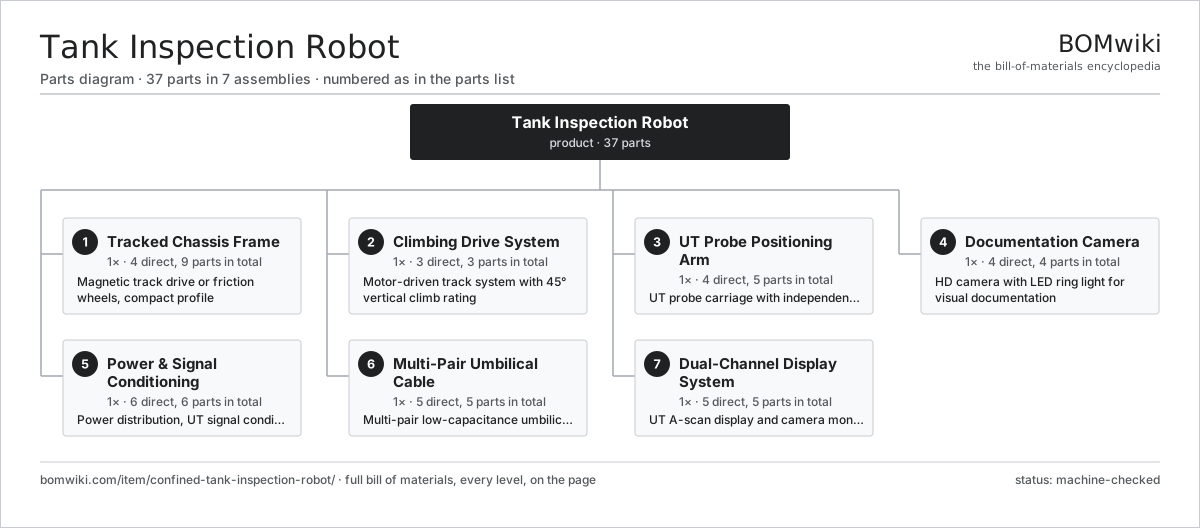
| # | Part | Qty | What it does |
|---|---|---|---|
| 1 | Tracked Chassis Frame 4 parts | 1× | Magnetic track drive or friction wheels, compact profile |
| 2 | Climbing Drive System 3 parts | 1× | Motor-driven track system with 45° vertical climb rating |
| 3 | UT Probe Positioning Arm 4 parts | 1× | UT probe carriage with independent pan-tilt positioning |
| 4 | Documentation Camera 4 parts | 1× | HD camera with LED ring light for visual documentation |
| 5 | Power & Signal Conditioning 6 parts | 1× | Power distribution, UT signal conditioning, tether interface |
| 6 | Multi-Pair Umbilical Cable 5 parts | 1× | Multi-pair low-capacitance umbilical, 200m rated |
| 7 | Dual-Channel Display System 5 parts | 1× | UT A-scan display and camera monitor, dual-channel |
3D model
No 3D model yet. Have a CAD file of this? Add a 3D model — STL renders right on this page; STEP, FreeCAD, and OpenSCAD sources are welcome too (openly licensed, like all 3D models on BOMwiki).
Build & assembly graph
expand / collapse · shared sub-assemblies converge · links to related products · est. labourTap an assembly to expand/collapse · tap a part to open it · use “Open page” for any node · drag to pan, scroll to zoom.
Bill of materials for Tank Inspection Robot
7 top-level lines · 38 rows shown · 37 parts total · indented to 3 levels| # | Item / sub-assembly | Part no. | Qty/assy | Ext. qty | Parts | Type |
|---|---|---|---|---|---|---|
| 1 | Tracked Chassis Frame 4 parts | confined-tank-inspection-robot-chassis | 1× | 1 | 9 | assembly |
| 1.1 | Aluminum Structural Frame | confined-tank-inspection-robot-frame | 1× | 1 | · | part |
| 1.2 | Electromagnetic Track Drive | confined-tank-inspection-robot-magnet-track | 2× | 2 | · | part |
| 1.3 | 48V Track Motor | confined-tank-inspection-robot-track-motor | 2× | 2 | · | part |
| 1.4 | Track Guide Wheel | confined-tank-inspection-robot-guide-wheel | 4× | 4 | · | part |
| 2 | Climbing Drive System 3 parts | confined-tank-inspection-robot-locomotion | 1× | 1 | 3 | assembly |
| 2.1 | Dual ESC Controller | confined-tank-inspection-robot-esc-drive | 1× | 1 | · | part |
| 2.2 | Magnetic Wheel Encoder | confined-tank-inspection-robot-encoder | 1× | 1 | · | part |
| 2.3 | Spring-Applied Magnetic Brake | confined-tank-inspection-robot-brake | 1× | 1 | · | part |
| 3 | UT Probe Positioning Arm 4 parts | confined-tank-inspection-robot-probe-mount | 1× | 1 | 5 | assembly |
| 3.1 | Articulated Carbon-Fiber Arm | confined-tank-inspection-robot-arm | 1× | 1 | · | part |
| 3.2 | Arm Tip Adhesion Magnet | confined-tank-inspection-robot-arm-magnet | 1× | 1 | · | part |
| 3.3 | Arm Articulation Servo | confined-tank-inspection-robot-arm-servo | 2× | 2 | · | part |
| 3.4 | UT Probe Carriage | confined-tank-inspection-robot-ut-carriage | 1× | 1 | · | part |
| 4 | Documentation Camera 4 parts | confined-tank-inspection-robot-camera | 1× | 1 | 4 | assembly |
| 4.1 | 5MP Camera Sensor | confined-tank-inspection-robot-camera-sensor | 1× | 1 | · | part |
| 4.2 | 20mm Fixed Focal Lens | confined-tank-inspection-robot-lens | 1× | 1 | · | part |
| 4.3 | LED Ring Light Module | confined-tank-inspection-robot-led-ring | 1× | 1 | · | part |
| 4.4 | Auto-Focus Servo | confined-tank-inspection-robot-focus-servo | 1× | 1 | · | part |
| 5 | Power & Signal Conditioning 6 parts | confined-tank-inspection-robot-electronics | 1× | 1 | 6 | assembly |
| 5.1 | Isolated 48V Supply | confined-tank-inspection-robot-psu | 1× | 1 | · | part |
| 5.2 | UT Pulser Module | confined-tank-inspection-robot-ut-pulser | 1× | 1 | · | part |
| 5.3 | UT Receiver Card | confined-tank-inspection-robot-ut-receiver | 1× | 1 | · | part |
| 5.4 | 12-Bit 100 MS/s ADC | confined-tank-inspection-robot-adc | 1× | 1 | · | part |
| 5.5 | ARM Cortex-M4 Logger | confined-tank-inspection-robot-mcu | 1× | 1 | · | part |
| 5.6 | 8-Contact Slip Ring | confined-tank-inspection-robot-slip-ring | 1× | 1 | · | part |
| 6 | Multi-Pair Umbilical Cable 5 parts | confined-tank-inspection-robot-tether | 1× | 1 | 5 | assembly |
| 6.1 | 2.5mm² Power Conductor | confined-tank-inspection-robot-power-pair | 1× | 1 | · | part |
| 6.2 | RG-6 Video Coaxial Cable | confined-tank-inspection-robot-video-coax | 1× | 1 | · | part |
| 6.3 | 50Ω Twisted Pair | confined-tank-inspection-robot-ut-pair | 1× | 1 | · | part |
| 6.4 | Aramid Load Member | confined-tank-inspection-robot-kevlar | 1× | 1 | · | part |
| 6.5 | Polyurethane Cable Jacket | confined-tank-inspection-robot-jacket | 1× | 1 | · | part |
| 7 | Dual-Channel Display System 5 parts | confined-tank-inspection-robot-topside | 1× | 1 | 5 | assembly |
| 7.1 | Industrial PC Core | confined-tank-inspection-robot-console-cpu | 1× | 1 | · | part |
| 7.2 | A-Scan UT Display | confined-tank-inspection-robot-display-left | 1× | 1 | · | part |
| 7.3 | Camera Video Monitor | confined-tank-inspection-robot-display-right | 1× | 1 | · | part |
| 7.4 | Dual-Joystick Control Pad | confined-tank-inspection-robot-control-joystick | 1× | 1 | · | part |
| 7.5 | Stainless Weatherproof Case | confined-tank-inspection-robot-enclosure | 1× | 1 | · | part |
Sourcing: possible vendors
Prices, MOQ, and lead times are algorithmic estimates, not quotes, and not claims about these companies. Company mappings are curated by keyword; est. price band $3k–$500k. How estimates work| Vendor | HQ | Specialty | MOQ | Lead time |
|---|---|---|---|---|
|
🇯🇵Fanuc
fanuc.com ↗
|
Oshino, JP | Industrial robots & CNC | 20 units | 10–18 wks |
| abb.com ↗ | Zurich, CH | Industrial robots | 20 units | 10–18 wks |
|
🇯🇵Yaskawa
yaskawa.com ↗
|
Kitakyushu, JP | Robots & motion | 20 units | 10–18 wks |
|
🇩🇪KUKA
kuka.com ↗
|
Augsburg, DE | Industrial robots | 20 units | 10–18 wks |
| universal-robots.com ↗ | Odense, DK | Collaborative robots | 20 units | 10–18 wks |
1,637-word article