Inspection ROV
ProductOverview
Remotely operated vehicles (ROVs) extend human inspection capability into underwater environments, pipelines, subsea infrastructure, harbors, and research sites, where human diving is dangerous, expensive, or impossible. A typical inspection ROV carries a maneuverable camera, lights, and optional sampling or manipulation equipment, connected to a surface ship or platform via a single multi-conductor tether that supplies power, telemetry, and real-time video.
This compact inspection ROV is designed for modest depths (to 500m) and moderate current environments, making it suitable for harbor surveys, environmental monitoring, and utility line inspections rather than deep-ocean research. Six thrusters in redundant vectored configuration provide 6-degree-of-freedom control, surge, sway, heave (translation), plus yaw, pitch, roll (rotation). An autopilot microcontroller fuses IMU and depth sensor data to provide depth-hold and attitude-hold modes, reducing operator fatigue during long hover periods.
The vehicle is neutrally buoyant in seawater, achieved by combining a dense aluminum pressure hull with syntactic foam blocks. A hybrid tether carries 48VDC power and video via slip rings, plus single-mode fiber for high-bandwidth video telemetry. The topside winch is motor-driven with tension feedback, allowing the operator to maintain proper tether tension even in strong currents. Recovery time from 1000m depth is approximately 20 minutes at standard winch speed.
Pressure Hull & Buoyancy Design
The main pressure housing is a 6061-T6 aluminum tube, 200mm outer diameter, 3mm wall thickness. Hemispherical endcaps with O-ring seals create an internal dry chamber housing the electronics and power distribution. The design is rated to 500m depth (50 bar internal overpressure), corresponding to a safety factor of 2.5 on material yield.
Surrounding the pressure hull are two large syntactic foam blocks (50 kg/m³ density), each providing approximately 100 kg of buoyancy in seawater. These are precision-machined hydrodynamic shapes (torpedo-like cross-section) to minimize drag. The total buoyancy is tuned so the ROV, including all equipment, tether weight in water, and thrusters, is neutrally buoyant at the surface and slightly heavier-than-water at 500m depth (due to compressibility). This trim allows the vehicle to hang stationary mid-water without thruster effort, conserving power.
All fasteners are stainless steel (316L) or anodized aluminum to resist galvanic corrosion in seawater. The frame is aluminum extrusion (T-slots) with cable clamps for organizing tether routing and sensor cables. Every opening (cable glands, connectors) uses dynamic seals (O-rings or metal face seals) rated for the depth and salinity.
Six-Axis Propulsion System
The six-thruster configuration is arranged as four horizontal thrusters (two forward-left, two forward-right, vectored inward 15°) for surge and sway control, plus two vertical thrusters (up and down) for heave. This arrangement provides redundancy: loss of any single thruster degrades maneuverability but does not cripple the vehicle. Each thruster is a compact brushless motor (90W) driving a variable-pitch propeller, mounted on a ball-joint that allows vectoring ±15° off the primary axis.
Each thruster is driven by a dedicated 30A electronic speed controller (ESC) with feedback. The ESC monitors motor current and detects stall (overcurrent); if a thruster jams (due to net entanglement or debris), the ESC automatically reduces current to prevent burnout and alerts the topside operator. The combined rated thrust is 180 kg total, sufficient to achieve 1 knot (0.5 m/s) forward speed or hovering against 0.5 knot current.
The thrusters are sealed with dynamic shaft seals and require regular maintenance: every 50 flight hours, they are serviced to flush salt deposits from the motor bearings. Spare thrusters are carried aboard the surface platform for rapid hot-swap during missions.
Camera & Lighting System
The primary payload is a 1080p HD color camera with motorized 10× optical zoom. The lens has a minimum focusing distance of 20cm, allowing close inspection of small features. Auto-focus and auto-exposure firmware handles variable lighting (from bright surface sun to deep-water darkness). The camera outputs both analog composite video (for immediate topside display) and digital H.264 video (for recording to the topside logger).
Three 1000-lumen LED work lights are mounted around the camera head, each independently dimmable via PWM (pulse-width modulation). In deep water where natural light is absent, the LEDs provide essential illumination; in shallow water, they can be dimmed to reduce glare and conserve power. All lights are spectrally calibrated to 6000K (daylight white), which minimizes water absorption and renders true colors for biological or mineral identification.
The camera assembly is mounted on a pan-tilt mechanism: a continuous-rotation pan motor allows 360° yaw (for sweeping scans), and a tilt servo motor provides ±90° pitch (for looking up at overheads or down at the seafloor). A third servo provides fixed mounting of the whole assembly to ensure repeatable camera orientation. This allows the operator to steer the camera independent of vehicle heading, a critical feature for detailed inspection work.
Tether Management & Power Distribution
The hybrid tether is 10mm diameter, carrying eight power conductors (48V, return, sense), one redundant 24V circuit, and a single-mode fiber-optic pair embedded in the jacket. The electrical paths are sized to deliver 10A at 48V over 1000m with <5% voltage drop. The slip-ring coupler at the ROV end has eight gold-plated contacts rated for 5A each, with mercury-free brushes for reliability.
The single-mode fiber carries HD video from the topside to the ROV (for optional operator commands) and standard definition video back from the ROV to topside. Bandwidth is sufficient for 1080p 30fps H.264 video at 2–3 Mbps, plus telemetry data (IMU, depth, attitude) at low bitrate.
Topside, the power source is a 5 kW 48VDC supply (shore-powered or generator-backed), which connects to a large motorized winch. The winch spool is 1.2m diameter, storing up to 1000m of tether. A variable-frequency drive (VFD) on the winch motor allows smooth speed control: 0.5–2 m/min descent/ascent rates are typical, allowing careful handling in currents. A load cell mounted on the tether bracket measures tension continuously; if tension exceeds a setpoint (e.g., vehicle snagged), the operator can pause and adjust attitude to minimize strain.
A mechanical depth counter (essentially an odometer on the winch) tracks tether payout; when the counter reaches the 1000m mark, a limit switch halts motor advance and alerts the operator to begin retrieval.
Navigation & Autopilot
The onboard autopilot computer is an ARM-based microcontroller with 9-DOF IMU (accelerometer, gyroscope, magnetometer), barometric depth sensor, and compass. It fuses these sensors via a Kalman filter to estimate attitude (roll, pitch, yaw) and depth. A proportional-integral controller uses attitude error to command individual thruster current, stabilizing the ROV against hydrodynamic disturbances (current, wave surge).
Two autopilot modes are available:
- Depth-hold: The operator commands horizontal thruster only; the vehicle maintains constant depth via vertical thruster feedback.
- Attitude-hold: The operator commands horizontal thrust and yaw; the vehicle automatically levels roll and pitch.
These modes dramatically reduce operator workload during sustained hover operations (e.g., inspecting a fixed subsea structure). Without autopilot, the operator must constantly adjust all six thrusters to counteract current and vehicle dynamics.
Manipulator Arm & Sampling
An optional 5-axis hydraulic manipulator arm extends reach to 1m from the ROV body. The arm has proportional solenoid servo valves allowing smooth (not bang-bang) joint motion. A variable-flow hydraulic pump supplies oil at the ROV; the pump displacement is modulated by the topside operator via a proportional valve. Typical grip force is 50 kg, sufficient to collect sediment samples, manipulate subsea tools, or clear light obstructions.
A sample basket (titanium frame, stainless mesh) is mounted on the manipulator's end effector. Once samples are collected, the arm lowers the basket over a catch basin on the ROV frame, then retracts. Upon return to the surface, the basket is recovered and samples are processed.
Hydraulic operation in seawater requires scrupulous maintenance: all hoses are stainless-braided with quick-disconnect flat-face couplers (preventing spillage on disconnect), and the hydraulic fluid is a special biodegradable formulation. Annual inspection includes hose replacement and seal service.
Operational Workflow & Maintenance
Pre-dive checks include a 30-minute tankside test: the ROV is placed in a test tank, all thrusters are exercised, camera focus and zoom are verified, and lights are tested. Battery voltage on the topside supply is confirmed. The tether is visually inspected for kinks or damage; the winch is spun forward and reverse to verify smooth operation.
At the survey site, the ROV is lowered to 10m depth for a trim check: buoyancy is adjusted by adding or removing small lead weights until the vehicle hovers without thruster input. Then the descent begins at <1 m/min, with the topside operator monitoring depth gauge and attitude display. As depth increases, water pressure compresses the air remaining in the hull; the onboard pressure sensor registers this, and the topside crew is alerted if compression exceeds design limits (indicating a leak).
At the target depth, the operator takes manual control via the joystick, piloting the ROV along predefined inspection routes (e.g., along a pipeline axis). The camera and lights are continuously repositioned to examine structures. Video is recorded digitally for later analysis, and a topside technician takes still photographs of notable features.
At mission end, retrieval begins at 1 m/min, with the winch tension monitored to prevent shock loads. Once at the surface, the ROV is lifted aboard and immediately rinsed with fresh water to remove salt. The electronics pod is opened and inspected for water ingress (a desiccant packet inside should be dry); if wet, the pod is disassembled and carefully dried.
Maintenance is scheduled as follows: after every 50 flight hours, each thruster is serviced (flush and bearing relubrication). Annually, all seals, O-rings, and slip-ring contacts are inspected and replaced if necessary. The pressure hull is hydrostatically pressure-tested every 2 years to confirm structural integrity.
Inspection ROV parts and their functions
8 top-level parts · 54 parts in total · full bill of materials below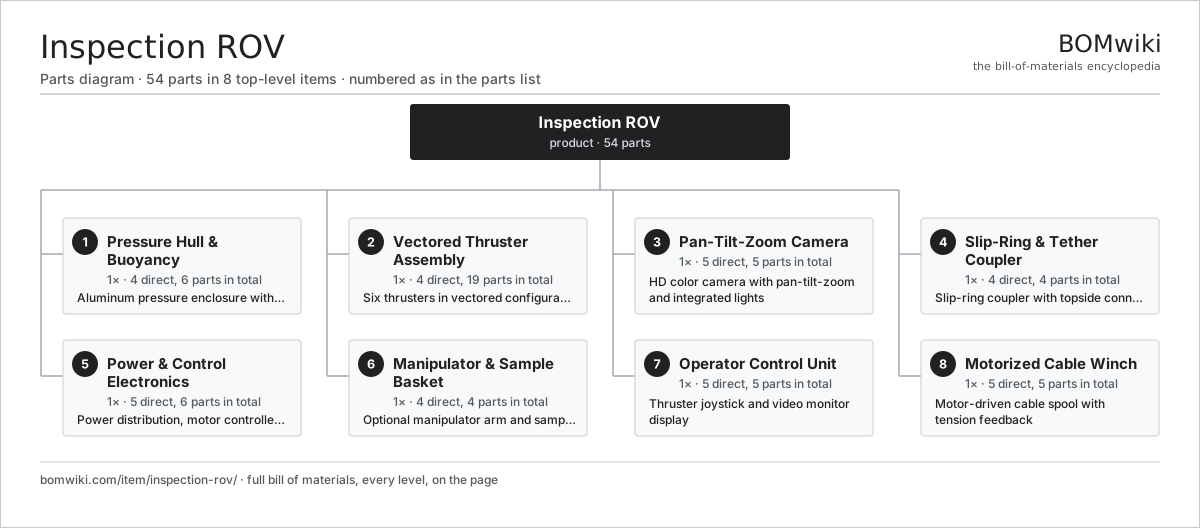
| # | Part | Qty | What it does |
|---|---|---|---|
| 1 | Pressure Hull & Buoyancy 4 parts | 1× | Aluminum pressure enclosure with buoyancy foam pods |
| 2 | Vectored Thruster Assembly 4 parts | 1× | Six thrusters in vectored configuration for 6-DOF control |
| 3 | Pan-Tilt-Zoom Camera 5 parts | 1× | HD color camera with pan-tilt-zoom and integrated lights |
| 4 | Slip-Ring & Tether Coupler 4 parts | 1× | Slip-ring coupler with topside connection and management arm |
| 5 | Power & Control Electronics 5 parts | 1× | Power distribution, motor controllers, sonar interface |
| 6 | Manipulator & Sample Basket 4 parts | 1× | Optional manipulator arm and sample basket |
| 7 | Operator Control Unit 5 parts | 1× | Thruster joystick and video monitor display |
| 8 | Motorized Cable Winch 5 parts | 1× | Motor-driven cable spool with tension feedback |
3D model
No 3D model yet. Have a CAD file of this? Add a 3D model. STL renders right on this page; STEP, FreeCAD, and OpenSCAD sources are welcome too (openly licensed, like all 3D models on BOMwiki).
Build & assembly graph
expand / collapse · shared sub-assemblies converge · links to related products · est. labourTap an assembly to expand/collapse · tap a part to open it · use “Open page” for any node · drag to pan, scroll to zoom.
Bill of materials for Inspection ROV
8 top-level lines · 44 rows shown · 54 parts total · indented to 3 levels| # | Item / sub-assembly | Part no. | Qty/assy | Ext. qty | Parts | Type |
|---|---|---|---|---|---|---|
| 1 | Pressure Hull & Buoyancy 4 parts | inspection-rov-hull | 1× | 1 | 6 | assembly |
| 1.1 | Aluminum Pressure Tube | inspection-rov-tube-body | 1× | 1 | · | part |
| 1.2 | Hemispherical Endcap | inspection-rov-endcaps | 2× | 2 | · | part |
| 1.3 | Syntactic Foam Buoyancy Block | inspection-rov-foam-pod | 2× | 2 | · | part |
| 1.4 | Aluminum Structural Rail | inspection-rov-frame-extrusion | 1× | 1 | · | part |
| 2 | Vectored Thruster Assembly 4 parts | inspection-rov-thruster-array | 1× | 1 | 19 | assembly |
| 2.1 | Brushless Thruster Unit | inspection-rov-thruster | 6× | 6 | · | part |
| 2.2 | Thruster Electronic Speed Controller | inspection-rov-thruster-esc | 6× | 6 | · | part |
| 2.3 | Thruster Swivel Mount | inspection-rov-mount-gimbal | 6× | 6 | · | part |
| 2.4 | Flexible Motor-Prop Coupling | inspection-rov-coupling | 1× | 1 | · | part |
| 3 | Pan-Tilt-Zoom Camera 5 parts | inspection-rov-camera-head | 1× | 1 | 5 | assembly |
| 3.1 | 1080p Camera Sensor | inspection-rov-camera-sensor | 1× | 1 | · | part |
| 3.2 | 10× Optical Zoom Lens | inspection-rov-zoom-lens | 1× | 1 | · | part |
| 3.3 | Pan Motor with Gearbox | inspection-rov-pan-motor | 1× | 1 | · | part |
| 3.4 | Tilt Servo Motor | inspection-rov-tilt-motor | 1× | 1 | · | part |
| 3.5 | LED Work Light Cluster | inspection-rov-led-array | 1× | 1 | · | part |
| 4 | Slip-Ring & Tether Coupler 4 parts | inspection-rov-tether-interface | 1× | 1 | 4 | assembly |
| 4.1 | Industrial Slip Ring Assembly | inspection-rov-slip-ring | 1× | 1 | · | part |
| 4.2 | Single-Mode Fiber Rotary Joint | inspection-rov-fiber-rotary | 1× | 1 | · | part |
| 4.3 | Wet-Mateable Circular Connector | inspection-rov-connector-wet | 1× | 1 | · | part |
| 4.4 | Tether Management Arm | inspection-rov-management-arm | 1× | 1 | · | part |
| 5 | Power & Control Electronics 5 parts | inspection-rov-electronics-pod | 1× | 1 | 6 | assembly |
| 5.1 | 500W 48VDC Isolated Supply | inspection-rov-psu-48v | 2× | 2 | · | part |
| 5.2 | Power Distribution Panel | inspection-rov-distribution-board | 1× | 1 | · | part |
| 5.3 | Six-Channel ESC Driver | inspection-rov-esc-driver-board | 1× | 1 | · | part |
| 5.4 | Autopilot Navigation Computer | inspection-rov-nav-computer | 1× | 1 | · | part |
| 5.5 | Forward-Looking Sonar Interface | inspection-rov-sonar-interface | 1× | 1 | · | part |
| 6 | Manipulator & Sample Basket 4 parts | inspection-rov-sampling-frame | 1× | 1 | 4 | assembly |
| 6.1 | Hydraulic 5-Axis Manipulator | inspection-rov-manipulator-arm | 1× | 1 | · | part |
| 6.2 | High-Pressure Hydraulic Hose | inspection-rov-hydraulic-lines | 1× | 1 | · | part |
| 6.3 | Sample Collection Basket | inspection-rov-sample-basket | 1× | 1 | · | part |
| 6.4 | Manipulator Claw Assembly | inspection-rov-hook-clamp | 1× | 1 | · | part |
| 7 | Operator Control Unit 5 parts | inspection-rov-topside-console | 1× | 1 | 5 | assembly |
| 7.1 | Dual-Axis Analog Joystick | inspection-rov-joystick | 1× | 1 | · | part |
| 7.2 | Fiber-Optic Video Demodulator | inspection-rov-video-demod | 1× | 1 | · | part |
| 7.3 | 17-inch LCD Monitor | inspection-rov-monitor-17in | 1× | 1 | · | part |
| 7.4 | Control Box Weatherproof Housing | inspection-rov-console-enclosure | 1× | 1 | · | part |
| 7.5 | Topside Ethernet Module | inspection-rov-comms-interface | 1× | 1 | · | part |
| 8 | Motorized Cable Winch 5 parts | inspection-rov-tether-winch | 1× | 1 | 5 | assembly |
| 8.1 | 5 kW Three-Phase Motor | inspection-rov-winch-motor | 1× | 1 | · | part |
| 8.2 | Steel Cable Spool | inspection-rov-winch-drum | 1× | 1 | · | part |
| 8.3 | Tension Load Cell | inspection-rov-tension-monitor | 1× | 1 | · | part |
| 8.4 | Tether Depth Counter | inspection-rov-depth-counter | 1× | 1 | · | part |
| 8.5 | Disc Brake with Spring Release | inspection-rov-brake-system | 1× | 1 | · | part |
Something wrong in this list? Report a problem with this BOM.
Sourcing: possible vendors
Browse the supplier directory → Prices, MOQ, and lead times are algorithmic estimates, not quotes, and not claims about these companies. Company mappings are curated by keyword; est. price band $3k–$500k. How estimates work| Vendor | HQ | Specialty | MOQ | Lead time |
|---|---|---|---|---|
|
🇯🇵Fanuc
fanuc.com ↗
|
Oshino, JP | Industrial robots & CNC | 20 units | 10–18 wks |
| abb.com ↗ | Zurich, CH | Industrial robots | 20 units | 10–18 wks |
|
🇯🇵Yaskawa
yaskawa.com ↗
|
Kitakyushu, JP | Robots & motion | 20 units | 10–18 wks |
|
🇩🇪KUKA
kuka.com ↗
|
Augsburg, DE | Industrial robots | 20 units | 10–18 wks |
| universal-robots.com ↗ | Odense, DK | Collaborative robots | 20 units | 10–18 wks |
1,657-word article