LiDAR Mapping Payload
ProductOverview
LiDAR (Light Detection and Ranging) mapping payloads transform drones into airborne surveying instruments, collecting dense three-dimensional point clouds of terrain, vegetation, and structures from altitudes of 50–500m. Unlike passive photogrammetry (which requires sufficient lighting and visible features), LiDAR actively illuminates with a laser, measuring distance via return-time analysis. This enables rapid high-accuracy topographic mapping, utility corridor inspection, corridor powerline modeling, and 3D forest biomass estimation.
An integrated payload pod houses a spinning 905nm laser with polygon mirror scanner, generating 600,000 range measurements per second across 16, 32, or 64 channels (depending on configuration). A real-time inertial/GNSS module records the drone's pose and orientation 10 times per second; a high-speed FPGA captures and timestamps each LiDAR frame. The collected point cloud is instantly geo-referenced (ground-corrected) onboard and written to disk in industry-standard LAS 1.4 format, enabling immediate post-processing with Pix4D, CloudCompare, or proprietary GIS tools.
The payload integrates a motorized three-axis gimbal, stabilizing the LiDAR's nadir direction to true-vertical despite drone pitch, roll, and yaw perturbations. This active stabilization ensures data quality even during windy flights or aggressive turns. The pod is encased in vibration-isolated carbon-fiber aerodynamics, thermally managed to keep the laser and electronics within safe operating ranges across −10 to +50°C ambient.
Laser Scanning Architecture
The laser head consists of a compact 905nm pulsed diode (50W peak power, 100ns pulse width) fiber-coupled to a collimating optic that produces a 0.5° divergence beam. The laser fires at 600 kHz pulse rate, generating one range sample per pulse. The return light is collected by a Fresnel lens (100mm diameter), focused onto an avalanche photodiode (APD) array.
The key innovation is the rotating polygon mirror: a precision-machined 16-facet reflective cylinder spins at 600 rpm, presenting each facet sequentially to the incoming laser beam. This deflection creates a circular scan pattern in the horizontal plane, sweeping a full 360° every rotation cycle (100 ms at 600 rpm). Stacking multiple scanners with different elevation angles yields the 16, 32, or 64-channel configurations. Each channel has dedicated optics, timing electronics, and a photodiode; time-to-digital converters (TDCs) measure the return flight-time with <100 picosecond resolution, translating directly to range with <3cm accuracy.
The receiver array must be sensitive to weak returns from dark targets at 200m distance, the return power drops as the fourth power of distance. Each APD is individually quenched and reset after each pulse, allowing measurement of the next return. The timing module combines all channel outputs into a synchronized frame: up to 600k 16-bit range values plus intensity (reflectivity) per second.
Real-Time Georeferencing
A critical advantage of modern airborne LiDAR is immediate georeferencing: point clouds are grounded in absolute position and orientation as they are collected, not after post-processing. This requires tight time-synchronization and dual-rate fusion of inertial and GNSS data.
The onboard IMU (nine-axis MEMS accelerometer, gyroscope, magnetometer) samples at 200 Hz, capturing high-frequency attitude dynamics (drone banking, pitch changes). A multi-constellation GNSS receiver (GPS + GLONASS + Galileo + BeiDou) outputs position and velocity 10 times per second with meter-level accuracy; when operating with an RTK base station, accuracy improves to <2cm horizontal and <5cm vertical.
A Kalman filter fuses both sensors: the gyroscope provides high-rate attitude derivative (dθ/dt), the accelerometer provides gravity reference (horizon detection), and the GNSS provides long-term position correction. The output is a pose estimate (X, Y, Z, roll, pitch, yaw) at 200 Hz, synchronized to the LiDAR frame timestamp by a disciplined oscillator (10 MHz OCXO) disciplined by GNSS PPS (pulse-per-second). Each range measurement is tagged with capture time; at post-processing time, the pose at that moment is interpolated, and the 3D point is computed:
point = drone_position + rotation_matrix(attitude) × local_range_vector
This results in point clouds where absolute coordinates are known to within sensor accuracy limits (±5cm typical), eliminating tedious manual tie-point surveys and reducing post-processing time from days to hours.
Gimbal Stabilization & Data Quality
Wind and drone dynamics introduce pitch, roll, and yaw perturbations. Without active stabilization, the LiDAR beam would sweep erratically, creating angular distortion in the point cloud and missing data in lee areas. The gimbal system uses three brushless servo motors (pan, tilt, roll) to maintain the LiDAR's nadir (downward vertical) to within 0.1° of true vertical.
A rate-gyroscope senses angular velocity on all three axes at 200 Hz. A dual-loop controller generates motor commands: an inner "rate" loop uses gyro feedback to dampen oscillation (proportional-integral-derivative PID), and an outer "angle" loop (running at 10 Hz) uses GNSS heading and IMU roll/pitch to slowly trim the gimbal back toward true vertical. This cascaded architecture keeps the gimbal responsive to high-frequency wind gusts while stable over long timescales.
The tilt axis (elevation) is typically locked at 0° (full nadir) for topographic survey, but it can be tilted ±45° for oblique scanning (e.g., inspecting vertical building facades or cliff walls). The roll and pan axes allow a full ±15° roll correction and continuous 360° pan rotation, enabling the operator to aim the LiDAR at specific features even while flying straight.
Compute & Data I/O
Real-time point-cloud processing demands significant compute. A quad-core ARM A72 processor (1 GHz) with 4GB RAM runs a Linux kernel and the LiDAR driver software. An FPGA (Virtex-7) handles the time-critical LiDAR frame capture and timestamping; the CPU polls the FPGA every millisecond, reads buffered frame data, applies sensor calibration (range bias, intensity scale factors), and writes to the SSD.
A disciplined 10 MHz oscillator locks to the GNSS 1-PPS signal, providing a master clock with <10 ppm drift. The LiDAR and IMU sample clocks are derived from this master, ensuring all sensors run on the same timebase. Time-synchronization errors (more than a few milliseconds) cause artifacts in the fused point cloud; the disciplined oscillator is essential for survey-grade accuracy.
The SSD storage is industrial-grade MLC NAND with <500ms write latency. At 600k points/second, each point occupies 8 bytes (2 bytes range, 2 bytes intensity, 2 bytes channel ID, 2 bytes timestamp delta), yielding 4.8 MB/s raw data rate. Compression (lossless zstd) reduces this to 1.5–2 MB/s depending on scene complexity. A 256GB SSD therefore stores 3+ hours of continuous mapping, more than enough for a typical mission.
Thermal Management & Ruggedness
The laser and receiver APD array dissipate 180W collectively. Passive copper thermosiphon coolers (heat pipes) route waste heat to the aerodynamic pod exterior. The open-cell polyurethane foam lining acts as both vibration isolator (50–100 Hz natural frequency) and thermal insulation, minimizing temperature swings during altitude changes (where ambient can vary 40°C/1000m).
Operating temperature range is −10 to +50°C. At high-altitude operations (e.g., survey at 3000m AGL on a cold day), the pod interior remains within specification due to passive cooling and insulation. The laser diode output is thermally compensated via a feedback circuit that adjusts drive current to maintain constant optical power across temperature.
The enclosure is carbon-fiber/epoxy with a quick-disconnect interface for rapid payload swaps. Typical attachment to a drone frame is four-point isolation feet (silicone elastomer) to decouple pod vibration from the airframe, reducing coupling into the IMU and improving attitude measurement fidelity.
Integration & Workflow
Pre-flight setup includes a ten-minute bench calibration: the pod is placed on a level surface, the IMU performs a static bias calibration (gyro null, accel gravity vector), and the GNSS receiver achieves initial fix. The LiDAR is energized and fires a test scan; the FPGA reports frame rate and channel health. The SSD is wiped and formatted for the upcoming mission.
During flight, the operator monitors telemetry on a remote display: drone position (via GNSS), battery remaining, LiDAR range returns, and gimbal attitude. At the mission end or SSD capacity limit, the drone returns home, landing and powering down. The SSD is extracted and connected to a workstation; the onboard LAS files are moved to a network storage or cloud server for post-processing.
Post-processing tools (Pix4D, DJI Terra) ingest the LAS files and perform optional refinements: RTK base-station post-processing (if RTK corrections were unavailable during flight), intensity normalization across varying incidence angles, and noise filtering (removal of spurious returns from birds or dust). The output point cloud is typically 10–50 million points for a 10 km² survey, with <5cm horizontal and <10cm vertical accuracy. Dense point clouds enable derivation of digital elevation models (DEMs), orthomosaics, and 3D meshes for GIS integration or volume calculations.
LiDAR Mapping Payload parts and their functions
6 top-level parts · 30 parts in total · full bill of materials below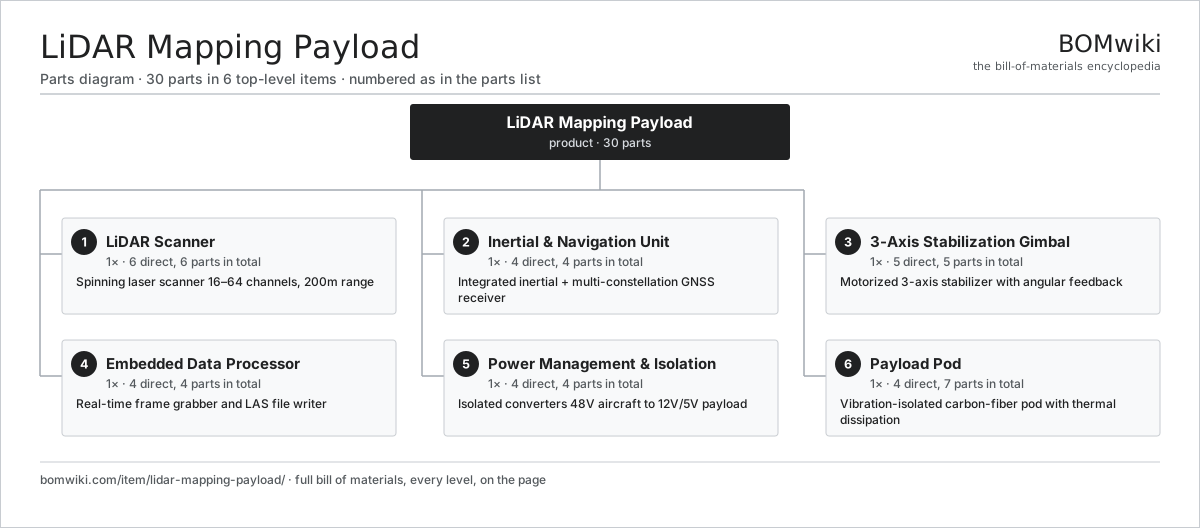
| # | Part | Qty | What it does |
|---|---|---|---|
| 1 | LiDAR Scanner 6 parts | 1× | Spinning laser scanner 16–64 channels, 200m range |
| 2 | Inertial & Navigation Unit 4 parts | 1× | Integrated inertial + multi-constellation GNSS receiver |
| 3 | 3-Axis Stabilization Gimbal 5 parts | 1× | Motorized 3-axis stabilizer with angular feedback |
| 4 | Embedded Data Processor 4 parts | 1× | Real-time frame grabber and LAS file writer |
| 5 | Power Management & Isolation 4 parts | 1× | Isolated converters 48V aircraft to 12V/5V payload |
| 6 | Payload Pod 4 parts | 1× | Vibration-isolated carbon-fiber pod with thermal dissipation |
3D model
No 3D model yet. Have a CAD file of this? Add a 3D model. STL renders right on this page; STEP, FreeCAD, and OpenSCAD sources are welcome too (openly licensed, like all 3D models on BOMwiki).
Build & assembly graph
expand / collapse · shared sub-assemblies converge · links to related products · est. labourTap an assembly to expand/collapse · tap a part to open it · use “Open page” for any node · drag to pan, scroll to zoom.
Bill of materials for LiDAR Mapping Payload
6 top-level lines · 33 rows shown · 30 parts total · indented to 3 levels| # | Item / sub-assembly | Part no. | Qty/assy | Ext. qty | Parts | Type |
|---|---|---|---|---|---|---|
| 1 | LiDAR Scanner 6 parts | lidar-mapping-payload-lidar-module | 1× | 1 | 6 | assembly |
| 1.1 | Pulsed Laser Diode Module | lidar-mapping-payload-laser-head | 1× | 1 | · | part |
| 1.2 | Brushless Scanner Motor | lidar-mapping-payload-motor | 1× | 1 | · | part |
| 1.3 | MEMS Polygon Mirror | lidar-mapping-payload-scanner-mirror | 1× | 1 | · | part |
| 1.4 | APD Receiver Array | lidar-mapping-payload-receiver-array | 1× | 1 | · | part |
| 1.5 | Time-to-Digital Converter | lidar-mapping-payload-timing-module | 1× | 1 | · | part |
| 1.6 | Copper Thermosiphon | lidar-mapping-payload-thermal-vent | 1× | 1 | · | part |
| 2 | Inertial & Navigation Unit 4 parts | lidar-mapping-payload-imu-gnss | 1× | 1 | 4 | assembly |
| 2.1 | 9-DOF MEMS IMU | lidar-mapping-payload-imu-sensor | 1× | 1 | · | part |
| 2.2 | Multi-Constellation RTK GNSS | lidar-mapping-payload-gnss-receiver | 1× | 1 | · | part |
| 2.3 | Sensor Fusion Processor | lidar-mapping-payload-fusion-proc | 1× | 1 | · | part |
| 2.4 | Active GNSS Antenna | lidar-mapping-payload-antenna | 1× | 1 | · | part |
| 3 | 3-Axis Stabilization Gimbal 5 parts | lidar-mapping-payload-gimbal | 1× | 1 | 5 | assembly |
| 3.1 | Pan Servo Motor | lidar-mapping-payload-pan-motor | 1× | 1 | · | part |
| 3.2 | Tilt Servo Motor | lidar-mapping-payload-tilt-motor | 1× | 1 | · | part |
| 3.3 | Roll Servo Motor | lidar-mapping-payload-roll-motor | 1× | 1 | · | part |
| 3.4 | Dual-Loop Servo Controller | lidar-mapping-payload-gimbal-controller | 1× | 1 | · | part |
| 3.5 | Angular Contact Bearing Pair | lidar-mapping-payload-bearing-set | 1× | 1 | · | part |
| 4 | Embedded Data Processor 4 parts | lidar-mapping-payload-computer | 1× | 1 | 4 | assembly |
| 4.1 | Quad-Core ARM A72 SBC | lidar-mapping-payload-cpu-board | 1× | 1 | · | part |
| 4.2 | 256GB Industrial SSD | lidar-mapping-payload-storage | 1× | 1 | · | part |
| 4.3 | Virtex-7 FPGA Module | lidar-mapping-payload-interface-fpga | 1× | 1 | · | part |
| 4.4 | Disciplined Oscillator | lidar-mapping-payload-clock-module | 1× | 1 | · | part |
| 5 | Power Management & Isolation 4 parts | lidar-mapping-payload-power-dist | 1× | 1 | 4 | assembly |
| 5.1 | 48V-to-12V Isolated Converter | lidar-mapping-payload-isolated-12v | 1× | 1 | · | part |
| 5.2 | 12V-to-5V Isolated Converter | lidar-mapping-payload-isolated-5v | 1× | 1 | · | part |
| 5.3 | Soft-Start Limiter | lidar-mapping-payload-soft-start | 1× | 1 | · | part |
| 5.4 | Rail Monitor ADC | lidar-mapping-payload-voltage-monitor | 1× | 1 | · | part |
| 6 | Payload Pod 4 parts | lidar-mapping-payload-enclosure | 1× | 1 | 7 | assembly |
| 6.1 | Carbon-Fiber Pod | lidar-mapping-payload-pod-shell | 1× | 1 | · | part |
| 6.2 | Polyurethane Foam | lidar-mapping-payload-foam-insulation | 1× | 1 | · | part |
| 6.3 | Silicone Isolator Foot | lidar-mapping-payload-iso-feet | 4× | 4 | · | part |
| 6.4 | Aluminum Connector Backplate | lidar-mapping-payload-connector-plate | 1× | 1 | · | part |
Something wrong in this list? Report a problem with this BOM.
Sourcing: possible vendors
Browse the supplier directory → Prices, MOQ, and lead times are algorithmic estimates, not quotes, and not claims about these companies. Company mappings are curated by keyword; est. price band $3k–$500k. How estimates work| Vendor | HQ | Specialty | MOQ | Lead time |
|---|---|---|---|---|
|
🇯🇵Fanuc
fanuc.com ↗
|
Oshino, JP | Industrial robots & CNC | 20 units | 10–18 wks |
| abb.com ↗ | Zurich, CH | Industrial robots | 20 units | 10–18 wks |
|
🇯🇵Yaskawa
yaskawa.com ↗
|
Kitakyushu, JP | Robots & motion | 20 units | 10–18 wks |
|
🇩🇪KUKA
kuka.com ↗
|
Augsburg, DE | Industrial robots | 20 units | 10–18 wks |
| universal-robots.com ↗ | Odense, DK | Collaborative robots | 20 units | 10–18 wks |
1,457-word article