Pipe Inspection Crawler
ProductAlso known as: Pipe Inspection Crawler (Large Bore)
Overview
Pipe inspection crawlers are small tracked robots that navigate through the interior of pipelines, transmitting live video of the bore condition to topside operators. They are deployed through isolation plugs or tees, crawling along the pipe interior while a motorized reel controls cable tension and payout. This non-destructive inspection method is critical for water utilities, gas distributors, wastewater treatment, and industrial processes to detect corrosion, blockages, cracks, root intrusion, and joint misalignment without excavation.
The crawler is a compact low-profile chassis with rubber caterpillar tracks, differential-steered by independent motor drive on left and right sides. A motorized pan-tilt camera head rotates 360° horizontally and ±45° vertically, allowing the operator to examine pipes walls, joints, and obstacles. A ring of white LEDs illuminates the pipe bore; the operator can adjust brightness via PWM dimming to optimize contrast and detect subtle defects.
A topside control station, typically a portable battery-powered case with joystick controller and 7-inch touchscreen display, shows live video feed transmitted through an armored cable. The cable is wound on a motorized spool with variable-speed drive, allowing the operator to control crawler speed and direction via the cable reel motor. This hybrid approach (dual control channels: cable reel speed + crawler motor differential steering) provides intuitive operation: the reel drives the crawler forward/reverse like a remote-controlled car on a tether.
Tracked Chassis & Drive System
The chassis is injection-molded from durable polycarbonate or nylon, sized to fit pipes from 200–600mm internal diameter. The low profile (100mm height) minimizes contact with pipe crown and floor, reducing stuck-in-pipe risk. Two rubber caterpillar belts, each 200mm long and 40mm wide, drive the robot via independent sprockets. Guide wheels above and below the tracks ensure tracking and prevent derailment on curved sections or joints.
Each track is powered by a 48V 60W brushless motor with 30:1 planetary gearbox reduction, providing high torque at low speed. The gearbox ratio yields approximately 10 rpm at the sprocket, translating to 0.3 m/min crawl speed at 30% throttle and 1.0 m/min at 100% throttle. This low speed is intentional: it gives the operator time to examine walls and prevents overshooting areas of interest.
Differential steering is achieved by commanding different speeds to the left and right motors. Equal speed drives straight; left slower drives right (left turn) and vice versa. A proportional dual-channel ESC (electronic speed controller) takes joystick input and modulates each motor independently, giving the operator smooth proportional control. Overspeed protection automatically limits thrust if either motor draws >15A, preventing stalls and prolonging motor life.
Track design is critical: serrated drive lugs provide grip on wet surfaces inside pipes; the rubber compound is selected for temperature range (−5 to +50°C), resistant to oils and grease, and rated for ~500 hours continuous use before replacement (typical after 5–10 inspection missions). Spare track sets are included with every deployment kit.
Camera & Lighting
The forward-mounted camera is a compact 5MP global-shutter CMOS sensor delivering 1920×1080 progressive video at 30 frames per second. A 16mm fixed focal length lens gives a 60° horizontal field of view, standard for pipe inspection (wide enough to see walls, joints, and diameter, narrow enough to provide detail). The global shutter (all pixels captured simultaneously) eliminates rolling-shutter distortion common in rolling-shutter devices, crucial when panning quickly across joints.
Auto-focus and auto-exposure firmware (onboard edge processor) adjust image brightness to accommodate varying lighting conditions. In dark sections (unlit pipe), the LED ring provides supplemental illumination; in sections where daylight penetrates (e.g., near a manhole access), the LEDs are dimmed to avoid bloom and overexposure.
The pan-tilt unit uses two digital servo motors: a continuous-rotation servo for pan (allowing unlimited 360° horizontal sweep) and a standard tilt servo for ±45° pitch (looking up at the crown or down at the invert, the lowest part of the pipe where sediment collects). Servo response time is <0.2 seconds, allowing the operator to quickly reposition the camera to follow moving targets (sediment plume, debris) or examine specific defects.
Tether & Cable Management
The umbilical is a hybrid armored cable carrying 48VDC power (two 2.5mm² conductors) and video (one RG-6 coaxial pair). The cable jacket is polyurethane (oil-resistant), and spiral steel armor provides mechanical protection and prevents external kinking. The complete 500m spool weighs approximately 80 kg, manageable by two operators.
At the crawler end, the cable terminates in a durable multi-pin connector (typically a circular wet-mateable type) mated to a quick-disconnect bulkhead on the crawler chassis. Slip rings at the motorized reel maintain electrical continuity as the drum rotates; each slip ring contact is gold-plated to ensure low resistance and reliable video signal even after thousands of deployments.
Video is transmitted as composite CVBS (color video blanking sync) analog signal, standard for surveillance cameras. Analog transmission is preferred in pipe work because it is robust to cable impedance variations and requires no digital processing on the crawler (simplifying electronics and reducing power consumption). A topside demodulator converts the analog signal to digital USB video for display on the tablet.
Motorized Reel & Speed Control
The topside winch motor is a 1.5 kW three-phase induction motor controlled by a variable frequency drive (VFD) from 0–300 rpm. The aluminum spool is 300mm diameter, storing up to 500m of cable. At 300 rpm and 300mm diameter, the cable pay-out rate is approximately 2.8 m/min maximum (typical deployment speed is 0.5–1.5 m/min to allow deliberate inspection).
A spring-applied brake (20 Nm holding torque) prevents cable drift when the motor is stopped. The operator can hold the crawler in place mid-pipe simply by stopping the reel motor; the brake engages and the crawler hangs stationary, allowing close examination of features.
A mechanical depth counter (odometer-style) on the reel tracks total cable payout, displayed to the operator as "distance deployed." This informs decisions: if the crawler has traveled 300m and the target section is at 250m, the operator knows to begin retrieval soon.
Topside Control System
The portable control station is housed in a weatherproof case containing a 7-inch Windows tablet, USB joystick controller, video demodulator (analog-to-digital converter), and a 100Ah LiFePO4 battery with integrated 48VDC supply. The tablet runs a custom inspection software (or generic USB joystick driver) that displays live video, allows recording to SSD, and logs inspection data (time, distance, observed defects).
The dual-axis joystick controls the crawler's propulsion: forward/backward axis drives the cable reel motor forward/reverse (at speed proportional to stick displacement), and left/right axis commands differential steering between left and right track motors. This intuitive control scheme mimics a RC vehicle: pushing the stick forward fast deploys the cable quickly, pushing it slowly crawls carefully; tilting left/right turns the crawler accordingly.
Video quality is typically ~480 lines (composite CVBS standard), adequate for identifying major defects (cracks, holes, joint misalignment, debris) but not sufficient for measuring precise depths or quantifying corrosion. Modern inspections often record HD video locally on the crawler's onboard SSD (if equipped) for post-mission detailed analysis; the topside live video serves as real-time navigation and hazard detection.
Defect Detection & Classification
Common pipe defects detected by crawlers include:
- Root intrusion: Roots from trees or shrubs penetrating cracks, appearing as fine white tendrils.
- Cracks and breaks: Linear fissures indicating structural failure, typically at joints or bends.
- Corrosion: Pitting or rust staining on metal pipes, or loss of internal coatings.
- Joint misalignment: Lateral or vertical offset at pipe coupling points, reducing capacity.
- Sediment and grease: Accumulated deposits reducing bore and indicating slow flow.
- Debris: Rags, roots, or other obstructions in the line.
The operator notes the distance (from the depth counter) and approximate location (inches from joint, clock position) of each defect. Post-mission, a technician interprets the video, classifies severity, and recommends maintenance priority (urgent repair, schedule for next maintenance window, or monitor).
Deployment & Operational Limits
Pre-deployment, the pipe section is isolated and purged (for safety in gas pipelines). The crawler is connected to the cable, the reel is positioned, and the topside station is powered on. Test video frames are captured to verify all systems are functional. Then the crawler is placed at the pipe entrance (typically through an access point or isolation plug). The operator slowly advances the cable reel, crawling the robot into the pipe.
Deployment speed is typically 0.5–1.0 m/min, allowing the operator time to examine wall condition continuously. If an interesting defect is spotted, the operator halts forward motion, backs the crawler slightly, and pans the camera to examine the feature from multiple angles before proceeding.
Operational limits include:
- Slope: Pipes inclined >45° are difficult (crawler may slip); some operators add adhesive-backed rubber pads to tracks for grip on steep sections.
- Bends: Radius of curvature <1m requires careful steering to avoid binding.
- Diameter: Crawlers sized for 200–600mm pipe will be loose (unstable) in larger pipes or tight in smaller ones, affecting steering and image stability.
- Obstacles: Large blockages (collapsed sections, complete roots) can snag the crawler; a pull-reel on the cable allows safe recovery.
Typical inspection speed is 3–5 m/min, so a 500m pipe takes ~2 hours to fully traverse. Multi-pass inspections (one pass straight, second pass focused on joint areas) are common for critical infrastructure.
Pipe Inspection Crawler parts and their functions
5 top-level parts · 28 parts in total · full bill of materials below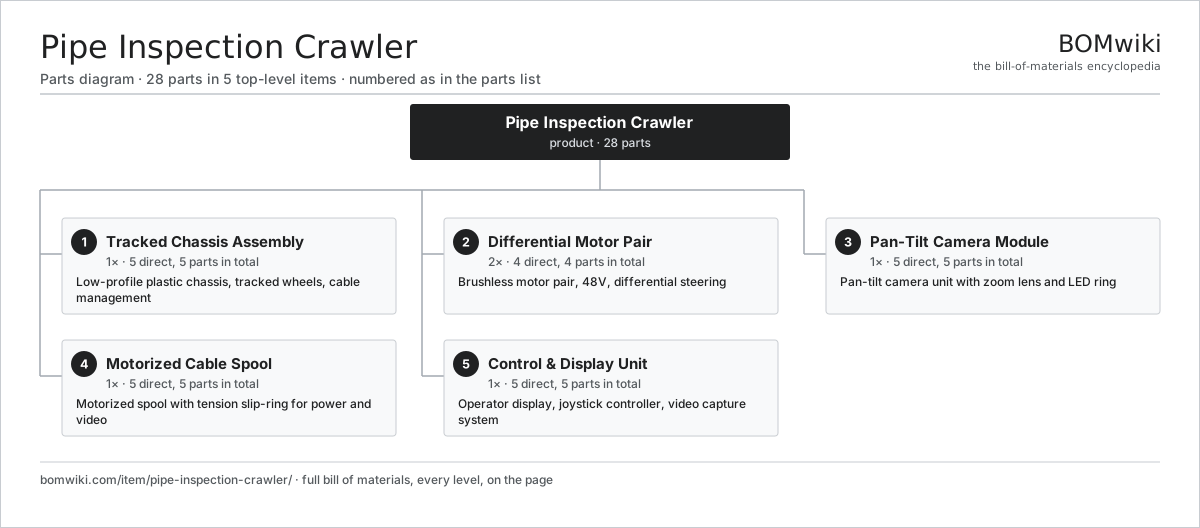
| # | Part | Qty | What it does |
|---|---|---|---|
| 1 | Tracked Chassis Assembly 5 parts | 1× | Low-profile plastic chassis, tracked wheels, cable management |
| 2 | Differential Motor Pair 4 parts | 2× | Brushless motor pair, 48V, differential steering |
| 3 | Pan-Tilt Camera Module 5 parts | 1× | Pan-tilt camera unit with zoom lens and LED ring |
| 4 | Motorized Cable Spool 5 parts | 1× | Motorized spool with tension slip-ring for power and video |
| 5 | Control & Display Unit 5 parts | 1× | Operator display, joystick controller, video capture system |
3D model
No 3D model yet. Have a CAD file of this? Add a 3D model. STL renders right on this page; STEP, FreeCAD, and OpenSCAD sources are welcome too (openly licensed, like all 3D models on BOMwiki).
Build & assembly graph
expand / collapse · shared sub-assemblies converge · links to related products · est. labourTap an assembly to expand/collapse · tap a part to open it · use “Open page” for any node · drag to pan, scroll to zoom.
Bill of materials for Pipe Inspection Crawler
5 top-level lines · 29 rows shown · 28 parts total · indented to 3 levels| # | Item / sub-assembly | Part no. | Qty/assy | Ext. qty | Parts | Type |
|---|---|---|---|---|---|---|
| 1 | Tracked Chassis Assembly 5 parts | pipe-inspection-crawler-chassis | 1× | 1 | 5 | assembly |
| 1.1 | Polymer Chassis Frame | pipe-inspection-crawler-hull | 1× | 1 | · | part |
| 1.2 | Left Rubber Track | pipe-inspection-crawler-track-left | 1× | 1 | · | part |
| 1.3 | Right Rubber Track | pipe-inspection-crawler-track-right | 1× | 1 | · | part |
| 1.4 | Sprocket & Guide Wheel Assembly | pipe-inspection-crawler-wheel-set | 1× | 1 | · | part |
| 1.5 | Spiral Armor Conduit | pipe-inspection-crawler-cable-shield | 1× | 1 | · | part |
| 2 | Differential Motor Pair 4 parts | pipe-inspection-crawler-drive-motors | 2× | 2 | 4 | assembly |
| 2.1 | Left Brushless Motor | pipe-inspection-crawler-motor-left | 1× | 2 | · | part |
| 2.2 | Right Brushless Motor | pipe-inspection-crawler-motor-right | 1× | 2 | · | part |
| 2.3 | Planetary Gearbox | pipe-inspection-crawler-gearbox-pair | 1× | 2 | · | part |
| 2.4 | Dual-Channel Motor Controller | pipe-inspection-crawler-esc-twin | 1× | 2 | · | part |
| 3 | Pan-Tilt Camera Module 5 parts | pipe-inspection-crawler-camera-head | 1× | 1 | 5 | assembly |
| 3.1 | 5MP CMOS Camera Sensor | pipe-inspection-crawler-camera-sensor | 1× | 1 | · | part |
| 3.2 | 16mm Fixed Focal Length Lens | pipe-inspection-crawler-lens | 1× | 1 | · | part |
| 3.3 | Pan Servo Motor | pipe-inspection-crawler-pan-servo | 1× | 1 | · | part |
| 3.4 | Tilt Servo Motor | pipe-inspection-crawler-tilt-servo | 1× | 1 | · | part |
| 3.5 | LED Ring Light | pipe-inspection-crawler-led-ring | 1× | 1 | · | part |
| 4 | Motorized Cable Spool 5 parts | pipe-inspection-crawler-cable-reel | 1× | 1 | 5 | assembly |
| 4.1 | Spool Drive Motor with VFD | pipe-inspection-crawler-motor-spool | 1× | 1 | · | part |
| 4.2 | Aluminum Spool Drum | pipe-inspection-crawler-drum | 1× | 1 | · | part |
| 4.3 | 4-Contact Slip Ring | pipe-inspection-crawler-slip-ring | 1× | 1 | · | part |
| 4.4 | Spring-Applied Brake | pipe-inspection-crawler-brake | 1× | 1 | · | part |
| 4.5 | Armored Power/Video Cable | pipe-inspection-crawler-cable-armor | 1× | 1 | · | part |
| 5 | Control & Display Unit 5 parts | pipe-inspection-crawler-topside-console | 1× | 1 | 5 | assembly |
| 5.1 | 7-inch Rugged Tablet | pipe-inspection-crawler-console-tablet | 1× | 1 | · | part |
| 5.2 | Composite Video Demodulator | pipe-inspection-crawler-video-receiver | 1× | 1 | · | part |
| 5.3 | USB Joystick Controller | pipe-inspection-crawler-joystick-pad | 1× | 1 | · | part |
| 5.4 | Portable Control Case | pipe-inspection-crawler-console-housing | 1× | 1 | · | part |
| 5.5 | 48V Battery & Supply Module | pipe-inspection-crawler-power-pack | 1× | 1 | · | part |
Something wrong in this list? Report a problem with this BOM.
Sourcing: possible vendors
Browse the supplier directory → Prices, MOQ, and lead times are algorithmic estimates, not quotes, and not claims about these companies. Company mappings are curated by keyword; est. price band $3k–$500k. How estimates work| Vendor | HQ | Specialty | MOQ | Lead time |
|---|---|---|---|---|
|
🇯🇵Fanuc
fanuc.com ↗
|
Oshino, JP | Industrial robots & CNC | 20 units | 10–18 wks |
| abb.com ↗ | Zurich, CH | Industrial robots | 20 units | 10–18 wks |
|
🇯🇵Yaskawa
yaskawa.com ↗
|
Kitakyushu, JP | Robots & motion | 20 units | 10–18 wks |
|
🇩🇪KUKA
kuka.com ↗
|
Augsburg, DE | Industrial robots | 20 units | 10–18 wks |
| universal-robots.com ↗ | Odense, DK | Collaborative robots | 20 units | 10–18 wks |
1,588-word article