Tethered Drone System
ProductOverview
Tethered drone systems eliminate the endurance constraint of battery-powered aircraft by powering the airframe over a conductive tether while flying. The system is deployed from a motor-driven spool on a vessel or ground station, transmitting 48VDC power through copper conductors and high-speed telemetry over single-mode fiber optics. Power-hungry sensors, thermal radiometers, scanning LIDAR, high-resolution cameras, become practical because aircraft endurance is no longer a hard constraint; mission duration is limited by daylight, crew stamina, or operational requirements, not battery capacity.
A hybrid tether cable merges seven power conductors (2.5mm² copper), single-mode fiber tube, and high-strength Kevlar load members into one composite 7.5mm cable. The ground station supplies 5 kW 48VDC from industrial power supplies, regulated and managed through a programmable VFD-driven spool motor and proportional tension feedback. Aloft, the lightweight quadcopter frame carries four 400kV brushless motors drawing power through a quick-disconnect tether coupler. A small LiPo battery backup enables autorotation descent if tether failure occurs.
The operator controls the drone via a touchscreen console (either wireless RC link or hardwired fiber-Ethernet), viewing live thermal or RGB video transmitted back through the single-mode fiber at gigabit speeds. Tension is continuously monitored by a load cell; if tether angle becomes too steep (e.g., drift in high wind), the ground station automatically adjusts spool tension to keep the drone stable. Emergency descent is automated: an E-stop command triggers controlled winch braking while the onboard battery fires the four motors in descent mode, ensuring a soft landing even if tether connection is lost.
System Architecture
The ground station is a modular cabinet containing a 5 kW 48VDC power supply, a 7.5 kW three-phase induction motor with variable frequency drive (VFD), slip-ring commutator, and an industrial PC running safety logic and spool management. The spool itself is 1m diameter aluminum, bearing-mounted on tapered rollers, and equipped with a spring-applied disc brake holding 500 Nm. The hybrid tether feeds through the slip ring, which has 7 electrical paths (each handling up to 50A) and 1 single-mode fiber rotary joint, allowing continuous 360-degree rotation without disconnection.
Aloft, the 500mm wheelbase X-frame quadcopter is constructed from carbon fiber, weighing only 2.8 kg empty. Each of the four brushless motors spins a 12-inch propeller, delivering 12 kg hover thrust per motor at 48V; the total system lifts 4–5 kg payload. A four-channel sinusoidal ESC board commutates each motor independently, drawing up to 30A per phase. A Pixhawk-class flight controller runs the drone's autopilot firmware: it stabilizes pitch/roll/yaw from 9-DOF IMU data, maintains altitude via barometer and sonar (if fitted), and executes waypoint missions sent over the fiber link.
The tether coupler is a quick-disconnect 7-pin connector rated for 50A mating cycles; the drone can be rapidly swapped without rewiring. A small 3S LiPo battery (2200mAh) provides emergency power for 30 seconds of autorotation if the main tether is severed. The operator's console is a rugged 7-inch IP67 Android tablet with integrated single-mode fiber-optic transceiver (SFP module) and onboard 4G LTE for redundant telemetry if tether connectivity drops. A dedicated emergency return button on the console halts spool pay-out and initiates winch retraction at safe speeds.
Power Regulation & Thermal Management
The 5 kW ground supply feeds a transformer or 480V→48VDC conversion unit (depending on shore power availability). Redundant PSU modules ensure no single point of failure; if one supply fails, the other carries the load automatically. Voltage is monitored at the slip ring and dynamically adjusted: if the drone draws peak current during heavy maneuver, the supply sags to 46V; a feedback loop on the console tablet communicates desired voltage, and the supply adjusts its setpoint.
The airborne ESC board includes a 48V–24V isolated converter for the flight controller, barometer, and compass. Brushless motor currents are smoothed by per-phase capacitor banks on the ESC; rapid throttle changes (e.g., evasive maneuver) are damped to prevent voltage transients. A thermal monitoring circuit on the ESC triggers low-current mode if any FET reaches 100°C, extending operating temperature to −10 to +55°C for marine and tropical deployment.
Payload Integration & Sensor Mounting
The payload bay is a quick-release aluminum frame bolted to the top of the drone frame, equipped with three silicone vibration isolators to decouple payload oscillation from IMU feedback. T-slot rails allow custom mounting of sensors: thermal radiometer (320×256 uncooled microbolometer), RGB camera (5 MP global-shutter), scanning LiDAR (16 channels, 100m range), or spectrometer (400–1000 nm). A secondary power port on the tether coupler delivers regulated 12VDC (at 5A) for sensor auxiliary circuits; the main 48V power is current-limited via the ESC to prevent runaway.
Recovery & Emergency Operations
If the tether becomes entangled or wind conditions exceed safe thresholds (e.g., >40 knot gusts at altitude), the operator presses E-stop on the console. The PLC immediately commands the VFD to reduce spool speed to <1 m/s, engages the spring-applied brake, and signals the flight controller to power the four motors at 70% throttle in descent mode. This creates a stable vertical descent at 0.5 m/s. Simultaneously, the winch motor retracts at proportional tension, ensuring the tether remains taut and does not tangle. If the tether severed during descent, the onboard LiPo battery would sustain the motors for 30 seconds, allowing the drone to settle to ground or water safely.
Operational Workflow
Pre-flight checks include verifying tether continuity (electrical and optical), inspecting the slip ring for salt or debris, and confirming ground supply voltage. The drone is connected to the tether coupler via quick-disconnect; a technician powers up the flight controller and performs compass calibration using a calibration jig. The ground operator then spools out tether at 5 m/min to initial altitude (e.g., 50m), performs a hover check (trim adjustment on RC controller), and clears the flight envelope with visual observers. Once airspace is clear, the console app switches to autonomous mission mode, uploading GPS-based waypoints. The drone climbs at 2 m/s, following the pre-loaded mission while maintaining constant tension via the spool VFD feedback loop.
Throughout flight, live 30 fps video from the payload camera streams over the fiber-optic link, visible on the console tablet with <50ms latency. At mission end, a return-to-home command retracts the tether at safe speed; the drone descends and lands on the spool platform. Total mission duration is typically 2–4 hours depending on sensor power draw and sea state (wind forcing higher spool tension and energy expenditure).
Tethered Drone System parts and their functions
7 top-level parts · 36 parts in total · full bill of materials below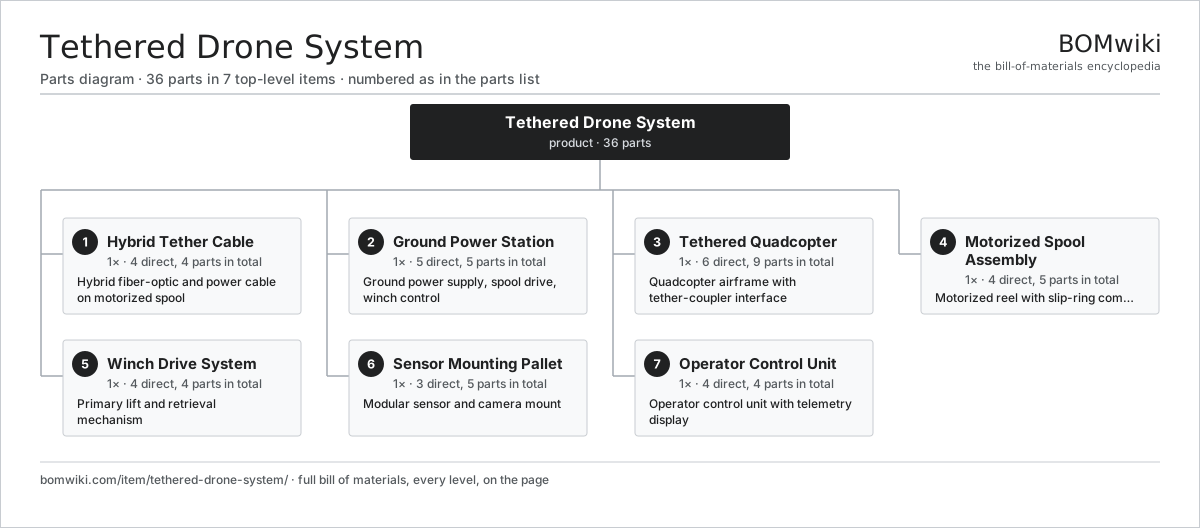
| # | Part | Qty | What it does |
|---|---|---|---|
| 1 | Hybrid Tether Cable 4 parts | 1× | Hybrid fiber-optic and power cable on motorized spool |
| 2 | Ground Power Station 5 parts | 1× | Ground power supply, spool drive, winch control |
| 3 | Tethered Quadcopter 6 parts | 1× | Quadcopter airframe with tether-coupler interface |
| 4 | Motorized Spool Assembly 4 parts | 1× | Motorized reel with slip-ring commutator |
| 5 | Winch Drive System 4 parts | 1× | Primary lift and retrieval mechanism |
| 6 | Sensor Mounting Pallet 3 parts | 1× | Modular sensor and camera mount |
| 7 | Operator Control Unit 4 parts | 1× | Operator control unit with telemetry display |
3D model
No 3D model yet. Have a CAD file of this? Add a 3D model. STL renders right on this page; STEP, FreeCAD, and OpenSCAD sources are welcome too (openly licensed, like all 3D models on BOMwiki).
Build & assembly graph
expand / collapse · shared sub-assemblies converge · links to related products · est. labourTap an assembly to expand/collapse · tap a part to open it · use “Open page” for any node · drag to pan, scroll to zoom.
Bill of materials for Tethered Drone System
7 top-level lines · 37 rows shown · 36 parts total · indented to 3 levels| # | Item / sub-assembly | Part no. | Qty/assy | Ext. qty | Parts | Type |
|---|---|---|---|---|---|---|
| 1 | Hybrid Tether Cable 4 parts | tethered-drone-system-tether | 1× | 1 | 4 | assembly |
| 1.1 | Power Conductor Bundle | tethered-drone-system-tether-core | 1× | 1 | · | part |
| 1.2 | Single-Mode Fiber Tube | tethered-drone-system-fiber-buffer | 1× | 1 | · | part |
| 1.3 | Aramid Load Member | tethered-drone-system-strength-member | 1× | 1 | · | part |
| 1.4 | UV-Resistant Jacket | tethered-drone-system-jacket | 1× | 1 | · | part |
| 2 | Ground Power Station 5 parts | tethered-drone-system-ground-unit | 1× | 1 | 5 | assembly |
| 2.1 | 5kW Redundant PSU | tethered-drone-system-psu | 1× | 1 | · | part |
| 2.2 | 7.5 kW Three-Phase Motor | tethered-drone-system-spool-motor | 1× | 1 | · | part |
| 2.3 | Load Feedback Module | tethered-drone-system-tension-controller | 1× | 1 | · | part |
| 2.4 | Rotary Power & Fiber Coupler | tethered-drone-system-slip-ring-unit | 1× | 1 | · | part |
| 2.5 | Industrial Control Cabinet | tethered-drone-system-controller-box | 1× | 1 | · | part |
| 3 | Tethered Quadcopter 6 parts | tethered-drone-system-drone | 1× | 1 | 9 | assembly |
| 3.1 | Carbon-Fiber Quadframe | tethered-drone-system-frame | 1× | 1 | · | part |
| 3.2 | Brushless Motor 400kV | tethered-drone-system-motors | 4× | 4 | · | part |
| 3.3 | 4-Channel Sinusoidal ESC | tethered-drone-system-esc-board | 1× | 1 | · | part |
| 3.4 | Pixhawk Flight Computer | tethered-drone-system-flight-controller | 1× | 1 | · | part |
| 3.5 | Power Data Connector | tethered-drone-system-tether-coupler | 1× | 1 | · | part |
| 3.6 | 3S LiPo Battery Pack | tethered-drone-system-lipo-buffer | 1× | 1 | · | part |
| 4 | Motorized Spool Assembly 4 parts | tethered-drone-system-spool | 1× | 1 | 5 | assembly |
| 4.1 | Aluminum Spool Drum | tethered-drone-system-spool-drum | 1× | 1 | · | part |
| 4.2 | Rotary Joint Assembly | tethered-drone-system-slip-ring | 1× | 1 | · | part |
| 4.3 | Tapered Roller Bearing | tethered-drone-system-spool-bearing | 2× | 2 | · | part |
| 4.4 | Spring-Applied Disc Brake | tethered-drone-system-brake | 1× | 1 | · | part |
| 5 | Winch Drive System 4 parts | tethered-drone-system-winch | 1× | 1 | 4 | assembly |
| 5.1 | 50:1 Helical Gearbox | tethered-drone-system-reducer | 1× | 1 | · | part |
| 5.2 | Flexible Shaft Coupling | tethered-drone-system-coupling | 1× | 1 | · | part |
| 5.3 | Tension Load Cell | tethered-drone-system-load-cell | 1× | 1 | · | part |
| 5.4 | Variable Frequency Drive | tethered-drone-system-vfd | 1× | 1 | · | part |
| 6 | Sensor Mounting Pallet 3 parts | tethered-drone-system-payload-bay | 1× | 1 | 5 | assembly |
| 6.1 | Sensor Mount Adapter | tethered-drone-system-mount-bracket | 1× | 1 | · | part |
| 6.2 | Vibration Damper | tethered-drone-system-isolator | 3× | 3 | · | part |
| 6.3 | T-Slot Mounting Rail | tethered-drone-system-sensor-rails | 1× | 1 | · | part |
| 7 | Operator Control Unit 4 parts | tethered-drone-system-topside-console | 1× | 1 | 4 | assembly |
| 7.1 | Industrial Tablet | tethered-drone-system-console-tablet | 1× | 1 | · | part |
| 7.2 | Fiber-Optic Transceiver | tethered-drone-system-console-transceiver | 1× | 1 | · | part |
| 7.3 | Waterproof Console Case | tethered-drone-system-console-housing | 1× | 1 | · | part |
| 7.4 | 4G LTE Antenna | tethered-drone-system-console-antenna | 1× | 1 | · | part |
Something wrong in this list? Report a problem with this BOM.
Sourcing: possible vendors
Browse the supplier directory → Prices, MOQ, and lead times are algorithmic estimates, not quotes, and not claims about these companies. Company mappings are curated by keyword; est. price band $3k–$500k. How estimates work| Vendor | HQ | Specialty | MOQ | Lead time |
|---|---|---|---|---|
|
🇯🇵Fanuc
fanuc.com ↗
|
Oshino, JP | Industrial robots & CNC | 20 units | 10–18 wks |
| abb.com ↗ | Zurich, CH | Industrial robots | 20 units | 10–18 wks |
|
🇯🇵Yaskawa
yaskawa.com ↗
|
Kitakyushu, JP | Robots & motion | 20 units | 10–18 wks |
|
🇩🇪KUKA
kuka.com ↗
|
Augsburg, DE | Industrial robots | 20 units | 10–18 wks |
| universal-robots.com ↗ | Odense, DK | Collaborative robots | 20 units | 10–18 wks |
1,120-word article