Weld Inspection Crawler
ProductOverview
Weld inspection crawlers employ ultrasonic testing (UT) to detect internal defects, cracks, porosities, lack of fusion, in pipe seams and pressure vessel welds without cutting or destructive sectioning. Mounted on a magnetic wheeled carriage that adheres directly to ferrous pipe surfaces, the UT probe sweeps across and along the weld, transmitting ultrasonic pulses and measuring echo returns to build a thickness profile. Deviations from nominal thickness or anomalous echoes indicate flaws; the operator can then measure depth and length, triggering immediate maintenance decisions.
The crawler is driven by four pairs of electromagnetic wheels, each wheel a variable-reluctance solenoid that develops attraction force to steel pipe surfaces. Independent speed control on each wheel pair allows slow deliberate movement during inspection (0.1–0.3 m/min for detailed scanning) or faster transit between welds (0.5–1 m/min). A magnetic rotary encoder on the drive wheel provides absolute position feedback (100 CPR resolution, ~1cm per count), logged alongside each ultrasonic A-scan to build a map of measured thickness along the weld.
Ultrasonic measurement involves sending a short 50V pulse (50 nanosecond rise time) to a transducer pressed against the pipe outer surface. The pulse propagates through the steel; at the inner surface (back wall), it reflects and returns to the receiver. The time delay (typically 5–50 microseconds for 10–150mm wall) is converted to thickness using the known sound velocity of steel (~5900 m/s). Any intermediate reflections (echoes from cracks or inclusions before the back wall) indicate flaws, the time-of-flight indicates depth; the echo magnitude estimates flaw size.
A companion EMAT (electromagnetic acoustic transducer) probe provides redundant measurement capability, especially useful for coarse or corroded surfaces where UT coupling is problematic. EMAT generates shear waves without contact coupling, ideal for automated or high-temperature scanning.
Electromagnetic Adhesion Wheels
Each wheel is a 80mm diameter steel disk coupled to a variable-reluctance solenoid coil (48V, capable of drawing 5–10A). When energized, the solenoid circuit closes, pulling the steel wheel disk firmly against ferromagnetic pipe surface. A non-contact position encoder senses wheel rotation, eliminating slip and enabling precise distance tracking.
Four wheel pairs (8 wheels total) are mounted on a carriage frame in a diamond configuration: two leading wheels forward, two trailing wheels back. This arrangement distributes the load and improves traction on rough or corroded surfaces. The solenoid field strength can be PWM-modulated to adjust holding force without draining battery; at 50% PWM, holding force remains >100 kg per wheel, adequate for vertical climbing on a pipe even with gravity assisting downward forces.
Each wheel is independently driven by a 48V 30W brushless motor with a 30:1 gearbox, yielding <1 rpm wheel speed at full throttle. An electronic speed controller (ESC) takes joystick input and modulates motor current independently for each wheel pair, allowing differential steering (left wheels slower = left turn; right wheels slower = right turn). At lowest speeds (10% throttle), forward travel is approximately 6 cm/min, allowing the operator to deliberately position the probe over specific welds.
The magnetic holding force (>300 kg per carriage) far exceeds the crawler weight (~25 kg), providing safe adhesion even on vertical or inverted surfaces. However, surface cleanliness is critical: rust scale, paint, or soil on the pipe exterior reduces magnetic grip. Pre-inspection cleaning with a wire brush or scraper is standard.
Ultrasonic Transducer & Signal Processing
The phased-array UT probe consists of 64 thin piezoelectric elements arranged in a linear array (50mm aperture, 0.8mm pitch). The probe is capable of 0.5–5 MHz operation; typical weld inspection uses 2–3 MHz for penetration and resolution balance. The elements can be independently excited with programmable delays, creating electronic beam steering (phased-array technique) that allows the operator to angle the beam without mechanically steering the probe, critical for examining seam flanks at shallow angles.
A compact pulser circuit generates 50V electrical pulses (50ns rise time, <10ns jitter) applied to selected probe elements. Return echoes are received by the same elements and amplified by a programmable-gain receiver (0–110 dB adjustable gain). The received signal is digitized by a 12-bit 200 MS/s analog-to-digital converter and buffered in dual-channel mode to capture both transmit timing and receive waveform.
An onboard FPGA implements real-time gating and threshold detection: the firmware waits for the echo at a predicted time (based on nominal wall thickness), measures the echo amplitude and time-of-flight, and computes wall thickness instantaneously. If any echo exceeds a user-set threshold (indicating a potential flaw), the FPGA logs a flag and stores the full waveform to the data logger.
Thickness accuracy is ±0.1mm over the measurement range (10–150mm). Flaw sizing relies on the "6dB drop" method: a flaw's lateral size is estimated from the ultrasonic energy scattered by the defect, assuming a standard reference block calibration. Typical flaw detection threshold is ~1 mm equivalent flat-bottom hole (EFBH), a standardized metric in UT.
Probe Positioning & Scanning Strategy
The UT and optional EMAT probes are mounted on a two-axis linear stage: one axis moves the probe across the pipe (perpendicular to weld), and the other moves along the weld seam. The carriage itself moves the probe axially along the pipe, providing one degree of freedom "for free." The cross-pipe axis is manually adjusted by a micrometer or, optionally, by a stepper motor for automated grid scanning.
A typical inspection grid is 1mm spacing along the weld (in the axial direction, provided by fine carriage speed control) and 3–5mm spacing across the weld (via the cross-axis stage). This yields a measurement density of ~1 point per mm², sufficient to detect and size flaws >1 mm diameter.
Acoustic couplant (typically a water-soluble gel or oil) is applied at the probe-pipe interface to ensure acoustic impedance matching and eliminate air gaps. A metering pump dispenses couplant continuously as the probe scans, maintaining coupling efficiency.
Data Acquisition & Analysis Workflow
As the carriage moves, the onboard data logger captures one ultrasonic A-scan (digitized echo waveform) approximately every 1 cm of travel (at 0.1 m/min scan speed, that's one A-scan per 6 seconds). Each A-scan is tagged with the encoder position (wheel distance traveled) and timestamp. The full A-scan waveform (typically 500–2000 samples per scan) is stored to flash memory or an SSD for post-mission analysis.
Topside, the operator monitors a real-time A-scan display on a 10-inch touchscreen. As the probe scans, the waveform updates in real-time: a vertical line represents the transmit pulse, then a gap (dead zone near the surface, typically 1–2mm), then echoes from internal defects (if any), and finally a back-wall echo. The distance from transmit to back-wall is displayed as thickness; any anomalous peaks indicate flaws. If a flaw is detected, the operator can pause, take multiple measurements at that location, and manually annotate the feature (location, size estimate, severity).
Post-mission analysis uses specialized UT analysis software (typically proprietary ASME or EN-standard-compliant tools) that imports the A-scan data, aligns by position, and creates a thickness map (C-scan). The C-scan is a 2D image where each pixel's brightness represents wall thickness, making flaws visible as regions of thinning. The operator then classifies flaws by depth (surface vs. subsurface), size, and location relative to the weld centerline, and generates a detailed report with recommendations (accept, monitor, repair).
Electromagnetic Acoustic Transducers (EMAT)
The optional EMAT probe operates without acoustic couplant, using a combination of permanent magnet and RF coil to generate and detect shear waves in the pipe steel. EMAT is valuable for:
- High-temperature scanning: Pipes at elevated temperature (>100°C) are difficult for conventional UT because couplant degrades; EMAT operates up to 500°C.
- Rough/corroded surfaces: EMAT is less sensitive to surface condition; couplant adhesion is not required.
- Creeping waves: EMAT can detect very shallow flaws (within 1mm of the surface) that standard UT might miss due to dead-zone limitations.
The EMAT probe operates at 400 kHz (lower frequency than UT, but adequate for weld inspection). It is integrated onto the same carriage as the UT probe, allowing rapid toggle between modalities or simultaneous dual-mode measurement for redundancy.
Regulatory Context & Certification
Weld inspection crawlers are typically deployed under ASME Section V (Nondestructive Examination) or EN 1435 standards. Operators must be Level II or III certified (trained on ultrasonic principles, equipment calibration, defect interpretation). Annual equipment calibration uses standard reference blocks with known flaws, verifying that the crawler's measurements match certified calibration data.
Inspection results are documented in digital form (A-scan data + thickness maps + photos) and stored for regulatory audit. Traceability (who inspected, when, with which equipment) is mandatory for safety-critical applications (nuclear, high-pressure pipelines). The crawler's data logging, GPS sync (via topside WiFi), and SSD archival support this requirement.
Maintenance & Field Operations
Pre-mission setup includes equipment checks: wheels are cleaned (wire brush removes surface rust), couplant supply is verified, and ultrasonic system gain is calibrated against a reference block. The encoder is zeroed (distance counter reset). Setup time is typically 30 minutes for a first-time operator, 10 minutes for experienced crews.
During operation, the crawler is manually repositioned between welds (lifting it off the pipe, walking it to the next seam). Transition time between welds is 2–5 minutes. A typical 50-weld inspection takes 4–8 hours depending on weld complexity and flaw density.
Post-mission, the crawler is cleaned and inspected for corrosion; wheels are dried and stored in a desiccant environment to prevent rust. The data logger SSD is extracted and uploaded to the office for analysis. Electromagnetic wheels typically require annual servicing (solenoid coil check, bearing relubrication) and replacement every 5–10 years.
Electromagnetic wheel adhesion is reliable on ferrous surfaces but does not work on stainless steel, aluminum, or composite pipes. For non-ferrous welds, alternative methods (friction-wheel crawlers or manual probe repositioning) are required.
Weld Inspection Crawler parts and their functions
6 top-level parts · 35 parts in total · full bill of materials below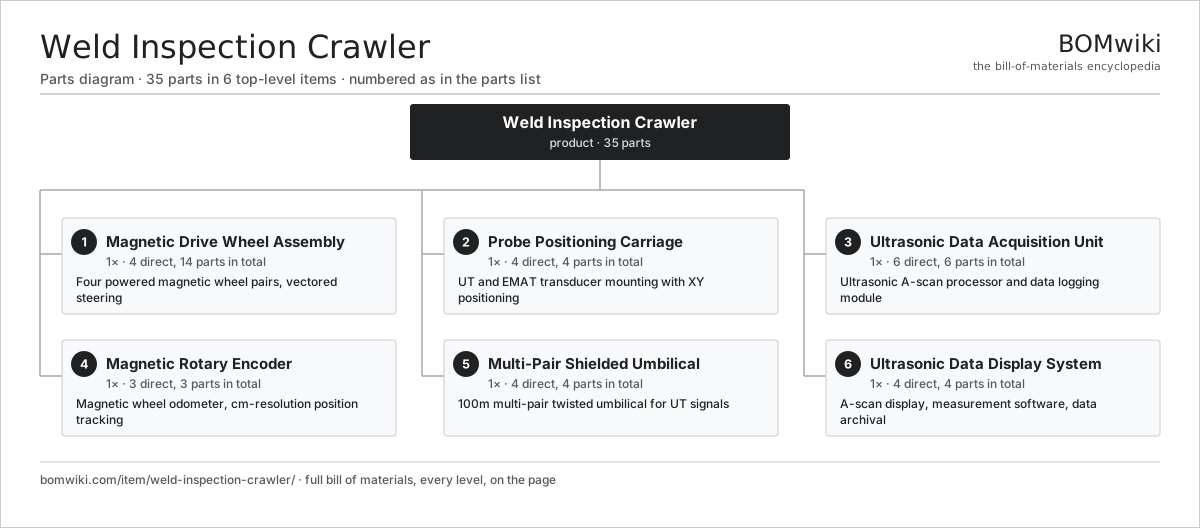
| # | Part | Qty | What it does |
|---|---|---|---|
| 1 | Magnetic Drive Wheel Assembly 4 parts | 1× | Four powered magnetic wheel pairs, vectored steering |
| 2 | Probe Positioning Carriage 4 parts | 1× | UT and EMAT transducer mounting with XY positioning |
| 3 | Ultrasonic Data Acquisition Unit 6 parts | 1× | Ultrasonic A-scan processor and data logging module |
| 4 | Magnetic Rotary Encoder 3 parts | 1× | Magnetic wheel odometer, cm-resolution position tracking |
| 5 | Multi-Pair Shielded Umbilical 4 parts | 1× | 100m multi-pair twisted umbilical for UT signals |
| 6 | Ultrasonic Data Display System 4 parts | 1× | A-scan display, measurement software, data archival |
3D model
No 3D model yet. Have a CAD file of this? Add a 3D model. STL renders right on this page; STEP, FreeCAD, and OpenSCAD sources are welcome too (openly licensed, like all 3D models on BOMwiki).
Build & assembly graph
expand / collapse · shared sub-assemblies converge · links to related products · est. labourTap an assembly to expand/collapse · tap a part to open it · use “Open page” for any node · drag to pan, scroll to zoom.
Bill of materials for Weld Inspection Crawler
6 top-level lines · 31 rows shown · 35 parts total · indented to 3 levels| # | Item / sub-assembly | Part no. | Qty/assy | Ext. qty | Parts | Type |
|---|---|---|---|---|---|---|
| 1 | Magnetic Drive Wheel Assembly 4 parts | weld-inspection-crawler-magnetic-wheels | 1× | 1 | 14 | assembly |
| 1.1 | Electromagnetic Adhesion Wheel | weld-inspection-crawler-em-wheel | 8× | 8 | · | part |
| 1.2 | Brushless Wheel Drive Motor | weld-inspection-crawler-wheel-motor | 4× | 4 | · | part |
| 1.3 | Four-Channel Magnetic ESC | weld-inspection-crawler-magnet-esc | 1× | 1 | · | part |
| 1.4 | Magnetic Encoder Rotor | weld-inspection-crawler-encoder-disk | 1× | 1 | · | part |
| 2 | Probe Positioning Carriage 4 parts | weld-inspection-crawler-probe-carriage | 1× | 1 | 4 | assembly |
| 2.1 | Phased-Array UT Probe | weld-inspection-crawler-ut-transducer | 1× | 1 | · | part |
| 2.2 | Electromagnetic Acoustic Transducer | weld-inspection-crawler-emat-probe | 1× | 1 | · | part |
| 2.3 | XZ Linear Positioning Stage | weld-inspection-crawler-xz-stage | 1× | 1 | · | part |
| 2.4 | Acoustic Couplant Dispenser | weld-inspection-crawler-coupler | 1× | 1 | · | part |
| 3 | Ultrasonic Data Acquisition Unit 6 parts | weld-inspection-crawler-controller | 1× | 1 | 6 | assembly |
| 3.1 | 48V to 25V Isolated Supply | weld-inspection-crawler-psu-ht | 1× | 1 | · | part |
| 3.2 | Ultrasonic Pulser IC | weld-inspection-crawler-pulser | 1× | 1 | · | part |
| 3.3 | UT Receiver Amplifier | weld-inspection-crawler-receiver | 1× | 1 | · | part |
| 3.4 | 12-Bit 200 MS/s Dual-Channel ADC | weld-inspection-crawler-adc | 1× | 1 | · | part |
| 3.5 | Spartan-6 FPGA Module | weld-inspection-crawler-fpga-logic | 1× | 1 | · | part |
| 3.6 | ARM Cortex-M4 Microcontroller | weld-inspection-crawler-mcu | 1× | 1 | · | part |
| 4 | Magnetic Rotary Encoder 3 parts | weld-inspection-crawler-encoder | 1× | 1 | 3 | assembly |
| 4.1 | AS5048B Magnetic Encoder | weld-inspection-crawler-encoder-ic | 1× | 1 | · | part |
| 4.2 | Diametric Pole Magnet Rotor | weld-inspection-crawler-magnet-rotor | 1× | 1 | · | part |
| 4.3 | Encoder Bracket & Preload | weld-inspection-crawler-encoder-mount | 1× | 1 | · | part |
| 5 | Multi-Pair Shielded Umbilical 4 parts | weld-inspection-crawler-cable-umbilical | 1× | 1 | 4 | assembly |
| 5.1 | Low-Capacitance Twisted Pair | weld-inspection-crawler-tx-rx-pair | 1× | 1 | · | part |
| 5.2 | 2.5mm² Power Conductors | weld-inspection-crawler-power-pair | 1× | 1 | · | part |
| 5.3 | 80% Copper Braid Shield | weld-inspection-crawler-shield-braid | 1× | 1 | · | part |
| 5.4 | Polyurethane Cable Jacket | weld-inspection-crawler-jacket | 1× | 1 | · | part |
| 6 | Ultrasonic Data Display System 4 parts | weld-inspection-crawler-topside-unit | 1× | 1 | 4 | assembly |
| 6.1 | 10-inch Touchscreen SBC | weld-inspection-crawler-display-sbc | 1× | 1 | · | part |
| 6.2 | USB 3.0 Data Interface | weld-inspection-crawler-usb-interface | 1× | 1 | · | part |
| 6.3 | 256GB Industrial SSD | weld-inspection-crawler-storage-ssd | 1× | 1 | · | part |
| 6.4 | WiFi 802.11ac Adapter | weld-inspection-crawler-wifi-module | 1× | 1 | · | part |
Something wrong in this list? Report a problem with this BOM.
Sourcing: possible vendors
Browse the supplier directory → Prices, MOQ, and lead times are algorithmic estimates, not quotes, and not claims about these companies. Company mappings are curated by keyword; est. price band $3k–$500k. How estimates work| Vendor | HQ | Specialty | MOQ | Lead time |
|---|---|---|---|---|
|
🇯🇵Fanuc
fanuc.com ↗
|
Oshino, JP | Industrial robots & CNC | 20 units | 10–18 wks |
| abb.com ↗ | Zurich, CH | Industrial robots | 20 units | 10–18 wks |
|
🇯🇵Yaskawa
yaskawa.com ↗
|
Kitakyushu, JP | Robots & motion | 20 units | 10–18 wks |
|
🇩🇪KUKA
kuka.com ↗
|
Augsburg, DE | Industrial robots | 20 units | 10–18 wks |
| universal-robots.com ↗ | Odense, DK | Collaborative robots | 20 units | 10–18 wks |
1,678-word article