Autonomous Forklift
ProductOverview
An autonomous forklift is a self-driving materials handling vehicle for warehouse and logistics automation. Unlike small mobile robots, the autonomous forklift handles the full load-carrying mission: navigating to a pallet stack, detecting the pallet location, lowering the forks, inserting them under the pallet, lifting the load, traveling to a destination, lowering, and withdrawing. The primary LiDAR continuously maps the warehouse in 3D; the dual safety scanners continuously monitor the perimeter, triggering emergency brakes if a human approaches. The stereo pallet cameras detect pallet height and orientation, enabling precise fork insertion even if the pallet is slightly misaligned or partially obscured. All decisions are made by the onboard SoC, which executes pickup-to-dropoff sequences without driver input.
Typical deployment: a 10,000 m² warehouse operates 3–5 autonomous forklifts during the night shift, moving pallets between receiving and storage zones. A warehouse management system (WMS) link feeds job lists (origin pallet, destination location) wirelessly; the fleet self-orchestrates to avoid collisions and distribute work fairly.
Electrified chassis and drive
The chassis is derived from a standard sit-down counterbalanced forklift, but with drive-by-wire actuation. The BLDC traction motor is mounted directly to the front axle (eliminating the mechanical gearbox), delivering smooth, infinitely variable speed control from 0 to 2 m/s. The electric steering actuator replaces the hydraulic cylinder, accepting proportional commands from the control SoC.
The 48 V 400 Ah LiFePO4 pack (19.2 kWh) in the rear counterweight delivers 400 A continuous (traction) and 100 A peak (lifting). A single shift (8–10 hours) of mixed loading/unloading and travel exhausts the battery; overnight charging from 480 VAC 3-phase replenishes it for the next shift.
Lift mechanism and load sensing
The mast and forks are hydraulic-assisted or fully electric. A proportional lift actuator raises and lowers the carriage at up to 1 m/s. The load cell underneath the forks measures pallet weight in real time; the control system uses this to:
- Confirm a pallet has been picked up (weight suddenly increases by 200+ kg).
- Monitor oscillation (swaying load detected by weight spikes) and slow travel if needed.
- Enforce load limits (e.g., refuse to lift if total weight exceeds 2,500 kg).
- Log payload weight for per-pallet traceability and inventory reconciliation.
Hydraulic system pressure is monitored by sensors, if pressure spikes unexpectedly (forks jamming), the system aborts the pickup and alerts the operator.
Perception and autonomous navigation
LiDAR SLAM: The 64-channel primary LiDAR continuously scans the warehouse, creating a real-time 3D point cloud map. The GPU-accelerated SoC runs a SLAM (Simultaneous Localization and Mapping) algorithm that fuses LiDAR scans with wheel encoder odometry, maintaining absolute position within ±100 mm, accurate enough for lane-keeping and racking aisle navigation.
Safety Scanners: Two certified SIL2 safety laser scanners (one forward, one rear) run independent hardwired logic. If any object enters the 2 m safety perimeter while the forklift is moving, the scanner triggers a hardwired contactor that cuts motor power within 100 ms, bringing the forklift to an immediate stop. This hardware-based safety is independent of software and does not require CPU responsiveness, essential for protecting workers.
Pallet Detection: A stereo RGB camera pair mounted on the mast looks downward at approaching pallets. A trained neural network detects pallet edges and corners, computing the pallet's 3D position relative to the fork centerline. If the pallet is 50 mm too far left, the control system corrects steering before fork insertion. If the pallet is at an unusual angle (45° instead of 90°), the system detects this and adjusts approach angle or alerts the operator if the pickup is infeasible.
Collision Avoidance: A 77 GHz radar continuously scans forward and detects moving obstacles (people, carts) approaching at any speed. Unlike LiDAR, radar detects motion (Doppler shift), allowing the system to distinguish a stationary racking unit from a moving person. When combined with the LiDAR map, the system can navigate around a person, replanning its path in real time.
Path planning and fleet orchestration
The SoC runs a real-time path planner that continuously updates a navigation graph as new obstacles appear. If the main aisle is blocked by a person, the planner routes through an adjacent aisle. When multiple autonomous forklifts are present, the V2I (Vehicle-to-Infrastructure) link coordinates movement: each forklift reports its position and intended path; a central fleet manager (running on a warehouse server) prevents collisions by issuing micro-adjustments or temporary parking instructions.
A typical job sequence:
- WMS dispatch: A job arrives: "Pickup pallet P12345 from location [3, A, 1] (aisle 3, bay A, level 1), deliver to outbound staging area."
- Navigation: The forklift plots a path, navigating via SLAM. If the path is blocked, it waits or reroutes.
- Pallet approach: The stereo camera detects the target pallet, the forklift centers its forks.
- Insertion and lift: Forks insert under the pallet, the load cell confirms pickup.
- Delivery: The forklift navigates to the staging area, lowers the pallet, and retracts for the next job.
- Reporting: The completion timestamp and payload weight are sent back to WMS via Wi-Fi.
Total cycle time: 3–5 minutes for a 100 m round trip, depending on navigation complexity. Manual forklifts achieve similar speeds but require driver labor; autonomous forklifts run continuously, including nights and weekends.
Safety and regulatory compliance
The autonomous forklift complies with ISO 3691-4:2020 (industrial trucks, safety of driverless trucks) and ANSI B56.5 (powered industrial trucks). Key requirements:
- Dual safety scanning: Two independent laser scanners, one forward/one rear, each capable of autonomous emergency stop without processor involvement.
- Load stability: Load cell prevents tip-over. The 3 m lift height and 2,500 kg payload are balanced by the rear counterweight (battery pack) achieving a stable center of gravity.
- Environmental limits: The robot operates only in designated zones (warehouses, yard) with defined boundaries encoded in the SLAM map. If the robot drifts outside the boundary (e.g., toward a pedestrian area), it halts.
- Operational awareness: The forklift emits warning tones (approach beep) and illuminates warning lights (LED tower) when moving with a load.
A human safety supervisor monitors the fleet via a dashboard, with the ability to remotely pause or halt any forklift in an emergency.
Fleet economics
A typical scenario: A large warehouse (50,000 m² distribution center) operates 10 autonomous forklifts, working two shifts (24 hours per day). Each forklift handles 100–150 moves per shift, so 1,000–1,500 moves per day across the fleet. Labor cost for manual forklifts (10 drivers) is $250k/year; autonomous forklifts amortize their capital cost ($80–120k per unit, $0.8–1.2M fleet) over 5 years, netting ~$400k in labor savings. Additional benefits include:
- Safety: Autonomous forklifts don't have fatigue-related accidents or near-misses.
- Data: Every move is logged (time, location, load weight), enabling optimization of warehouse layout.
- Flexibility: The same platform can handle different picking strategies (batch picks, individual orders) by reprogramming job sequences.
Adoption is accelerating in food distribution, automotive parts, and e-commerce fulfillment, sectors with high labor costs and large warehouses where ROI is fastest.
Autonomous Forklift parts and their functions
10 top-level parts · 342 parts in total · full bill of materials below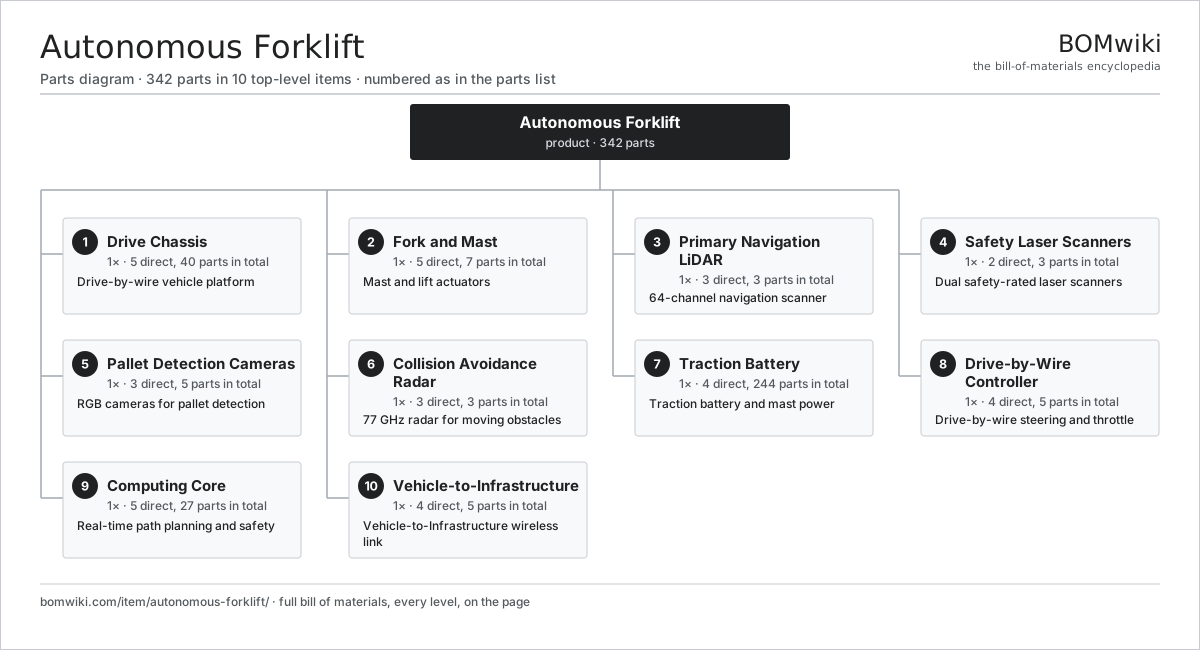
| # | Part | Qty | What it does |
|---|---|---|---|
| 1 | Drive Chassis 5 parts | 1× | Drive-by-wire vehicle platform |
| 2 | Fork and Mast 5 parts | 1× | Mast and lift actuators |
| 3 | Primary Navigation LiDAR 3 parts | 1× | 64-channel navigation scanner |
| 4 | Safety Laser Scanners 2 parts | 1× | Dual safety-rated laser scanners |
| 5 | Pallet Detection Cameras 3 parts | 1× | RGB cameras for pallet detection |
| 6 | Collision Avoidance Radar 3 parts | 1× | 77 GHz radar for moving obstacles |
| 7 | Traction Battery 4 parts | 1× | Traction battery and mast power |
| 8 | Drive-by-Wire Controller 4 parts | 1× | Drive-by-wire steering and throttle |
| 9 | Computing Core 5 parts | 1× | Real-time path planning and safety |
| 10 | Vehicle-to-Infrastructure 4 parts | 1× | Vehicle-to-Infrastructure wireless link |
3D model
No 3D model yet. Have a CAD file of this? Add a 3D model. STL renders right on this page; STEP, FreeCAD, and OpenSCAD sources are welcome too (openly licensed, like all 3D models on BOMwiki).
Build & assembly graph
expand / collapse · shared sub-assemblies converge · links to related products · est. labourTap an assembly to expand/collapse · tap a part to open it · use “Open page” for any node · drag to pan, scroll to zoom.
Bill of materials for Autonomous Forklift
10 top-level lines · 57 rows shown · 342 parts total · indented to 3 levels| # | Item / sub-assembly | Part no. | Qty/assy | Ext. qty | Parts | Type |
|---|---|---|---|---|---|---|
| 1 | Drive Chassis 5 parts | autonomous-forklift-chassis | 1× | 1 | 40 | assembly |
| 1.1 | Chassis Frame | autonomous-forklift-frame | 1× | 1 | · | part |
| 1.2 | Steering Motor | autonomous-forklift-steering-motor | 1× | 1 | · | part |
| 1.3 | Traction Motor | autonomous-forklift-traction-motor | 1× | 1 | · | part |
| 1.4 | Wheel Assembly 5 parts | wheel-assembly | 4× | 4 | 9 | assembly |
| 1.4.1 | Alloy Wheel | alloy-wheel | 1× | 4 | · | part |
| 1.4.2 | Tire | tire | 1× | 4 | · | part |
| 1.4.3 | TPMS Sensor | tpms-sensor | 1× | 4 | · | part |
| 1.4.4 | Lug Nut | lug-nut | 5× | 20 | · | part |
| 1.4.5 | Valve Stem | valve-stem | 1× | 4 | · | part |
| 1.5 | Steering Servo | autonomous-forklift-steering-servo | 1× | 1 | · | part |
| 2 | Fork and Mast 5 parts | autonomous-forklift-fork-carriage | 1× | 1 | 7 | assembly |
| 2.1 | Lift Cylinder | autonomous-forklift-mast-cylinder | 1× | 1 | · | part |
| 2.2 | Fork Blade | autonomous-forklift-fork-blades | 2× | 2 | · | part |
| 2.3 | Mast Chain | autonomous-forklift-mast-chain | 1× | 1 | · | part |
| 2.4 | Load Cell | autonomous-forklift-load-cell | 1× | 1 | · | part |
| 2.5 | Pressure Sensor | pressure-sensor | 2× | 2 | · | part |
| 3 | Primary Navigation LiDAR 3 parts | autonomous-forklift-lidar-primary | 1× | 1 | 3 | assembly |
| 3.1 | LiDAR Unit | autonomous-forklift-lidar-unit | 1× | 1 | · | part |
| 3.2 | LiDAR Processor | autonomous-forklift-lidar-processor | 1× | 1 | · | part |
| 3.3 | Bare PCB | pcb-bare | 1× | 1 | · | part |
| 4 | Safety Laser Scanners 2 parts | autonomous-forklift-lidar-safety | 1× | 1 | 3 | assembly |
| 4.1 | Safety Scanner | autonomous-forklift-safety-scanner | 2× | 2 | · | part |
| 4.2 | Safety Controller | autonomous-forklift-safety-controller | 1× | 1 | · | part |
| 5 | Pallet Detection Cameras 3 parts | autonomous-forklift-camera-bank | 1× | 1 | 5 | assembly |
| 5.1 | Stereo Camera | autonomous-forklift-camera-stereo | 2× | 2 | · | part |
| 5.2 | Camera Lens | autonomous-forklift-camera-lens | 2× | 2 | · | part |
| 5.3 | Bare PCB | pcb-bare | 1× | 1 | · | part |
| 6 | Collision Avoidance Radar 3 parts | autonomous-forklift-radar | 1× | 1 | 3 | assembly |
| 6.1 | Radar Transceiver | autonomous-forklift-radar-transceiver | 1× | 1 | · | part |
| 6.2 | Radar Antenna | autonomous-forklift-radar-antenna | 1× | 1 | · | part |
| 6.3 | Bare PCB | pcb-bare | 1× | 1 | · | part |
| 7 | Traction Battery 4 parts | autonomous-forklift-battery | 1× | 1 | 244 | assembly |
| 7.1 | Li-ion Cell, 18650 | li-cell-18650 | 240× | 240 | · | part |
| 7.2 | BMS Board | bms-board | 1× | 1 | · | part |
| 7.3 | Battery Case | autonomous-forklift-battery-case | 1× | 1 | · | part |
| 7.4 | Connector | connector | 2× | 2 | · | part |
| 8 | Drive-by-Wire Controller 4 parts | autonomous-forklift-motor-drive | 1× | 1 | 5 | assembly |
| 8.1 | Motor H-Bridge | autonomous-forklift-motor-driver | 1× | 1 | · | part |
| 8.2 | Steering Controller | autonomous-forklift-steering-controller | 1× | 1 | · | part |
| 8.3 | Bare PCB | pcb-bare | 1× | 1 | · | part |
| 8.4 | IGBT Power Module | igbt-module | 2× | 2 | · | part |
| 9 | Computing Core 5 parts | autonomous-forklift-computing | 1× | 1 | 27 | assembly |
| 9.1 | Compute SoC Module | soc-module | 1× | 1 | · | part |
| 9.2 | Microcontroller | mcu | 1× | 1 | · | part |
| 9.3 | Bare PCB | pcb-bare | 1× | 1 | · | part |
| 9.4 | I/O Board 4 parts | autonomous-forklift-io-board | 1× | 1 | 23 | assembly |
| 9.4.1 | Power MOSFET | mosfet | 8× | 8 | · | part |
| 9.4.2 | IGBT Power Module | igbt-module | 2× | 2 | · | part |
| 9.4.3 | Bare PCB | pcb-bare | 1× | 1 | · | part |
| 9.4.4 | Connector | connector | 12× | 12 | · | part |
| 9.5 | Thermal Fuse | thermal-fuse | 1× | 1 | · | part |
| 10 | Vehicle-to-Infrastructure 4 parts | autonomous-forklift-v2i | 1× | 1 | 5 | assembly |
| 10.1 | Wi-Fi Modem | autonomous-forklift-wifi-module | 1× | 1 | · | part |
| 10.2 | Antenna | autonomous-forklift-antenna-array | 2× | 2 | · | part |
| 10.3 | RTK GNSS | autonomous-forklift-gps-module | 1× | 1 | · | part |
| 10.4 | Bare PCB | pcb-bare | 1× | 1 | · | part |
Something wrong in this list? Report a problem with this BOM.
Related products
same domain, ranked by shared parts Fruit Picking Robot
144 parts · shares 10 with this page
Security Patrol Robot
582 parts · shares 10 with this page
Fruit Picking Robot
144 parts · shares 10 with this page
Security Patrol Robot
582 parts · shares 10 with this page
 Bricklaying Robot
221 parts · shares 10 with this page
Bricklaying Robot
221 parts · shares 10 with this page
 Telepresence Robot
240 parts · shares 9 with this page
Rebar Tying Robot
144 parts · shares 9 with this page
Telepresence Robot
240 parts · shares 9 with this page
Rebar Tying Robot
144 parts · shares 9 with this page
Sourcing: possible vendors
Browse the supplier directory → Prices, MOQ, and lead times are algorithmic estimates, not quotes, and not claims about these companies. Company mappings are curated by keyword; est. price band $3k–$500k. How estimates work| Vendor | HQ | Specialty | MOQ | Lead time |
|---|---|---|---|---|
|
🇯🇵Fanuc
fanuc.com ↗
|
Oshino, JP | Industrial robots & CNC | 20 units | 10–18 wks |
| abb.com ↗ | Zurich, CH | Industrial robots | 20 units | 10–18 wks |
|
🇯🇵Yaskawa
yaskawa.com ↗
|
Kitakyushu, JP | Robots & motion | 20 units | 10–18 wks |
|
🇩🇪KUKA
kuka.com ↗
|
Augsburg, DE | Industrial robots | 20 units | 10–18 wks |
| universal-robots.com ↗ | Odense, DK | Collaborative robots | 20 units | 10–18 wks |
1,276-word article