Bricklaying Robot
ProductOverview
A bricklaying robot automates the placement of unit masonry by combining mobility, reach, and adhesive control. The system is anchored by a wheeled mobile platform fitted with a three-stage telescopic boom driven by proportional hydraulic cylinders. The boom carries a pneumatic brick gripper, an adhesive applicator, and a multi-laser positioning head. The robot accepts a stack of uniform bricks from an on-site magazine, then grips each brick, moves to the placement location, applies mortar beads, sets the brick level, and repeats. Typical production is 400–600 bricks/hour on a simple facade; complex patterns with color variation or complex geometry slow the rate proportionally.
Mobility and boom positioning
The platform is an omnidirectional wheeled chassis with four independent BLDC hub motors, allowing it to move and rotate freely around the building perimeter without reversing. The boom pivots from a central slew bearing and extends via three sliding stages, reaching from 3.5 m (fully retracted) to 8.5 m (fully extended). Height is controlled by a main lift hydraulic cylinder, giving vertical coverage from the platform to 4.5 m above ground, enough to place bricks three stories high without repositioning.
The motion computer continuously solves the inverse kinematics for the boom, translating target brick placement coordinates from the wall plane into boom stage extension and angle commands. The hydraulic system uses proportional directional valves driven at 100 Hz by the SoC, enabling smooth, human-like motion with no jerking that might drop a brick.
Brick handling
The on-board magazine holds 12–15 bricks of uniform size stacked vertically. A push solenoid indexes the next brick forward. The pneumatic gripper, two compliant jaws driven by a single cylinder, clamps the brick with 80–120 N force monitored by a pressure sensor. The gripper can grasp bricks in standard or soldier orientation; for specialty bonds (Flemish, running bond patterns), the robot orients each brick pre-placement via boom twist.
Adhesive application and leveling
Immediately before placing a brick, the applicator head extrudes a four-stripe mortar bead via a hydraulic pump fed from the building's external mortar cart (or the robot carries a small on-board mixer for self-sufficient operation). The proportional flow valve modulates bead width and height, thin-bed method uses less material (~5 mm joint height) than traditional full-mortar (~15 mm). After the brick is set on the lower course, the optical level sensor confirms the bed joint is within ±3 mm of the target datum; if not, the controller signals the next brick placement to correct upward or downward.
The laser positioning system projects horizontal and vertical reference lines at 50 m visibility, allowing the human operator or a site vision system to detect wall geometry drift (e.g., if the wall bows). The robot automatically adjusts placement to stay within tolerance.
Hydraulic and pneumatic power
The hydraulic system is powered by a variable electric motor driving a swashplate pump up to 15 L/min at 250 bar. Peak demands occur during rapid boom extension and lift; an accumulator (nitrogen-charged sphere) stores energy to level pressure spikes. A relief valve caps system pressure at 280 bar for component protection. The gripper and hopper are pneumatic, supplied by a small onboard 6 bar compressor or external site air.
Battery and endurance
The 48 V 300 Ah LiFePO4 pack (14.4 kWh) powers all wheel motors and the hydraulic pump motor. On a typical facade with 400 bricks/hour placement, the robot consumes ~1.2 kWh per hour (wheels ~200 W continuous, pump ~1 kW intermittent 60 % duty), yielding 12-hour autonomy on a full charge. Overnight shore charging from 480 VAC 3-phase takes 4 hours.
On-site workflow
A single operator monitors the robot from a tablet (or fully autonomous with CAD-sourced wall plans). The brick hopper is pre-loaded during setup; mortar supply runs via hose from the job's concrete truck or mixer. The robot is positioned at the wall base, the operator inputs the section dimensions and bond pattern, and the system begins autonomous placement. The laser reference lines help the operator visually confirm wall plane; the robot's on-board sensors catch joint variations before they propagate.
Bricklaying Robot parts and their functions
10 top-level parts · 221 parts in total · full bill of materials below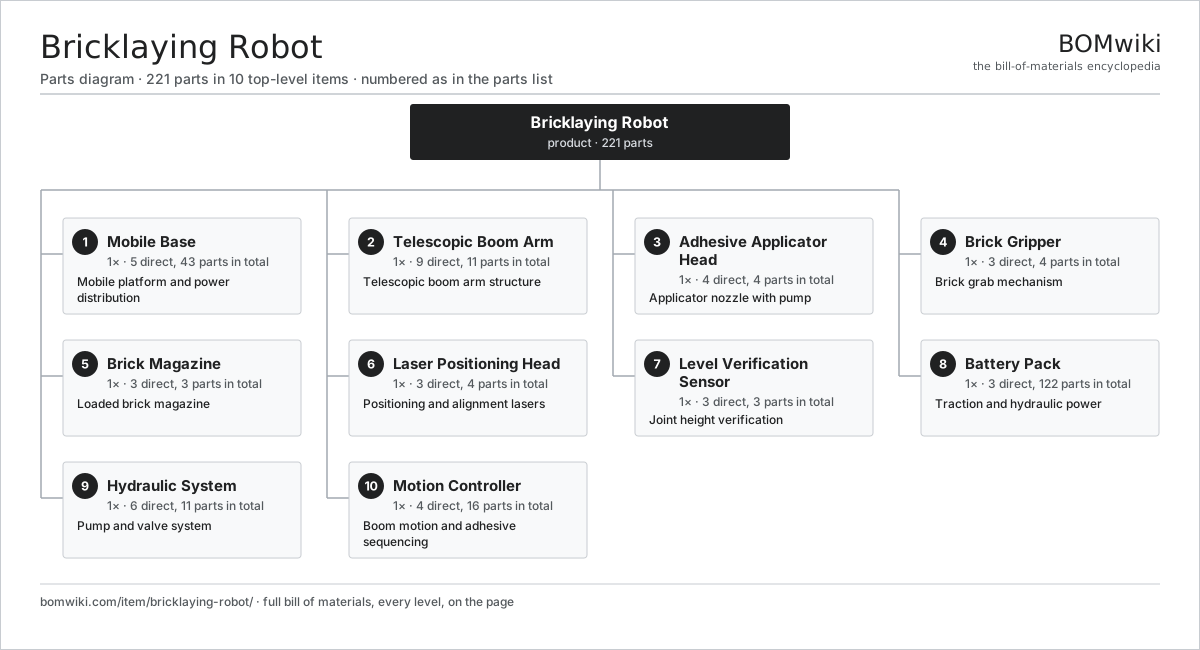
| # | Part | Qty | What it does |
|---|---|---|---|
| 1 | Mobile Base 5 parts | 1× | Mobile platform and power distribution |
| 2 | Telescopic Boom Arm 9 parts | 1× | Telescopic boom arm structure |
| 3 | Adhesive Applicator Head 4 parts | 1× | Applicator nozzle with pump |
| 4 | Brick Gripper 3 parts | 1× | Brick grab mechanism |
| 5 | Brick Magazine 3 parts | 1× | Loaded brick magazine |
| 6 | Laser Positioning Head 3 parts | 1× | Positioning and alignment lasers |
| 7 | Level Verification Sensor 3 parts | 1× | Joint height verification |
| 8 | Battery Pack 3 parts | 1× | Traction and hydraulic power |
| 9 | Hydraulic System 6 parts | 1× | Pump and valve system |
| 10 | Motion Controller 4 parts | 1× | Boom motion and adhesive sequencing |
3D model
No 3D model yet. Have a CAD file of this? Add a 3D model. STL renders right on this page; STEP, FreeCAD, and OpenSCAD sources are welcome too (openly licensed, like all 3D models on BOMwiki).
Build & assembly graph
expand / collapse · shared sub-assemblies converge · links to related products · est. labourTap an assembly to expand/collapse · tap a part to open it · use “Open page” for any node · drag to pan, scroll to zoom.
Bill of materials for Bricklaying Robot
10 top-level lines · 61 rows shown · 221 parts total · indented to 3 levels| # | Item / sub-assembly | Part no. | Qty/assy | Ext. qty | Parts | Type |
|---|---|---|---|---|---|---|
| 1 | Mobile Base 5 parts | bricklaying-robot-base | 1× | 1 | 43 | assembly |
| 1.1 | Base Frame | bricklaying-robot-frame | 1× | 1 | · | part |
| 1.2 | Wheel Assembly 5 parts | wheel-assembly | 4× | 4 | 9 | assembly |
| 1.2.1 | Alloy Wheel | alloy-wheel | 1× | 4 | · | part |
| 1.2.2 | Tire | tire | 1× | 4 | · | part |
| 1.2.3 | TPMS Sensor | tpms-sensor | 1× | 4 | · | part |
| 1.2.4 | Lug Nut | lug-nut | 5× | 20 | · | part |
| 1.2.5 | Valve Stem | valve-stem | 1× | 4 | · | part |
| 1.3 | Wheel Motor | bricklaying-robot-wheel-motor | 4× | 4 | · | part |
| 1.4 | Hydraulic Tank | bricklaying-robot-hydraulic-tank | 1× | 1 | · | part |
| 1.5 | Fastener Set | fastener-set | 1× | 1 | · | part |
| 2 | Telescopic Boom Arm 9 parts | bricklaying-robot-boom | 1× | 1 | 11 | assembly |
| 2.1 | Boom Pivot Bearing | bricklaying-robot-boom-pivot | 1× | 1 | · | part |
| 2.2 | Boom Stage 1 | bricklaying-robot-boom-stage1 | 1× | 1 | · | part |
| 2.3 | Boom Stage 2 | bricklaying-robot-boom-stage2 | 1× | 1 | · | part |
| 2.4 | Boom Stage 3 | bricklaying-robot-boom-stage3 | 1× | 1 | · | part |
| 2.5 | Slew Cylinder | bricklaying-robot-boom-cylinder-slew | 1× | 1 | · | part |
| 2.6 | Extension Cylinder | bricklaying-robot-boom-cylinder-extend | 1× | 1 | · | part |
| 2.7 | Lift Cylinder | bricklaying-robot-boom-cylinder-lift | 1× | 1 | · | part |
| 2.8 | Joint Cylinder | bricklaying-robot-boom-joint-cylinder | 2× | 2 | · | part |
| 2.9 | Pressure Sensor | pressure-sensor | 2× | 2 | · | part |
| 3 | Adhesive Applicator Head 4 parts | bricklaying-robot-adhesive-head | 1× | 1 | 4 | assembly |
| 3.1 | Adhesive Pump | bricklaying-robot-adhesive-pump | 1× | 1 | · | part |
| 3.2 | Nozzle Head | bricklaying-robot-adhesive-nozzle | 1× | 1 | · | part |
| 3.3 | Flow Control Valve | bricklaying-robot-flow-valve | 1× | 1 | · | part |
| 3.4 | Adhesive Hose | bricklaying-robot-adhesive-hose | 1× | 1 | · | part |
| 4 | Brick Gripper 3 parts | bricklaying-robot-gripper | 1× | 1 | 4 | assembly |
| 4.1 | Gripper Jaw | bricklaying-robot-gripper-jaw | 2× | 2 | · | part |
| 4.2 | Grip Cylinder | bricklaying-robot-gripper-cylinder | 1× | 1 | · | part |
| 4.3 | Grip Sensor | bricklaying-robot-gripper-height-sensor | 1× | 1 | · | part |
| 5 | Brick Magazine 3 parts | bricklaying-robot-brick-hopper | 1× | 1 | 3 | assembly |
| 5.1 | Hopper Tray | bricklaying-robot-hopper-tray | 1× | 1 | · | part |
| 5.2 | Hopper Actuator | bricklaying-robot-hopper-actuator | 1× | 1 | · | part |
| 5.3 | Hopper Sensor | bricklaying-robot-hopper-sensor | 1× | 1 | · | part |
| 6 | Laser Positioning Head 3 parts | bricklaying-robot-laser-head | 1× | 1 | 4 | assembly |
| 6.1 | Laser Line Module | bricklaying-robot-laser-line | 2× | 2 | · | part |
| 6.2 | Laser Driver | bricklaying-robot-laser-power | 1× | 1 | · | part |
| 6.3 | Bare PCB | pcb-bare | 1× | 1 | · | part |
| 7 | Level Verification Sensor 3 parts | bricklaying-robot-leveling-sensor | 1× | 1 | 3 | assembly |
| 7.1 | Pressure Sensor | pressure-sensor | 1× | 1 | · | part |
| 7.2 | IMU Module | imu-module | 1× | 1 | · | part |
| 7.3 | Bare PCB | pcb-bare | 1× | 1 | · | part |
| 8 | Battery Pack 3 parts | bricklaying-robot-battery | 1× | 1 | 122 | assembly |
| 8.1 | Li-ion Cell, 18650 | li-cell-18650 | 120× | 120 | · | part |
| 8.2 | BMS Board | bms-board | 1× | 1 | · | part |
| 8.3 | Battery Case | bricklaying-robot-battery-case | 1× | 1 | · | part |
| 9 | Hydraulic System 6 parts | bricklaying-robot-hydraulic-circuit | 1× | 1 | 11 | assembly |
| 9.1 | Pump Motor | bricklaying-robot-pump-motor | 1× | 1 | · | part |
| 9.2 | Hydraulic Pump | bricklaying-robot-hydraulic-pump | 1× | 1 | · | part |
| 9.3 | Main Directional Valve | bricklaying-robot-main-valve | 1× | 1 | · | part |
| 9.4 | Pressure Relief | bricklaying-robot-pressure-relief | 1× | 1 | · | part |
| 9.5 | Accumulator | bricklaying-robot-accumulator | 1× | 1 | · | part |
| 9.6 | Connector | connector | 6× | 6 | · | part |
| 10 | Motion Controller 4 parts | bricklaying-robot-controller | 1× | 1 | 16 | assembly |
| 10.1 | Compute SoC Module | soc-module | 1× | 1 | · | part |
| 10.2 | Microcontroller | mcu | 1× | 1 | · | part |
| 10.3 | Bare PCB | pcb-bare | 1× | 1 | · | part |
| 10.4 | Proportional Driver Board 3 parts | bricklaying-robot-io-board | 1× | 1 | 13 | assembly |
| 10.4.1 | Bare PCB | pcb-bare | 1× | 1 | · | part |
| 10.4.2 | Power MOSFET | mosfet | 8× | 8 | · | part |
| 10.4.3 | Connector | connector | 4× | 4 | · | part |
Something wrong in this list? Report a problem with this BOM.
Related products
same domain, ranked by shared parts Fruit Picking Robot
144 parts · shares 9 with this page
Rebar Tying Robot
144 parts · shares 9 with this page
Security Patrol Robot
582 parts · shares 9 with this page
Fruit Picking Robot
144 parts · shares 9 with this page
Rebar Tying Robot
144 parts · shares 9 with this page
Security Patrol Robot
582 parts · shares 9 with this page
 Telepresence Robot
240 parts · shares 8 with this page
Telepresence Robot
240 parts · shares 8 with this page
Sourcing: possible vendors
Browse the supplier directory → Prices, MOQ, and lead times are algorithmic estimates, not quotes, and not claims about these companies. Company mappings are curated by keyword; est. price band $3k–$500k. How estimates work| Vendor | HQ | Specialty | MOQ | Lead time |
|---|---|---|---|---|
|
🇯🇵Fanuc
fanuc.com ↗
|
Oshino, JP | Industrial robots & CNC | 20 units | 10–18 wks |
| abb.com ↗ | Zurich, CH | Industrial robots | 20 units | 10–18 wks |
|
🇯🇵Yaskawa
yaskawa.com ↗
|
Kitakyushu, JP | Robots & motion | 20 units | 10–18 wks |
|
🇩🇪KUKA
kuka.com ↗
|
Augsburg, DE | Industrial robots | 20 units | 10–18 wks |
| universal-robots.com ↗ | Odense, DK | Collaborative robots | 20 units | 10–18 wks |
831-word article