Duct Cleaning Robot
ProductOverview
The Duct Cleaning Robot is a tethered crawler designed for in-situ cleaning of residential and commercial HVAC ductwork. The system combines a compact tracked platform with an independent brush mechanism and integrated camera system, all controlled remotely via an umbilical cable. A technician navigates the robot through ductwork using joystick commands, observing duct condition in real time via video while the brush head dislodges accumulated dust, lint, and debris. Displaced material is vacuumed through an external hose to a ground-based collection system.
The robot is designed for standard residential ductwork (6-12 inches square or round) and can reach 100 m into the duct network from a single entry point. A single unit can clean an entire house (2000-3000 sq ft) in 2-3 hours, compared to 6-8 hours for manual brush-and-hose service. The system reduces worker exposure to dusty environments and provides documented video evidence of cleaning completion.
How it works
The duct cleaning process involves navigation, real-time inspection, brush cleaning, and debris extraction:
Joystick-Controlled Navigation
The operator stands at the duct intake with the ground control station (portable joystick + 7-inch monitor). The umbilical cable carries two-conductor power to the drive motor and four-conductor control signals (forward/reverse, brush speed). The joystick is proportional: partial deflection = slow movement, full deflection = fast movement. The operator watches the live camera feed to avoid obstacles (dampers, bends, obstacles) and navigate toward clogged sections.
The crawler platform is a tracked design: two independent rubber belts on the left and right, each driven by a separate BLDC motor. The drive motors provide sufficient torque to climb vertical ducts and navigate 90-degree bends by swerving. Track tension is maintained by spring-loaded idler wheels, allowing smooth motion over uneven duct bottoms.
Real-Time Duct Inspection
The camera assembly is mounted on the front of the crawler, pointing forward and slightly downward. Two LED modules provide illumination, enabling clear video even in dark ducts. The operator observes dust accumulation, duct damage, mold growth, or debris (plastic bags, drywall pieces, animal nesting). This real-time feedback guides cleaning strategy: heavily soiled areas receive longer brush exposure.
Mechanical and Vacuum Cleaning
Once the robot reaches a soiled area, the operator engages the brush motor. The brush drum rotates at 0-500 RPM, controlled by a second joystick axis or button. The rotating nylon bristles contact the duct walls, dislodging dust. Simultaneously, a ground-based vacuum system (typically 3-5 kW commercial HVAC vacuum) creates negative pressure in the duct. The debris outlet feeds dislodged material toward the vacuum hose outlet, where it is drawn into a cyclone separator on the ground.
The mechanical + vacuum combination is far more effective than brush alone: brush action loosens material, and vacuum immediately removes it rather than allowing re-settlement. Efficacy on standard residential ducts is 85-95% dust removal (measured by post-cleaning fiber optic inspection).
Cable Management and Safety
The umbilical cable is fed into the duct through a guide pulley system, preventing kinks and snagging. A motorized winch on the ground controls feed rate, allowing the operator to manage cable tension. If the robot snags or gets stuck, the winch can back-drive to extract the unit. The cable includes power conductors (12V main), signal wires (joystick commands), and a twisted pair for optional camera data return (analog composite video or low-bandwidth digital stream).
The tether length is typically 100 m, sufficient to reach the far end of most residential duct runs. Longer runs require a longer cable and potentially higher-power supply to overcome resistive drop.
Mechanical Design
The crawler base is aluminum extrusion with precision-molded rubber tracks. The tracks are designed for quiet operation and gentle on ductwork: soft rubber prevents scratching and damping. The frame is sealed against dust ingress; motors and gearboxes are moisture-resistant. The tracks provide excellent grip on smooth galvanized steel or flexible ductwork, and sufficient width distribution (contact patch ~100 mm²) to avoid puncturing softer materials.
The brush mechanism is a cylindrical drum (180 mm diameter, 150 mm wide) with four spiral grooves holding nylon bristle strips. As the drum rotates, bristles contact the duct wall at a variable angle, providing both longitudinal scrubbing (along the duct) and circumferential action (around the walls). Bristle density and stiffness are balanced: soft enough to avoid duct wall damage but stiff enough to dislodge typical dust. Bristles are color-coded for wear inspection; replacement bristles are available as consumables.
The brush drum is driven via a flexible coupling to a 20:1 gearbox, allowing low-speed high-torque rotation (0-500 RPM, ~50 Nm max torque). This torque is sufficient to break loose compacted dust but not so high as to damage ductwork if the brush jams.
Electrical Architecture
The drive motor is a 12V 200W BLDC outrunner connected to a 30:1 gearbox, providing ~500 mN (50 kg-force equivalent) at the track sprockets. A PWM speed controller (20A) modulates motor speed from 0-100% based on joystick input. The brush motor is independently controlled by a second 15A PWM driver, allowing simultaneous control of crawler speed and brush rotation rate.
The ground control station is a portable unit: 12V DC power supply (360W), joystick controller with proportional axes and discrete buttons, 7-inch LCD monitor for video display, and a signal receiver module. The receiver decodes joystick commands and distributes 12V DC + control signals down the umbilical. Video from the on-robot camera is either analog composite (modulated over the umbilical) or low-bandwidth MJPEG (requires power-hungry codec, rarely used in tethered systems due to voltage drop).
The camera is a 1/2-inch CMOS sensor (1080p, 30 fps) with a 3.6 mm wide-angle lens. At 0.3 m (working distance in a duct), the field-of-view is ~90°, capturing the full duct width and ~1 m of depth. LED modules are dimmable, allowing adjustment for different dust conditions.
Vacuum System Integration
The debris collection interface is a 75 mm quick-disconnect hose coupling. The external vacuum system (truck-mounted or portable industrial vacuum, 3-5 kW) is connected via flexible hose. The robot's outlet duct acts as a static suction point: as the brush dislodges material, negative pressure draws it into the collection chamber. A replaceable cyclone cartridge spins down the debris, separating heavy particles (drywall, insulation flakes) before the air stream reaches the vacuum filter. This reduces filter clogging and extends vacuum system life.
Maintenance and Consumables
Brush bristles are consumable: after ~20-30 duct cleanings or 50+ hours of operation, bristle stiffness degrades due to wear and caking. Replacement bristle strips are field-replaceable (remove retaining clips, slide out worn strips, install new ones). Track rubber wear is slow; under normal conditions (soft ductwork), tracks last 2-3 years of weekly operation. Bearing lubrication (ball bearings in track idlers and brush drum) requires inspection annually; sealed bearings need no intervention.
The motor and gearbox are sealed against moisture and dust ingress, but should be inspected every 200 hours for oil degradation. The umbilical cable should be tested annually for insulation integrity (megohm test at 500 VDC).
Typical Deployment
A residential HVAC cleaning job proceeds: technician connects the robot at the return air plenum, feeds the cable through the duct, navigates each branch systematically (observing video to confirm cleaning), and retracts. Total time: 2-3 hours for a 2000 sq ft house. At job completion, the operator can save video segments showing pre- and post-cleaning condition, providing proof of service to the homeowner. This documentation is increasingly required for health-conscious customers and those with mold or indoor air quality concerns.
Duct Cleaning Robot parts and their functions
8 top-level parts · 84 parts in total · full bill of materials below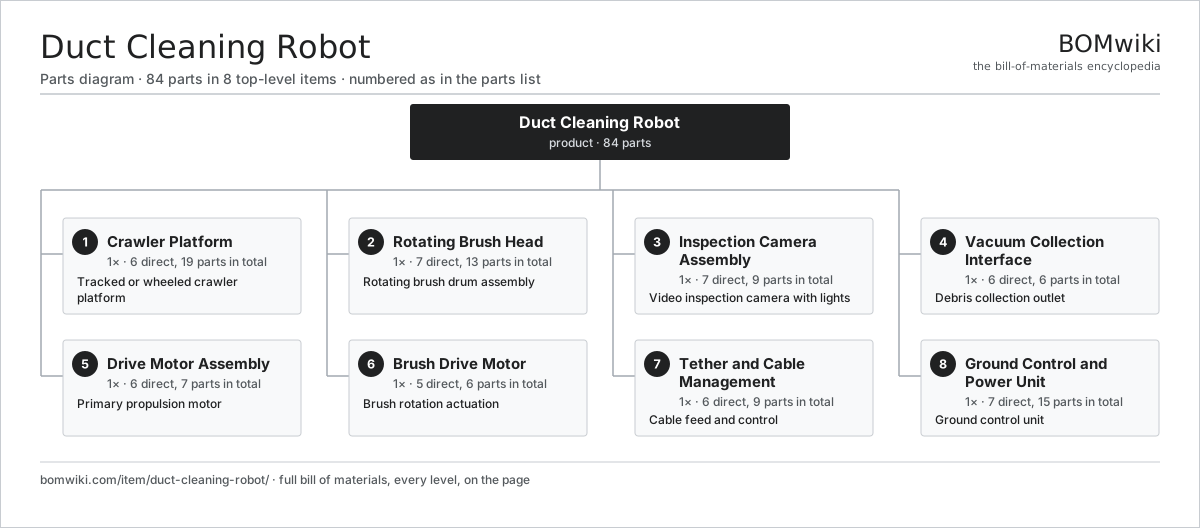
| # | Part | Qty | What it does |
|---|---|---|---|
| 1 | Crawler Platform 6 parts | 1× | Tracked or wheeled crawler platform |
| 2 | Rotating Brush Head 7 parts | 1× | Rotating brush drum assembly |
| 3 | Inspection Camera Assembly 7 parts | 1× | Video inspection camera with lights |
| 4 | Vacuum Collection Interface 6 parts | 1× | Debris collection outlet |
| 5 | Drive Motor Assembly 6 parts | 1× | Primary propulsion motor |
| 6 | Brush Drive Motor 5 parts | 1× | Brush rotation actuation |
| 7 | Tether and Cable Management 6 parts | 1× | Cable feed and control |
| 8 | Ground Control and Power Unit 7 parts | 1× | Ground control unit |
3D model
No 3D model yet. Have a CAD file of this? Add a 3D model. STL renders right on this page; STEP, FreeCAD, and OpenSCAD sources are welcome too (openly licensed, like all 3D models on BOMwiki).
Build & assembly graph
expand / collapse · shared sub-assemblies converge · links to related products · est. labourTap an assembly to expand/collapse · tap a part to open it · use “Open page” for any node · drag to pan, scroll to zoom.
Bill of materials for Duct Cleaning Robot
8 top-level lines · 58 rows shown · 84 parts total · indented to 3 levels| # | Item / sub-assembly | Part no. | Qty/assy | Ext. qty | Parts | Type |
|---|---|---|---|---|---|---|
| 1 | Crawler Platform 6 parts | duct-cleaning-robot-crawler-base | 1× | 1 | 19 | assembly |
| 1.1 | Robot Chassis Frame | duct-cleaning-robot-chassis | 1× | 1 | · | part |
| 1.2 | Crawler Track Assembly | duct-cleaning-robot-track-unit | 2× | 2 | · | part |
| 1.3 | Track Idler Wheel | duct-cleaning-robot-idler-wheel | 4× | 4 | · | part |
| 1.4 | Drive Sprocket | duct-cleaning-robot-drive-wheel | 2× | 2 | · | part |
| 1.5 | Ball Bearing | ball-bearing | 8× | 8 | · | part |
| 1.6 | Fastener Set | fastener-set | 2× | 2 | · | part |
| 2 | Rotating Brush Head 7 parts | duct-cleaning-robot-brush-head | 1× | 1 | 13 | assembly |
| 2.1 | Brush Rotating Drum | duct-cleaning-robot-brush-drum | 1× | 1 | · | part |
| 2.2 | Brush Bristle Strip | duct-cleaning-robot-brush-bristles | 6× | 6 | · | part |
| 2.3 | Brush Drum Bearing | duct-cleaning-robot-brush-bearing | 2× | 2 | · | part |
| 2.4 | Brush Shaft | duct-cleaning-robot-brush-shaft | 1× | 1 | · | part |
| 2.5 | Motor-to-Brush Coupling | duct-cleaning-robot-brush-drive-coupling | 1× | 1 | · | part |
| 2.6 | Connector | connector | 1× | 1 | · | part |
| 2.7 | Fastener Set | fastener-set | 1× | 1 | · | part |
| 3 | Inspection Camera Assembly 7 parts | duct-cleaning-robot-camera-system | 1× | 1 | 9 | assembly |
| 3.1 | CMOS Image Sensor | image-sensor | 1× | 1 | · | part |
| 3.2 | Lens Assembly | camera-lens | 1× | 1 | · | part |
| 3.3 | LED Light Module | duct-cleaning-robot-led-light | 2× | 2 | · | part |
| 3.4 | Camera Mounting Bracket | duct-cleaning-robot-camera-mount | 1× | 1 | · | part |
| 3.5 | Bare PCB | pcb-bare | 1× | 1 | · | part |
| 3.6 | Connector | connector | 2× | 2 | · | part |
| 3.7 | Wire Bundle | wire-bundle | 1× | 1 | · | part |
| 4 | Vacuum Collection Interface 6 parts | duct-cleaning-robot-vacuum-interface | 1× | 1 | 6 | assembly |
| 4.1 | Debris Collection Chamber | duct-cleaning-robot-debris-chamber | 1× | 1 | · | part |
| 4.2 | Cyclone Separator Cartridge | duct-cleaning-robot-separator-cyclone | 1× | 1 | · | part |
| 4.3 | Vacuum Adapter | duct-cleaning-robot-vacuum-hose-adapter | 1× | 1 | · | part |
| 4.4 | Intake Filter Screen | duct-cleaning-robot-filter-screen | 1× | 1 | · | part |
| 4.5 | Connector | connector | 1× | 1 | · | part |
| 4.6 | Fastener Set | fastener-set | 1× | 1 | · | part |
| 5 | Drive Motor Assembly 6 parts | duct-cleaning-robot-drive-motor | 1× | 1 | 7 | assembly |
| 5.1 | Propulsion Motor | duct-cleaning-robot-motor | 1× | 1 | · | part |
| 5.2 | Drive Motor Controller | duct-cleaning-robot-motor-controller | 1× | 1 | · | part |
| 5.3 | Drive Gearbox | duct-cleaning-robot-gearbox | 1× | 1 | · | part |
| 5.4 | Encoder | encoder | 1× | 1 | · | part |
| 5.5 | Connector | connector | 2× | 2 | · | part |
| 5.6 | Fastener Set | fastener-set | 1× | 1 | · | part |
| 6 | Brush Drive Motor 5 parts | duct-cleaning-robot-brush-motor | 1× | 1 | 6 | assembly |
| 6.1 | Brush Motor | duct-cleaning-robot-brush-bldc | 1× | 1 | · | part |
| 6.2 | Brush Motor Controller | duct-cleaning-robot-brush-controller | 1× | 1 | · | part |
| 6.3 | Brush Gearbox | duct-cleaning-robot-brush-gearbox | 1× | 1 | · | part |
| 6.4 | Connector | connector | 2× | 2 | · | part |
| 6.5 | Fastener Set | fastener-set | 1× | 1 | · | part |
| 7 | Tether and Cable Management 6 parts | duct-cleaning-robot-tether-management | 1× | 1 | 9 | assembly |
| 7.1 | Umbilical Cable | duct-cleaning-robot-tether-cable | 1× | 1 | · | part |
| 7.2 | Umbilical Winch | duct-cleaning-robot-tether-winch | 1× | 1 | · | part |
| 7.3 | Cable Guide Pulley | duct-cleaning-robot-tether-guide | 2× | 2 | · | part |
| 7.4 | Vacuum Hose Assembly | duct-cleaning-robot-vacuum-hose | 1× | 1 | · | part |
| 7.5 | Connector | connector | 3× | 3 | · | part |
| 7.6 | Fastener Set | fastener-set | 1× | 1 | · | part |
| 8 | Ground Control and Power Unit 7 parts | duct-cleaning-robot-controller-umbilical | 1× | 1 | 15 | assembly |
| 8.1 | Ground Power Supply | duct-cleaning-robot-power-supply | 1× | 1 | · | part |
| 8.2 | Control Joystick | duct-cleaning-robot-joystick-controller | 1× | 1 | · | part |
| 8.3 | Video Monitor | duct-cleaning-robot-display-monitor | 1× | 1 | · | part |
| 8.4 | Signal Receiver Module | duct-cleaning-robot-receiver-module | 1× | 1 | · | part |
| 8.5 | Bare PCB | pcb-bare | 1× | 1 | · | part |
| 8.6 | Connector | connector | 8× | 8 | · | part |
| 8.7 | Wire Bundle | wire-bundle | 2× | 2 | · | part |
Something wrong in this list? Report a problem with this BOM.
Related products
same domain, ranked by shared parts AGV Mobile Robot
383 parts · shares 2 with this page
Assistive Feeding Robot
96 parts · shares 2 with this page
AGV Mobile Robot
383 parts · shares 2 with this page
Assistive Feeding Robot
96 parts · shares 2 with this page
 Autonomous Mobile Robot (AMR)
627 parts · shares 2 with this page
Bin Picking Cell
118 parts · shares 2 with this page
Autonomous Mobile Robot (AMR)
627 parts · shares 2 with this page
Bin Picking Cell
118 parts · shares 2 with this page
Sourcing: possible vendors
Browse the supplier directory → Prices, MOQ, and lead times are algorithmic estimates, not quotes, and not claims about these companies. Company mappings are curated by keyword; est. price band $3k–$500k. How estimates work| Vendor | HQ | Specialty | MOQ | Lead time |
|---|---|---|---|---|
|
🇯🇵Fanuc
fanuc.com ↗
|
Oshino, JP | Industrial robots & CNC | 20 units | 10–18 wks |
| abb.com ↗ | Zurich, CH | Industrial robots | 20 units | 10–18 wks |
|
🇯🇵Yaskawa
yaskawa.com ↗
|
Kitakyushu, JP | Robots & motion | 20 units | 10–18 wks |
|
🇩🇪KUKA
kuka.com ↗
|
Augsburg, DE | Industrial robots | 20 units | 10–18 wks |
| universal-robots.com ↗ | Odense, DK | Collaborative robots | 20 units | 10–18 wks |
1,342-word article