Hexapod Robot
ProductOverview
A hexapod robot walks on six legs arranged around a hexagonal body, each leg a chain of three powered joints. Six legs is the engineering sweet spot for static stability: the robot can lift three legs at once and still stand on a stable tripod, so it never has to balance dynamically the way bipeds and quadrupeds do. The controller can be slow, the gait can pause mid-stride, and a power loss leaves the machine standing rather than falling. The price is mass and cost, 18 actuators against a quadruped's 12, and modest speed.
The architecture is insect-derived. Each Leg Module copies the cockroach leg plan: a Coxa Joint yaws the leg fore-aft, a Femur Joint pitches the upper segment, and a Tibia Joint extends the knee. All six legs are identical, so one spare covers any position.
Legs and actuation
Every joint uses the same Smart Servo: a Servo Motor and geartrain wrapped with an Microcontroller, an output Encoder, and a bus transceiver on a small Bare PCB. Smart servos replaced hobby PWM servos in this class because they daisy-chain on a single half-duplex bus (18 servos, one cable tree through the Servo Bus Board) and they talk back, position, load current, and temperature stream to the controller, which turns a blind open-loop machine into one that can detect a stalled or overheating joint. Machined Joint Brackets couple each servo horn to the next link, with a Ball Bearing supporting the idler side so the servo case never takes bending loads.
The Tibia Link ends in a Compliant Foot whose rubber Foot Tip rides on a Coil Spring above a Foot Contact Switch. Touchdown sensing is what lets the gait engine walk on ground it has not seen: each leg lowers until the switch closes, rather than to a precomputed height, so the body flows over rubble and steps without a terrain map.
Gait control
The Gait Controller solves inverse kinematics for all 18 joints at 50 to 100 Hz. For a 3-DOF leg the IK is closed-form trigonometry, cheap enough that the Compute SoC Module spends most of its budget on gait sequencing and the operator interface while a real-time Microcontroller masters the servo bus. Three canonical gaits cover the speed-stability trade:
- Tripod, legs move in two alternating sets of three; fastest, always statically stable, the default on firm ground.
- Ripple, overlapping pairs; intermediate speed, smoother body motion.
- Wave, one leg at a time; slowest but maximally stable, used on steep or loose terrain.
Because each leg places independently, the same machinery yields omnidirectional translation, zero-radius turns, and body pose control: the IMU Module feeds a leveling loop that keeps the Top Plate horizontal on slopes to about 30 degrees by redistributing leg extension.
Structure and power
The Body Chassis is a sandwich of a Top Plate and Bottom Plate separated by a Standoff Set, with six Leg Mount Bracket brackets taking the leg moments into both plates at once. A Belly Pan skid plate protects the electronics bay when the robot deliberately drops its body to crawl under obstacles at 40 mm clearance.
Walking is energetically expensive, unlike a wheel, every servo holds torque even when standing still. The Battery Pack (three LiPo Cells, 55 Wh, on a quick-release Battery Tray at the body centroid) gives about an hour of mixed walking; average draw runs 40 to 60 W with peaks near 150 W when all stance legs lift the body simultaneously.
Sensing and operation
The Sensor Head puts a wide-angle Head Camera and a ToF Rangefinder on a two-servo pan-tilt mast, streaming video over the Remote Link to a gamepad operator or a waypoint planner. Hexapods earn their keep in exactly the places the platform suggests: inspection of confined or rubble-strewn spaces, research into legged locomotion (the static stability makes them forgiving testbeds), and education, where one chassis exercises kinematics, control, and embedded buses in a single project.
Hexapod Robot parts and their functions
7 top-level parts · 679 parts in total · full bill of materials below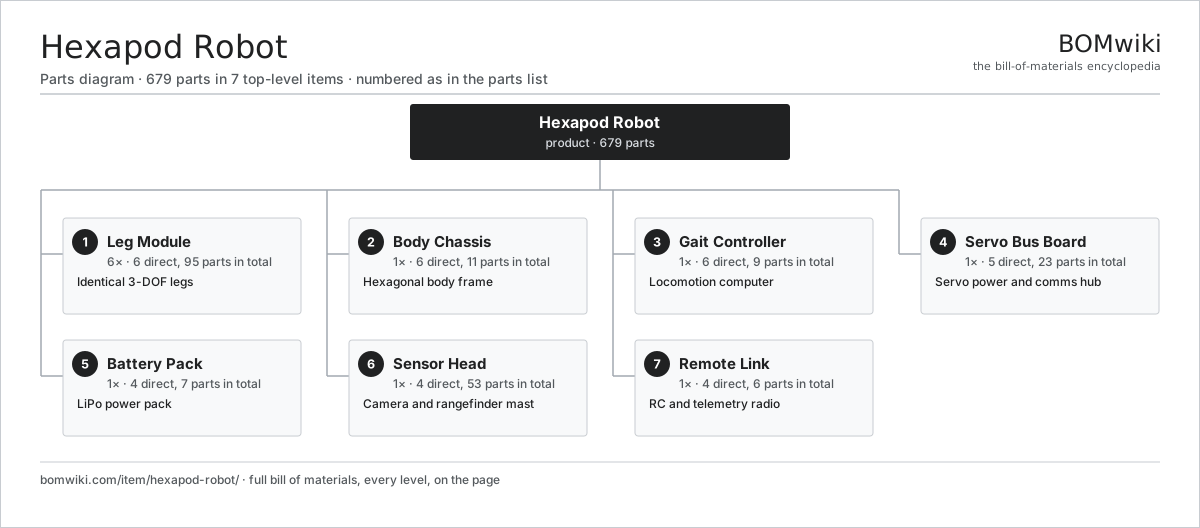
| # | Part | Qty | What it does |
|---|---|---|---|
| 1 | Leg Module 6 parts | 6× | Identical 3-DOF legs |
| 2 | Body Chassis 6 parts | 1× | Hexagonal body frame |
| 3 | Gait Controller 6 parts | 1× | Locomotion computer |
| 4 | Servo Bus Board 5 parts | 1× | Servo power and comms hub |
| 5 | Battery Pack 4 parts | 1× | LiPo power pack |
| 6 | Sensor Head 4 parts | 1× | Camera and rangefinder mast |
| 7 | Remote Link 4 parts | 1× | RC and telemetry radio |
Diagrams & photos


3D model
No 3D model yet. Have a CAD file of this? Add a 3D model. STL renders right on this page; STEP, FreeCAD, and OpenSCAD sources are welcome too (openly licensed, like all 3D models on BOMwiki).
Build & assembly graph
expand / collapse · shared sub-assemblies converge · links to related products · est. labourTap an assembly to expand/collapse · tap a part to open it · use “Open page” for any node · drag to pan, scroll to zoom.
Bill of materials for Hexapod Robot
7 top-level lines · 61 rows shown · 679 parts total · indented to 3 levels| # | Item / sub-assembly | Part no. | Qty/assy | Ext. qty | Parts | Type |
|---|---|---|---|---|---|---|
| 1 | Leg Module 6 parts | hexapod-robot-leg-module | 6× | 6 | 95 | assembly |
| 1.1 | Coxa Joint 3 parts | hexapod-robot-coxa-joint | 1× | 6 | 30 | assembly |
| 1.1.1 | Smart Servo 5 parts + deeper › | hexapod-robot-smart-servo | 1× | 6 | 28 | assembly |
| 1.1.2 | Joint Bracket | hexapod-robot-joint-bracket | 1× | 6 | · | part |
| 1.1.3 | Ball Bearing | ball-bearing | 1× | 6 | · | part |
| 1.2 | Femur Joint 3 parts | hexapod-robot-femur-joint | 1× | 6 | 30 | assembly |
| 1.2.1 | Smart Servo 5 parts + deeper › | hexapod-robot-smart-servo | 1× | 6 | 28 | assembly |
| 1.2.2 | Joint Bracket | hexapod-robot-joint-bracket | 1× | 6 | · | part |
| 1.2.3 | Ball Bearing | ball-bearing | 1× | 6 | · | part |
| 1.3 | Tibia Joint 3 parts | hexapod-robot-tibia-joint | 1× | 6 | 30 | assembly |
| 1.3.1 | Smart Servo 5 parts + deeper › | hexapod-robot-smart-servo | 1× | 6 | 28 | assembly |
| 1.3.2 | Joint Bracket | hexapod-robot-joint-bracket | 1× | 6 | · | part |
| 1.3.3 | Ball Bearing | ball-bearing | 1× | 6 | · | part |
| 1.4 | Femur Link | hexapod-robot-femur-link | 1× | 6 | · | part |
| 1.5 | Tibia Link | hexapod-robot-tibia-link | 1× | 6 | · | part |
| 1.6 | Compliant Foot 3 parts | hexapod-robot-foot | 1× | 6 | 3 | assembly |
| 1.6.1 | Foot Tip | hexapod-robot-foot-tip | 1× | 6 | · | part |
| 1.6.2 | Coil Spring | coil-spring | 1× | 6 | · | part |
| 1.6.3 | Foot Contact Switch | hexapod-robot-contact-switch | 1× | 6 | · | part |
| 2 | Body Chassis 6 parts | hexapod-robot-body-chassis | 1× | 1 | 11 | assembly |
| 2.1 | Top Plate | hexapod-robot-top-plate | 1× | 1 | · | part |
| 2.2 | Bottom Plate | hexapod-robot-bottom-plate | 1× | 1 | · | part |
| 2.3 | Standoff Set | hexapod-robot-standoff-set | 1× | 1 | · | part |
| 2.4 | Leg Mount Bracket | hexapod-robot-leg-mount | 6× | 6 | · | part |
| 2.5 | Belly Pan | hexapod-robot-belly-pan | 1× | 1 | · | part |
| 2.6 | Fastener Set | fastener-set | 1× | 1 | · | part |
| 3 | Gait Controller 6 parts | hexapod-robot-gait-controller | 1× | 1 | 9 | assembly |
| 3.1 | Compute SoC Module | soc-module | 1× | 1 | · | part |
| 3.2 | Microcontroller | mcu | 1× | 1 | · | part |
| 3.3 | Bare PCB | pcb-bare | 1× | 1 | · | part |
| 3.4 | IMU Module | hexapod-robot-imu | 1× | 1 | · | part |
| 3.5 | SMD Passive (R/C/L) | smd-passives | 1× | 1 | · | part |
| 3.6 | Connector | connector | 4× | 4 | · | part |
| 4 | Servo Bus Board 5 parts | hexapod-robot-servo-bus-board | 1× | 1 | 23 | assembly |
| 4.1 | Bare PCB | pcb-bare | 1× | 1 | · | part |
| 4.2 | Power MOSFET | mosfet | 2× | 2 | · | part |
| 4.3 | Connector | connector | 18× | 18 | · | part |
| 4.4 | SMD Passive (R/C/L) | smd-passives | 1× | 1 | · | part |
| 4.5 | Thermal Fuse | thermal-fuse | 1× | 1 | · | part |
| 5 | Battery Pack 4 parts | hexapod-robot-battery-pack | 1× | 1 | 7 | assembly |
| 5.1 | LiPo Cell | lipo-cell | 3× | 3 | · | part |
| 5.2 | BMS Board | bms-board | 1× | 1 | · | part |
| 5.3 | Battery Tray | hexapod-robot-battery-tray | 1× | 1 | · | part |
| 5.4 | Connector | connector | 2× | 2 | · | part |
| 6 | Sensor Head 4 parts | hexapod-robot-sensor-head | 1× | 1 | 53 | assembly |
| 6.1 | Servo Motor 4 parts | servo-motor | 2× | 2 | 24 | assembly |
| 6.1.1 | Stator Assembly 3 parts + deeper › | stator-assembly | 1× | 2 | 3 | assembly |
| 6.1.2 | Rotor Assembly 4 parts + deeper › | rotor-assembly | 1× | 2 | 19 | assembly |
| 6.1.3 | Encoder | encoder | 1× | 2 | · | part |
| 6.1.4 | Motor Housing | motor-housing | 1× | 2 | · | part |
| 6.2 | Head Camera 3 parts | hexapod-robot-head-camera | 1× | 1 | 3 | assembly |
| 6.2.1 | CMOS Image Sensor | image-sensor | 1× | 1 | · | part |
| 6.2.2 | Lens Assembly | camera-lens | 1× | 1 | · | part |
| 6.2.3 | Bare PCB | pcb-bare | 1× | 1 | · | part |
| 6.3 | ToF Rangefinder | hexapod-robot-tof-rangefinder | 1× | 1 | · | part |
| 6.4 | Head Shell | hexapod-robot-head-shell | 1× | 1 | · | part |
| 7 | Remote Link 4 parts | hexapod-robot-remote-link | 1× | 1 | 6 | assembly |
| 7.1 | Compute SoC Module | soc-module | 1× | 1 | · | part |
| 7.2 | Bare PCB | pcb-bare | 1× | 1 | · | part |
| 7.3 | Antenna | hexapod-robot-antenna | 2× | 2 | · | part |
| 7.4 | Connector | connector | 2× | 2 | · | part |
Something wrong in this list? Report a problem with this BOM.
Related products
same domain, ranked by shared parts Sidewalk Delivery Robot
568 parts · shares 5 with this page
Sidewalk Delivery Robot
568 parts · shares 5 with this page
 Wall-Climbing Inspection Robot
235 parts · shares 4 with this page
Wall-Climbing Inspection Robot
235 parts · shares 4 with this page
Sourcing: possible vendors
Browse the supplier directory → Prices, MOQ, and lead times are algorithmic estimates, not quotes, and not claims about these companies. Company mappings are curated by keyword; est. price band $3k–$500k. How estimates work| Vendor | HQ | Specialty | MOQ | Lead time |
|---|---|---|---|---|
|
🇯🇵Fanuc
fanuc.com ↗
|
Oshino, JP | Industrial robots & CNC | 20 units | 10–18 wks |
| abb.com ↗ | Zurich, CH | Industrial robots | 20 units | 10–18 wks |
|
🇯🇵Yaskawa
yaskawa.com ↗
|
Kitakyushu, JP | Robots & motion | 20 units | 10–18 wks |
|
🇩🇪KUKA
kuka.com ↗
|
Augsburg, DE | Industrial robots | 20 units | 10–18 wks |
| universal-robots.com ↗ | Odense, DK | Collaborative robots | 20 units | 10–18 wks |
719-word article