Ship Hull Cleaning Robot
ProductOverview
The Ship Hull Cleaning Robot is a remotely operated vehicle (ROV) designed for removing marine biofouling and corroded paint from vessel hulls underwater. The system uses dual cleaning mechanisms, a rotating brush for soft biofouling (algae, soft coral) and a reciprocating scraper for hard fouling (barnacles, mussels, oxidized paint). Adhesion is maintained via powerful neodymium magnets (for steel hulls) or vectored thruster pressure (for composite hulls). Dislodged debris is immediately suctioned into a separator and transported to the surface via discharge hose.
A single ROV can clean 200-300 m² of hull per 8-hour shift, compared to 50-80 m² for divers in the same time. The system reduces human exposure to nitrogen narcosis, cold water, and decompression risk. Modern container ships (300-400 m long) require 3-5 days of ROV cleaning to achieve biofouling removal; hull cleaning extends fuel efficiency by 5-10% (significant for ships consuming 150+ tons of fuel per day at sea).
How it works
The hull cleaning workflow proceeds from hull conditioning, real-time monitoring, mechanical cleaning, and debris extraction:
Magnetic Adhesion and Thrust Vectoring
The adhesion system employs rare-earth neodymium magnets (typically four 50 mm discs per unit) to grip steel hulls. The magnetic force is ~2000 kg, sufficient to hold the 150 kg ROV even during aggressive brush or scraper action. For composite (fiberglass or carbon) hulls, thrust vectoring is employed: the vectorable thrusters are angled to push the ROV against the hull at +200-300 N of contact pressure. A solenoid-modulated magnet reduces adhesion force on command, allowing the operator to release the ROV without moving away from the hull.
Real-Time Visual Feedback
The camera and lighting system provides live 1080p 60 fps video to the topside operator. Wide-angle optics (2.8 mm lens) capture ~80° field-of-view, showing the brush/scraper contact area and 1-2 meters of hull beyond. Dual 1000-lumen LED arrays illuminate the hull, revealing biofouling severity and cleaning progress. The operator watches for cracks, corrosion pitting, or compromised paint, critical safety information for hull integrity.
Brush Cleaning for Soft Biofouling
The rotating brush head spins at 0-200 RPM, controlled by the operator via joystick secondary axis. The high-density nylon bristles (~3 cm length) contact the hull at angles, both scrubbing longitudinally and sweeping around the circumference. This action loosens algae, diatoms, and soft coral. The rotating speed is tuned empirically: fast spinning (200 RPM) is aggressive but risks bristle wear and paint scuffing; slow speeds (50-100 RPM) are gentler on paint but slower to clean.
Scraper for Hard Fouling
For hard-fouled areas, a reciprocating scraper blade (tungsten carbide or stainless steel) delivers high unit force. A proportional hydraulic actuator drives the blade in and out at 0-50 mm stroke, 2-10 Hz frequency. The operator modulates stroke depth: shallow strokes (10 mm) gently remove thin barnacle layers, while full strokes (50 mm) aggressively remove thick encrustations. Blade pressure is tunable via pilot valve modulation, balancing cleaning efficacy against the risk of hull paint damage.
Debris Suction and Separation
A 5 kW centrifugal pump suction motor creates negative pressure in the brush/scraper work zone. Dislodged debris is immediately drawn into a separation chamber on the ROV. A cyclone separator spins down heavy particles (shells, scale) while water and fine silt are discharged. The separated material is accumulated in an onboard hopper; when full, the ROV returns to the surface and the hopper is emptied into a topside collection bin.
Alternatively, debris can be continuously discharged via a 50 mm discharge hose routed to the surface. This method avoids hopper overflow but requires a topside suction manifold to manage the debris flow.
Three-Axis Thruster Coordination
Three vectored thrusters (1 kW each) provide translation and positioning: typically vertical (hovering depth control), horizontal forward/back, and lateral strafe. The pilot joystick is proportional: pushing forward accelerates forward; releasing centers the stick, halting forward motion. A secondary axis controls depth. This control scheme allows the operator to position the ROV precisely against the hull without manual anchor points.
Thrust vectoring (nozzle rotation) adds directional flexibility without yaw rotation. An intelligent autopilot can hold depth and position automatically, freeing the operator to focus on brush/scraper control.
Mechanical Design
The main chassis is machined aluminum, rated for 300 m depth (40 bar). All electronics are sealed in titanium or aluminum pressure housings to survive seawater pressure. External surfaces are either stainless steel or coated with marine epoxy. Sacrificial zinc anodes are bolted to the frame to prevent galvanic corrosion of aluminum in seawater. The frame is designed for modular tool changes: the brush and scraper heads are quick-disconnect, allowing operators to swap to specialized tools (high-velocity water jets, abrasive brushes, ultrasonic transducers) without returning to the surface.
The brush mechanism employs a stainless drum (150 mm diameter, 100 mm width) with radial grooves holding spiral-wrapped nylon bristles. The brush is driven by a slipring coupler attached to a vectored thruster motor, allowing rotation independent of the thruster direction. At 200 RPM, surface speed is ~31 m/s, sufficient to dislodge soft biofouling without damage.
The scraper blade uses tungsten carbide (for harder fouling) or stainless steel (for paint removal). The blade is mounted on a hydraulic cylinder driven by a 24V solenoid proportional valve. Pressure regulator and pilot logic allow the operator to fine-tune scraping pressure, critical for achieving clean hulls without deep gouging.
Electrical and Control Systems
All thrusters, solenoids, and pumps are 24V DC, fed from a 500A topside supply via the armored umbilical cable. The cable is 500 m long, multiconductor (power, signal, telemetry), with steel armor for abrasion resistance. A slip ring at the ROV interface allows unlimited rotation of the ROV without twisting the umbilical.
The topside control station includes a 24V 500A DC supply (marine-duty enclosure with surge protection), proportional joystick (6-axis control), and 15-inch HD monitor for video display. A real-time control computer runs ROV firmware, translating joystick commands into motor driver outputs. Telemetry (ROV depth, thruster current, water temperature) is displayed on the monitor, alerting the operator to system status.
The camera system is a 1/1.8-inch CCD sensor (1080p 60 fps) with wide-angle lens and titanium dome port. LED arrays provide 1000+ lumens of illumination. Video is digitally encoded and transmitted via the umbilical at low bandwidth (MPEG-4 compression); latency is typically 100-300 ms, acceptable for remote control at shallow depths.
Operational Challenges and Mitigations
Hull cleaning in open water (not in dry dock) requires careful planning. Timing must avoid high sea states (waves > 2 m) and strong currents. The ROV is launched from a support vessel using a davit (A-frame crane), tethered via the slip-ring winch. Depth and position are continuously monitored via umbilical data and GPS-based surface marker.
Magnetic adhesion works well on steel hulls but loses effectiveness on composite hulls, requiring full thruster-driven contact. Fouling severity varies: tropical waters (warm, nutrient-rich) develop heavy biofouling in weeks; cold North Atlantic waters develop slower but harder calcified encrustations.
Maintenance and Consumables
Brush bristles wear out after ~100-200 m² of cleaning, becoming matted and ineffective. Replacement bristle sets are field-replaceable at the slip ring. Scraper blades dull after ~500 m² of hard fouling; tungsten carbide blades are sharpenable at specialist shops; stainless is replaced when dull.
Bearings, seals, and electrical connectors require inspection after every dive. The pressure housings and dome port require annual hydrostatic testing (to 1.5× max depth) to verify integrity. The slip ring requires electrical continuity checks and brush contact pressure verification after every 100 hours of operation.
Umbilical cables are replaced every 2-3 years as armor corrosion and insulation degradation accumulate. Total cost of ownership is ~$2-4M for a capable hull cleaning system, including ROV, support vessel time, and crew training.
Ship Hull Cleaning Robot parts and their functions
9 top-level parts · 88 parts in total · full bill of materials below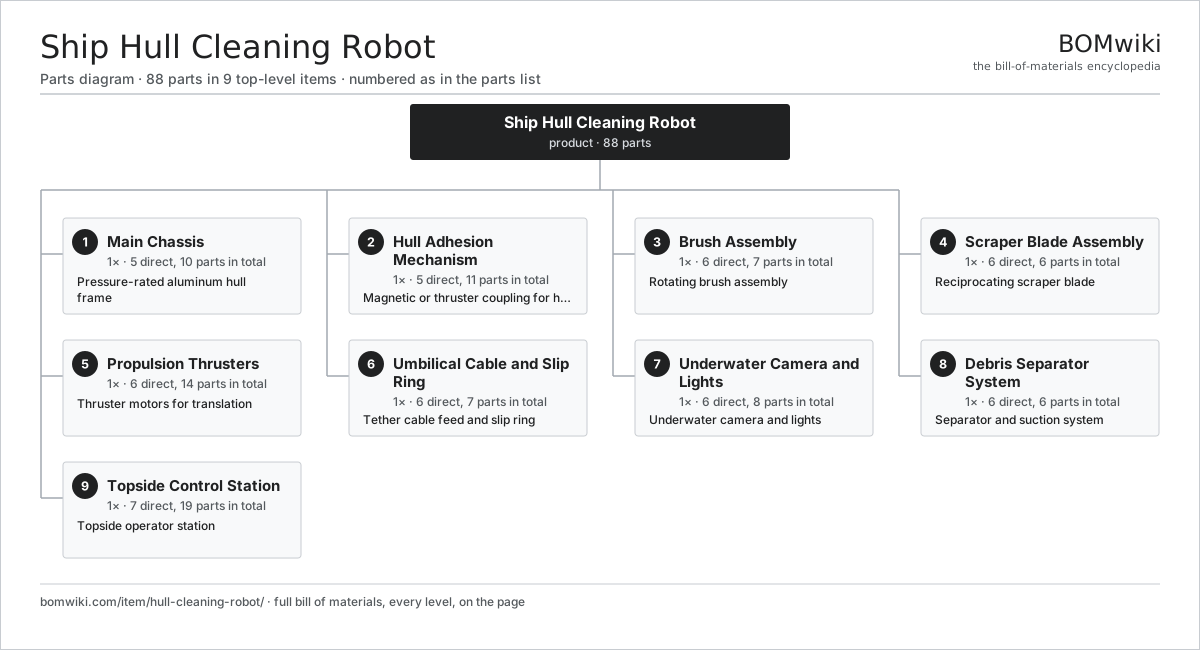
| # | Part | Qty | What it does |
|---|---|---|---|
| 1 | Main Chassis 5 parts | 1× | Pressure-rated aluminum hull frame |
| 2 | Hull Adhesion Mechanism 5 parts | 1× | Magnetic or thruster coupling for hull grip |
| 3 | Brush Assembly 6 parts | 1× | Rotating brush assembly |
| 4 | Scraper Blade Assembly 6 parts | 1× | Reciprocating scraper blade |
| 5 | Propulsion Thrusters 6 parts | 1× | Thruster motors for translation |
| 6 | Umbilical Cable and Slip Ring 6 parts | 1× | Tether cable feed and slip ring |
| 7 | Underwater Camera and Lights 6 parts | 1× | Underwater camera and lights |
| 8 | Debris Separator System 6 parts | 1× | Separator and suction system |
| 9 | Topside Control Station 7 parts | 1× | Topside operator station |
3D model
No 3D model yet. Have a CAD file of this? Add a 3D model. STL renders right on this page; STEP, FreeCAD, and OpenSCAD sources are welcome too (openly licensed, like all 3D models on BOMwiki).
Build & assembly graph
expand / collapse · shared sub-assemblies converge · links to related products · est. labourTap an assembly to expand/collapse · tap a part to open it · use “Open page” for any node · drag to pan, scroll to zoom.
Bill of materials for Ship Hull Cleaning Robot
9 top-level lines · 62 rows shown · 88 parts total · indented to 3 levels| # | Item / sub-assembly | Part no. | Qty/assy | Ext. qty | Parts | Type |
|---|---|---|---|---|---|---|
| 1 | Main Chassis 5 parts | hull-cleaning-robot-chassis | 1× | 1 | 10 | assembly |
| 1.1 | Pressure Hull Frame | hull-cleaning-robot-frame | 1× | 1 | · | part |
| 1.2 | Pressure Vessel | hull-cleaning-robot-pressure-housing | 2× | 2 | · | part |
| 1.3 | O-Ring Set | oring-set | 2× | 2 | · | part |
| 1.4 | Fastener Set | fastener-set | 3× | 3 | · | part |
| 1.5 | Anodes | hull-cleaning-robot-anodes | 2× | 2 | · | part |
| 2 | Hull Adhesion Mechanism 5 parts | hull-cleaning-robot-adhesion-system | 1× | 1 | 11 | assembly |
| 2.1 | Neodymium Magnet | neodymium-magnet | 4× | 4 | · | part |
| 2.2 | Magnet Backing Pad | hull-cleaning-robot-magnet-pad | 2× | 2 | · | part |
| 2.3 | Magnetic Modulation Motor | hull-cleaning-robot-adhesion-motor | 1× | 1 | · | part |
| 2.4 | Vectorable Nozzle | hull-cleaning-robot-thrust-vector | 2× | 2 | · | part |
| 2.5 | Connector | connector | 2× | 2 | · | part |
| 3 | Brush Assembly 6 parts | hull-cleaning-robot-brush-unit | 1× | 1 | 7 | assembly |
| 3.1 | Brush Rotating Drum | hull-cleaning-robot-brush-drum | 1× | 1 | · | part |
| 3.2 | Brush Bristles | hull-cleaning-robot-brush-bristles | 1× | 1 | · | part |
| 3.3 | Brush Motor | hull-cleaning-robot-brush-motor | 1× | 1 | · | part |
| 3.4 | Brush Bearing Block | hull-cleaning-robot-brush-bearing | 2× | 2 | · | part |
| 3.5 | Drive Coupling | hull-cleaning-robot-brush-coupling | 1× | 1 | · | part |
| 3.6 | Fastener Set | fastener-set | 1× | 1 | · | part |
| 4 | Scraper Blade Assembly 6 parts | hull-cleaning-robot-scraper-unit | 1× | 1 | 6 | assembly |
| 4.1 | Scraper Blade | hull-cleaning-robot-scraper-blade | 1× | 1 | · | part |
| 4.2 | Scraper Linkage Arm | hull-cleaning-robot-scraper-arm | 1× | 1 | · | part |
| 4.3 | Proportional Hydraulic Cylinder | hull-cleaning-robot-scraper-actuator | 1× | 1 | · | part |
| 4.4 | Hydraulic Controller | hull-cleaning-robot-scraper-controller | 1× | 1 | · | part |
| 4.5 | Connector | connector | 1× | 1 | · | part |
| 4.6 | Fastener Set | fastener-set | 1× | 1 | · | part |
| 5 | Propulsion Thrusters 6 parts | hull-cleaning-robot-propulsion | 1× | 1 | 14 | assembly |
| 5.1 | Vectored Thruster Motor | hull-cleaning-robot-thruster-motor | 3× | 3 | · | part |
| 5.2 | Thruster Nozzle | hull-cleaning-robot-thruster-nozzle | 3× | 3 | · | part |
| 5.3 | Thruster ESC | hull-cleaning-robot-thruster-controller | 1× | 1 | · | part |
| 5.4 | Encoder | encoder | 3× | 3 | · | part |
| 5.5 | Connector | connector | 3× | 3 | · | part |
| 5.6 | Fastener Set | fastener-set | 1× | 1 | · | part |
| 6 | Umbilical Cable and Slip Ring 6 parts | hull-cleaning-robot-umbilical-system | 1× | 1 | 7 | assembly |
| 6.1 | Armored Umbilical Cable | hull-cleaning-robot-umbilical-cable | 1× | 1 | · | part |
| 6.2 | Electrical Slip Ring | hull-cleaning-robot-slip-ring | 1× | 1 | · | part |
| 6.3 | Cable Fairlead | hull-cleaning-robot-cable-guide | 1× | 1 | · | part |
| 6.4 | Umbilical Winch | hull-cleaning-robot-cable-winch | 1× | 1 | · | part |
| 6.5 | Connector | connector | 2× | 2 | · | part |
| 6.6 | Fastener Set | fastener-set | 1× | 1 | · | part |
| 7 | Underwater Camera and Lights 6 parts | hull-cleaning-robot-vision-system | 1× | 1 | 8 | assembly |
| 7.1 | CMOS Image Sensor | image-sensor | 1× | 1 | · | part |
| 7.2 | Lens Assembly | camera-lens | 1× | 1 | · | part |
| 7.3 | LED Light Array | hull-cleaning-robot-led-array | 2× | 2 | · | part |
| 7.4 | Camera Dome Housing | hull-cleaning-robot-camera-housing | 1× | 1 | · | part |
| 7.5 | Bare PCB | pcb-bare | 1× | 1 | · | part |
| 7.6 | Connector | connector | 2× | 2 | · | part |
| 8 | Debris Separator System 6 parts | hull-cleaning-robot-debris-collection | 1× | 1 | 6 | assembly |
| 8.1 | Suction Pump Motor | hull-cleaning-robot-suction-motor | 1× | 1 | · | part |
| 8.2 | Cyclone Separator | hull-cleaning-robot-cyclone-separator | 1× | 1 | · | part |
| 8.3 | Discharge Hose | hull-cleaning-robot-discharge-hose | 1× | 1 | · | part |
| 8.4 | Separation Solenoid Valve | hull-cleaning-robot-separator-valve | 1× | 1 | · | part |
| 8.5 | Connector | connector | 1× | 1 | · | part |
| 8.6 | Fastener Set | fastener-set | 1× | 1 | · | part |
| 9 | Topside Control Station 7 parts | hull-cleaning-robot-control-unit | 1× | 1 | 19 | assembly |
| 9.1 | Marine Power Supply Unit | hull-cleaning-robot-power-supply | 1× | 1 | · | part |
| 9.2 | Joystick Control Panel | hull-cleaning-robot-joystick-panel | 1× | 1 | · | part |
| 9.3 | Video Monitor Display | hull-cleaning-robot-video-display | 1× | 1 | · | part |
| 9.4 | Control Computer | hull-cleaning-robot-control-processor | 1× | 1 | · | part |
| 9.5 | Bare PCB | pcb-bare | 1× | 1 | · | part |
| 9.6 | Connector | connector | 12× | 12 | · | part |
| 9.7 | Wire Bundle | wire-bundle | 2× | 2 | · | part |
Something wrong in this list? Report a problem with this BOM.
Related products
same domain, ranked by shared parts Robotic Assembly Cell
1,746 parts · shares 3 with this page
Robotic Assembly Cell
1,746 parts · shares 3 with this page
Sourcing: possible vendors
Browse the supplier directory → Prices, MOQ, and lead times are algorithmic estimates, not quotes, and not claims about these companies. Company mappings are curated by keyword; est. price band $3k–$500k. How estimates work| Vendor | HQ | Specialty | MOQ | Lead time |
|---|---|---|---|---|
|
🇯🇵Fanuc
fanuc.com ↗
|
Oshino, JP | Industrial robots & CNC | 20 units | 10–18 wks |
| abb.com ↗ | Zurich, CH | Industrial robots | 20 units | 10–18 wks |
|
🇯🇵Yaskawa
yaskawa.com ↗
|
Kitakyushu, JP | Robots & motion | 20 units | 10–18 wks |
|
🇩🇪KUKA
kuka.com ↗
|
Augsburg, DE | Industrial robots | 20 units | 10–18 wks |
| universal-robots.com ↗ | Odense, DK | Collaborative robots | 20 units | 10–18 wks |
1,374-word article