Quadruped Robot
ProductOverview
A quadruped robot walks on four legs, each with three powered joints: hip abduction (sideways swing), hip flexion (forward swing), and knee. The twelve joints are identical Joint Actuator modules, which simplifies spares and lets the manufacturer tune one actuator design well. The legs bolt to a Torso Chassis that also carries the Battery Pack, the Compute Unit, and the Perception Suite.
Unlike a wheeled platform, a quadruped is statically unstable for much of its gait cycle. The machine stays upright because a controller replans contact forces about a thousand times per second, using the IMU Module for attitude and each Foot Assembly for touchdown confirmation. The payoff is terrain access: stairs, rubble, 30° slopes, and gaps that stop wheels and tracks.
Actuation
The defining component is the quasi-direct-drive actuator. A conventional servo pairs a small fast motor with a 100:1 or higher reduction; that maximizes torque density but makes the joint stiff, fragile under impact, and blind to external forces. A quadruped instead uses a large-diameter, high-pole-count BLDC motor, an outer Rotor Assembly carrying 28 Neodymium Magnet poles around a concentrated-winding Stator Assembly, geared down only ~9:1 through a single-stage Planetary Gearset (Sun Gear, three Planet Gears, fixed Ring Gear).
The shallow reduction keeps reflected inertia low, so foot impacts backdrive the gears instead of shattering teeth, and motor current remains an honest proxy for joint torque. Each actuator embeds its own Actuator Driver Board: an Microcontroller running field-oriented control through a six-Power MOSFET bridge, with two Encoders (rotor and output) for commutation and absolute joint angle. The drivers hang off CAN buses routed by the Wiring Harness, receiving torque setpoints at 1 kHz.
Within each Leg Module, the knee actuator sits coaxial with the hip at the top of the Upper Leg Link and drives the shin through the Knee Linkage. Mounting all three actuators near the hip keeps leg inertia low, which is what allows fast swing phases and rapid recovery steps. The Lower Leg Link is a carbon tube ending in a rubber Foot Pad over a Foot Shell; an internal Pressure Sensor reports contact force so the controller knows the instant each foot loads.
Perception and control
Five Stereo Depth Camera units cover the front (two), both sides, and rear. Each is a global-shutter stereo pair (CMOS Image Sensor ×2 behind matched Lens Assemblyes) with a IR Pattern Projector adding infrared texture so depth works on featureless floors. The cameras feed one of the two Compute SoC Modules in the Compute Unit, which fuses them into a local elevation map; the second SoC runs the locomotion stack. A separate real-time Microcontroller supervises joint limits and fault states, and the Compute Heatsink dumps compute heat into the Torso Frame.
The locomotion controller works in two layers. A gait planner selects footholds on the elevation map a few steps ahead; a whole-body controller then solves, every millisecond, for the twelve joint torques that track the body trajectory while keeping each stance foot's force inside its friction cone. State estimation fuses IMU rates, joint encoders, and foot contact events, there is no GPS dependency, so the robot works indoors and underground.
Power
The Battery Pack is an 84-cell 12S7P block of Li-ion Cell, 18650 cells (about 605 Wh) in a latching Battery Case that slides into the belly bay and blind-mates its Connector; swaps take under a minute. A BMS Board handles balancing and protection, backed by a Thermal Fuse. Downstream, the Power Distribution Board board soft-starts the actuator bus through paralleled MOSFETs, holds a Relay contactor closed during operation, and drops 50 V battery voltage to the 12 V and 5 V rails for compute and sensors. The Emergency Stop opens that contactor directly, a hardware path that works even if every processor has hung.
Walking economy is dominated by stance torque, not motion: standing still costs roughly 150 W because the knees hold the body up against gravity, while a steady trot draws 400–600 W. Gaits that use more passive leg geometry (straighter knees) extend the ~90-minute runtime noticeably.
Applications
Production quadrupeds carry inspection payloads, pan-tilt-zoom cameras, thermal imagers, gas sniffers, LiDAR, through plants, substations, construction sites, and tunnels on scheduled autonomous missions, returning to a charging dock between rounds. The Carry Handle and the 32 kg mass keep single-person transport practical, and field service mostly means swapping a leg module or actuator, both designed as line-replaceable units held by a standard Fastener Set.
Quadruped Robot parts and their functions
8 top-level parts · 1,080 parts in total · full bill of materials below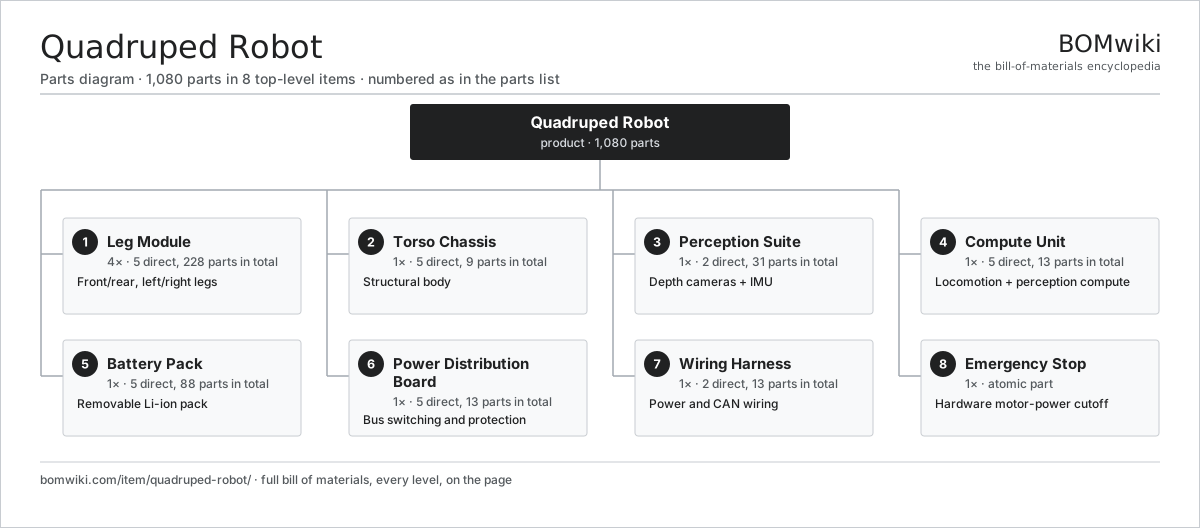
| # | Part | Qty | What it does |
|---|---|---|---|
| 1 | Leg Module 5 parts | 4× | Front/rear, left/right legs |
| 2 | Torso Chassis 5 parts | 1× | Structural body |
| 3 | Perception Suite 2 parts | 1× | Depth cameras + IMU |
| 4 | Compute Unit 5 parts | 1× | Locomotion + perception compute |
| 5 | Battery Pack 5 parts | 1× | Removable Li-ion pack |
| 6 | Power Distribution Board 5 parts | 1× | Bus switching and protection |
| 7 | Wiring Harness 2 parts | 1× | Power and CAN wiring |
| 8 | Emergency Stop | 1× | Hardware motor-power cutoff |
Diagrams & photos


3D model
No 3D model yet. Have a CAD file of this? Add a 3D model. STL renders right on this page; STEP, FreeCAD, and OpenSCAD sources are welcome too (openly licensed, like all 3D models on BOMwiki).
Build & assembly graph
expand / collapse · shared sub-assemblies converge · links to related products · est. labourTap an assembly to expand/collapse · tap a part to open it · use “Open page” for any node · drag to pan, scroll to zoom.
Bill of materials for Quadruped Robot
8 top-level lines · 52 rows shown · 1,080 parts total · indented to 3 levels| # | Item / sub-assembly | Part no. | Qty/assy | Ext. qty | Parts | Type |
|---|---|---|---|---|---|---|
| 1 | Leg Module 5 parts | quadruped-robot-leg-module | 4× | 4 | 228 | assembly |
| 1.1 | Joint Actuator 8 parts | quadruped-robot-joint-actuator | 3× | 12 | 74 | assembly |
| 1.1.1 | Stator Assembly 3 parts + deeper › | stator-assembly | 1× | 12 | 3 | assembly |
| 1.1.2 | Rotor Assembly 4 parts + deeper › | rotor-assembly | 1× | 12 | 19 | assembly |
| 1.1.3 | Neodymium Magnet | neodymium-magnet | 28× | 336 | · | part |
| 1.1.4 | Planetary Gearset 4 parts + deeper › | quadruped-robot-planetary-gearset | 1× | 12 | 8 | assembly |
| 1.1.5 | Motor Housing | motor-housing | 1× | 12 | · | part |
| 1.1.6 | Ball Bearing | ball-bearing | 2× | 24 | · | part |
| 1.1.7 | Encoder | encoder | 2× | 24 | · | part |
| 1.1.8 | Actuator Driver Board 5 parts + deeper › | quadruped-robot-actuator-driver | 1× | 12 | 11 | assembly |
| 1.2 | Upper Leg Link | quadruped-robot-upper-leg-link | 1× | 4 | · | part |
| 1.3 | Lower Leg Link | quadruped-robot-lower-leg-link | 1× | 4 | · | part |
| 1.4 | Knee Linkage | quadruped-robot-knee-linkage | 1× | 4 | · | part |
| 1.5 | Foot Assembly 3 parts | quadruped-robot-foot-assembly | 1× | 4 | 3 | assembly |
| 1.5.1 | Foot Pad | quadruped-robot-foot-pad | 1× | 4 | · | part |
| 1.5.2 | Foot Shell | quadruped-robot-foot-shell | 1× | 4 | · | part |
| 1.5.3 | Pressure Sensor | pressure-sensor | 1× | 4 | · | part |
| 2 | Torso Chassis 5 parts | quadruped-robot-torso-chassis | 1× | 1 | 9 | assembly |
| 2.1 | Torso Frame | quadruped-robot-torso-frame | 1× | 1 | · | part |
| 2.2 | Actuator Bulkhead | quadruped-robot-bulkhead | 2× | 2 | · | part |
| 2.3 | Sheet Metal Panel | sheet-panel | 4× | 4 | · | part |
| 2.4 | Carry Handle | quadruped-robot-carry-handle | 1× | 1 | · | part |
| 2.5 | Fastener Set | fastener-set | 1× | 1 | · | part |
| 3 | Perception Suite 2 parts | quadruped-robot-perception-suite | 1× | 1 | 31 | assembly |
| 3.1 | Stereo Depth Camera 4 parts | quadruped-robot-depth-camera | 5× | 5 | 6 | assembly |
| 3.1.1 | CMOS Image Sensor | image-sensor | 2× | 10 | · | part |
| 3.1.2 | Lens Assembly | camera-lens | 2× | 10 | · | part |
| 3.1.3 | IR Pattern Projector | quadruped-robot-ir-projector | 1× | 5 | · | part |
| 3.1.4 | Bare PCB | pcb-bare | 1× | 5 | · | part |
| 3.2 | IMU Module | quadruped-robot-imu | 1× | 1 | · | part |
| 4 | Compute Unit 5 parts | quadruped-robot-compute-unit | 1× | 1 | 13 | assembly |
| 4.1 | Compute SoC Module | soc-module | 2× | 2 | · | part |
| 4.2 | Microcontroller | mcu | 1× | 1 | · | part |
| 4.3 | Bare PCB | pcb-bare | 1× | 1 | · | part |
| 4.4 | Compute Heatsink | quadruped-robot-heatsink | 1× | 1 | · | part |
| 4.5 | Connector | connector | 8× | 8 | · | part |
| 5 | Battery Pack 5 parts | quadruped-robot-battery-pack | 1× | 1 | 88 | assembly |
| 5.1 | Li-ion Cell, 18650 | li-cell-18650 | 84× | 84 | · | part |
| 5.2 | BMS Board | bms-board | 1× | 1 | · | part |
| 5.3 | Battery Case | quadruped-robot-battery-case | 1× | 1 | · | part |
| 5.4 | Thermal Fuse | thermal-fuse | 1× | 1 | · | part |
| 5.5 | Connector | connector | 1× | 1 | · | part |
| 6 | Power Distribution Board 5 parts | quadruped-robot-power-distribution | 1× | 1 | 13 | assembly |
| 6.1 | Bare PCB | pcb-bare | 1× | 1 | · | part |
| 6.2 | Power MOSFET | mosfet | 4× | 4 | · | part |
| 6.3 | Relay | relay | 1× | 1 | · | part |
| 6.4 | SMD Passive (R/C/L) | smd-passives | 1× | 1 | · | part |
| 6.5 | Connector | connector | 6× | 6 | · | part |
| 7 | Wiring Harness 2 parts | quadruped-robot-harness | 1× | 1 | 13 | assembly |
| 7.1 | Wire Bundle | wire-bundle | 1× | 1 | · | part |
| 7.2 | Connector | connector | 12× | 12 | · | part |
| 8 | Emergency Stop | quadruped-robot-estop | 1× | 1 | · | part |
Something wrong in this list? Report a problem with this BOM.
Related products
same domain, ranked by shared parts Fruit Picking Robot
144 parts · shares 6 with this page
Drone Docking Station
210 parts · shares 7 with this page
Fruit Picking Robot
144 parts · shares 6 with this page
Drone Docking Station
210 parts · shares 7 with this page
 Sidewalk Delivery Robot
568 parts · shares 6 with this page
ASRS Shuttle Robot
296 parts · shares 6 with this page
Sidewalk Delivery Robot
568 parts · shares 6 with this page
ASRS Shuttle Robot
296 parts · shares 6 with this page
Sourcing: possible vendors
Browse the supplier directory → Prices, MOQ, and lead times are algorithmic estimates, not quotes, and not claims about these companies. Company mappings are curated by keyword; est. price band $3k–$500k. How estimates work| Vendor | HQ | Specialty | MOQ | Lead time |
|---|---|---|---|---|
|
🇯🇵Fanuc
fanuc.com ↗
|
Oshino, JP | Industrial robots & CNC | 20 units | 10–18 wks |
| abb.com ↗ | Zurich, CH | Industrial robots | 20 units | 10–18 wks |
|
🇯🇵Yaskawa
yaskawa.com ↗
|
Kitakyushu, JP | Robots & motion | 20 units | 10–18 wks |
|
🇩🇪KUKA
kuka.com ↗
|
Augsburg, DE | Industrial robots | 20 units | 10–18 wks |
| universal-robots.com ↗ | Odense, DK | Collaborative robots | 20 units | 10–18 wks |
814-word article