Shelf Scanning Robot
ProductOverview
A shelf-scanning robot automates planogram compliance and inventory checks in retail stores, a labor-intensive task currently performed by human crew members walking aisles with clipboards or scanning guns. The robot is a mobile column (1.2 m × 0.8 m footprint) equipped with a vertical lift mast (0–2.5 m reach), a three-camera imaging head, and a 64-channel LiDAR scanner. As it navigates autonomously through store aisles, the robot continuously scans shelves, decoding product barcodes, reading price tags and expiration dates, and comparing the physical layout to the store's planogram (blueprint of where each SKU should be). Discrepancies, out-of-stock items, misplaced products, expired goods, are logged in real time and sent to the store backend, alerting staff to restocking needs or pricing issues.
The robot autonomously charges itself at a dock between shifts, making it a zero-intervention system once deployed.
Mobility and navigation
The mobile base has four omnidirectional wheels, each driven by an independent BLDC motor, enabling true Cartesian motion, forward/backward, strafe left/right, and point-turn rotation without wheel skidding. This mobility is crucial in tight supermarket aisles (1.2–1.5 m wide) where narrow turning is essential.
Navigation is powered by simultaneous localization and mapping (SLAM): the LiDAR continuously scans the 3D environment (endcaps, shelving units, floor clutter), building a live point-cloud map. The onboard GPU runs a SLAM algorithm that fuses LiDAR odometry with motor encoder feedback, maintaining accurate pose within 5 cm error even over multi-aisle traversals. Obstacles (a customer standing in the aisle, a fallen item) are detected; the robot stops and alerts staff or reroutes autonomously to an adjacent aisle.
Camera system and image acquisition
The camera head comprises three synchronized sensors at different focal lengths:
- Wide-angle camera (24 mm equivalent, 12 MP): Captures the full section of a 1.2 m × 1.8 m shelf unit, providing context for planogram position. Three images per unit (bottom, middle, top shelves).
- Standard camera (50 mm, 8 MP): Optimized for barcode reading at 1 m distance. The backend vision model decodes Code128 and QR codes with 98+ % accuracy; if a barcode is unreadable (damaged, facing wrong direction), OCR falls back to reading the product label text.
- Macro camera (telephoto macro, 5 MP): Captures price tags and expiration date codes in high detail, allowing the system to detect mismatches (wrong price sign) or expired stock.
All three are synchronized to capture within 100 ms of each other, ensuring consistent lighting. The LED ring light provides soft, diffuse illumination preventing glossy product reflections or harsh shadows.
Planogram matching and compliance
The SoC runs a neural network trained on thousands of real store shelf images and planogram blueprints. For each shelf unit scanned, the system:
- Extracts all visible product barcodes and reads them.
- Detects product positions (using object detection on the wide-angle image).
- Compares actual barcode positions to the planogram blueprint, which specifies "SKU 12345 should be in position [2,1]" (second shelf, first column).
- Flags discrepancies: missing SKU, wrong position, overstock, incorrect facing (label facing wrong way).
- Reads expiration codes, flagging items outside acceptable date ranges.
Accuracy is ~95 %, high enough to guide restocking crew to problem areas, though a human still verifies edge cases (cosmetic damage, hard-to-read labels, handwritten date codes). The system learns over time: if a particular SKU's barcode is routinely unreadable, the model learns to use visual features (color, shape, label pattern) as a backup.
Data transmission and backend integration
The Wi-Fi uplink streams compressed image metadata (barcode reads, positions, expiry flags) to the store's backend in real time at ~1 Mbps. Barcode lists and planogram blueprints are synced to the robot's onboard SSD every night at the dock, ensuring the robot has the latest inventory and expected layout. If Wi-Fi is intermittent (common in older retail buildings), the robot buffers scan data on local storage and uploads during the dock recharge window.
A store manager or inventory system (e.g., a Shopify or SAP integration) queries the robot's latest scan: "Aisle 3, Shelf 2 is missing 6 units of SKU 45678, and one product expired on 2024-05-15". This enables real-time restocking alerts and proactive markdown of aging stock.
Autonomous charging and scheduling
The robot autonomously navigates to the charging dock once per shift (e.g., after scanning 500–1,000 meters of shelves on a 14.4 kWh battery, runtime ~8–10 hours). The dock is stationary and placed in a back-of-store location. The robot's SLAM map includes the dock location; when battery falls below 20 %, the robot ceases scanning, navigates to the dock, and backs onto the charging contacts. The dock supplies 48 V 50 A to the onboard BMS, recharging in ~4 hours. Meanwhile, the robot's backend connection transmits all buffered scans to the server.
Overnight, the store schedule can program multiple charge/scan cycles: Robot goes to dock at 2 AM, charges for 4 hours, scans aisles from 6 AM to 2 PM, charges again, scans 2 PM to 10 PM. Over a week, comprehensive coverage of the entire store is achieved with zero manual intervention.
Retail outcomes and integration
Stores using shelf-scanning robots report:
- Faster restocking: Crew receives a prioritized list of empty/misplaced locations, eliminating wandering and guesswork.
- Reduced shrink: Expired items are flagged before they reach checkout, preventing writeoffs.
- Planogram compliance: Automatically enforced; marketing campaigns (seasonal displays, end-cap arrangements) are verified against expectations.
- Labor shift: Human crew transitions from manual auditing to action-based restocking, improving job satisfaction and throughput.
- Data-driven analytics: Daily scan logs reveal trending stock, customer preferences, and store-specific patterns invisible in POS-only data.
The robot is particularly valuable in large supermarkets (10,000+ SKUs, 30+ aisles) where manual compliance audits are infeasible. Medium stores (5,000 SKU, 15 aisles) can deploy one or two units; large distribution centers or hypermarkets employ fleets of 10+ robots working in coordinated shifts.
Shelf Scanning Robot parts and their functions
10 top-level parts · 162 parts in total · full bill of materials below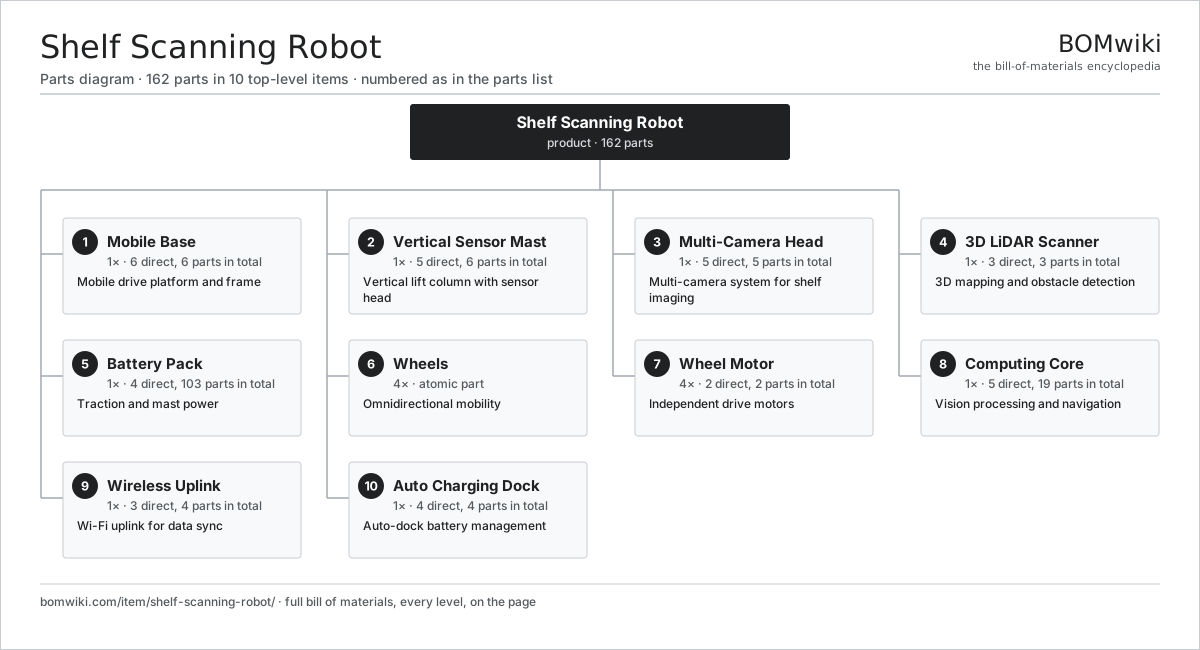
| # | Part | Qty | What it does |
|---|---|---|---|
| 1 | Mobile Base 6 parts | 1× | Mobile drive platform and frame |
| 2 | Vertical Sensor Mast 5 parts | 1× | Vertical lift column with sensor head |
| 3 | Multi-Camera Head 5 parts | 1× | Multi-camera system for shelf imaging |
| 4 | 3D LiDAR Scanner 3 parts | 1× | 3D mapping and obstacle detection |
| 5 | Battery Pack 4 parts | 1× | Traction and mast power |
| 6 | Wheels | 4× | Omnidirectional mobility |
| 7 | Wheel Motor 2 parts | 4× | Independent drive motors |
| 8 | Computing Core 5 parts | 1× | Vision processing and navigation |
| 9 | Wireless Uplink 3 parts | 1× | Wi-Fi uplink for data sync |
| 10 | Auto Charging Dock 4 parts | 1× | Auto-dock battery management |
3D model
No 3D model yet. Have a CAD file of this? Add a 3D model. STL renders right on this page; STEP, FreeCAD, and OpenSCAD sources are welcome too (openly licensed, like all 3D models on BOMwiki).
Build & assembly graph
expand / collapse · shared sub-assemblies converge · links to related products · est. labourTap an assembly to expand/collapse · tap a part to open it · use “Open page” for any node · drag to pan, scroll to zoom.
Bill of materials for Shelf Scanning Robot
10 top-level lines · 50 rows shown · 162 parts total · indented to 3 levels| # | Item / sub-assembly | Part no. | Qty/assy | Ext. qty | Parts | Type |
|---|---|---|---|---|---|---|
| 1 | Mobile Base 6 parts | shelf-scanning-robot-base | 1× | 1 | 6 | assembly |
| 1.1 | Frame Chassis | shelf-scanning-robot-frame | 1× | 1 | · | part |
| 1.2 | Left Front Wheel | shelf-scanning-robot-wheel-left-front | 1× | 1 | · | part |
| 1.3 | Right Front Wheel | shelf-scanning-robot-wheel-right-front | 1× | 1 | · | part |
| 1.4 | Left Rear Wheel | shelf-scanning-robot-wheel-left-rear | 1× | 1 | · | part |
| 1.5 | Right Rear Wheel | shelf-scanning-robot-wheel-right-rear | 1× | 1 | · | part |
| 1.6 | Fastener Set | fastener-set | 1× | 1 | · | part |
| 2 | Vertical Sensor Mast 5 parts | shelf-scanning-robot-mast | 1× | 1 | 6 | assembly |
| 2.1 | Mast Column | shelf-scanning-robot-mast-column | 1× | 1 | · | part |
| 2.2 | Mast Motor | shelf-scanning-robot-mast-motor | 1× | 1 | · | part |
| 2.3 | Mast Carriage | shelf-scanning-robot-mast-carriage | 1× | 1 | · | part |
| 2.4 | Mast Encoder | shelf-scanning-robot-mast-encoder | 1× | 1 | · | part |
| 2.5 | Ball Bearing | ball-bearing | 2× | 2 | · | part |
| 3 | Multi-Camera Head 5 parts | shelf-scanning-robot-camera-bank | 1× | 1 | 5 | assembly |
| 3.1 | Wide Camera | shelf-scanning-robot-camera-wide | 1× | 1 | · | part |
| 3.2 | Standard Camera | shelf-scanning-robot-camera-standard | 1× | 1 | · | part |
| 3.3 | Macro Camera | shelf-scanning-robot-camera-macro | 1× | 1 | · | part |
| 3.4 | LED Ring | shelf-scanning-robot-light-panel | 1× | 1 | · | part |
| 3.5 | Bare PCB | pcb-bare | 1× | 1 | · | part |
| 4 | 3D LiDAR Scanner 3 parts | shelf-scanning-robot-lidar | 1× | 1 | 3 | assembly |
| 4.1 | LiDAR Sensor | shelf-scanning-robot-lidar-sensor | 1× | 1 | · | part |
| 4.2 | LiDAR Cover | shelf-scanning-robot-lidar-enclosure | 1× | 1 | · | part |
| 4.3 | Bare PCB | pcb-bare | 1× | 1 | · | part |
| 5 | Battery Pack 4 parts | shelf-scanning-robot-battery | 1× | 1 | 103 | assembly |
| 5.1 | Li-ion Cell, 18650 | li-cell-18650 | 100× | 100 | · | part |
| 5.2 | BMS Board | bms-board | 1× | 1 | · | part |
| 5.3 | Battery Case | shelf-scanning-robot-battery-case | 1× | 1 | · | part |
| 5.4 | Dock Contacts | shelf-scanning-robot-dock-contacts | 1× | 1 | · | part |
| 6 | Wheels | shelf-scanning-robot-wheels | 4× | 4 | · | part |
| 7 | Wheel Motor 2 parts | shelf-scanning-robot-wheel-motors | 4× | 4 | 2 | assembly |
| 7.1 | Motor | shelf-scanning-robot-motor | 1× | 4 | · | part |
| 7.2 | Motor Encoder | shelf-scanning-robot-motor-encoder | 1× | 4 | · | part |
| 8 | Computing Core 5 parts | shelf-scanning-robot-computing-core | 1× | 1 | 19 | assembly |
| 8.1 | Compute SoC Module | soc-module | 1× | 1 | · | part |
| 8.2 | Microcontroller | mcu | 1× | 1 | · | part |
| 8.3 | Bare PCB | pcb-bare | 1× | 1 | · | part |
| 8.4 | Storage | shelf-scanning-robot-storage | 1× | 1 | · | part |
| 8.5 | Motor Driver Board 3 parts | shelf-scanning-robot-io-board | 1× | 1 | 15 | assembly |
| 8.5.1 | Power MOSFET | mosfet | 6× | 6 | · | part |
| 8.5.2 | Bare PCB | pcb-bare | 1× | 1 | · | part |
| 8.5.3 | Connector | connector | 8× | 8 | · | part |
| 9 | Wireless Uplink 3 parts | shelf-scanning-robot-communication | 1× | 1 | 4 | assembly |
| 9.1 | Wi-Fi Module | shelf-scanning-robot-wifi-module | 1× | 1 | · | part |
| 9.2 | Antenna | shelf-scanning-robot-antenna-array | 2× | 2 | · | part |
| 9.3 | Router Interface | shelf-scanning-robot-router-interface | 1× | 1 | · | part |
| 10 | Auto Charging Dock 4 parts | shelf-scanning-robot-charging-dock | 1× | 1 | 4 | assembly |
| 10.1 | Dock Platform | shelf-scanning-robot-dock-platform | 1× | 1 | · | part |
| 10.2 | Dock Charger | shelf-scanning-robot-dock-charger | 1× | 1 | · | part |
| 10.3 | Dock Coupler | shelf-scanning-robot-dock-coupler | 1× | 1 | · | part |
| 10.4 | Connector | connector | 1× | 1 | · | part |
Something wrong in this list? Report a problem with this BOM.
Related products
same domain, ranked by shared parts AGV Mobile Robot
383 parts · shares 3 with this page
Assistive Feeding Robot
96 parts · shares 3 with this page
Autonomous Forklift
342 parts · shares 3 with this page
AGV Mobile Robot
383 parts · shares 3 with this page
Assistive Feeding Robot
96 parts · shares 3 with this page
Autonomous Forklift
342 parts · shares 3 with this page
 Bricklaying Robot
221 parts · shares 3 with this page
Drywall Finishing Robot
179 parts · shares 3 with this page
Bricklaying Robot
221 parts · shares 3 with this page
Drywall Finishing Robot
179 parts · shares 3 with this page
 Mobile Manipulator
1,307 parts · shares 3 with this page
Mobile Manipulator
1,307 parts · shares 3 with this page
Sourcing: possible vendors
Browse the supplier directory → Prices, MOQ, and lead times are algorithmic estimates, not quotes, and not claims about these companies. Company mappings are curated by keyword; est. price band $3k–$500k. How estimates work| Vendor | HQ | Specialty | MOQ | Lead time |
|---|---|---|---|---|
|
🇯🇵Fanuc
fanuc.com ↗
|
Oshino, JP | Industrial robots & CNC | 20 units | 10–18 wks |
| abb.com ↗ | Zurich, CH | Industrial robots | 20 units | 10–18 wks |
|
🇯🇵Yaskawa
yaskawa.com ↗
|
Kitakyushu, JP | Robots & motion | 20 units | 10–18 wks |
|
🇩🇪KUKA
kuka.com ↗
|
Augsburg, DE | Industrial robots | 20 units | 10–18 wks |
| universal-robots.com ↗ | Odense, DK | Collaborative robots | 20 units | 10–18 wks |
1,089-word article