Agricultural Weeding Robot
ProductOverview
The Agricultural Weeding Robot is an autonomous platform designed for mechanical and thermal weed suppression in crop rows without chemical herbicides. It combines multispectral crop/weed classification with dual weeding implements: a mechanical finger weeder for small weeds and a high-power laser for larger perennials. The platform is powered by a 48V LiFePO4 battery with integrated solar panels, enabling 8-12 hours of continuous operation per charge. RTK-GPS guidance holds the robot within 2 cm of target row centerlines, critical for safety and efficacy in narrow-row crops.
The system targets organic farming and high-value perennial crops (grapes, berries, tree nuts) where selective weed removal without chemical residue is a premium. A single unit can cover 4-8 hectares per day in typical row crops, achieving 90%+ weed control rates while preserving crop rows.
How it works
The weeding workflow cycles through perception, navigation, target classification, and actuation:
Multispectral Weed Detection
A 5MP RGB-NIR camera mounted at the perception head captures the soil surface and emerging weeds at 10 Hz. The NVIDIA Jetson Xavier NX GPU runs a YOLOv5-based classifier trained on 200,000 labeled weed and crop plant images. The model outputs bounding boxes for each plant, along with species confidence (95%+ for common weeds). The system distinguishes weed type (grass, broadleaf, sedge) to inform tool selection: mechanical for shallow-rooted species, laser for deep-rooted perennials.
RTK-GPS and Row Following
The robot maintains row centerline position using RTK-GNSS corrections from a fixed base station (typically a smartphone with survey-grade positioning). A 9-axis IMU complements GPS, fusing data at 50 Hz to estimate heading and lateral drift. The navigation stack uses a simple proportional-integral controller: if GPS deviation exceeds ±5 cm, motor commands adjust track speed to steer back to centerline. This tight coupling keeps the robot aligned within crop rows as narrow as 30 cm.
Mechanical Weeding
For small weeds (< 8 cm height) within 5 cm of crop rows, a servo-driven finger weeder lowers into the soil 2-4 cm deep. The implement oscillates at 2 Hz, pulling weeds by the roots without soil inversion. A soil depth sensor prevents over-engagement that could uproot crop plants. This method is gentle enough for young transplants and capable of removing 100-150 weeds per hour.
Laser Weeding
Larger or deeper-rooted weeds are targeted by the 50-100W CO2 laser. Once a weed is detected and classified as a perennial (confidence > 0.8), the robot halts, aims the laser at the plant apex, and fires a 0.5-1 second pulse. The thermal energy ruptures plant cells, killing the weed. A solenoid safety shutter prevents accidental firing if the robot tips. Laser efficacy is highest on sunny days (90%+ kill rates) and lower in wet conditions (65-75%).
Power and Solar Integration
The 960 Wh LiFePO4 battery powers all systems. Eight 100W monocrystalline solar cells arranged on a rooftop frame provide continuous trickle charging during operation, extending field runtime to 10-12 hours without returning to base. An MPPT controller optimizes power extraction across varying sunlight conditions.
Mechanical Construction
The tracked platform uses rubber tracks 0.8 m long with individual suspension per track, allowing ground contact conformance on rough tilled soil. Track tension is spring-biased to prevent over-loosening. Ground clearance is 30 cm, typical for single-row row crops. The main frame is welded steel with bolt-on module hardpoints for easy field repair.
The drive system uses dual 48V 1000W brushless motors driving through 20:1 gearboxes to track sprockets. Differential gearing between left/right drives enables skid steering. Motor current is monitored for obstacle detection; if resistance spikes beyond 50A, the robot pauses and reports blockage to the field operator.
The mechanical implement is a flex-arm assembly with three hardened steel finger tines. A servo motor raises/lowers the arm to adjust soil engagement depth. A pressure sensor in the implement base provides feedback on soil hardness, automatically adjusting depth if the robot encounters compacted sections.
Electrical and Navigation
The main controller is a dual-core ARM processor running a custom Linux-based stack. It fuses RTK-GPS, IMU, motor encoder, and AI inference data at 50 Hz. The navigation loop outputs independent track speed commands to left and right motors, correcting for GPS drift and compass deviation.
The RTK-GPS module receives corrections from a local base station mounted on a barn or tractor, broadcast via 4G LTE or local radio. Dual-frequency reception (L1/L2) corrects for ionospheric delay, achieving 2 cm accuracy within a 5 km radius of the base. The IMU provides drift correction during brief signal loss (seconds to minutes).
The vision pipeline runs inference at 10 Hz on 1280×960 RGB-NIR frames. Raw pixel data is normalized per-channel, fed through the YOLOv5 backbone, and decoded into plant detections. Detections are labeled as crop or weed; weeds are further classified as grass, broadleaf, or sedge. Spatial coordinates are transformed to robot frame-of-reference using a calibrated camera-to-base transform.
Field Deployment
Operators deploy a single robot per field, typically alongside a 4G base station mounted on a tractor. The robot is released at the field edge and autonomously weed all rows in the zone. RTK corrections are broadcast via LTE; if signal is lost, the robot uses IMU-corrected odometry for up to 15 minutes before stopping to avoid row-crop collisions.
Real-time telemetry is streamed to a cloud dashboard: battery level, weed detection rate, GPS position, and laser firing count. The operator can issue commands (pause, change row, return to home) via mobile app.
Maintenance intervals are 60 operating hours for track tension inspection, 200 hours for laser optics cleaning (dust occlusion reduces power), and 400 hours for battery health diagnostics (capacity fade monitored via coulomb counting).
Agricultural Weeding Robot parts and their functions
9 top-level parts · 104 parts in total · full bill of materials below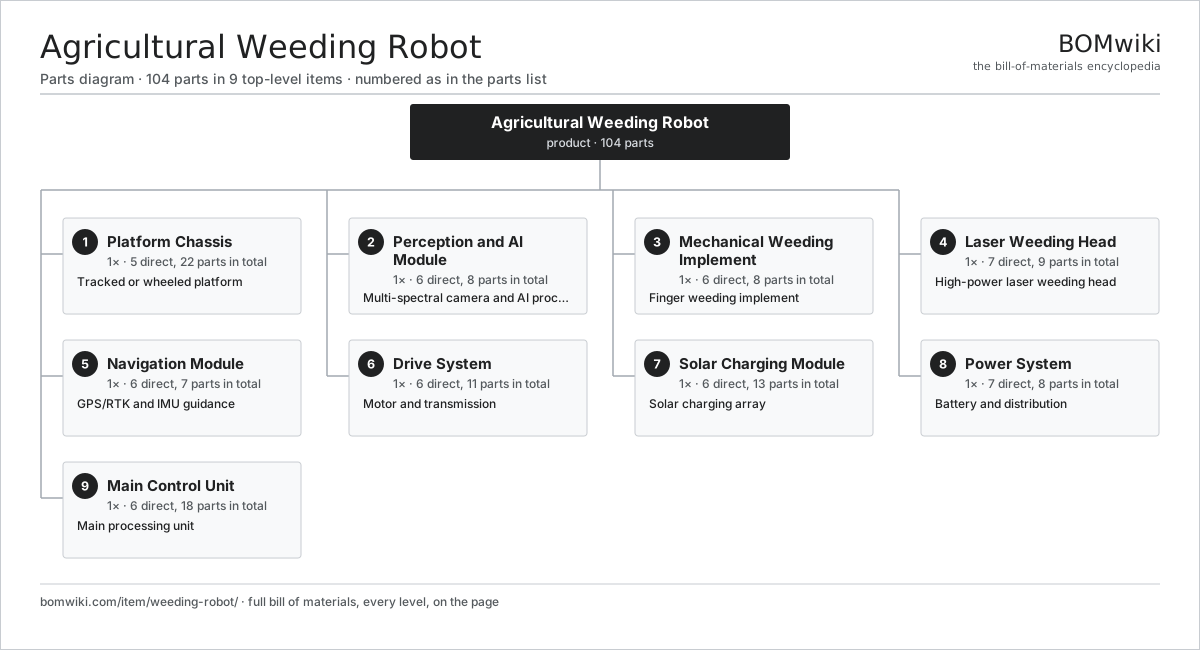
| # | Part | Qty | What it does |
|---|---|---|---|
| 1 | Platform Chassis 5 parts | 1× | Tracked or wheeled platform |
| 2 | Perception and AI Module 6 parts | 1× | Multi-spectral camera and AI processor |
| 3 | Mechanical Weeding Implement 6 parts | 1× | Finger weeding implement |
| 4 | Laser Weeding Head 7 parts | 1× | High-power laser weeding head |
| 5 | Navigation Module 6 parts | 1× | GPS/RTK and IMU guidance |
| 6 | Drive System 6 parts | 1× | Motor and transmission |
| 7 | Solar Charging Module 6 parts | 1× | Solar charging array |
| 8 | Power System 7 parts | 1× | Battery and distribution |
| 9 | Main Control Unit 6 parts | 1× | Main processing unit |
3D model
No 3D model yet. Have a CAD file of this? Add a 3D model. STL renders right on this page; STEP, FreeCAD, and OpenSCAD sources are welcome too (openly licensed, like all 3D models on BOMwiki).
Build & assembly graph
expand / collapse · shared sub-assemblies converge · links to related products · est. labourTap an assembly to expand/collapse · tap a part to open it · use “Open page” for any node · drag to pan, scroll to zoom.
Bill of materials for Agricultural Weeding Robot
9 top-level lines · 64 rows shown · 104 parts total · indented to 3 levels| # | Item / sub-assembly | Part no. | Qty/assy | Ext. qty | Parts | Type |
|---|---|---|---|---|---|---|
| 1 | Platform Chassis 5 parts | weeding-robot-chassis | 1× | 1 | 22 | assembly |
| 1.1 | Track Assembly | weeding-robot-track-unit | 2× | 2 | · | part |
| 1.2 | Main Frame Structure | weeding-robot-frame | 1× | 1 | · | part |
| 1.3 | Suspension Arm | weeding-robot-suspension | 4× | 4 | · | part |
| 1.4 | Ball Bearing | ball-bearing | 12× | 12 | · | part |
| 1.5 | Fastener Set | fastener-set | 3× | 3 | · | part |
| 2 | Perception and AI Module 6 parts | weeding-robot-perception-head | 1× | 1 | 8 | assembly |
| 2.1 | CMOS Image Sensor | image-sensor | 1× | 1 | · | part |
| 2.2 | Edge GPU Module | weeding-robot-ai-processor | 1× | 1 | · | part |
| 2.3 | Lens Assembly | camera-lens | 1× | 1 | · | part |
| 2.4 | Bare PCB | pcb-bare | 1× | 1 | · | part |
| 2.5 | Connector | connector | 3× | 3 | · | part |
| 2.6 | Wire Bundle | wire-bundle | 1× | 1 | · | part |
| 3 | Mechanical Weeding Implement 6 parts | weeding-robot-mechanical-weeder | 1× | 1 | 8 | assembly |
| 3.1 | Weeder Arm Assembly | weeding-robot-weeder-arm | 1× | 1 | · | part |
| 3.2 | Finger Tine Unit | weeding-robot-weeder-fingers | 3× | 3 | · | part |
| 3.3 | Weeder Position Servo | weeding-robot-weeder-servo | 1× | 1 | · | part |
| 3.4 | Pressure Sensor | pressure-sensor | 1× | 1 | · | part |
| 3.5 | Connector | connector | 1× | 1 | · | part |
| 3.6 | Fastener Set | fastener-set | 1× | 1 | · | part |
| 4 | Laser Weeding Head 7 parts | weeding-robot-laser-module | 1× | 1 | 9 | assembly |
| 4.1 | CO2 Laser Tube | weeding-robot-laser-tube | 1× | 1 | · | part |
| 4.2 | Laser Power Supply | weeding-robot-laser-psu | 1× | 1 | · | part |
| 4.3 | Laser Focusing Optics | weeding-robot-laser-optics | 1× | 1 | · | part |
| 4.4 | Laser Mirror | weeding-robot-laser-mirror | 2× | 2 | · | part |
| 4.5 | Laser Safety Shutter | weeding-robot-laser-shutter | 1× | 1 | · | part |
| 4.6 | Connector | connector | 2× | 2 | · | part |
| 4.7 | Wire Bundle | wire-bundle | 1× | 1 | · | part |
| 5 | Navigation Module 6 parts | weeding-robot-navigation-system | 1× | 1 | 7 | assembly |
| 5.1 | RTK-GPS Antenna | weeding-robot-rtk-antenna | 1× | 1 | · | part |
| 5.2 | RTK Receiver Module | weeding-robot-gps-receiver | 1× | 1 | · | part |
| 5.3 | Inertial Measurement Unit | weeding-robot-imu | 1× | 1 | · | part |
| 5.4 | Bare PCB | pcb-bare | 1× | 1 | · | part |
| 5.5 | Connector | connector | 2× | 2 | · | part |
| 5.6 | Fastener Set | fastener-set | 1× | 1 | · | part |
| 6 | Drive System 6 parts | weeding-robot-drivetrain | 1× | 1 | 11 | assembly |
| 6.1 | Drive Motor | weeding-robot-drive-motor | 2× | 2 | · | part |
| 6.2 | Brushless ESC | weeding-robot-motor-controller | 1× | 1 | · | part |
| 6.3 | Gearbox | weeding-robot-transmission | 1× | 1 | · | part |
| 6.4 | Encoder | encoder | 2× | 2 | · | part |
| 6.5 | Ball Bearing | ball-bearing | 4× | 4 | · | part |
| 6.6 | Fastener Set | fastener-set | 1× | 1 | · | part |
| 7 | Solar Charging Module 6 parts | weeding-robot-solar-panel | 1× | 1 | 13 | assembly |
| 7.1 | Solar Cell Module | weeding-robot-solar-cell | 8× | 8 | · | part |
| 7.2 | Solar Panel Frame | weeding-robot-solar-frame | 1× | 1 | · | part |
| 7.3 | MPPT Charge Controller | weeding-robot-mppt-charger | 1× | 1 | · | part |
| 7.4 | Connector | connector | 1× | 1 | · | part |
| 7.5 | Wire Bundle | wire-bundle | 1× | 1 | · | part |
| 7.6 | Fastener Set | fastener-set | 1× | 1 | · | part |
| 8 | Power System 7 parts | weeding-robot-power-electronics | 1× | 1 | 8 | assembly |
| 8.1 | LiFePO4 Battery Module | weeding-robot-battery | 1× | 1 | · | part |
| 8.2 | BMS Board | bms-board | 1× | 1 | · | part |
| 8.3 | 48V to 24V Converter | weeding-robot-dcdc-primary | 1× | 1 | · | part |
| 8.4 | 48V to 12V Converter | weeding-robot-dcdc-secondary | 1× | 1 | · | part |
| 8.5 | Power Supply | power-supply | 1× | 1 | · | part |
| 8.6 | Thermal Fuse | thermal-fuse | 2× | 2 | · | part |
| 8.7 | O-Ring Set | oring-set | 1× | 1 | · | part |
| 9 | Main Control Unit 6 parts | weeding-robot-controller | 1× | 1 | 18 | assembly |
| 9.1 | Microcontroller | mcu | 1× | 1 | · | part |
| 9.2 | Wireless Module | weeding-robot-wireless-module | 1× | 1 | · | part |
| 9.3 | Bare PCB | pcb-bare | 1× | 1 | · | part |
| 9.4 | SMD Passive (R/C/L) | smd-passives | 1× | 1 | · | part |
| 9.5 | Connector | connector | 12× | 12 | · | part |
| 9.6 | Wire Bundle | wire-bundle | 2× | 2 | · | part |
Something wrong in this list? Report a problem with this BOM.
Related products
same domain, ranked by shared parts Fruit Picking Robot
144 parts · shares 6 with this page
Drone Docking Station
210 parts · shares 6 with this page
Drywall Finishing Robot
179 parts · shares 5 with this page
Quadruped Robot
1,080 parts · shares 5 with this page
Fruit Picking Robot
144 parts · shares 6 with this page
Drone Docking Station
210 parts · shares 6 with this page
Drywall Finishing Robot
179 parts · shares 5 with this page
Quadruped Robot
1,080 parts · shares 5 with this page
 Sidewalk Delivery Robot
568 parts · shares 5 with this page
Security Patrol Robot
582 parts · shares 5 with this page
Sidewalk Delivery Robot
568 parts · shares 5 with this page
Security Patrol Robot
582 parts · shares 5 with this page
Sourcing: possible vendors
Browse the supplier directory → Prices, MOQ, and lead times are algorithmic estimates, not quotes, and not claims about these companies. Company mappings are curated by keyword; est. price band $3k–$500k. How estimates work| Vendor | HQ | Specialty | MOQ | Lead time |
|---|---|---|---|---|
|
🇯🇵Fanuc
fanuc.com ↗
|
Oshino, JP | Industrial robots & CNC | 20 units | 10–18 wks |
| abb.com ↗ | Zurich, CH | Industrial robots | 20 units | 10–18 wks |
|
🇯🇵Yaskawa
yaskawa.com ↗
|
Kitakyushu, JP | Robots & motion | 20 units | 10–18 wks |
|
🇩🇪KUKA
kuka.com ↗
|
Augsburg, DE | Industrial robots | 20 units | 10–18 wks |
| universal-robots.com ↗ | Odense, DK | Collaborative robots | 20 units | 10–18 wks |
998-word article