Vehicle Turntable
ProductOverview
A vehicle turntable (or rotating platform) is a large-diameter horizontal rotating table used to reposition vehicles, equipment, or structures for access, parking, or maintenance. The platform is supported by a massive slew ring bearing (typically 15–25 m diameter) and driven by an electric motor or hydraulic pump through a gearbox and pinion-gear system. Turntables are common in vehicle service centers, aircraft maintenance hangars, naval shipyards, parking structures, and equipment rental facilities.
The slew ring bearing is the critical component: a massive rolling-element bearing supporting both the radial weight of the platform and cargo (20–100 tonnes) and the substantial rotational torque required to move heavy loads. Modern slew ring bearings are designed to handle full rotation without interruption for millions of cycles, with sealed, grease-lubricated rolling elements requiring only periodic maintenance.
Turntables rotate at slow, controlled speeds, typically 0.5–2 rpm (30–120 seconds for a full 360-degree rotation). This low speed, combined with the enormous slew ring bearing diameter, naturally provides excellent mechanical advantage. A 5 kW motor can rotate a 60-tonne vehicle because the bearing's large radius multiplies the motor's torque.
How it Works
A vehicle drives onto or is towed onto the rotating platform. The driver or a technician presses a button (or uses a wireless remote) to initiate rotation. The control system energizes the AC motor (or hydraulic pump in hydraulic systems).
In electric systems: The motor, typically 5–15 kW at 1500 rpm, couples through an elastomeric flexible coupling to a planetary or helical gearbox with a reduction ratio of 50–200:1. The gearbox output shaft connects to the drive pinion, a spur or helical gear with 20–30 teeth.
The pinion engages with a ring gear (typically 300–500 teeth) mounted on the platform perimeter. As the pinion rotates, it drives the platform in a smooth arc at a preset speed, typically 0.5–2 rpm. The holding brake, engaged at rest, disengages when the motor starts and re-engages when the motor stops, holding the platform at any intermediate position.
In hydraulic systems: The variable-displacement pump (driven by an AC motor) delivers pressurized flow to a hydraulic motor mounted on the gearbox input. The pump displacement adjusts automatically to maintain constant speed regardless of load (load-sensing compensation). The proportional directional control valve allows clockwise or counterclockwise rotation, enabling precise positioning. A relief valve protects the system from overpressure.
The slew ring bearing is at the heart of the system: the inner race is bolted to the stationary pit ring, and the outer race is bolted to the rotating platform. Large ball or roller elements (typically 40–60 mm diameter, numbering 40–60 per bearing) support the full weight and transmit rotational forces. Lubrication fittings allow periodic manual or automatic grease injection to maintain rolling-element health.
As the platform rotates, guidance wheels running on the pit ring perimeter guide the platform and constrain vertical lift, ensuring the platform remains parallel to the ground despite any load imbalance or bearing wear.
When rotation is complete, the platform is positioned at the desired angle. The operator presses stop; the motor de-energizes, and the holding brake engages, preventing any further rotation. If a mechanical parking lock pin is present, a solenoid or manual lever retracts it during operation and re-engages it at the parked position, providing a positive mechanical hold.
Slew Ring Bearing Technology
The slew ring bearing is the most expensive and critical component. A typical large-diameter bearing (20 m outer diameter) supporting 100 tonnes on a 60-tonne vehicle might cost 50,000–150,000 USD. The bearing's load rating is calculated by:
- Static Load Capacity: The maximum radial load the bearing can support without permanent deformation. For a 60-tonne platform, this is typically 3–5× the load (180–300 tonnes), providing a safety factor.
- Dynamic Load Capacity: The equivalent load the bearing can handle during rotation for a specified number of cycles (typically 10 million rotations, roughly 20–40 years of operation).
- Moment Load Capacity: The torque applied to the bearing. For vehicle turntables, moment loads are modest; the pinion-gear system distributes torque across many gear teeth.
The bearing is sealed with dual-lip seals (nitrile or EPDM) protecting the rolling elements from dirt and moisture. The sealed design allows the bearing to operate outdoors or in corrosive environments (shipyards, coastal facilities) with minimal maintenance beyond periodic grease injection.
Grease selection is critical: most turntable bearings use lithium complex or polyurea-based grease with corrosion inhibitors and anti-oxidants. Bearing manufacturers recommend re-greasing every 6–12 months, depending on operating frequency. Over-greasing can cause excessive friction and heat; under-greasing leads to bearing wear and failure. Modern installations use automatic greasing systems that dispense precise amounts of grease via a timer or pressure-actuated pump.
Load Distribution and Stability
The guidance wheels are essential for load distribution. Without them, all vertical load would concentrate on the slew ring bearing. With typically 8–12 guidance wheels evenly spaced around the pit ring perimeter, the vertical load is shared: a 60-tonne vehicle on a turntable might see 30 tonnes on the slew ring bearing and 30 tonnes distributed across the 8 guidance wheels (approximately 3.75 tonnes per wheel).
The pit ring structure is a steel or reinforced-concrete ring embedded in or mounted above the floor. The pit ring must be perfectly level; if tilted, the platform will not rotate smoothly, and bearing loads will become uneven.
Safety Features
Parking Lock: A mechanical pin engages a receiver on the pit ring when the platform is parked, providing a positive mechanical hold. The pin is automatically withdrawn by a solenoid when rotation is initiated.
Holding Brake: The spring-applied brake disengages during rotation and re-engages when the motor stops, preventing any drift.
Limit Switches: Optional limit switches at preset angles (e.g., every 90 degrees) can automatically stop the motor, allowing precise positioning without manual oversight.
Load Indicator: Some systems include a rotary position indicator visible to the operator, showing the current platform angle.
Pressure Monitoring: Hydraulic systems include pressure gauges and transducers. Abnormal pressure (indicating a stuck pinion or seized bearing) triggers an alarm.
Environmental Considerations
Electric motor-driven turntables are clean and efficient, consuming only 5–15 kW during steady rotation. A typical vehicle repositioning cycle (180-degree rotation) consumes approximately 1–3 kWh. Hydraulic systems consume more energy (10–30 kW), with the excess dissipated as heat in the hydraulic fluid. Both systems are noise-friendly: mechanical rotation produces minimal noise (70–75 dB at the motor), lower than typical machinery.
Outdoor turntables require protection: corrosion-resistant coating on steel components, stainless-steel fasteners, and sealed electrical enclosures (IP67 minimum). The slew ring bearing's sealed design makes it well-suited to outdoor environments; many marine and shipyard applications operate reliably for 20–40 years.
Comparison with Alternatives
For smaller vehicles or light equipment, vertical car elevators or goods lifts can reposition cargo, but turntables are more compact and efficient for horizontal rotation. Large capacity ship lifts handle vertical repositioning of vessels; turntables are used in dry docks alongside lifts to rotate vessels for inspection or maintenance.
Vehicle Turntable parts and their functions
8 top-level parts · 1,059 parts in total · full bill of materials below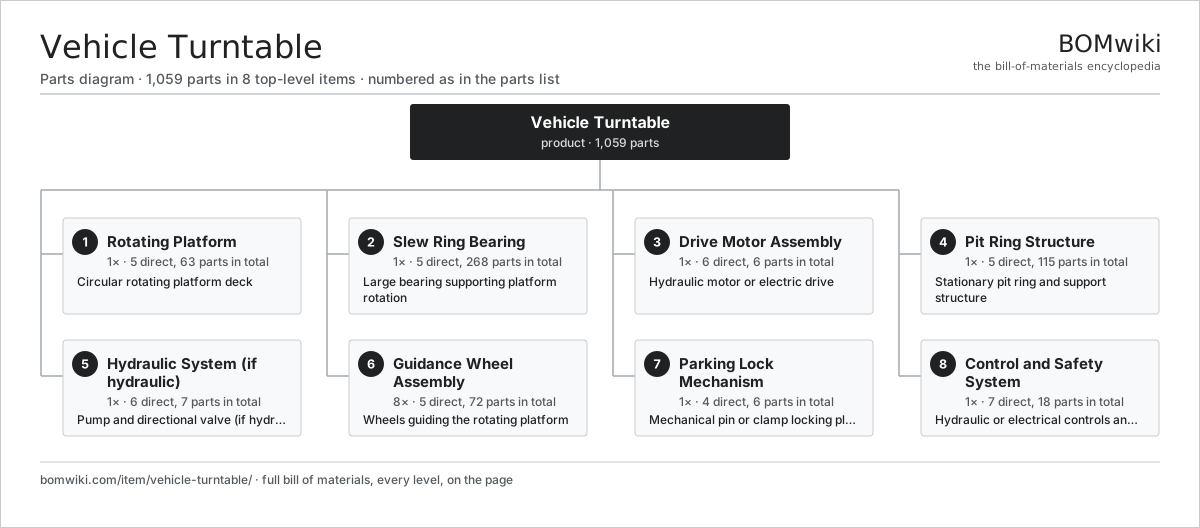
| # | Part | Qty | What it does |
|---|---|---|---|
| 1 | Rotating Platform 5 parts | 1× | Circular rotating platform deck |
| 2 | Slew Ring Bearing 5 parts | 1× | Large bearing supporting platform rotation |
| 3 | Drive Motor Assembly 6 parts | 1× | Hydraulic motor or electric drive |
| 4 | Pit Ring Structure 5 parts | 1× | Stationary pit ring and support structure |
| 5 | Hydraulic System (if hydraulic) 6 parts | 1× | Pump and directional valve (if hydraulic) |
| 6 | Guidance Wheel Assembly 5 parts | 8× | Wheels guiding the rotating platform |
| 7 | Parking Lock Mechanism 4 parts | 1× | Mechanical pin or clamp locking platform at rest |
| 8 | Control and Safety System 7 parts | 1× | Hydraulic or electrical controls and safety |
Diagrams & photos


3D model
No 3D model yet. Have a CAD file of this? Add a 3D model. STL renders right on this page; STEP, FreeCAD, and OpenSCAD sources are welcome too (openly licensed, like all 3D models on BOMwiki).
Build & assembly graph
expand / collapse · shared sub-assemblies converge · links to related products · est. labourTap an assembly to expand/collapse · tap a part to open it · use “Open page” for any node · drag to pan, scroll to zoom.
Bill of materials for Vehicle Turntable
8 top-level lines · 51 rows shown · 1,059 parts total · indented to 3 levels| # | Item / sub-assembly | Part no. | Qty/assy | Ext. qty | Parts | Type |
|---|---|---|---|---|---|---|
| 1 | Rotating Platform 5 parts | vehicle-turntable-platform | 1× | 1 | 63 | assembly |
| 1.1 | Platform Deck | vehicle-turntable-platform-deck | 1× | 1 | · | part |
| 1.2 | Platform Rim Ring | vehicle-turntable-platform-rim | 1× | 1 | · | part |
| 1.3 | Drive Attachment Lug | vehicle-turntable-cable-lugs | 12× | 12 | · | part |
| 1.4 | Railing Sector | vehicle-turntable-railing-sector | 1× | 1 | · | part |
| 1.5 | Fastener Set | fastener-set | 48× | 48 | · | part |
| 2 | Slew Ring Bearing 5 parts | vehicle-turntable-slew-ring | 1× | 1 | 268 | assembly |
| 2.1 | Bearing Race | vehicle-turntable-slew-bearing-race | 2× | 2 | · | part |
| 2.2 | Bearing Element | vehicle-turntable-rolling-element | 200× | 200 | · | part |
| 2.3 | Bearing Seal | vehicle-turntable-seal-pack | 2× | 2 | · | part |
| 2.4 | Grease Nipple | vehicle-turntable-grease-fitting | 4× | 4 | · | part |
| 2.5 | Mounting Stud | vehicle-turntable-mounting-stud | 60× | 60 | · | part |
| 3 | Drive Motor Assembly 6 parts | vehicle-turntable-drive-motor | 1× | 1 | 6 | assembly |
| 3.1 | AC Motor | vehicle-turntable-electric-motor | 1× | 1 | · | part |
| 3.2 | Hydraulic Motor | vehicle-turntable-hydraulic-motor | 1× | 1 | · | part |
| 3.3 | Gear Reducer | vehicle-turntable-gearbox | 1× | 1 | · | part |
| 3.4 | Drive Pinion Gear | vehicle-turntable-drive-pinion | 1× | 1 | · | part |
| 3.5 | Flexible Coupling | vehicle-turntable-coupling | 1× | 1 | · | part |
| 3.6 | Holding Brake | vehicle-turntable-motor-brake | 1× | 1 | · | part |
| 4 | Pit Ring Structure 5 parts | vehicle-turntable-pit-frame | 1× | 1 | 115 | assembly |
| 4.1 | Pit Ring Segment | vehicle-turntable-pit-ring-segment | 8× | 8 | · | part |
| 4.2 | Pit Cross-Brace | vehicle-turntable-pit-cross-brace | 8× | 8 | · | part |
| 4.3 | Center Support Post | vehicle-turntable-pit-center-post | 2× | 2 | · | part |
| 4.4 | Concrete Pit Foundation | vehicle-turntable-concrete-pit-base | 1× | 1 | · | part |
| 4.5 | Fastener Set | fastener-set | 96× | 96 | · | part |
| 5 | Hydraulic System (if hydraulic) 6 parts | vehicle-turntable-hydraulic-circuit | 1× | 1 | 7 | assembly |
| 5.1 | Hydraulic Pump | vehicle-turntable-hydraulic-pump | 1× | 1 | · | part |
| 5.2 | Hydraulic Tank | vehicle-turntable-hydraulic-tank | 1× | 1 | · | part |
| 5.3 | Directional Valve | vehicle-turntable-directional-valve | 1× | 1 | · | part |
| 5.4 | Manifold Block | vehicle-turntable-manifold-block | 1× | 1 | · | part |
| 5.5 | Hydraulic Hose | vehicle-turntable-hose-bundle | 2× | 2 | · | part |
| 5.6 | Relief Valve | vehicle-turntable-pressure-relief | 1× | 1 | · | part |
| 6 | Guidance Wheel Assembly 5 parts | vehicle-turntable-guidance-wheels | 8× | 8 | 72 | assembly |
| 6.1 | Guidance Wheel | vehicle-turntable-guidance-wheel | 8× | 64 | · | part |
| 6.2 | Pillow Block Bearing | vehicle-turntable-wheel-mounting-block | 8× | 64 | · | part |
| 6.3 | Wheel Bracket | vehicle-turntable-wheel-bracket | 8× | 64 | · | part |
| 6.4 | Ball Bearing | ball-bearing | 16× | 128 | · | part |
| 6.5 | Fastener Set | fastener-set | 32× | 256 | · | part |
| 7 | Parking Lock Mechanism 4 parts | vehicle-turntable-parking-lock | 1× | 1 | 6 | assembly |
| 7.1 | Lock Pin | vehicle-turntable-lock-pin | 1× | 1 | · | part |
| 7.2 | Lock Receiver | vehicle-turntable-lock-receiver | 2× | 2 | · | part |
| 7.3 | Lock Solenoid | vehicle-turntable-lock-solenoid | 1× | 1 | · | part |
| 7.4 | Connector | connector | 2× | 2 | · | part |
| 8 | Control and Safety System 7 parts | vehicle-turntable-control-system | 1× | 1 | 18 | assembly |
| 8.1 | Control Enclosure | vehicle-turntable-control-enclosure | 1× | 1 | · | part |
| 8.2 | Motor Starter | vehicle-turntable-motor-starter | 1× | 1 | · | part |
| 8.3 | Limit Switch | vehicle-turntable-limit-switch | 2× | 2 | · | part |
| 8.4 | Position Indicator | vehicle-turntable-position-indicator | 1× | 1 | · | part |
| 8.5 | Pressure Gauge | vehicle-turntable-pressure-gauge | 1× | 1 | · | part |
| 8.6 | Relay | relay | 4× | 4 | · | part |
| 8.7 | Connector | connector | 8× | 8 | · | part |
Something wrong in this list? Report a problem with this BOM.
Sourcing: possible vendors
Browse the supplier directory → Prices, MOQ, and lead times are algorithmic estimates, not quotes, and not claims about these companies. Company mappings are curated by keyword; est. price band $10k–$200k. How estimates work| Vendor | HQ | Specialty | MOQ | Lead time |
|---|---|---|---|---|
|
🇺🇸Otis
otis.com ↗
|
Farmington, US | Elevators & escalators | 20 units | 14–24 wks |
| schindler.com ↗ | Ebikon, CH | Elevators & escalators | 20 units | 14–24 wks |
|
🇫🇮KONE
kone.com ↗
|
Espoo, FI | Elevators & escalators | 20 units | 14–24 wks |
| tkelevator.com ↗ | Düsseldorf, DE | Elevators | 20 units | 14–24 wks |
| mitsubishielectric.com ↗ | Tokyo, JP | Elevators & electronics | 20 units | 14–24 wks |
1,338-word article