Electric Floor Burnisher
ProductOverview
A floor burnisher exists to produce one thing: the deep "wet look" gloss on finished commercial floors, supermarkets, hospitals, schools, airports. It is not a scrubber. Where a rotary floor machine turns a pad at 175–300 rpm to clean, a burnisher spins a soft pad at 1,500–2,000 rpm under deliberately light pressure. At that rim speed the pad does not abrade the acrylic floor finish; it friction-heats the top few microns until the thermoplastic finish momentarily softens and reflows, healing micro-scratches and scuffs into a smooth, mirror-flat surface. Gloss is a function of surface flatness at the scale of visible light, which is why a burnished floor reads as wet.
Electric corded burnishers are the indoor, fume-free counterpart to propane machines: lower pad pressure and speed, but zero emissions and a noise level that allows daytime use in occupied buildings.
How it works
The High-Speed Pad Motor is a 1.5 hp single-phase induction motor mounted vertically, its shaft driving the pad directly, no belt or gearbox at these speeds. A shaft-mounted Motor Cooling Fan forces air through the Copper Winding because burnishing is continuous full-load duty, and a Thermal Fuse protects the winding if cooling is blocked. At 115 V the motor draws 13–15 A, which is why the Power Cord is 12 AWG: a thin or overlong extension drops enough voltage to stall the motor into overheating.
Torque reaches the pad through a Flex Coupling and the Flexible Pad Driver, a compliant disc that lets the Burnishing Pad float. Floors are never perfectly flat; at 2,000 rpm a rigid driver would chatter on every tile joint, while the flexible driver keeps the full pad face in even contact. The Pad Centering Lug and Center Pad Clamp keep the pad concentric, an off-center pad at burnishing speed shakes the whole machine. Pads are soft by design: natural hair blends or fine synthetics that polish rather than cut, consumed at roughly one pad per 1,000–3,000 m².
Pad pressure is the variable operators get wrong most often. Burnishing wants light, even load, around a tenth of scrubbing pressure, set by the Pad Pressure Adjuster on the transport wheels. Too much pressure burns through the finish layer instead of reflowing its surface, leaving dull "swirl burn" that only recoating fixes.
Dust control
Reflowing a finish surface still liberates fine dust, powdered finish, dried soil, pad fiber. The Dust Control System system keeps it out of the building air: a Dust Control Skirt of brush fringe seals the pad housing perimeter, the pad's own windage drives the dust-laden air into the Vacuum Shroud, and it collects in the Dust Filter Bag. For healthcare and LEED-program buildings, the Vacuum Port Adapter replaces the passive bag with a hose to an external HEPA vacuum. Active dust control is the main feature separating burnishers certified for occupied-space daytime use from basic units.
Operation
Unlike a swing buffer, a burnisher is driven straight: overlapping forward lanes at a steady walk, typically covering 1,500–2,500 m² per hour. The machine starts only when the Start Lockout Button is pressed together with a Dead-Man Lever; releasing the levers stops the pad, and tipping the machine back onto its Wheel Assembly pair lifts the pad for transport. The Hour Meter schedules maintenance, pad drivers, skirt fringe, and motor Ball Bearing sets are the wear items.
Burnishing fits into a maintenance cycle: dust-mop, damp-mop or autoscrub, then burnish once the floor is clean and dry. Run over a dirty floor, the pad grinds grit into the finish instead of glossing it. On a properly maintained acrylic finish, burnishing two to five times per week keeps gloss high enough to extend the strip-and-recoat interval from months to a year or more, which is the economic argument for the machine.
Electric Floor Burnisher parts and their functions
7 top-level parts · 77 parts in total · full bill of materials below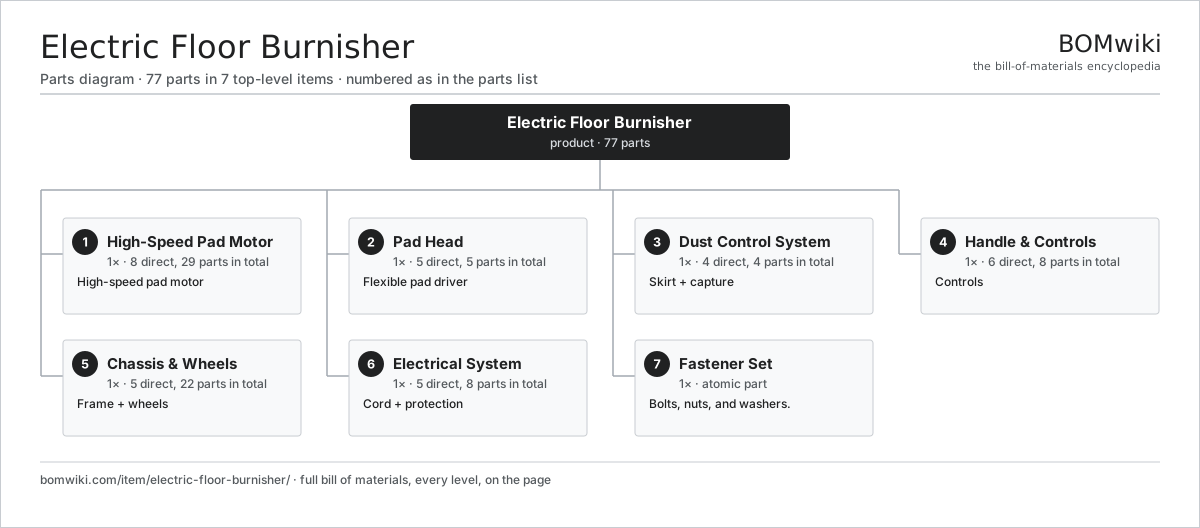
| # | Part | Qty | What it does |
|---|---|---|---|
| 1 | High-Speed Pad Motor 8 parts | 1× | High-speed pad motor |
| 2 | Pad Head 5 parts | 1× | Flexible pad driver |
| 3 | Dust Control System 4 parts | 1× | Skirt + capture |
| 4 | Handle & Controls 6 parts | 1× | Controls |
| 5 | Chassis & Wheels 5 parts | 1× | Frame + wheels |
| 6 | Electrical System 5 parts | 1× | Cord + protection |
| 7 | Fastener Set | 1× | Bolts, nuts, and washers. |
3D model
No 3D model yet. Have a CAD file of this? Add a 3D model. STL renders right on this page; STEP, FreeCAD, and OpenSCAD sources are welcome too (openly licensed, like all 3D models on BOMwiki).
Build & assembly graph
expand / collapse · shared sub-assemblies converge · links to related products · est. labourTap an assembly to expand/collapse · tap a part to open it · use “Open page” for any node · drag to pan, scroll to zoom.
Bill of materials for Electric Floor Burnisher
7 top-level lines · 52 rows shown · 77 parts total · indented to 3 levels| # | Item / sub-assembly | Part no. | Qty/assy | Ext. qty | Parts | Type |
|---|---|---|---|---|---|---|
| 1 | High-Speed Pad Motor 8 parts | electric-floor-burnisher-motor | 1× | 1 | 29 | assembly |
| 1.1 | Stator Assembly 3 parts | stator-assembly | 1× | 1 | 3 | assembly |
| 1.1.1 | Stator Core (laminations) | stator-core | 1× | 1 | · | part |
| 1.1.2 | Copper Winding | copper-winding | 1× | 1 | · | part |
| 1.1.3 | Slot Insulation | stator-insulation | 1× | 1 | · | part |
| 1.2 | Rotor Assembly 4 parts | rotor-assembly | 1× | 1 | 19 | assembly |
| 1.2.1 | Rotor Shaft | rotor-shaft | 1× | 1 | · | part |
| 1.2.2 | Rotor Core | rotor-core | 1× | 1 | · | part |
| 1.2.3 | Neodymium Magnet | neodymium-magnet | 16× | 16 | · | part |
| 1.2.4 | Ball Bearing | ball-bearing | 1× | 1 | · | part |
| 1.3 | Copper Winding | copper-winding | 1× | 1 | · | part |
| 1.4 | Motor Housing | motor-housing | 1× | 1 | · | part |
| 1.5 | Ball Bearing | ball-bearing | 2× | 2 | · | part |
| 1.6 | Run Capacitor | electric-floor-burnisher-run-capacitor | 1× | 1 | · | part |
| 1.7 | Motor Cooling Fan | electric-floor-burnisher-cooling-fan | 1× | 1 | · | part |
| 1.8 | Thermal Fuse | thermal-fuse | 1× | 1 | · | part |
| 2 | Pad Head 5 parts | electric-floor-burnisher-pad-head | 1× | 1 | 5 | assembly |
| 2.1 | Flexible Pad Driver | electric-floor-burnisher-pad-driver | 1× | 1 | · | part |
| 2.2 | Center Pad Clamp | electric-floor-burnisher-pad-clamp | 1× | 1 | · | part |
| 2.3 | Burnishing Pad | electric-floor-burnisher-burnish-pad | 1× | 1 | · | part |
| 2.4 | Flex Coupling | electric-floor-burnisher-flex-coupling | 1× | 1 | · | part |
| 2.5 | Pad Centering Lug | electric-floor-burnisher-centering-lug | 1× | 1 | · | part |
| 3 | Dust Control System 4 parts | electric-floor-burnisher-dust-control | 1× | 1 | 4 | assembly |
| 3.1 | Dust Control Skirt | electric-floor-burnisher-dust-skirt | 1× | 1 | · | part |
| 3.2 | Vacuum Shroud | electric-floor-burnisher-vacuum-shroud | 1× | 1 | · | part |
| 3.3 | Dust Filter Bag | electric-floor-burnisher-dust-bag | 1× | 1 | · | part |
| 3.4 | Vacuum Port Adapter | electric-floor-burnisher-port-adapter | 1× | 1 | · | part |
| 4 | Handle & Controls 6 parts | electric-floor-burnisher-handle | 1× | 1 | 8 | assembly |
| 4.1 | Handle Tube | electric-floor-burnisher-handle-tube | 1× | 1 | · | part |
| 4.2 | Dead-Man Lever | electric-floor-burnisher-safety-lever | 2× | 2 | · | part |
| 4.3 | Start Lockout Button | electric-floor-burnisher-lockout-button | 1× | 1 | · | part |
| 4.4 | Handle Grip | electric-floor-burnisher-grip | 2× | 2 | · | part |
| 4.5 | Handle Adjust Latch | electric-floor-burnisher-adjust-latch | 1× | 1 | · | part |
| 4.6 | Switch Box | electric-floor-burnisher-switch-box | 1× | 1 | · | part |
| 5 | Chassis & Wheels 5 parts | electric-floor-burnisher-chassis | 1× | 1 | 22 | assembly |
| 5.1 | Chassis Frame | electric-floor-burnisher-frame | 1× | 1 | · | part |
| 5.2 | Wheel Assembly 5 parts | wheel-assembly | 2× | 2 | 9 | assembly |
| 5.2.1 | Alloy Wheel | alloy-wheel | 1× | 2 | · | part |
| 5.2.2 | Tire | tire | 1× | 2 | · | part |
| 5.2.3 | TPMS Sensor | tpms-sensor | 1× | 2 | · | part |
| 5.2.4 | Lug Nut | lug-nut | 5× | 10 | · | part |
| 5.2.5 | Valve Stem | valve-stem | 1× | 2 | · | part |
| 5.3 | Perimeter Bumper | electric-floor-burnisher-bumper | 1× | 1 | · | part |
| 5.4 | Pad Pressure Adjuster | electric-floor-burnisher-pressure-adjuster | 1× | 1 | · | part |
| 5.5 | Fastener Set | fastener-set | 1× | 1 | · | part |
| 6 | Electrical System 5 parts | electric-floor-burnisher-electrical | 1× | 1 | 8 | assembly |
| 6.1 | Power Cord | electric-floor-burnisher-power-cord | 1× | 1 | · | part |
| 6.2 | Circuit Breaker | electric-floor-burnisher-breaker | 1× | 1 | · | part |
| 6.3 | Hour Meter | electric-floor-burnisher-hour-meter | 1× | 1 | · | part |
| 6.4 | Connector | connector | 4× | 4 | · | part |
| 6.5 | Wire Bundle | wire-bundle | 1× | 1 | · | part |
| 7 | Fastener Set | fastener-set | 1× | 1 | · | part |
Something wrong in this list? Report a problem with this BOM.
Related products
same domain, ranked by shared parts Floor Stripping Machine
94 parts · shares 17 with this page
Orbital Floor Machine
95 parts · shares 17 with this page
Outdoor Litter Vacuum
301 parts · shares 17 with this page
Ride-On Industrial Sweeper
179 parts · shares 17 with this page
Street Sweeper
317 parts · shares 15 with this page
Floor Stripping Machine
94 parts · shares 17 with this page
Orbital Floor Machine
95 parts · shares 17 with this page
Outdoor Litter Vacuum
301 parts · shares 17 with this page
Ride-On Industrial Sweeper
179 parts · shares 17 with this page
Street Sweeper
317 parts · shares 15 with this page
Sourcing: possible vendors
Browse the supplier directory → Prices, MOQ, and lead times are algorithmic estimates, not quotes, and not claims about these companies. Company mappings are curated by keyword; est. price band $50–$1.5k. How estimates work| Vendor | HQ | Specialty | MOQ | Lead time |
|---|---|---|---|---|
| sharkninja.com ↗ | Needham, US | Floorcare & kitchen | 1,000 units | 8–12 wks |
|
🇬🇧Dyson
dyson.com ↗
|
Malmesbury, GB | Vacuums & hair care | 1,000 units | 8–12 wks |
|
🇺🇸Bissell
bissell.com ↗
|
Grand Rapids, US | Floorcare | 1,000 units | 8–12 wks |
|
🇺🇸iRobot
irobot.com ↗
|
Bedford, US | Robot vacuums | 1,000 units | 8–12 wks |
|
🇩🇪Kärcher
karcher.com ↗
|
Winnenden, DE | Cleaning equipment | 1,000 units | 8–12 wks |
694-word article