Orbital Floor Machine
ProductOverview
An orbital floor machine looks like a traditional rotary buffer but works on a different principle. Instead of spinning a circular pad, it vibrates a rectangular pad through a tight orbit a few millimetres across, thousands of times per minute. Every point on the pad traces the same small circle, so the abrasive action is uniform from edge to edge, there is no slow-moving center or fast rim as on a rotary machine. The result is a machine with essentially no side torque: it does not try to walk sideways, a first-time operator can hold it steady, and the rectangular Pad Driver Platen reaches flush into corners and along baseboards where round pads cannot.
The format became prominent for chemical-free floor finish removal. With the Weight System loaded and an aggressive pad fitted, the orbital action abrades old acrylic finish off vinyl composition tile using only water, avoiding the caustic stripper chemicals a rotary machine needs.
How it works
The Drive Motor, a single-phase induction motor running at 3,450 rpm, drives the head through a Drive Belt connecting the Motor Drive Pulley to the Driven Pulley on the Eccentric Shaft. The eccentric's offset journal, typically 3 to 4.5 mm of throw, carries the platen spindle in Ball Bearing pairs, so as the shaft rotates, the platen is swept through a circular orbit of 6 to 9 mm diameter without itself rotating. A cast Counterweight fixed opposite the throw cancels the orbiting platen's inertial force; without it the machine would shake violently at 25–60 Hz.
Four rubber Rubber Isolator Mount mounts couple the platen to the head. They are compliant enough to allow the orbit but stiff enough to transmit down-pressure, and they are the main wear item in the drive: hardened or torn isolators show up as new vibration in the Handle & Controls.
The Platen Plate spreads the machine's weight across the full 14 × 20 in pad area. A Hook-and-Loop Face sheet bonded to its underside grips the consumable Working Pad, anything from a black stripping pad to a diamond-impregnated polishing pad to 60-grit sanding screen for wood floors. Because the pad only oscillates, it never slings material outward the way a rotary pad does; the Splash Skirt catches what little slurry escapes.
Weight and pressure
Cutting rate on an orbital machine is governed by down-pressure, not speed. The base machine weighs 40–55 kg; the Weight Plate stack on its Weight Locating Rail keys adds another 30–35 kg for stripping work. Operators run fully weighted for finish removal and strip the plates off for screening or polishing, where excess pressure would scour the surface. The plates are pinned with a Weight Retainer Pin so they cannot bounce loose under vibration.
Controls and safety
The machine starts only through a deliberate sequence: the operator presses the lockout button on the Start Interlock Switch and then squeezes a Dead-Man Safety Lever. Releasing both levers cuts power instantly, a dead-man arrangement required because an unattended running machine, even a torque-neutral orbital, will migrate across the floor. The Handle Angle Lock sets handle angle for operator height, and the handle folds flat over the deck for loading. A Circuit Breaker protects the motor circuit, and the 15 m Power Cord of 12 AWG wire keeps voltage drop acceptable at the motor's full-load current.
Applications
One chassis covers most hard-floor maintenance by swapping pads. With water and a black pad it strips finish from VCT; with a red pad and neutral cleaner it deep-scrubs; with sanding screens it abrades wood floors between coats; with white or diamond pads it dry-polishes stone and concrete. The orbital action leaves a finer, more uniform scratch pattern than rotary scrubbing at the same grit, which is why the same mechanism appears at smaller scale in hand-held orbital sanders. Transport is on the rear Wheel Assembly pair: tip the machine back on its Handle Tube and the platen lifts clear of the floor.
Orbital Floor Machine parts and their functions
8 top-level parts · 95 parts in total · full bill of materials below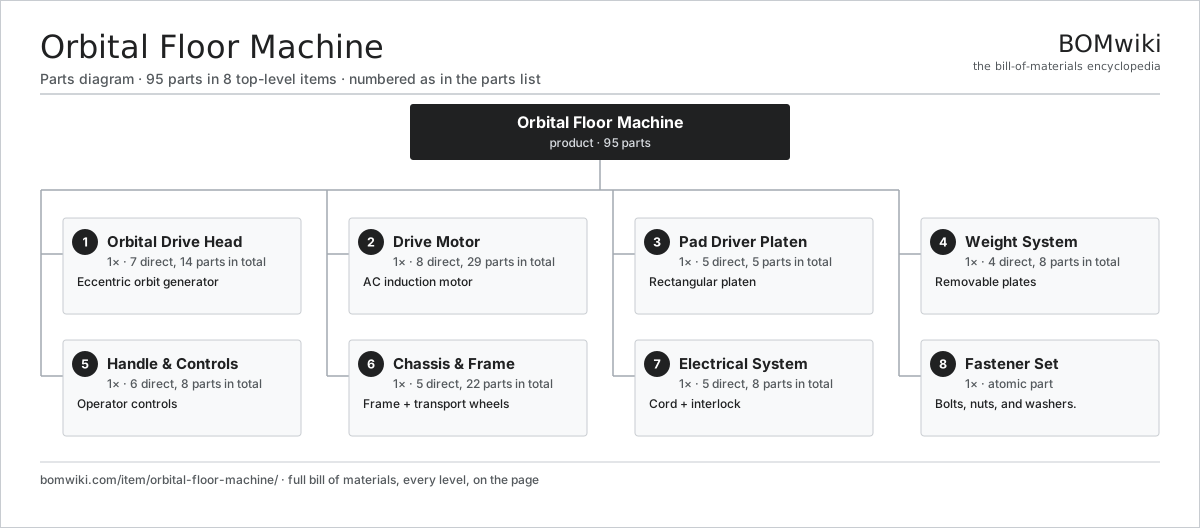
| # | Part | Qty | What it does |
|---|---|---|---|
| 1 | Orbital Drive Head 7 parts | 1× | Eccentric orbit generator |
| 2 | Drive Motor 8 parts | 1× | AC induction motor |
| 3 | Pad Driver Platen 5 parts | 1× | Rectangular platen |
| 4 | Weight System 4 parts | 1× | Removable plates |
| 5 | Handle & Controls 6 parts | 1× | Operator controls |
| 6 | Chassis & Frame 5 parts | 1× | Frame + transport wheels |
| 7 | Electrical System 5 parts | 1× | Cord + interlock |
| 8 | Fastener Set | 1× | Bolts, nuts, and washers. |
3D model
No 3D model yet. Have a CAD file of this? Add a 3D model. STL renders right on this page; STEP, FreeCAD, and OpenSCAD sources are welcome too (openly licensed, like all 3D models on BOMwiki).
Build & assembly graph
expand / collapse · shared sub-assemblies converge · links to related products · est. labourTap an assembly to expand/collapse · tap a part to open it · use “Open page” for any node · drag to pan, scroll to zoom.
Bill of materials for Orbital Floor Machine
8 top-level lines · 60 rows shown · 95 parts total · indented to 3 levels| # | Item / sub-assembly | Part no. | Qty/assy | Ext. qty | Parts | Type |
|---|---|---|---|---|---|---|
| 1 | Orbital Drive Head 7 parts | orbital-floor-machine-drive-head | 1× | 1 | 14 | assembly |
| 1.1 | Eccentric Shaft | orbital-floor-machine-eccentric-shaft | 1× | 1 | · | part |
| 1.2 | Counterweight | orbital-floor-machine-counterweight | 1× | 1 | · | part |
| 1.3 | Bearing Housing | orbital-floor-machine-bearing-housing | 1× | 1 | · | part |
| 1.4 | Ball Bearing | ball-bearing | 4× | 4 | · | part |
| 1.5 | Rubber Isolator Mount | orbital-floor-machine-isolator | 4× | 4 | · | part |
| 1.6 | Driven Pulley | orbital-floor-machine-driven-pulley | 1× | 1 | · | part |
| 1.7 | Oil Seal | oil-seal | 2× | 2 | · | part |
| 2 | Drive Motor 8 parts | orbital-floor-machine-motor | 1× | 1 | 29 | assembly |
| 2.1 | Stator Assembly 3 parts | stator-assembly | 1× | 1 | 3 | assembly |
| 2.1.1 | Stator Core (laminations) | stator-core | 1× | 1 | · | part |
| 2.1.2 | Copper Winding | copper-winding | 1× | 1 | · | part |
| 2.1.3 | Slot Insulation | stator-insulation | 1× | 1 | · | part |
| 2.2 | Rotor Assembly 4 parts | rotor-assembly | 1× | 1 | 19 | assembly |
| 2.2.1 | Rotor Shaft | rotor-shaft | 1× | 1 | · | part |
| 2.2.2 | Rotor Core | rotor-core | 1× | 1 | · | part |
| 2.2.3 | Neodymium Magnet | neodymium-magnet | 16× | 16 | · | part |
| 2.2.4 | Ball Bearing | ball-bearing | 1× | 1 | · | part |
| 2.3 | Copper Winding | copper-winding | 1× | 1 | · | part |
| 2.4 | Motor Housing | motor-housing | 1× | 1 | · | part |
| 2.5 | Ball Bearing | ball-bearing | 2× | 2 | · | part |
| 2.6 | Run Capacitor | orbital-floor-machine-run-capacitor | 1× | 1 | · | part |
| 2.7 | Motor Drive Pulley | orbital-floor-machine-drive-pulley | 1× | 1 | · | part |
| 2.8 | Thermal Fuse | thermal-fuse | 1× | 1 | · | part |
| 3 | Pad Driver Platen 5 parts | orbital-floor-machine-pad-driver | 1× | 1 | 5 | assembly |
| 3.1 | Platen Plate | orbital-floor-machine-platen | 1× | 1 | · | part |
| 3.2 | Hook-and-Loop Face | orbital-floor-machine-hook-face | 1× | 1 | · | part |
| 3.3 | Working Pad | orbital-floor-machine-pad | 1× | 1 | · | part |
| 3.4 | Pad Centering Ring | orbital-floor-machine-centering-ring | 1× | 1 | · | part |
| 3.5 | Drive Belt | drive-belt | 1× | 1 | · | part |
| 4 | Weight System 4 parts | orbital-floor-machine-weight-system | 1× | 1 | 8 | assembly |
| 4.1 | Weight Plate | orbital-floor-machine-weight-plate | 3× | 3 | · | part |
| 4.2 | Weight Locating Rail | orbital-floor-machine-weight-rail | 2× | 2 | · | part |
| 4.3 | Weight Retainer Pin | orbital-floor-machine-retainer-pin | 2× | 2 | · | part |
| 4.4 | Fastener Set | fastener-set | 1× | 1 | · | part |
| 5 | Handle & Controls 6 parts | orbital-floor-machine-handle | 1× | 1 | 8 | assembly |
| 5.1 | Handle Tube | orbital-floor-machine-handle-tube | 1× | 1 | · | part |
| 5.2 | Handle Angle Lock | orbital-floor-machine-adjust-lever | 1× | 1 | · | part |
| 5.3 | Dead-Man Safety Lever | orbital-floor-machine-safety-lever | 2× | 2 | · | part |
| 5.4 | Handle Grip | orbital-floor-machine-grip | 2× | 2 | · | part |
| 5.5 | Switch Box | orbital-floor-machine-switch-box | 1× | 1 | · | part |
| 5.6 | Wire Bundle | wire-bundle | 1× | 1 | · | part |
| 6 | Chassis & Frame 5 parts | orbital-floor-machine-chassis | 1× | 1 | 22 | assembly |
| 6.1 | Base Frame Deck | orbital-floor-machine-base-frame | 1× | 1 | · | part |
| 6.2 | Perimeter Bumper | orbital-floor-machine-bumper | 1× | 1 | · | part |
| 6.3 | Splash Skirt | orbital-floor-machine-splash-skirt | 1× | 1 | · | part |
| 6.4 | Wheel Assembly 5 parts | wheel-assembly | 2× | 2 | 9 | assembly |
| 6.4.1 | Alloy Wheel | alloy-wheel | 1× | 2 | · | part |
| 6.4.2 | Tire | tire | 1× | 2 | · | part |
| 6.4.3 | TPMS Sensor | tpms-sensor | 1× | 2 | · | part |
| 6.4.4 | Lug Nut | lug-nut | 5× | 10 | · | part |
| 6.4.5 | Valve Stem | valve-stem | 1× | 2 | · | part |
| 6.5 | Fastener Set | fastener-set | 1× | 1 | · | part |
| 7 | Electrical System 5 parts | orbital-floor-machine-electrical | 1× | 1 | 8 | assembly |
| 7.1 | Start Interlock Switch | orbital-floor-machine-interlock-switch | 1× | 1 | · | part |
| 7.2 | Circuit Breaker | orbital-floor-machine-breaker | 1× | 1 | · | part |
| 7.3 | Power Cord | orbital-floor-machine-power-cord | 1× | 1 | · | part |
| 7.4 | Connector | connector | 4× | 4 | · | part |
| 7.5 | Wire Bundle | wire-bundle | 1× | 1 | · | part |
| 8 | Fastener Set | fastener-set | 1× | 1 | · | part |
Something wrong in this list? Report a problem with this BOM.
Related products
same domain, ranked by shared parts Floor Stripping Machine
94 parts · shares 19 with this page
Ride-On Industrial Sweeper
179 parts · shares 19 with this page
Escalator Step Cleaner
124 parts · shares 18 with this page
Street Sweeper
317 parts · shares 16 with this page
Electric Floor Burnisher
77 parts · shares 17 with this page
Outdoor Litter Vacuum
301 parts · shares 17 with this page
Floor Stripping Machine
94 parts · shares 19 with this page
Ride-On Industrial Sweeper
179 parts · shares 19 with this page
Escalator Step Cleaner
124 parts · shares 18 with this page
Street Sweeper
317 parts · shares 16 with this page
Electric Floor Burnisher
77 parts · shares 17 with this page
Outdoor Litter Vacuum
301 parts · shares 17 with this page
Sourcing: possible vendors
Browse the supplier directory → Prices, MOQ, and lead times are algorithmic estimates, not quotes, and not claims about these companies. Company mappings are curated by keyword; est. price band $50–$1.5k. How estimates work| Vendor | HQ | Specialty | MOQ | Lead time |
|---|---|---|---|---|
| sharkninja.com ↗ | Needham, US | Floorcare & kitchen | 1,000 units | 8–12 wks |
|
🇬🇧Dyson
dyson.com ↗
|
Malmesbury, GB | Vacuums & hair care | 1,000 units | 8–12 wks |
|
🇺🇸Bissell
bissell.com ↗
|
Grand Rapids, US | Floorcare | 1,000 units | 8–12 wks |
|
🇺🇸iRobot
irobot.com ↗
|
Bedford, US | Robot vacuums | 1,000 units | 8–12 wks |
|
🇩🇪Kärcher
karcher.com ↗
|
Winnenden, DE | Cleaning equipment | 1,000 units | 8–12 wks |
730-word article