Evacuation Chair
ProductOverview
An evacuation chair solves a specific failure of building egress: lifts are barred during fire alarms, so anyone who cannot walk down stairs, wheelchair users, post-surgical patients, people injured in the incident itself, needs a way down that one untrained colleague can operate. Carrying a person downstairs in an ordinary chair takes four trained bearers; a track-type evacuation chair lets a single operator take a 150 kg occupant down multiple flights at a controlled walking pace, with the machine, not the operator, holding the load back.
The chairs hang folded on stairwell walls in offices, hospitals, and transport buildings, and the design brief follows from that placement: under 13 kg, deployable in seconds, operable from a pictogram card by someone who has never touched one.
How the descent works
The core idea is the Track Descent System. Two reinforced rubber Track Belt runs, carried on a Track Frame angled to the stair pitch, bridge across the stair nosings, the chair never drops step to step, it slides on a continuous rubber surface contacting two or three nosings at once. Track Roller beds on Ball Bearing races support the belts under load, Belt Tension Axle adjusters keep them taut, and the Track Deploy Linkage swings the track set down and locks it over-center as the operator tilts the chair at the stair head; on many models this happens automatically with the tilt, requiring no separate action.
Belt friction alone would let a heavy occupant accelerate, so descent speed is closed-loop mechanical: the Brake Governor. Belt motion drives the Governor Pinion through a speed-multiplying Helical Gear Pair into a centrifugal brake, above the set speed, Governor Shoe overcome their Coil Spring retractors and expand against the fixed Governor Drum, braking harder the faster the belts turn. The result is a self-regulating descent around 0.5–1 m/s whether the occupant weighs 60 kg or 150 kg, on a gentle or steep flight. Descent energy leaves as heat in the drum. A manual Parking Brake holds the chair dead on the stairs for rest stops or transfer.
Frame, handles, restraints
The Seat Frame is a scissor-folding chassis of anodized aluminum Main Frame Rail and Cross Brace members. Pulling the seat open snaps the Fold Lock catches over-center, squaring the frame rigid; folding reverses in one motion to a 200 mm-thick package. The Seat Assembly sling and flip-down Footrest position the occupant with weight centred over the tracks.
Operator geometry is set by the Operator Handles: the Rear Telescoping Handle telescopes so the operator stands upright two steps above the chair, steering and tilting rather than carrying, while the fold-out Front Handle lets a second person steady the foot end or two-person-lift the chair over a landing obstacle. Handle Position Lock detents fix each position and the Grip Set keeps gloved or sweating hands on the tubes.
The Occupant Restraints matter more than they look: the chair descends tilted back 30–40°, and an unrestrained occupant pitches forward at the first stair. The Lap Belt goes on before any tilt, the Chest Strap holds the torso, the Leg Strap keeps feet on the footrest and out of the belt path, and all three close with glove-operable Buckle Set hardware. A padded Head Support stabilizes weak or unconscious occupants.
Between flights, the chair rolls on its Rolling Gear gear, two rear Wheel Assembly wheels and swiveling Front Caster Wheel units in Caster Fork mounts, pushed like a transport chair along corridors and landings.
Limits and practice
Track chairs are built for straight flights of roughly 30–40° pitch; spiral stairs, escalators, and ascent are outside the envelope, powered stair climbers cover those cases. Descent on the tracks is also one-way down: the governor brakes but does not assist climbing.
Storage is part of the system. The Storage Provision provision hangs the folded chair on a Wall Mount Bracket at the refuge point or stair head, under a high-visibility Dust Cover, with the Instruction Panel pictograms on the chair back for first-time users. UK practice under BS 9999 and BS 8629 ties the chairs to Personal Emergency Evacuation Plans (PEEPs), with named, drilled operators per occupant; US accessibility guidance treats them as a complement to areas of refuge rather than a substitute. Maintenance is light, annual inspection of belts, governor action, buckles, and frame locks, but skipped inspections show up exactly when the chair is needed, so most jurisdictions mandate the schedule.
Evacuation Chair parts and their functions
7 top-level parts · 87 parts in total · full bill of materials below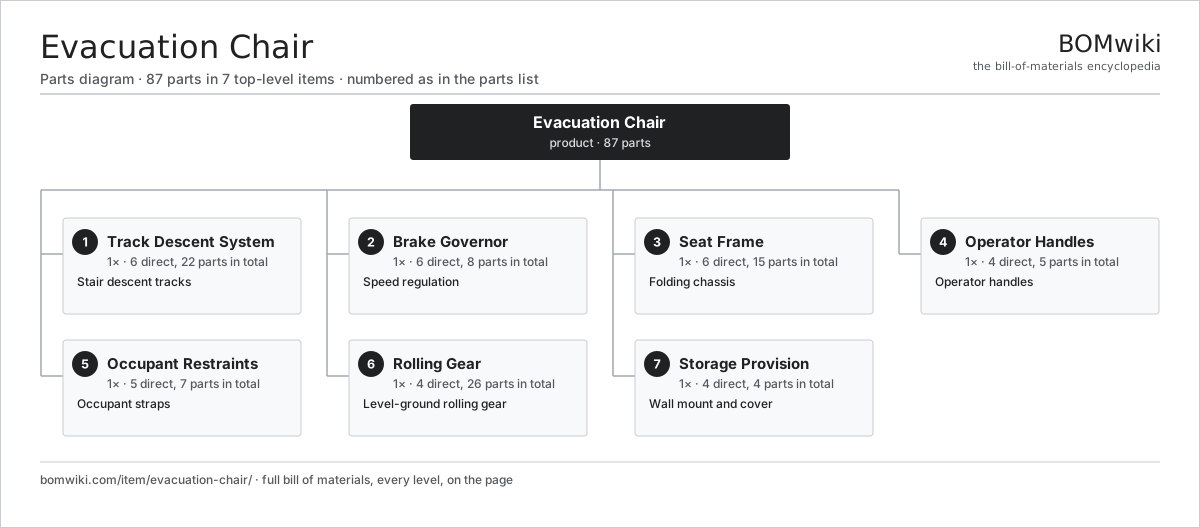
| # | Part | Qty | What it does |
|---|---|---|---|
| 1 | Track Descent System 6 parts | 1× | Stair descent tracks |
| 2 | Brake Governor 6 parts | 1× | Speed regulation |
| 3 | Seat Frame 6 parts | 1× | Folding chassis |
| 4 | Operator Handles 4 parts | 1× | Operator handles |
| 5 | Occupant Restraints 5 parts | 1× | Occupant straps |
| 6 | Rolling Gear 4 parts | 1× | Level-ground rolling gear |
| 7 | Storage Provision 4 parts | 1× | Wall mount and cover |
3D model
No 3D model yet. Have a CAD file of this? Add a 3D model. STL renders right on this page; STEP, FreeCAD, and OpenSCAD sources are welcome too (openly licensed, like all 3D models on BOMwiki).
Build & assembly graph
expand / collapse · shared sub-assemblies converge · links to related products · est. labourTap an assembly to expand/collapse · tap a part to open it · use “Open page” for any node · drag to pan, scroll to zoom.
Bill of materials for Evacuation Chair
7 top-level lines · 52 rows shown · 87 parts total · indented to 3 levels| # | Item / sub-assembly | Part no. | Qty/assy | Ext. qty | Parts | Type |
|---|---|---|---|---|---|---|
| 1 | Track Descent System 6 parts | evacuation-chair-track-system | 1× | 1 | 22 | assembly |
| 1.1 | Track Belt | evacuation-chair-track-belt | 2× | 2 | · | part |
| 1.2 | Track Frame | evacuation-chair-track-frame | 1× | 1 | · | part |
| 1.3 | Track Roller | evacuation-chair-track-roller | 8× | 8 | · | part |
| 1.4 | Belt Tension Axle | evacuation-chair-tension-axle | 2× | 2 | · | part |
| 1.5 | Track Deploy Linkage | evacuation-chair-deploy-linkage | 1× | 1 | · | part |
| 1.6 | Ball Bearing | ball-bearing | 8× | 8 | · | part |
| 2 | Brake Governor 6 parts | evacuation-chair-brake-governor | 1× | 1 | 8 | assembly |
| 2.1 | Governor Drum | evacuation-chair-governor-drum | 1× | 1 | · | part |
| 2.2 | Governor Shoe | evacuation-chair-governor-shoes | 2× | 2 | · | part |
| 2.3 | Coil Spring | coil-spring | 2× | 2 | · | part |
| 2.4 | Governor Pinion | evacuation-chair-governor-pinion | 1× | 1 | · | part |
| 2.5 | Helical Gear Pair | gear-pair | 1× | 1 | · | part |
| 2.6 | Parking Brake | evacuation-chair-park-brake | 1× | 1 | · | part |
| 3 | Seat Frame 6 parts | evacuation-chair-seat-frame | 1× | 1 | 15 | assembly |
| 3.1 | Main Frame Rail | evacuation-chair-main-rails | 2× | 2 | · | part |
| 3.2 | Cross Brace | evacuation-chair-cross-brace | 2× | 2 | · | part |
| 3.3 | Fold Lock | evacuation-chair-fold-lock | 2× | 2 | · | part |
| 3.4 | Seat Assembly 5 parts | seat-assembly | 1× | 1 | 7 | assembly |
| 3.4.1 | Seat Frame | seat-frame | 1× | 1 | · | part |
| 3.4.2 | Seat Foam | seat-foam | 2× | 2 | · | part |
| 3.4.3 | Seat Cover | seat-cover | 1× | 1 | · | part |
| 3.4.4 | Seat Motor | seat-motor | 2× | 2 | · | part |
| 3.4.5 | Seat Heater Mat | seat-heater | 1× | 1 | · | part |
| 3.5 | Footrest | evacuation-chair-footrest | 1× | 1 | · | part |
| 3.6 | Fastener Set | fastener-set | 1× | 1 | · | part |
| 4 | Operator Handles 4 parts | evacuation-chair-handles | 1× | 1 | 5 | assembly |
| 4.1 | Rear Telescoping Handle | evacuation-chair-rear-handle | 1× | 1 | · | part |
| 4.2 | Front Handle | evacuation-chair-front-handle | 1× | 1 | · | part |
| 4.3 | Handle Position Lock | evacuation-chair-handle-lock | 2× | 2 | · | part |
| 4.4 | Grip Set | evacuation-chair-grip-set | 1× | 1 | · | part |
| 5 | Occupant Restraints 5 parts | evacuation-chair-restraints | 1× | 1 | 7 | assembly |
| 5.1 | Lap Belt | evacuation-chair-lap-belt | 1× | 1 | · | part |
| 5.2 | Chest Strap | evacuation-chair-chest-strap | 1× | 1 | · | part |
| 5.3 | Leg Strap | evacuation-chair-leg-strap | 1× | 1 | · | part |
| 5.4 | Buckle Set | evacuation-chair-buckle-set | 3× | 3 | · | part |
| 5.5 | Head Support | evacuation-chair-head-support | 1× | 1 | · | part |
| 6 | Rolling Gear 4 parts | evacuation-chair-wheels | 1× | 1 | 26 | assembly |
| 6.1 | Wheel Assembly 5 parts | wheel-assembly | 2× | 2 | 9 | assembly |
| 6.1.1 | Alloy Wheel | alloy-wheel | 1× | 2 | · | part |
| 6.1.2 | Tire | tire | 1× | 2 | · | part |
| 6.1.3 | TPMS Sensor | tpms-sensor | 1× | 2 | · | part |
| 6.1.4 | Lug Nut | lug-nut | 5× | 10 | · | part |
| 6.1.5 | Valve Stem | valve-stem | 1× | 2 | · | part |
| 6.2 | Front Caster Wheel | evacuation-chair-front-caster | 2× | 2 | · | part |
| 6.3 | Caster Fork | evacuation-chair-caster-fork | 2× | 2 | · | part |
| 6.4 | Ball Bearing | ball-bearing | 4× | 4 | · | part |
| 7 | Storage Provision 4 parts | evacuation-chair-storage | 1× | 1 | 4 | assembly |
| 7.1 | Wall Mount Bracket | evacuation-chair-wall-bracket | 1× | 1 | · | part |
| 7.2 | Dust Cover | evacuation-chair-dust-cover | 1× | 1 | · | part |
| 7.3 | Instruction Panel | evacuation-chair-instruction-panel | 1× | 1 | · | part |
| 7.4 | Fastener Set | fastener-set | 1× | 1 | · | part |
Something wrong in this list? Report a problem with this BOM.
Related products
same domain, ranked by shared parts Aerial Ladder Truck
256 parts · shares 13 with this page
Aerial Ladder Truck
256 parts · shares 13 with this page
 Fire Engine
547 parts · shares 13 with this page
Fire Engine
547 parts · shares 13 with this page
 Fireboat
236 parts · shares 7 with this page
Fireboat
236 parts · shares 7 with this page
 Rigid Inflatable Rescue Boat
77 parts · shares 6 with this page
Rigid Inflatable Rescue Boat
77 parts · shares 6 with this page
 Air Ambulance Helicopter
150 parts · shares 2 with this page
Air Ambulance Helicopter
150 parts · shares 2 with this page
 Emergency Eyewash Station
89 parts · shares 2 with this page
Emergency Eyewash Station
89 parts · shares 2 with this page
Sourcing: possible vendors
Browse the supplier directory → Prices, MOQ, and lead times are algorithmic estimates, not quotes, and not claims about these companies. Company mappings are curated by keyword; est. price band $30–$1M. How estimates work| Vendor | HQ | Specialty | MOQ | Lead time |
|---|---|---|---|---|
| rosenbauer.com ↗ | Leonding, AT | Fire apparatus | 200 units | 8–14 wks |
|
🇺🇸Oshkosh
oshkoshcorp.com ↗
|
Oshkosh, US | Specialty trucks (Pierce) | 200 units | 8–14 wks |
| msasafety.com ↗ | Cranberry Township, US | Safety equipment | 200 units | 8–14 wks |
|
🇩🇪Dräger
draeger.com ↗
|
Lübeck, DE | Safety & medical tech | 200 units | 8–14 wks |
| honeywell.com ↗ | Charlotte, US | Building & safety tech | 200 units | 8–14 wks |
810-word article