Pocket Bike
ProductOverview
A pocket bike, or minimoto, is a functioning racing motorcycle scaled to roughly one quarter the size of a GP machine: 850 mm wheelbase, 470 mm seat height, 20-25 kg. It is not a toy in the engineering sense, the layout, chassis logic and riding technique are those of a full-size sportbike, but it is small enough that an adult rides it knees-out in a full racing crouch. Minimoto racing on karting circuits is an established junior feeder discipline in Italy, Spain and Japan; several MotoGP champions, including Valentino Rossi, started on them.
Engine
The standard powerplant is a 49 cc air-cooled two-stroke single derived from chainsaw and scooter engines. The two-stroke cycle suits the application: with ports instead of valves it has almost no moving parts, and it fires every revolution, so a 3 kg engine produces 3-4 hp stock and up to 12 hp with race porting. Inside the Two-Stroke Engine, the Piston does triple duty, power piston, intake valve and exhaust valve, covering and uncovering ports cast into the Cylinder and Head wall as it travels its 32 mm stroke. Mixture enters the Crankcase through a reed or piston-controlled inlet, gets compressed under the descending piston, and transfers up to the combustion chamber through the cylinder's transfer ports, scavenging exhaust ahead of it.
Two details define the engine's character. First, lubrication is total-loss: oil is premixed into the fuel at 25:1 to 40:1 in the Fuel Tank, so there is no oil pump, sump or filter, and the Crankshaft runs on rolling Ball Bearing mains that tolerate mist lubrication. Second, the Expansion Chamber is a tuned expansion chamber, not a silencer: its diverging and converging cones reflect pressure waves back to the exhaust port, first sucking the cylinder clean and then ramming escaping fresh charge back in just before the port closes. The chamber is worth several horsepower and only works near its design rpm, which is why a tuned pocket bike has a sharp power band around 9,000-10,000 rpm.
Ignition is a maintenance-free CDI Ignition flywheel magneto, and starting is a Pull Starter rope, lawnmower style. A 12-15 mm Slide Carburetor meters fuel; the Twist Throttle twist grip pulls its slide directly through a lined cable.
Transmission
There is no gearbox. A Centrifugal Clutch on the crank nose holds two friction Clutch Shoe segments against Coil Spring tension; past roughly 4,000 rpm centrifugal force overcomes the springs and the shoes grip the Clutch Drum, which carries the 6-8 tooth Front Sprocket. An 8 mm-pitch T8F Chain takes drive to a 44-54 tooth Rear Sprocket, an overall reduction near 7:1. Gearing changes are sprocket swaps, the standard tuning move for each circuit: more rear teeth for a tight kart track, fewer for a fast one.
Chassis
The Mini Frame is a welded steel Perimeter Frame Loop with the engine bolted rigidly into an Engine Cradle as a semi-stressed member. Suspension is minimal or absent, the Front Fork may have 30 mm of travel, the Swingarm is usually rigid, because at 25 kg total and kart-track smoothness, tire flex does most of the suspension's job. The 10-inch Cast Wheel rims wear tubeless slicks at about 1.8 bar, and brakes are scaled motorcycle practice: a 120-160 mm Brake Disc and two-piston Brake Caliper at each end, both operated by hand Brake Lever controls since there is no room for a foot brake. A bar-mounted Kill Switch is the only electrical control on the machine.
Riding and rules
Riding a pocket bike is an exercise in body steering. The bike is so light relative to the rider that rider position is the dominant input: hanging off moves the combined center of mass more than it ever could on a full-size machine, and the short wheelbase makes the bike change direction almost instantly. Race Race Bodywork copies GP fairings in ABS, and the Seat Pad is a token foam strip, riders support themselves on pegs and bars.
Legally, pocket bikes are competition machines: no lights, mirrors or homologation, so they are prohibited on public roads in nearly every jurisdiction and ridden on karting circuits and closed courses. The cheap imported wave of the mid-2000s blurred this in public perception, but organized minimoto remains a circuit sport with age classes starting around six years old.
Pocket Bike parts and their functions
8 top-level parts · 57 parts in total · full bill of materials below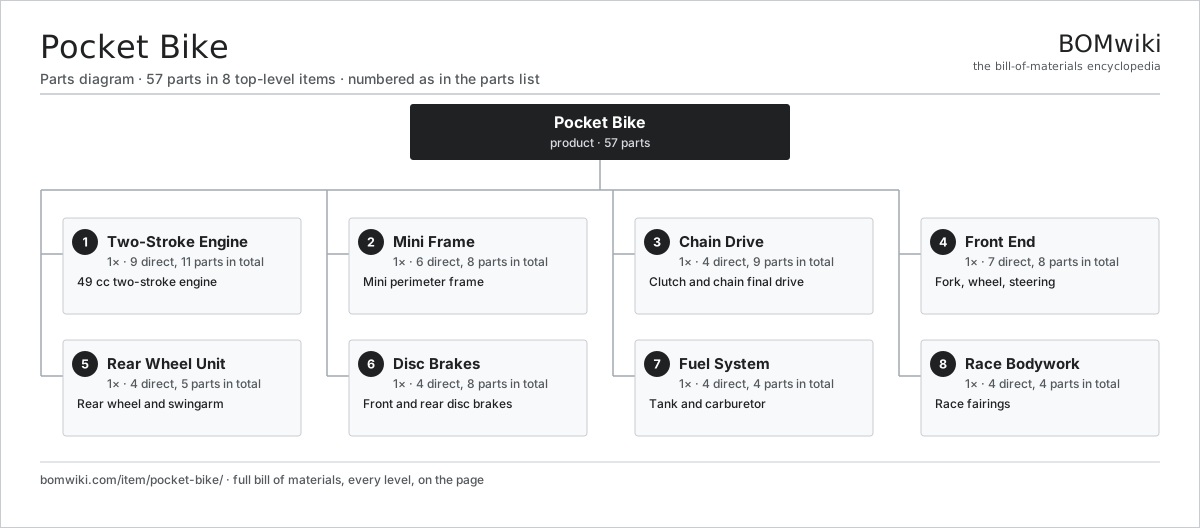
| # | Part | Qty | What it does |
|---|---|---|---|
| 1 | Two-Stroke Engine 9 parts | 1× | 49 cc two-stroke engine |
| 2 | Mini Frame 6 parts | 1× | Mini perimeter frame |
| 3 | Chain Drive 4 parts | 1× | Clutch and chain final drive |
| 4 | Front End 7 parts | 1× | Fork, wheel, steering |
| 5 | Rear Wheel Unit 4 parts | 1× | Rear wheel and swingarm |
| 6 | Disc Brakes 4 parts | 1× | Front and rear disc brakes |
| 7 | Fuel System 4 parts | 1× | Tank and carburetor |
| 8 | Race Bodywork 4 parts | 1× | Race fairings |
3D model
No 3D model yet. Have a CAD file of this? Add a 3D model. STL renders right on this page; STEP, FreeCAD, and OpenSCAD sources are welcome too (openly licensed, like all 3D models on BOMwiki).
Build & assembly graph
expand / collapse · shared sub-assemblies converge · links to related products · est. labourTap an assembly to expand/collapse · tap a part to open it · use “Open page” for any node · drag to pan, scroll to zoom.
Bill of materials for Pocket Bike
8 top-level lines · 54 rows shown · 57 parts total · indented to 3 levels| # | Item / sub-assembly | Part no. | Qty/assy | Ext. qty | Parts | Type |
|---|---|---|---|---|---|---|
| 1 | Two-Stroke Engine 9 parts | pocket-bike-engine | 1× | 1 | 11 | assembly |
| 1.1 | Cylinder and Head | pocket-bike-cylinder | 1× | 1 | · | part |
| 1.2 | Piston | pocket-bike-piston | 1× | 1 | · | part |
| 1.3 | Crankshaft | pocket-bike-crankshaft | 1× | 1 | · | part |
| 1.4 | Crankcase | pocket-bike-crankcase | 1× | 1 | · | part |
| 1.5 | CDI Ignition | pocket-bike-cdi-ignition | 1× | 1 | · | part |
| 1.6 | Pull Starter | pocket-bike-pull-starter | 1× | 1 | · | part |
| 1.7 | Expansion Chamber | pocket-bike-exhaust | 1× | 1 | · | part |
| 1.8 | Ball Bearing | ball-bearing | 2× | 2 | · | part |
| 1.9 | Oil Seal | oil-seal | 2× | 2 | · | part |
| 2 | Mini Frame 6 parts | pocket-bike-frame | 1× | 1 | 8 | assembly |
| 2.1 | Perimeter Frame Loop | pocket-bike-frame-loop | 1× | 1 | · | part |
| 2.2 | Engine Cradle | pocket-bike-engine-cradle | 1× | 1 | · | part |
| 2.3 | Seat Subframe | pocket-bike-subframe | 1× | 1 | · | part |
| 2.4 | Footpeg Bracket | pocket-bike-footpeg-bracket | 2× | 2 | · | part |
| 2.5 | Fastener Set | fastener-set | 1× | 1 | · | part |
| 2.6 | Ball Bearing | ball-bearing | 2× | 2 | · | part |
| 3 | Chain Drive 4 parts | pocket-bike-chain-drive | 1× | 1 | 9 | assembly |
| 3.1 | Centrifugal Clutch 4 parts | pocket-bike-centrifugal-clutch | 1× | 1 | 6 | assembly |
| 3.1.1 | Clutch Shoe | pocket-bike-clutch-shoe | 2× | 2 | · | part |
| 3.1.2 | Clutch Drum | pocket-bike-clutch-drum | 1× | 1 | · | part |
| 3.1.3 | Coil Spring | coil-spring | 2× | 2 | · | part |
| 3.1.4 | Ball Bearing | ball-bearing | 1× | 1 | · | part |
| 3.2 | Front Sprocket | pocket-bike-front-sprocket | 1× | 1 | · | part |
| 3.3 | Rear Sprocket | pocket-bike-rear-sprocket | 1× | 1 | · | part |
| 3.4 | T8F Chain | pocket-bike-chain | 1× | 1 | · | part |
| 4 | Front End 7 parts | pocket-bike-front-end | 1× | 1 | 8 | assembly |
| 4.1 | Front Fork | pocket-bike-fork | 1× | 1 | · | part |
| 4.2 | Cast Wheel | pocket-bike-wheel | 1× | 1 | · | part |
| 4.3 | Triple Clamp | pocket-bike-triple-clamp | 1× | 1 | · | part |
| 4.4 | Handlebar | pocket-bike-handlebar | 1× | 1 | · | part |
| 4.5 | Twist Throttle | pocket-bike-throttle | 1× | 1 | · | part |
| 4.6 | Kill Switch | pocket-bike-kill-switch | 1× | 1 | · | part |
| 4.7 | Ball Bearing | ball-bearing | 2× | 2 | · | part |
| 5 | Rear Wheel Unit 4 parts | pocket-bike-rear-wheel-unit | 1× | 1 | 5 | assembly |
| 5.1 | Swingarm | pocket-bike-swingarm | 1× | 1 | · | part |
| 5.2 | Rear Wheel | pocket-bike-rear-hub-wheel | 1× | 1 | · | part |
| 5.3 | Ball Bearing | ball-bearing | 2× | 2 | · | part |
| 5.4 | Fastener Set | fastener-set | 1× | 1 | · | part |
| 6 | Disc Brakes 4 parts | pocket-bike-brakes | 1× | 1 | 8 | assembly |
| 6.1 | Brake Disc | pocket-bike-brake-disc | 2× | 2 | · | part |
| 6.2 | Brake Caliper | pocket-bike-brake-caliper | 2× | 2 | · | part |
| 6.3 | Brake Lever | pocket-bike-brake-lever | 2× | 2 | · | part |
| 6.4 | Brake Line | pocket-bike-brake-line | 2× | 2 | · | part |
| 7 | Fuel System 4 parts | pocket-bike-fuel-system | 1× | 1 | 4 | assembly |
| 7.1 | Fuel Tank | pocket-bike-fuel-tank | 1× | 1 | · | part |
| 7.2 | Slide Carburetor | pocket-bike-carburetor | 1× | 1 | · | part |
| 7.3 | Fuel Line | pocket-bike-fuel-line | 1× | 1 | · | part |
| 7.4 | Air Filter | pocket-bike-air-filter | 1× | 1 | · | part |
| 8 | Race Bodywork 4 parts | pocket-bike-bodywork | 1× | 1 | 4 | assembly |
| 8.1 | Front Fairing | pocket-bike-front-fairing | 1× | 1 | · | part |
| 8.2 | Tail Fairing | pocket-bike-tail-fairing | 1× | 1 | · | part |
| 8.3 | Seat Pad | pocket-bike-seat-pad | 1× | 1 | · | part |
| 8.4 | Fastener Set | fastener-set | 1× | 1 | · | part |
Something wrong in this list? Report a problem with this BOM.
Sourcing: possible vendors
Browse the supplier directory → Prices, MOQ, and lead times are algorithmic estimates, not quotes, and not claims about these companies. Company mappings are curated by keyword; est. price band $300–$15k. How estimates work| Vendor | HQ | Specialty | MOQ | Lead time |
|---|---|---|---|---|
| global.honda ↗ | Tokyo, JP | Motorcycles & power products | made to order | 10–16 wks |
| yamaha-motor.com ↗ | Iwata, JP | Motorcycles & marine | made to order | 10–16 wks |
| heromotocorp.com ↗ | New Delhi, IN | Motorcycle & scooter maker | made to order | 10–16 wks |
| bajajauto.com ↗ | Pune, IN | Two- & three-wheeler maker | made to order | 10–16 wks |
| harley-davidson.com ↗ | Milwaukee, US | Motorcycles | made to order | 10–16 wks |
793-word article