Self-Balancing Scooter
ProductOverview
A self-balancing scooter, commonly called a hoverboard, is a two-wheeled platform that stays upright on its own and moves under the rider by sensing and responding to small shifts of body weight. There is no handlebar and no throttle. The rider stands on two footpads, leans forward to go and back to stop, and twists the pads relative to each other to turn. The illusion of a vehicle balancing itself comes from a fast control loop: a sensor array measures the platform's tilt many times a second and a balance mainboard commands the two hub drive modules to drive forward or backward just enough to keep the deck level under the rider.
The machine is small, light, and built mostly from electronics and two motorized wheels. Its defining trick is active balancing, the same inverted-pendulum control that keeps a Segway upright, scaled down to a footpad platform.
Drive modules
Each side of the platform has its own hub drive module, a brushless motor built into the wheel. The stator is fixed to the axle and the rotor turns the tire around it on ball bearings, with a hall sensor board reporting rotor position. Two independent motors are what make the scooter both balance and steer: driving them together moves the platform straight, while driving them at different speeds turns it. There is no mechanical differential, the steering is done entirely by the controller commanding unequal motor speeds.
Sensing and the balance loop
The sensor array is the input to the balance loop. Each footpad carries an inertial measurement unit combining a gyroscope and accelerometer, plus a tilt sensor board that detects how far the rider has leaned each pad. The control loop runs roughly 200 times a second. The mainboard reads the pitch angle and angular rate from the IMUs, computes the motor torque needed to drive the wheels under the platform's center of mass, and updates the motors. If the rider leans forward, the platform momentarily falls forward, the IMU detects it, and the motors accelerate to catch up, which the rider feels as the scooter moving off. Lean back and the loop drives the wheels in reverse to stay under the new balance point.
Mainboard and power electronics
The balance mainboard carries the control intelligence and the motor drives on one board. One microcontroller runs the balance algorithm and a second handles low-level motor commutation, switching twelve MOSFETs through two gate drivers, one bank of six per wheel. Four current sensors monitor motor current for torque control and overload protection, and a heatsink cools the switching devices. Because the board must react within milliseconds to keep the rider upright, its firmware and sensor timing are the critical engineering of the product.
Battery and chassis
The battery pack is a small 36-volt lithium array of 18650 cells with a management board for protection and balancing. Early hoverboards gained a reputation for battery fires from low-quality cells and missing protection, which led to the UL 2272 electrical safety standard that modern units are certified to.
The pivoting chassis is two die-cast footpad halves, left and right, joined by a central pivot shaft running through bearings. The pivot lets the rider twist one pad relative to the other; the tilt board senses that twist and the controller turns it into a steering command by speeding one wheel and slowing the other.
Footpad switches, shell, and indicators
The footpad presence switches are a safety interlock. Each pad has a presence sensor that detects a rider standing on it; the balance loop only engages the motors when both pads are pressed, so the scooter does not drive away when stepped off. The outer shell is a two-piece ABS housing with TPU corner bumpers and wheel fenders to survive low-speed impacts. The indicators and audio add status LED boards and a warning buzzer that sounds when the battery is low or the rider exceeds the safe lean angle.
Variants and use
Wheel size separates the variants: 6.5-inch units are the smallest and cheapest for smooth floors, while 8.5 and 10-inch all-terrain models add larger pneumatic tires for grass and gravel. Some models add Bluetooth speakers, app connectivity, and ride-mode selection for beginners. Hoverboard go-kart attachments add a seat and a steering bar that mechanically twists the pads, letting a seated rider drive the platform. The product is mostly recreational, valued for the novelty of a vehicle that balances itself and steers with the feet alone.
Self-Balancing Scooter parts and their functions
9 top-level parts · 282 parts in total · full bill of materials below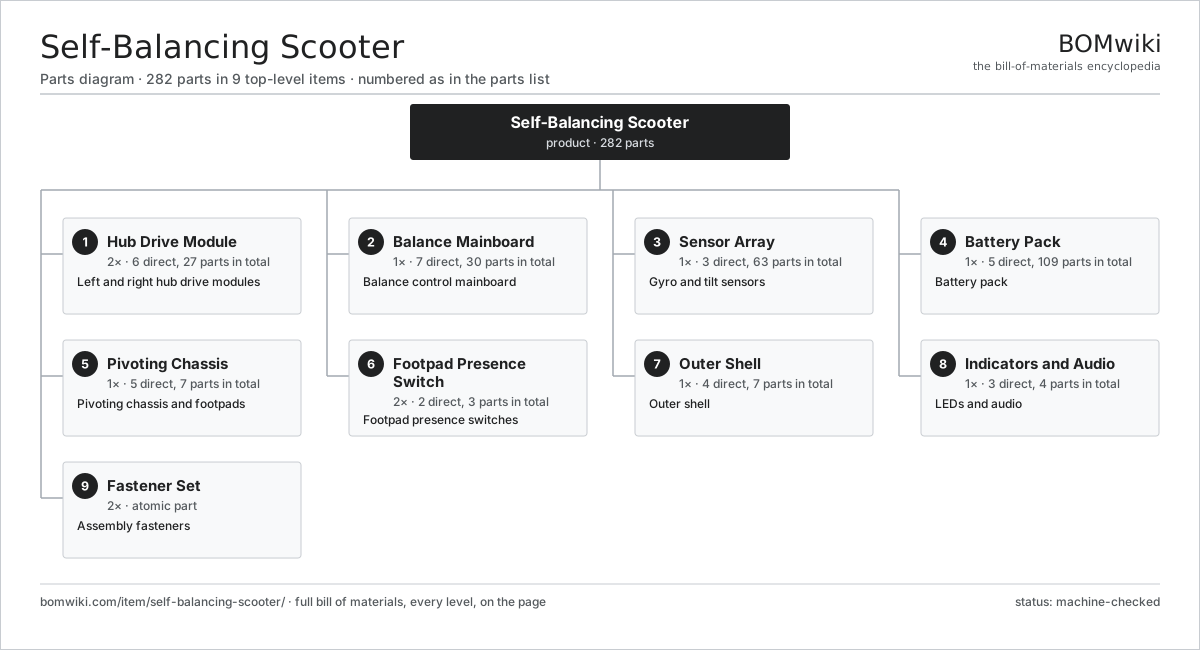
| # | Part | Qty | What it does |
|---|---|---|---|
| 1 | Hub Drive Module 6 parts | 2× | Left and right hub drive modules |
| 2 | Balance Mainboard 7 parts | 1× | Balance control mainboard |
| 3 | Sensor Array 3 parts | 1× | Gyro and tilt sensors |
| 4 | Battery Pack 5 parts | 1× | Battery pack |
| 5 | Pivoting Chassis 5 parts | 1× | Pivoting chassis and footpads |
| 6 | Footpad Presence Switch 2 parts | 2× | Footpad presence switches |
| 7 | Outer Shell 4 parts | 1× | Outer shell |
| 8 | Indicators and Audio 3 parts | 1× | LEDs and audio |
| 9 | Fastener Set | 2× | Assembly fasteners |
3D model
No 3D model yet. Have a CAD file of this? Add a 3D model. STL renders right on this page; STEP, FreeCAD, and OpenSCAD sources are welcome too (openly licensed, like all 3D models on BOMwiki).
Build & assembly graph
expand / collapse · shared sub-assemblies converge · links to related products · est. labourTap an assembly to expand/collapse · tap a part to open it · use “Open page” for any node · drag to pan, scroll to zoom.
Bill of materials for Self-Balancing Scooter
9 top-level lines · 55 rows shown · 282 parts total · indented to 3 levels| # | Item / sub-assembly | Part no. | Qty/assy | Ext. qty | Parts | Type |
|---|---|---|---|---|---|---|
| 1 | Hub Drive Module 6 parts | self-balancing-scooter-drive-module | 2× | 2 | 27 | assembly |
| 1.1 | Stator Assembly 3 parts | stator-assembly | 1× | 2 | 3 | assembly |
| 1.1.1 | Stator Core (laminations) | stator-core | 1× | 2 | · | part |
| 1.1.2 | Copper Winding | copper-winding | 1× | 2 | · | part |
| 1.1.3 | Slot Insulation | stator-insulation | 1× | 2 | · | part |
| 1.2 | Rotor Assembly 4 parts | rotor-assembly | 1× | 2 | 19 | assembly |
| 1.2.1 | Rotor Shaft | rotor-shaft | 1× | 2 | · | part |
| 1.2.2 | Rotor Core | rotor-core | 1× | 2 | · | part |
| 1.2.3 | Neodymium Magnet | neodymium-magnet | 16× | 32 | · | part |
| 1.2.4 | Ball Bearing | ball-bearing | 1× | 2 | · | part |
| 1.3 | Hall Sensor Board | self-balancing-scooter-hall | 1× | 2 | · | part |
| 1.4 | Solid Tire | self-balancing-scooter-tire | 1× | 2 | · | part |
| 1.5 | Ball Bearing | ball-bearing | 2× | 4 | · | part |
| 1.6 | Motor Axle | self-balancing-scooter-motor-axle | 1× | 2 | · | part |
| 2 | Balance Mainboard 7 parts | self-balancing-scooter-mainboard | 1× | 1 | 30 | assembly |
| 2.1 | Bare PCB | pcb-bare | 1× | 1 | · | part |
| 2.2 | Microcontroller | mcu | 2× | 2 | · | part |
| 2.3 | Power MOSFET | mosfet | 12× | 12 | · | part |
| 2.4 | Gate Driver IC | gate-driver-ic | 2× | 2 | · | part |
| 2.5 | Current Sensor | current-sensor | 4× | 4 | · | part |
| 2.6 | Connector | connector | 8× | 8 | · | part |
| 2.7 | Board Heatsink | self-balancing-scooter-heatsink | 1× | 1 | · | part |
| 3 | Sensor Array 3 parts | self-balancing-scooter-sensor-array | 1× | 1 | 63 | assembly |
| 3.1 | Gyro / Accel IMU | self-balancing-scooter-imu | 2× | 2 | · | part |
| 3.2 | Tilt Sensor Board | self-balancing-scooter-tilt-board | 1× | 1 | · | part |
| 3.3 | SMD Passive (R/C/L) | smd-passives | 60× | 60 | · | part |
| 4 | Battery Pack 5 parts | self-balancing-scooter-battery | 1× | 1 | 109 | assembly |
| 4.1 | 18650 Li-ion Cell | self-balancing-scooter-cell | 20× | 20 | · | part |
| 4.2 | Battery Management System 4 parts | self-balancing-scooter-bms | 1× | 1 | 86 | assembly |
| 4.2.1 | Bare PCB | pcb-bare | 1× | 1 | · | part |
| 4.2.2 | Microcontroller | mcu | 1× | 1 | · | part |
| 4.2.3 | Power MOSFET | mosfet | 4× | 4 | · | part |
| 4.2.4 | SMD Passive (R/C/L) | smd-passives | 80× | 80 | · | part |
| 4.3 | Pack Case | self-balancing-scooter-pack-case | 1× | 1 | · | part |
| 4.4 | Charge Port | self-balancing-scooter-charge-port | 1× | 1 | · | part |
| 4.5 | Wire Bundle | wire-bundle | 1× | 1 | · | part |
| 5 | Pivoting Chassis 5 parts | self-balancing-scooter-chassis | 1× | 1 | 7 | assembly |
| 5.1 | Left Footpad Frame | self-balancing-scooter-left-pad | 1× | 1 | · | part |
| 5.2 | Right Footpad Frame | self-balancing-scooter-right-pad | 1× | 1 | · | part |
| 5.3 | Center Pivot Shaft | self-balancing-scooter-pivot | 1× | 1 | · | part |
| 5.4 | Motor Axle Mount | self-balancing-scooter-axle-mount | 2× | 2 | · | part |
| 5.5 | Ball Bearing | ball-bearing | 2× | 2 | · | part |
| 6 | Footpad Presence Switch 2 parts | self-balancing-scooter-foot-switch | 2× | 2 | 3 | assembly |
| 6.1 | Switch Rubber Pad | self-balancing-scooter-switch-pad | 1× | 2 | · | part |
| 6.2 | Presence Sensor | self-balancing-scooter-switch-sensor | 2× | 4 | · | part |
| 7 | Outer Shell 4 parts | self-balancing-scooter-shell | 1× | 1 | 7 | assembly |
| 7.1 | Top Shell Half | self-balancing-scooter-top-shell | 2× | 2 | · | part |
| 7.2 | Bottom Shell | self-balancing-scooter-bottom-shell | 1× | 1 | · | part |
| 7.3 | Corner Bumper | self-balancing-scooter-bumper | 2× | 2 | · | part |
| 7.4 | Wheel Fender | self-balancing-scooter-fender | 2× | 2 | · | part |
| 8 | Indicators and Audio 3 parts | self-balancing-scooter-indicators | 1× | 1 | 4 | assembly |
| 8.1 | LED Indicator Board | self-balancing-scooter-led-board | 2× | 2 | · | part |
| 8.2 | Warning Buzzer | self-balancing-scooter-buzzer | 1× | 1 | · | part |
| 8.3 | Wire Bundle | wire-bundle | 1× | 1 | · | part |
| 9 | Fastener Set | fastener-set | 2× | 2 | · | part |
Related products
same domain, ranked by shared parts Seated Electric Scooter
262 parts · shares 12 with this page
Seated Electric Scooter
262 parts · shares 12 with this page
 Electric Skateboard
215 parts · shares 11 with this page
Electric Skateboard
215 parts · shares 11 with this page
 Self-Balancing Unicycle
602 parts · shares 11 with this page
Electric Trike
214 parts · shares 10 with this page
Electric Unicycle
176 parts · shares 10 with this page
Self-Balancing Unicycle
602 parts · shares 11 with this page
Electric Trike
214 parts · shares 10 with this page
Electric Unicycle
176 parts · shares 10 with this page
 Hoverboard
399 parts · shares 10 with this page
Hoverboard
399 parts · shares 10 with this page
Sourcing: possible vendors
Browse the supplier directory → Prices, MOQ, and lead times are algorithmic estimates, not quotes, and not claims about these companies. Company mappings are curated by keyword; est. price band $300–$15k. How estimates work| Vendor | HQ | Specialty | MOQ | Lead time |
|---|---|---|---|---|
| global.honda ↗ | Tokyo, JP | Motorcycles & power products | made to order | 10–16 wks |
| yamaha-motor.com ↗ | Iwata, JP | Motorcycles & marine | made to order | 10–16 wks |
| heromotocorp.com ↗ | New Delhi, IN | Motorcycle & scooter maker | made to order | 10–16 wks |
| bajajauto.com ↗ | Pune, IN | Two- & three-wheeler maker | made to order | 10–16 wks |
| harley-davidson.com ↗ | Milwaukee, US | Motorcycles | made to order | 10–16 wks |
899-word article