Self-Balancing Unicycle
ProductOverview
An electric self-balancing unicycle, usually shortened to EUC, is a single-wheeled transporter that keeps the rider upright by sensing how the body is tilting and driving the wheel to stay under the rider. There are no handlebars and no second wheel. The rider stands on two folding pedals, one on each side of the wheel, and steers by leaning and twisting. The whole machine is built around one large hub-motor wheel, a sizable battery pack, and a control board that runs the balance loop. Wheels are commonly 16 to 18 inches, motors are rated from about 1000 to 3000 watts, and battery voltage runs from roughly 67 to 100 volts.
How it works
Balance is a closed control loop. The logic mainboard carries an 6-axis IMU that reports pitch angle and angular rate hundreds of times per second. When the rider leans forward, the pitch reading changes, and the controller commands torque to roll the wheel forward fast enough to move the contact patch back under the combined center of mass. Lean harder and the wheel accelerates; lean back and it decelerates or reverses. Side-to-side steering comes from the rider tilting and yawing, which the firmware reads as a turn input. The loop never stops correcting, which is why a powered EUC feels alive underfoot and a powered-off one simply falls over.
The torque command becomes motion through the three-phase inverter. It switches battery voltage across the three motor phases using banks of power MOSFETs driven by gate driver ICs, with phase current sensors closing a field-oriented control loop so the motor produces smooth, precise torque. The hub motor is an outrunner: the wound stator is fixed to a hollow axle while the rotor shell carrying the magnets and the tyre spins around it, so the wheel is the motor and there is no gearbox. Three Hall sensors tell the controller where the rotor is. When the rider approaches the speed limit, firmware tilts the pedals back, a safety cue called tilt-back, and sounds the alarm buzzer so the rider eases off before the motor runs out of headroom.
Battery and power
Range and top speed both trace back to the pack. A typical battery pack is built from 80 or more 18650 cells welded with nickel strip into a series-parallel block, for example 16S5P. Higher voltage gives more speed headroom; more parallel cells give more capacity and current. A battery management system watches every series group through a cell-monitor AFE, balances cells with bleed resistors, and trips its MOSFET switches on over-voltage, under-voltage, over-current, or over-temperature. Charging is done off the bike with an external charger that converts mains AC to the pack charge voltage, commonly 67.2 V or 100.8 V at full charge, through the body charge port.
Materials and construction
The structural core is the inner frame, usually cast or machined aluminium, which carries the motor axle, the battery box, and the control board. The axle rides on sealed ball bearings protected by oil seals against road spray. Molded plastic shell halves enclose the internals, with replaceable impact bumpers at the corners and a mudguard over the tyre. The rider grips the machine through two power pads squeezed between the calves and stands on aluminium footplates that fold up for transport on spring-loaded hinges. A telescopic trolley handle lets the powered-down unicycle be wheeled like a suitcase. The pneumatic tyre runs 30 to 45 psi over its inner tube.
Variants
Models split mainly by battery and motor size. Commuter units favour lighter packs around 500 to 800 Wh, 16-inch wheels, and speeds near 40 km/h. Long-range and high-performance models stack 1500 to 2700 Wh of cells, push 100 V architectures, run 18-inch wheels, and reach 70 km/h, at the cost of weight near 30 kg or more. Suspension EUCs add a sprung linkage between frame and axle for rough ground. Most carry lighting with a headlight, a brake light, and side LED strips, plus a Bluetooth link to a phone app for speed limits, tilt-back points, and firmware updates.
Use and maintenance
Riding takes practice because the rider, not a handlebar, supplies all balance and steering. Beginners learn to mount against a wall, then to ride, then to turn and stop. Protective gear matters: a cutout or stall at speed drops the rider with no warning. Routine maintenance is light. Keep the tyre at pressure, store the pack near 60 percent for long idle periods, and avoid riding to zero charge, since a depleted pack starves the balance loop of the power it needs to hold the rider up. The pedals, bumpers, and tyre are the usual wear parts and are designed to be swapped.
Self-Balancing Unicycle parts and their functions
9 top-level parts · 602 parts in total · full bill of materials below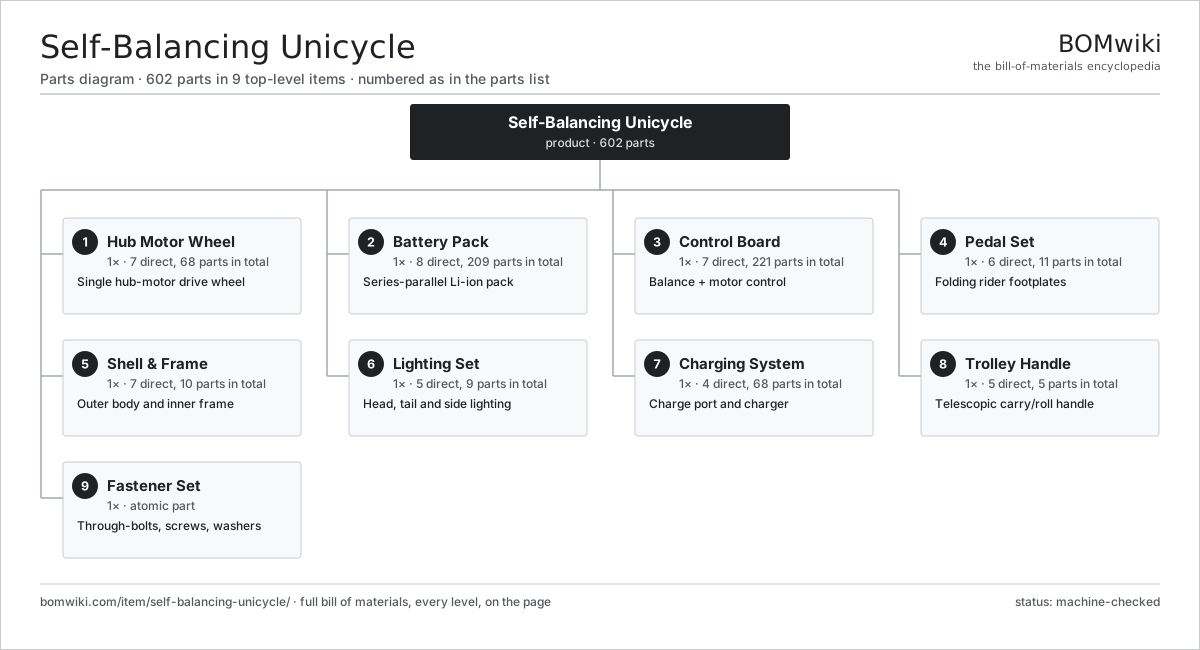
| # | Part | Qty | What it does |
|---|---|---|---|
| 1 | Hub Motor Wheel 7 parts | 1× | Single hub-motor drive wheel |
| 2 | Battery Pack 8 parts | 1× | Series-parallel Li-ion pack |
| 3 | Control Board 7 parts | 1× | Balance + motor control |
| 4 | Pedal Set 6 parts | 1× | Folding rider footplates |
| 5 | Shell & Frame 7 parts | 1× | Outer body and inner frame |
| 6 | Lighting Set 5 parts | 1× | Head, tail and side lighting |
| 7 | Charging System 4 parts | 1× | Charge port and charger |
| 8 | Trolley Handle 5 parts | 1× | Telescopic carry/roll handle |
| 9 | Fastener Set | 1× | Through-bolts, screws, washers |
3D model
No 3D model yet. Have a CAD file of this? Add a 3D model. STL renders right on this page; STEP, FreeCAD, and OpenSCAD sources are welcome too (openly licensed, like all 3D models on BOMwiki).
Build & assembly graph
expand / collapse · shared sub-assemblies converge · links to related products · est. labourTap an assembly to expand/collapse · tap a part to open it · use “Open page” for any node · drag to pan, scroll to zoom.
Bill of materials for Self-Balancing Unicycle
9 top-level lines · 89 rows shown · 602 parts total · indented to 3 levels| # | Item / sub-assembly | Part no. | Qty/assy | Ext. qty | Parts | Type |
|---|---|---|---|---|---|---|
| 1 | Hub Motor Wheel 7 parts | self-balancing-unicycle-wheel-motor | 1× | 1 | 68 | assembly |
| 1.1 | BLDC Hub Motor 7 parts | self-balancing-unicycle-hub-motor | 1× | 1 | 60 | assembly |
| 1.1.1 | Stator Assembly 3 parts + deeper › | stator-assembly | 1× | 1 | 3 | assembly |
| 1.1.2 | Rotor Assembly 4 parts + deeper › | rotor-assembly | 1× | 1 | 19 | assembly |
| 1.1.3 | Neodymium Magnet | neodymium-magnet | 30× | 30 | · | part |
| 1.1.4 | Hall Sensor | hall-sensor | 3× | 3 | · | part |
| 1.1.5 | Hollow Motor Axle | self-balancing-unicycle-motor-axle | 1× | 1 | · | part |
| 1.1.6 | Motor Phase Cable | self-balancing-unicycle-phase-cable | 3× | 3 | · | part |
| 1.1.7 | Winding Thermistor | self-balancing-unicycle-temp-sensor | 1× | 1 | · | part |
| 1.2 | Pneumatic Tyre | self-balancing-unicycle-tyre | 1× | 1 | · | part |
| 1.3 | Inner Tube | self-balancing-unicycle-inner-tube | 1× | 1 | · | part |
| 1.4 | Wheel Rim | self-balancing-unicycle-rim | 1× | 1 | · | part |
| 1.5 | Ball Bearing | ball-bearing | 2× | 2 | · | part |
| 1.6 | Oil Seal | oil-seal | 2× | 2 | · | part |
| 1.7 | Valve Stem | self-balancing-unicycle-valve-stem | 1× | 1 | · | part |
| 2 | Battery Pack 8 parts | self-balancing-unicycle-battery-pack | 1× | 1 | 209 | assembly |
| 2.1 | Li-ion Cell, 18650 | li-cell-18650 | 80× | 80 | · | part |
| 2.2 | Battery Management System 7 parts | self-balancing-unicycle-bms | 1× | 1 | 119 | assembly |
| 2.2.1 | Bare PCB | pcb-bare | 1× | 1 | · | part |
| 2.2.2 | Microcontroller | mcu | 1× | 1 | · | part |
| 2.2.3 | Cell-Monitor AFE IC | self-balancing-unicycle-afe-ic | 1× | 1 | · | part |
| 2.2.4 | Power MOSFET | mosfet | 8× | 8 | · | part |
| 2.2.5 | SMD Passive (R/C/L) | smd-passives | 90× | 90 | · | part |
| 2.2.6 | Balance Resistor | self-balancing-unicycle-balance-resistor | 16× | 16 | · | part |
| 2.2.7 | Winding Thermistor | self-balancing-unicycle-temp-sensor | 2× | 2 | · | part |
| 2.3 | Nickel Interconnect Strip | self-balancing-unicycle-nickel-strip | 1× | 1 | · | part |
| 2.4 | Cell Holder | self-balancing-unicycle-cell-holder | 4× | 4 | · | part |
| 2.5 | Pack Insulation Wrap | self-balancing-unicycle-pack-wrap | 1× | 1 | · | part |
| 2.6 | Pack Discharge Leads | self-balancing-unicycle-pack-leads | 1× | 1 | · | part |
| 2.7 | Connector | connector | 2× | 2 | · | part |
| 2.8 | Pack Fuse | self-balancing-unicycle-fuse | 1× | 1 | · | part |
| 3 | Control Board 7 parts | self-balancing-unicycle-control-board | 1× | 1 | 221 | assembly |
| 3.1 | Logic Mainboard 7 parts | self-balancing-unicycle-mainboard | 1× | 1 | 188 | assembly |
| 3.1.1 | Bare PCB | pcb-bare | 1× | 1 | · | part |
| 3.1.2 | Microcontroller | mcu | 1× | 1 | · | part |
| 3.1.3 | IMU (6-axis) | imu | 1× | 1 | · | part |
| 3.1.4 | Phase Current Sensor | self-balancing-unicycle-current-sensor | 3× | 3 | · | part |
| 3.1.5 | Pressure Sensor | pressure-sensor | 1× | 1 | · | part |
| 3.1.6 | SMD Passive (R/C/L) | smd-passives | 180× | 180 | · | part |
| 3.1.7 | LED Driver | self-balancing-unicycle-led-driver | 1× | 1 | · | part |
| 3.2 | Three-Phase Inverter Stage 5 parts | self-balancing-unicycle-inverter-stage | 1× | 1 | 23 | assembly |
| 3.2.1 | Power MOSFET | mosfet | 12× | 12 | · | part |
| 3.2.2 | Gate Driver IC | gate-driver-ic | 3× | 3 | · | part |
| 3.2.3 | DC-Link Capacitor | self-balancing-unicycle-bulk-cap | 4× | 4 | · | part |
| 3.2.4 | Phase Current Sensor | self-balancing-unicycle-current-sensor | 3× | 3 | · | part |
| 3.2.5 | Power Busbar | self-balancing-unicycle-busbar | 1× | 1 | · | part |
| 3.3 | Bluetooth Module | self-balancing-unicycle-bluetooth-module | 1× | 1 | · | part |
| 3.4 | Alarm Buzzer | self-balancing-unicycle-buzzer | 1× | 1 | · | part |
| 3.5 | MOSFET Heatsink | self-balancing-unicycle-heatsink | 1× | 1 | · | part |
| 3.6 | Connector | connector | 6× | 6 | · | part |
| 3.7 | Wire Bundle | wire-bundle | 1× | 1 | · | part |
| 4 | Pedal Set 6 parts | self-balancing-unicycle-pedal-set | 1× | 1 | 11 | assembly |
| 4.1 | Footplate | self-balancing-unicycle-pedal | 2× | 2 | · | part |
| 4.2 | Pedal Hanger | self-balancing-unicycle-pedal-hanger | 2× | 2 | · | part |
| 4.3 | Pedal Hinge | self-balancing-unicycle-pedal-hinge | 2× | 2 | · | part |
| 4.4 | Grip Pad | self-balancing-unicycle-grip-pad | 2× | 2 | · | part |
| 4.5 | Coil Spring | coil-spring | 2× | 2 | · | part |
| 4.6 | Fastener Set | fastener-set | 1× | 1 | · | part |
| 5 | Shell & Frame 7 parts | self-balancing-unicycle-shell | 1× | 1 | 10 | assembly |
| 5.1 | Inner Frame | self-balancing-unicycle-inner-frame | 1× | 1 | · | part |
| 5.2 | Sheet Metal Panel | sheet-panel | 2× | 2 | · | part |
| 5.3 | Power Pad | self-balancing-unicycle-power-pad | 2× | 2 | · | part |
| 5.4 | Impact Bumper | self-balancing-unicycle-bumper | 2× | 2 | · | part |
| 5.5 | Mudguard | self-balancing-unicycle-mudguard | 1× | 1 | · | part |
| 5.6 | O-Ring Set | oring-set | 1× | 1 | · | part |
| 5.7 | Fastener Set | fastener-set | 1× | 1 | · | part |
| 6 | Lighting Set 5 parts | self-balancing-unicycle-lighting | 1× | 1 | 9 | assembly |
| 6.1 | Headlight Module | self-balancing-unicycle-headlight | 1× | 1 | · | part |
| 6.2 | Tail/Brake Light | self-balancing-unicycle-taillight | 1× | 1 | · | part |
| 6.3 | Addressable LED Strip | self-balancing-unicycle-led-strip | 2× | 2 | · | part |
| 6.4 | Wire Bundle | wire-bundle | 1× | 1 | · | part |
| 6.5 | Connector | connector | 4× | 4 | · | part |
| 7 | Charging System 4 parts | self-balancing-unicycle-charging-system | 1× | 1 | 68 | assembly |
| 7.1 | Charge Port | self-balancing-unicycle-charge-port | 1× | 1 | · | part |
| 7.2 | External Charger 5 parts | self-balancing-unicycle-charger | 1× | 1 | 64 | assembly |
| 7.2.1 | Power Supply | power-supply | 1× | 1 | · | part |
| 7.2.2 | Bare PCB | pcb-bare | 1× | 1 | · | part |
| 7.2.3 | Microcontroller | mcu | 1× | 1 | · | part |
| 7.2.4 | Charger Cooling Fan | self-balancing-unicycle-cooling-fan | 1× | 1 | · | part |
| 7.2.5 | SMD Passive (R/C/L) | smd-passives | 60× | 60 | · | part |
| 7.3 | Relay | relay | 1× | 1 | · | part |
| 7.4 | Connector | connector | 2× | 2 | · | part |
| 8 | Trolley Handle 5 parts | self-balancing-unicycle-trolley-handle | 1× | 1 | 5 | assembly |
| 8.1 | Handle Tube | self-balancing-unicycle-handle-tube | 1× | 1 | · | part |
| 8.2 | Handle Grip | self-balancing-unicycle-handle-grip | 1× | 1 | · | part |
| 8.3 | Handle Latch | self-balancing-unicycle-handle-latch | 1× | 1 | · | part |
| 8.4 | Coil Spring | coil-spring | 1× | 1 | · | part |
| 8.5 | Fastener Set | fastener-set | 1× | 1 | · | part |
| 9 | Fastener Set | fastener-set | 1× | 1 | · | part |
Related products
same domain, ranked by shared parts Electric Skateboard
215 parts · shares 13 with this page
Electric Unicycle
176 parts · shares 13 with this page
Electric Skateboard
215 parts · shares 13 with this page
Electric Unicycle
176 parts · shares 13 with this page
 Hoverboard
399 parts · shares 13 with this page
Electric Trike
214 parts · shares 12 with this page
Hoverboard
399 parts · shares 13 with this page
Electric Trike
214 parts · shares 12 with this page
 Self-Balancing Personal Transporter
402 parts · shares 12 with this page
Self-Balancing Personal Transporter
402 parts · shares 12 with this page
 Seated Electric Scooter
262 parts · shares 11 with this page
Seated Electric Scooter
262 parts · shares 11 with this page
Sourcing: possible vendors
Browse the supplier directory → Prices, MOQ, and lead times are algorithmic estimates, not quotes, and not claims about these companies. Company mappings are curated by keyword; est. price band $300–$15k. How estimates work| Vendor | HQ | Specialty | MOQ | Lead time |
|---|---|---|---|---|
| global.honda ↗ | Tokyo, JP | Motorcycles & power products | made to order | 10–16 wks |
| yamaha-motor.com ↗ | Iwata, JP | Motorcycles & marine | made to order | 10–16 wks |
| heromotocorp.com ↗ | New Delhi, IN | Motorcycle & scooter maker | made to order | 10–16 wks |
| bajajauto.com ↗ | Pune, IN | Two- & three-wheeler maker | made to order | 10–16 wks |
| harley-davidson.com ↗ | Milwaukee, US | Motorcycles | made to order | 10–16 wks |
982-word article