UV/LED Nail Lamp
ProductOverview
A UV/LED nail lamp cures gel nail polish: it floods the nail plate with near-ultraviolet light so the photoinitiators in the gel start a free-radical polymerisation that hardens the coating in tens of seconds. Earlier salon lamps used 36 W fluorescent UV tubes with broad output and 3–5 minute cure times; this is the LED generation, which concentrates output at the two wavelengths gel chemistry actually uses and cures a layer in 30–60 seconds.
The light source is the LED Curing Array: three metal-core strips, a Top LED Strip in the cavity ceiling and a Side LED Strip on each wall, carrying 33 emitters in total. The mix matters. The 405 nm LED beads sit on the absorption peak of TPO-type photoinitiators used in ordinary gel polish, while the 365 nm UV LED beads reach the deeper-curing UVA initiators used in builder and hard gels. A lamp with only 405 nm output leaves some professional gels tacky or under-cured at depth; the dual array covers both.
How it works
Each LED string is driven from the Timer Control Board, where an 8-bit Microcontroller times the cycle and switches the strings through one Power MOSFET per string. Pressing one of the four Timer Preset Button selects a 10, 30, 60, or 99 second preset; the 7-Segment Display display behind its smoked Display Lens counts down, and the Piezo Buzzer beeps at zero. Holding the 99-second key engages low-heat mode: the controller PWMs the strings at roughly half power for the first part of the cycle. This addresses the main client complaint with fast LED curing, the polymerisation is exothermic, and a thick builder-gel layer cured at full power can produce a sharp heat spike in the nail bed. Ramping the dose spreads the same total energy over more time and keeps the temperature rise tolerable.
Most cycles start without a button press at all. The Hand Sensor Module aims a 940 nm IR Emitter LED across the cavity entrance; when a hand slides in, reflected infrared reaches the IR Phototransistor and the controller starts the last-used preset. Withdrawing the hand kills the LEDs immediately, which both saves the emitters and stops UV spilling out of the opening.
Optics and housing
Curing quality depends less on raw wattage than on irradiance uniformity, every nail, including the thumb lying at an angle, must receive enough dose. The Reflector Housing handles this optically: the Reflector Liner inside the Upper Shell is vacuum-metallised or high-reflectance white, so light that misses a nail on the first pass is recycled back into the cavity. The Removable Base Tray continues the scheme from below: its Tray Plate has a reflective top face that bounces light onto the underside of the free edge. The tray is held by four Tray Magnets and slides out, which serves two purposes, the acetone-resistant Tray Surface Pad can be wiped or replaced between clients, and with the tray removed the lamp sits directly over the toes for pedicure curing.
Stray UV toward the user is controlled by the Entry Skirt, an opaque lip around the hand opening. At 365–405 nm the photobiological risk is low compared with germicidal UV-C, but repeated salon exposure of the technician’s eyes and the client’s hand skin is still worth limiting, and many salons pair the lamp with fingerless UV gloves.
Thermal and power design
Thirty-three LEDs dissipating tens of watts in a closed plastic shell would cook themselves without a thermal path. Each strip is built on a Metal-Core PCB, an aluminium-substrate board that spreads heat into the shell, because LED output and lifetime fall steeply with junction temperature. Keeping the array cool is what lets the maker quote a ≈ 50,000-hour source life with no bulb changes, the key running-cost advantage over fluorescent-tube lamps, whose tubes degraded in months.
Power arrives from an external 24 V 2 A Power Supply through the DC Barrel Jack, so no mains voltage enters the lamp body, relevant for a device used near water, acetone, and wet product. The Input Protection Stage adds reverse-polarity blocking and bulk capacitance ahead of the LED drivers.
Curing performance
A typical gel-polish service cures each colour layer for 30 seconds and the top coat for 60. Under-curing leaves uncrosslinked monomer in contact with skin, the main cause of gel-related allergic sensitisation, so professional guidance is to match lamp and gel system: gel manufacturers validate cure times against a specific irradiance spectrum, and a lamp of the same wattage but different LED mix can under-cure. The dual-wavelength array and the reflector-lined cavity are this lamp’s answer, broad chemistry coverage and uniform dose across all five nails per hand.
UV/LED Nail Lamp parts and their functions
8 top-level parts · 81 parts in total · full bill of materials below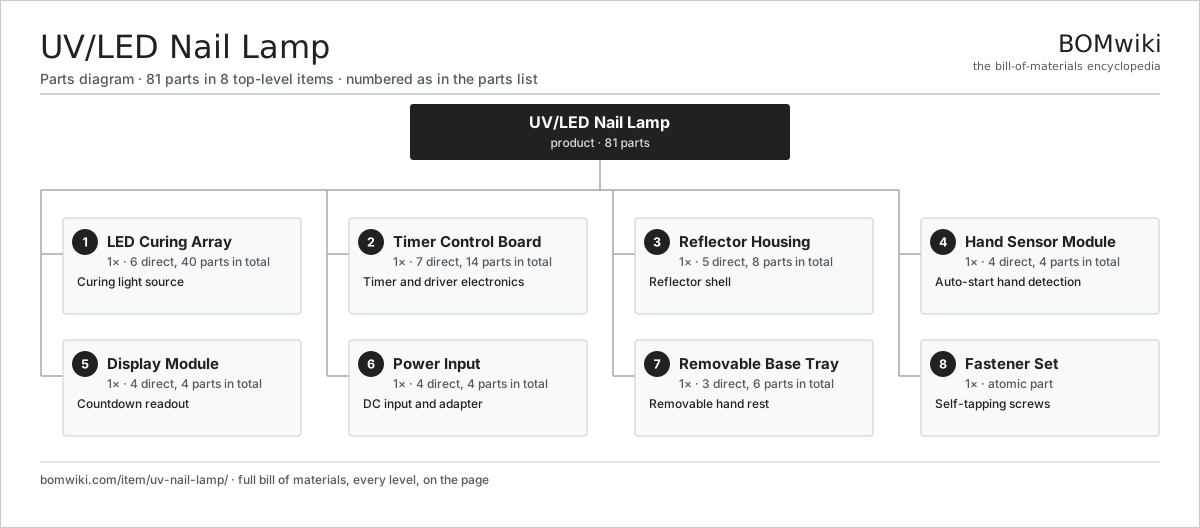
| # | Part | Qty | What it does |
|---|---|---|---|
| 1 | LED Curing Array 6 parts | 1× | Curing light source |
| 2 | Timer Control Board 7 parts | 1× | Timer and driver electronics |
| 3 | Reflector Housing 5 parts | 1× | Reflector shell |
| 4 | Hand Sensor Module 4 parts | 1× | Auto-start hand detection |
| 5 | Display Module 4 parts | 1× | Countdown readout |
| 6 | Power Input 4 parts | 1× | DC input and adapter |
| 7 | Removable Base Tray 3 parts | 1× | Removable hand rest |
| 8 | Fastener Set | 1× | Self-tapping screws |
3D model
No 3D model yet. Have a CAD file of this? Add a 3D model. STL renders right on this page; STEP, FreeCAD, and OpenSCAD sources are welcome too (openly licensed, like all 3D models on BOMwiki).
Build & assembly graph
expand / collapse · shared sub-assemblies converge · links to related products · est. labourTap an assembly to expand/collapse · tap a part to open it · use “Open page” for any node · drag to pan, scroll to zoom.
Bill of materials for UV/LED Nail Lamp
8 top-level lines · 41 rows shown · 81 parts total · indented to 3 levels| # | Item / sub-assembly | Part no. | Qty/assy | Ext. qty | Parts | Type |
|---|---|---|---|---|---|---|
| 1 | LED Curing Array 6 parts | uv-nail-lamp-led-array | 1× | 1 | 40 | assembly |
| 1.1 | Top LED Strip | uv-nail-lamp-led-strip-top | 1× | 1 | · | part |
| 1.2 | Side LED Strip | uv-nail-lamp-led-strip-side | 2× | 2 | · | part |
| 1.3 | 365 nm UV LED | uv-nail-lamp-led-365 | 12× | 12 | · | part |
| 1.4 | 405 nm LED | uv-nail-lamp-led-405 | 21× | 21 | · | part |
| 1.5 | Metal-Core PCB | uv-nail-lamp-mcpcb | 3× | 3 | · | part |
| 1.6 | Wire Bundle | wire-bundle | 1× | 1 | · | part |
| 2 | Timer Control Board 7 parts | uv-nail-lamp-control-board | 1× | 1 | 14 | assembly |
| 2.1 | Bare PCB | pcb-bare | 1× | 1 | · | part |
| 2.2 | Microcontroller | mcu | 1× | 1 | · | part |
| 2.3 | Power MOSFET | mosfet | 3× | 3 | · | part |
| 2.4 | SMD Passive (R/C/L) | smd-passives | 1× | 1 | · | part |
| 2.5 | Timer Preset Button | uv-nail-lamp-buttons | 4× | 4 | · | part |
| 2.6 | Piezo Buzzer | uv-nail-lamp-buzzer | 1× | 1 | · | part |
| 2.7 | Connector | connector | 3× | 3 | · | part |
| 3 | Reflector Housing 5 parts | uv-nail-lamp-housing | 1× | 1 | 8 | assembly |
| 3.1 | Upper Shell | uv-nail-lamp-upper-shell | 1× | 1 | · | part |
| 3.2 | Reflector Liner | uv-nail-lamp-reflector-liner | 1× | 1 | · | part |
| 3.3 | Lower Shell | uv-nail-lamp-lower-shell | 1× | 1 | · | part |
| 3.4 | Entry Skirt | uv-nail-lamp-entry-skirt | 1× | 1 | · | part |
| 3.5 | Rubber Foot | uv-nail-lamp-foot | 4× | 4 | · | part |
| 4 | Hand Sensor Module 4 parts | uv-nail-lamp-sensor-module | 1× | 1 | 4 | assembly |
| 4.1 | IR Emitter LED | uv-nail-lamp-ir-emitter | 1× | 1 | · | part |
| 4.2 | IR Phototransistor | uv-nail-lamp-ir-receiver | 1× | 1 | · | part |
| 4.3 | Sensor Carrier PCB | uv-nail-lamp-sensor-pcb | 1× | 1 | · | part |
| 4.4 | Connector | connector | 1× | 1 | · | part |
| 5 | Display Module 4 parts | uv-nail-lamp-display-module | 1× | 1 | 4 | assembly |
| 5.1 | 7-Segment Display | uv-nail-lamp-7seg | 1× | 1 | · | part |
| 5.2 | Display Lens | uv-nail-lamp-display-lens | 1× | 1 | · | part |
| 5.3 | Bare PCB | pcb-bare | 1× | 1 | · | part |
| 5.4 | Connector | connector | 1× | 1 | · | part |
| 6 | Power Input 4 parts | uv-nail-lamp-power-input | 1× | 1 | 4 | assembly |
| 6.1 | Power Supply | power-supply | 1× | 1 | · | part |
| 6.2 | DC Barrel Jack | uv-nail-lamp-dc-jack | 1× | 1 | · | part |
| 6.3 | Input Protection Stage | uv-nail-lamp-input-filter | 1× | 1 | · | part |
| 6.4 | Wire Bundle | wire-bundle | 1× | 1 | · | part |
| 7 | Removable Base Tray 3 parts | uv-nail-lamp-base-tray | 1× | 1 | 6 | assembly |
| 7.1 | Tray Plate | uv-nail-lamp-tray-plate | 1× | 1 | · | part |
| 7.2 | Tray Magnet | uv-nail-lamp-tray-magnet | 4× | 4 | · | part |
| 7.3 | Tray Surface Pad | uv-nail-lamp-tray-pad | 1× | 1 | · | part |
| 8 | Fastener Set | fastener-set | 1× | 1 | · | part |
Something wrong in this list? Report a problem with this BOM.
Related products
same domain, ranked by shared parts Electric Massage Table
180 parts · shares 3 with this page
Electrolysis Machine
97 parts · shares 3 with this page
Lighted Makeup Mirror
156 parts · shares 3 with this page
Microdermabrasion Machine
139 parts · shares 3 with this page
Electric Massage Table
180 parts · shares 3 with this page
Electrolysis Machine
97 parts · shares 3 with this page
Lighted Makeup Mirror
156 parts · shares 3 with this page
Microdermabrasion Machine
139 parts · shares 3 with this page
 Thermal Stencil Printer
39 parts · shares 2 with this page
Thermal Stencil Printer
39 parts · shares 2 with this page
 Electric Foot Spa
125 parts · shares 2 with this page
Electric Foot Spa
125 parts · shares 2 with this page
Sourcing: possible vendors
Browse the supplier directory → Prices, MOQ, and lead times are algorithmic estimates, not quotes, and not claims about these companies. Company mappings are curated by keyword; est. price band $15–$500. How estimates work| Vendor | HQ | Specialty | MOQ | Lead time |
|---|---|---|---|---|
| philips.com ↗ | Amsterdam, NL | Grooming & care | 2,000 units | 6–10 wks |
|
🇩🇪Braun
braun.com ↗
|
Kronberg, DE | Grooming (P&G) | 2,000 units | 6–10 wks |
|
🇺🇸Conair
conair.com ↗
|
Stamford, US | Personal care appliances | 2,000 units | 6–10 wks |
|
🇬🇧Dyson
dyson.com ↗
|
Malmesbury, GB | Vacuums & hair care | 2,000 units | 6–10 wks |
| panasonic.com ↗ | Osaka, JP | Electronics & appliances | 2,000 units | 6–10 wks |
863-word article