A/C Recovery Machine
ProductOverview
The A/C recovery machine is an essential shop tool that safely captures refrigerant from vehicle air-conditioning systems before service or disposal. U.S. federal law (Clean Air Act, 42 U.S.C. § 7671 et seq.) mandates the recovery and recycling of refrigerants; venting to atmosphere is prohibited and carries substantial fines. The machine combines several interconnected subsystems: a vapor-phase Vapor-Phase Recovery Compressor that draws low-pressure refrigerant gas from the vehicle's A/C lines, a Evacuation Vacuum Pump for initial evacuation, a Refrigerant Condenser Coil that liquefies the compressed vapor, a Filter-Dryer Cartridge removing moisture and contaminants, and an Oil Recovery Circuit recovering compressor lubricant. The clean refrigerant is measured on a Electronic Refrigerant Scale and stored in an ASME-coded Recycled Refrigerant Storage Tank for re-use or certified disposal.
The modern automotive A/C system operates at two pressure levels: a low-pressure (suction) side ~30–50 psi and a high-pressure (discharge) side ~250–350 psi, depending on ambient temperature and refrigerant type. Vehicle air-conditioning systems typically contain 1–2 lbs of refrigerant (older vehicles 3–4 lbs). Recovering that refrigerant in vapor form is the standard method, as vapor-phase recovery is faster and cleaner than liquid recovery and does not flood the compressor with liquid slug.
How it Works
The technician connects the Vehicle Connection Hose Set (high-side, low-side, and oil lines) to the vehicle's A/C service ports. The high-side hose draws vapor from the condenser outlet, the low-side hose supplies low-pressure vapor from the evaporator, and the oil line (if equipped) collects trace lubricant to a separate Oil Separator Tank. The technician energizes the machine, which activates the Recovery Compressor Motor.
The Compressor Head draws in the low-pressure vapor from the vehicle's A/C system and compresses it to 250–350 psi absolute, raising the temperature to 160–180°C. The high-temperature, high-pressure vapor exits through the Discharge Check Valve (a one-way check preventing backflow) and flows into the Refrigerant Condenser Coil. The Cooling Fan Motor blower cools the vapor with ambient shop air. As the vapor cools below its saturation temperature at the discharge pressure, it condenses into a liquid state and drips out the bottom of the Condenser Core.
The liquid refrigerant then passes through the Filter-Dryer Cartridge cartridge, which removes particulate matter (corrosion, wear debris, oil droplets) down to 5–10 microns and absorbs up to 2–3% moisture using the Desiccant Filter Element silica-gel desiccant. Clean, dry liquid then enters the Solenoid Valve Manifold, where three Solenoid Control Valve units route flow based on mode: recovery (compressor on, tank fill), recycle (purification loop), or isolation (tank disconnected).
The liquid flow then encounters the Oil Separator Tank, where any entrained oil droplets and residual compressor lubricant settle out by gravity. A thermostat-controlled Oil Heater Element warms the oil to reduce viscosity and accelerate drainage, and a drain valve allows technician collection of the separated oil for disposal or re-use (after analysis).
Finally, the pure liquid refrigerant is drawn across the Scale Load Cell Platform and Scale Display Unit (which measure mass ±0.1 oz) and enters the Pressure Tank. The tank pressure rises as more refrigerant is condensed and stored. A Relief Safety Valve set to 100 psig absolute protects the tank from over-pressure if temperature rises.
Recovery speed is typically 20–30 lbs/hour for vapor-phase operation, meaning a standard 1.5 lb vehicle charge is recovered in 3–5 minutes. Throughout the process, the Evacuation Vacuum Pump may be engaged in parallel to initially evacuate non-condensable air and moisture from low-pressure lines, reaching <3 torr absolute, ensuring the system is clean and dry before the customer's new refrigerant charge.
Recycling and Re-Use
One major advantage of modern recovery machines is the ability to recycle recovered refrigerant for immediate re-use, rather than shipping it for off-site reclamation. The Filter-Dryer Cartridge and Oil Recovery Circuit remove most contaminants, and the recycled refrigerant can be re-charged into the same or another vehicle without degradation. However, EPA regulations distinguish between recovery, recycling, and reclamation: recovery (capture), recycling (in-shop filtering), and reclamation (off-site reprocessing with lab analysis). Most shops use in-machine recycling for internal use and send high-contamination refrigerant off-site for certified reclamation.
Safety and Compliance
A/C recovery units are certified under EPA Section 608 regulations, requiring technicians to hold an EPA-approved certification to operate the equipment. The Recycled Refrigerant Storage Tank is an ASME pressure vessel, stamped and hydro-tested; state regulations often require annual inspection and certification. The Vehicle Connection Hose Set quick-disconnects are color-coded (red = high-side, blue = low-side, yellow = oil) per SAE J2196, preventing cross-contamination and wrong connections. Every recovery unit is equipped with a Relief Safety Valve to vent excess pressure if the tank temperature rises uncontrollably (e.g., in a hot storage room).
Maintenance and Service Life
The Desiccant Filter Element is a consumable item, replaced every 20–30 recovery cycles or annually, whichever comes first, to maintain water absorption capacity and particulate filtration. The Compressor Head bearings and seals are oil-lubricated and typically require replacement every 5–10 years of heavy use. The Rotary Vane Rotor vanes wear gradually; ultimate vacuum creeps upward (e.g., from 10 mtorr to 50 mtorr) after 10 years, signaling vane replacement is needed. The Cooling Fan Motor motor bearings are sealed and generally last 10+ years. The Scale Load Cell Platform load cell should be checked annually for drift and recalibrated against known weights.
A/C Recovery Machine parts and their functions
9 top-level parts · 26 parts in total · full bill of materials below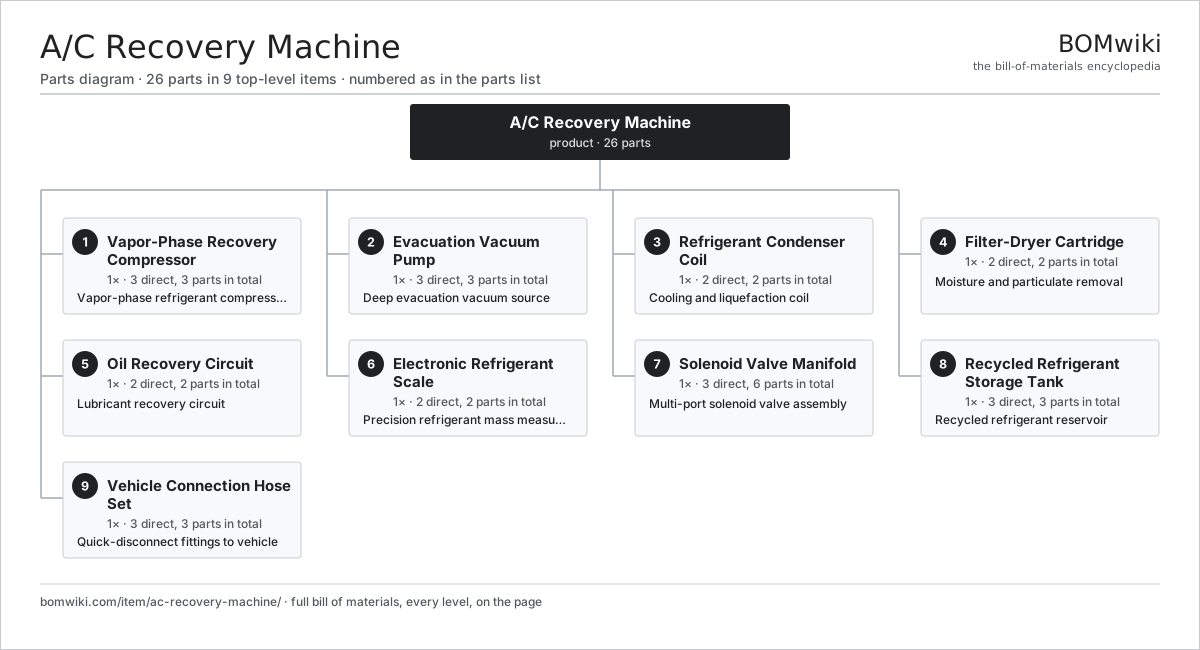
| # | Part | Qty | What it does |
|---|---|---|---|
| 1 | Vapor-Phase Recovery Compressor 3 parts | 1× | Vapor-phase refrigerant compressor |
| 2 | Evacuation Vacuum Pump 3 parts | 1× | Deep evacuation vacuum source |
| 3 | Refrigerant Condenser Coil 2 parts | 1× | Cooling and liquefaction coil |
| 4 | Filter-Dryer Cartridge 2 parts | 1× | Moisture and particulate removal |
| 5 | Oil Recovery Circuit 2 parts | 1× | Lubricant recovery circuit |
| 6 | Electronic Refrigerant Scale 2 parts | 1× | Precision refrigerant mass measurement |
| 7 | Solenoid Valve Manifold 3 parts | 1× | Multi-port solenoid valve assembly |
| 8 | Recycled Refrigerant Storage Tank 3 parts | 1× | Recycled refrigerant reservoir |
| 9 | Vehicle Connection Hose Set 3 parts | 1× | Quick-disconnect fittings to vehicle |
3D model
No 3D model yet. Have a CAD file of this? Add a 3D model. STL renders right on this page; STEP, FreeCAD, and OpenSCAD sources are welcome too (openly licensed, like all 3D models on BOMwiki).
Build & assembly graph
expand / collapse · shared sub-assemblies converge · links to related products · est. labourTap an assembly to expand/collapse · tap a part to open it · use “Open page” for any node · drag to pan, scroll to zoom.
Bill of materials for A/C Recovery Machine
9 top-level lines · 32 rows shown · 26 parts total · indented to 3 levels| # | Item / sub-assembly | Part no. | Qty/assy | Ext. qty | Parts | Type |
|---|---|---|---|---|---|---|
| 1 | Vapor-Phase Recovery Compressor 3 parts | ac-recovery-compressor | 1× | 1 | 3 | assembly |
| 1.1 | Recovery Compressor Motor | ac-recovery-compressor-motor | 1× | 1 | · | part |
| 1.2 | Compressor Head | ac-recovery-compressor-head | 1× | 1 | · | part |
| 1.3 | Discharge Check Valve | ac-recovery-compressor-discharge-valve | 1× | 1 | · | part |
| 2 | Evacuation Vacuum Pump 3 parts | ac-recovery-vacuum-pump | 1× | 1 | 3 | assembly |
| 2.1 | Vacuum Pump Motor | ac-recovery-vacuum-pump-motor | 1× | 1 | · | part |
| 2.2 | Rotary Vane Rotor | ac-recovery-vacuum-pump-rotor | 1× | 1 | · | part |
| 2.3 | Oil Back-Trap | ac-recovery-vacuum-pump-oil-trap | 1× | 1 | · | part |
| 3 | Refrigerant Condenser Coil 2 parts | ac-recovery-condenser | 1× | 1 | 2 | assembly |
| 3.1 | Condenser Core | ac-recovery-condenser-core | 1× | 1 | · | part |
| 3.2 | Cooling Fan Motor | ac-recovery-condenser-fan | 1× | 1 | · | part |
| 4 | Filter-Dryer Cartridge 2 parts | ac-recovery-filter-dryer | 1× | 1 | 2 | assembly |
| 4.1 | Desiccant Filter Element | ac-recovery-filter-dryer-element | 1× | 1 | · | part |
| 4.2 | Filter Housing | ac-recovery-filter-dryer-housing | 1× | 1 | · | part |
| 5 | Oil Recovery Circuit 2 parts | ac-recovery-oil-separator | 1× | 1 | 2 | assembly |
| 5.1 | Oil Separator Tank | ac-recovery-oil-separator-tank | 1× | 1 | · | part |
| 5.2 | Oil Heater Element | ac-recovery-oil-separator-heater | 1× | 1 | · | part |
| 6 | Electronic Refrigerant Scale 2 parts | ac-recovery-scale | 1× | 1 | 2 | assembly |
| 6.1 | Scale Load Cell Platform | ac-recovery-scale-platform | 1× | 1 | · | part |
| 6.2 | Scale Display Unit | ac-recovery-scale-indicator | 1× | 1 | · | part |
| 7 | Solenoid Valve Manifold 3 parts | ac-recovery-manifold-block | 1× | 1 | 6 | assembly |
| 7.1 | Solenoid Control Valve | ac-recovery-solenoid-valve | 3× | 3 | · | part |
| 7.2 | Manifold Check Valve | ac-recovery-check-valve | 2× | 2 | · | part |
| 7.3 | Valve Body Block | ac-recovery-port-block | 1× | 1 | · | part |
| 8 | Recycled Refrigerant Storage Tank 3 parts | ac-recovery-storage-tank | 1× | 1 | 3 | assembly |
| 8.1 | Pressure Tank | ac-recovery-tank-shell | 1× | 1 | · | part |
| 8.2 | Relief Safety Valve | ac-recovery-tank-relief-valve | 1× | 1 | · | part |
| 8.3 | Tank Shutoff Valve | ac-recovery-tank-isolation-valve | 1× | 1 | · | part |
| 9 | Vehicle Connection Hose Set 3 parts | ac-recovery-hose-set | 1× | 1 | 3 | assembly |
| 9.1 | High-Side Hose (Discharge) | ac-recovery-hose-high-side | 1× | 1 | · | part |
| 9.2 | Low-Side Hose (Suction) | ac-recovery-hose-low-side | 1× | 1 | · | part |
| 9.3 | Oil Recovery Hose | ac-recovery-hose-oil | 1× | 1 | · | part |
Something wrong in this list? Report a problem with this BOM.
Sourcing: possible vendors
Browse the supplier directory → Prices, MOQ, and lead times are algorithmic estimates, not quotes, and not claims about these companies. Company mappings are curated by keyword; est. price band $0.50–$100. How estimates work| Vendor | HQ | Specialty | MOQ | Lead time |
|---|
987-word article