Garage Creeper
ProductOverview
The garage creeper is the universal under-vehicle work platform found in every professional shop and many home garages. A mechanic lies on the padded deck and propels themselves with hands and feet while working on brakes, suspension, oil changes, or undercarriage corrosion inspection. The four swivel casters roll smoothly on any concrete shop floor, while a foot-operated brake prevents unintended rolling when work begins.
The key features are simplicity and toughness. No hydraulics, no electronics, just welded steel, casters, and padding. A mechanic can wheel a creeper under a vehicle in seconds and work in any position: prone, supine, or semi-seated if the optional folding seat is deployed. The adjustable headrest reduces neck strain during overhead work, and the magnetic tool tray keeps sockets and fasteners from scattering.
Creepers are rated for 350 lbs (user + tools), making them ideal for most automotive service tasks. They are less suitable for heavy tasks requiring sustained force (like prying a transmission or torquing suspension bolts) where a lift is safer; they are excellent for inspection, fastener replacement, and fluid service work.
Construction and durability
The frame is welded structural steel channel (2" × 1.5") forming a rectangular foundation 36" long × 18" wide. Cross-members and diagonal bracing bars prevent the frame from twisting under the mechanic's weight and uneven loading. The caster bosses are welded pads with M10 threaded inserts accepting mounting bolts.
The deck padding is 6 inches of closed-cell EVA foam glued to the frame with contact cement, then covered with 28 oz vinyl. This is considerably thicker and softer than foam mattress material, it distributes pressure evenly and reduces fatigue on spine and joints during extended under-vehicle work. The vinyl is oil-resistant, designed to shed shop fluids (brake fluid, coolant drips). Over time, the vinyl can crack or peel at edges; most shops refresh the padding every 5–10 years by peeling off old vinyl and foam, scraping the frame, and re-gluing new material.
The wheels are 6" diameter polyurethane, medium hardness, with sealed deep-groove ball bearings. This size is a compromise: large enough to roll smoothly over concrete seams and minor debris, small enough to fit under low-clearance vehicles (clearance under a lowered sports car is often just 3–4 inches). The swivel brackets allow all four wheels to rotate, making a creeper highly maneuverable, the operator can turn the creeper in its own length by pivoting on the rear wheels while rolling the front casters sideways.
Headrest and seating options
The headrest assembly is a critical feature for comfort and safety. The memory foam cushion (8" × 6" × 2") reduces pressure on the back of the skull and neck during sustained overhead work like transmission service or intake manifold work. The hinged bracket allows the headrest to angle backward ±30° from vertical, accommodating different body sizes and work angles.
A telescoping height rod extends the headrest ±6 inches, allowing a tall mechanic to rest their head while lying prone, or allowing a shorter mechanic to get clear sight lines to overhead bolts. Spring-loaded detent pins lock the headrest at the chosen angle, so it doesn't slide or collapse during work.
The optional folding seat is a hinged seat back with a 4" foam cushion that folds up against the creeper's foot area. When deployed, it allows the mechanic to sit upright in a semi-working position (knees slightly bent, back supported), useful for lower-body work like lower-control-arm replacement or brake bleeding. When folded, the seat adds only 2 inches to overall height, allowing the creeper to fit under vehicles with tight ground clearance (e.g., sports cars on lowering springs).
Mobility and parking brake
The parking brake is foot-operated, a simple mechanical linkage. Pressing a foot pedal on the side of the creeper tightens a stainless steel cable that presses rubber brake pads against all four wheels simultaneously. This prevents the creeper from rolling if the mechanic needs both hands free to work or if the shop floor is sloped.
Most creepers have a spring-loaded pedal that returns to neutral when released, so the brake is entirely mechanical and requires no power. Some shops add a second safety pin through the brake pedal, preventing accidental release if the creeper is bumped. The brake blocks are replaceable rubber pads glued to steel backing plates, wearing slowly over years of use.
Wheeling a creeper across a shop floor is effortless, most shops have floor space dedicated to storing creepers upright in a wall rack or cart dock. Pulling a creeper out, placing it under the first vehicle, and moving it to the next bay takes seconds. The light weight (about 100 lbs empty) allows a single technician to position it with one hand, leaving the other free to guide themselves under the vehicle.
Storage and tool integration
The under-deck magnetic tool tray (24" × 12") captures ferrous tools (wrenches, sockets, ratchets, screwdrivers) within arm's reach. The tray has 6 recessed N52 neodymium magnets embedded in the base, providing 5 lbs of holding force each, sufficient to keep a socket set in place while rolling and working. When the mechanic needs a socket, they reach underneath, grab it from the magnet, and work. When finished, it snaps back into place.
Non-ferrous tools (aluminum wrenches, plastic handles) or measuring instruments (calipers, gauges) are typically placed on the floor beside the creeper or hung on a magnetic hook bolted to the creeper side. Some shops add a small shelf or canvas pocket to the creeper to hold fasteners and small parts removed during service.
Common use cases and limitations
Creepers excel at lower-body and undercarriage service: brake pad replacement, suspension inspection, oil and filter changes, transmission leak detection, floor pan corrosion assessment, and suspension bushing wear checks. They are also used during diagnostics, allowing a mechanic to lie under a running vehicle and listen to transmission clunk, brake squeal, or suspension noise from the source.
Creepers are less suitable for work requiring sustained torque (e.g., tightening suspension bolts to specification) because the mechanic's leverage and body position are compromised compared to standing. A lift is preferred for work where accuracy and power matter. Similarly, creepers should not be used under a vehicle supported only on jack stands without additional blocking or safety chains; the creeper itself can roll out from under the vehicle if bumped, creating a collapse hazard.
Electric creepers (with battery-powered traction drive) exist for shops with large flat bays, but the standard mechanical creeper remains dominant because of cost, reliability, and the fact that most automotive service work does not require powered movement. A mechanic can propel themselves under a vehicle faster with their own limbs than with a low-speed electric motor.
Garage Creeper parts and their functions
7 top-level parts · 127 parts in total · full bill of materials below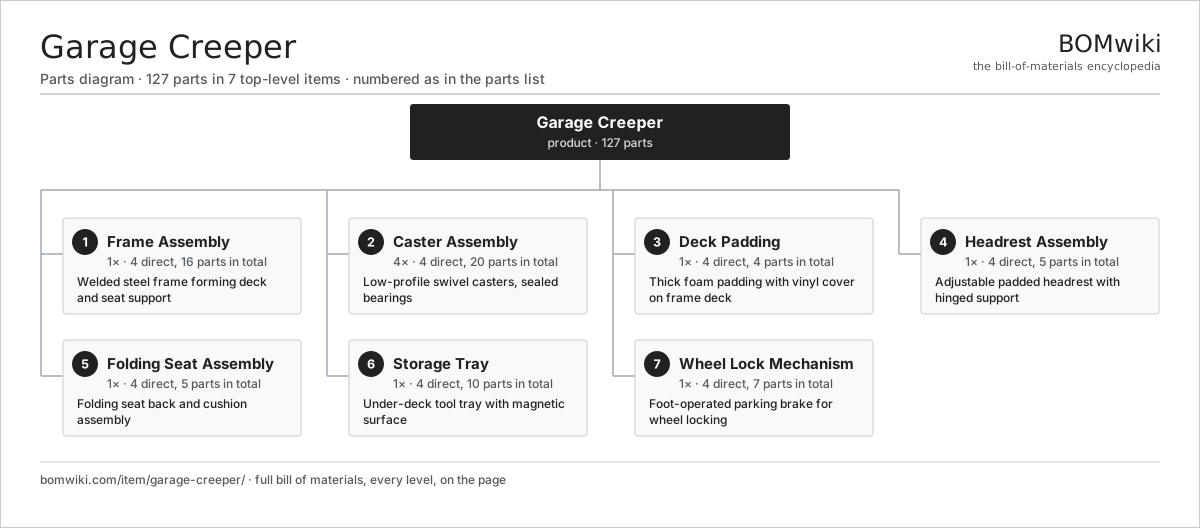
| # | Part | Qty | What it does |
|---|---|---|---|
| 1 | Frame Assembly 4 parts | 1× | Welded steel frame forming deck and seat support |
| 2 | Caster Assembly 4 parts | 4× | Low-profile swivel casters, sealed bearings |
| 3 | Deck Padding 4 parts | 1× | Thick foam padding with vinyl cover on frame deck |
| 4 | Headrest Assembly 4 parts | 1× | Adjustable padded headrest with hinged support |
| 5 | Folding Seat Assembly 4 parts | 1× | Folding seat back and cushion assembly |
| 6 | Storage Tray 4 parts | 1× | Under-deck tool tray with magnetic surface |
| 7 | Wheel Lock Mechanism 4 parts | 1× | Foot-operated parking brake for wheel locking |
3D model
No 3D model yet. Have a CAD file of this? Add a 3D model. STL renders right on this page; STEP, FreeCAD, and OpenSCAD sources are welcome too (openly licensed, like all 3D models on BOMwiki).
Build & assembly graph
expand / collapse · shared sub-assemblies converge · links to related products · est. labourTap an assembly to expand/collapse · tap a part to open it · use “Open page” for any node · drag to pan, scroll to zoom.
Bill of materials for Garage Creeper
7 top-level lines · 35 rows shown · 127 parts total · indented to 3 levels| # | Item / sub-assembly | Part no. | Qty/assy | Ext. qty | Parts | Type |
|---|---|---|---|---|---|---|
| 1 | Frame Assembly 4 parts | garage-creeper-frame | 1× | 1 | 16 | assembly |
| 1.1 | Main Rail | garage-creeper-frame-main-rail | 2× | 2 | · | part |
| 1.2 | Cross Member | garage-creeper-frame-cross-member | 6× | 6 | · | part |
| 1.3 | Caster Boss | garage-creeper-frame-caster-boss | 4× | 4 | · | part |
| 1.4 | Reinforcement Bar | garage-creeper-frame-reinforcement-bar | 4× | 4 | · | part |
| 2 | Caster Assembly 4 parts | garage-creeper-caster-wheel | 4× | 4 | 20 | assembly |
| 2.1 | Caster Wheel | garage-creeper-caster-wheel-rubber | 4× | 16 | · | part |
| 2.2 | Caster Bracket | garage-creeper-caster-bracket | 4× | 16 | · | part |
| 2.3 | Caster Bearing | garage-creeper-caster-bearing | 8× | 32 | · | part |
| 2.4 | Mounting Bolt | garage-creeper-caster-mounting-bolt | 4× | 16 | · | part |
| 3 | Deck Padding 4 parts | garage-creeper-deck-padding | 1× | 1 | 4 | assembly |
| 3.1 | Foam Padding | garage-creeper-padding-foam-sheet | 1× | 1 | · | part |
| 3.2 | Vinyl Cover | garage-creeper-padding-vinyl-cover | 1× | 1 | · | part |
| 3.3 | Edge Trim | garage-creeper-padding-vinyl-trim | 1× | 1 | · | part |
| 3.4 | Adhesive | garage-creeper-padding-adhesive | 1× | 1 | · | part |
| 4 | Headrest Assembly 4 parts | garage-creeper-headrest | 1× | 1 | 5 | assembly |
| 4.1 | Headrest Cushion | garage-creeper-headrest-cushion | 1× | 1 | · | part |
| 4.2 | Headrest Bracket | garage-creeper-headrest-bracket | 1× | 1 | · | part |
| 4.3 | Height Rod | garage-creeper-headrest-height-rod | 1× | 1 | · | part |
| 4.4 | Angle Pin | garage-creeper-headrest-angle-pin | 2× | 2 | · | part |
| 5 | Folding Seat Assembly 4 parts | garage-creeper-seat-option | 1× | 1 | 5 | assembly |
| 5.1 | Seat Frame | garage-creeper-seat-frame | 1× | 1 | · | part |
| 5.2 | Seat Cushion | garage-creeper-seat-cushion | 1× | 1 | · | part |
| 5.3 | Hinge Pin | garage-creeper-seat-hinge-pin | 2× | 2 | · | part |
| 5.4 | Seat Latch | garage-creeper-seat-latch | 1× | 1 | · | part |
| 6 | Storage Tray 4 parts | garage-creeper-storage-tray | 1× | 1 | 10 | assembly |
| 6.1 | Tray Base | garage-creeper-tray-steel-base | 1× | 1 | · | part |
| 6.2 | Tray Lip | garage-creeper-tray-lip-edge | 1× | 1 | · | part |
| 6.3 | Tray Bracket | garage-creeper-tray-mount-strap | 2× | 2 | · | part |
| 6.4 | Neodymium Magnet | neodymium-magnet | 6× | 6 | · | part |
| 7 | Wheel Lock Mechanism 4 parts | garage-creeper-wheel-lock | 1× | 1 | 7 | assembly |
| 7.1 | Lock Pedal | garage-creeper-lock-pedal | 1× | 1 | · | part |
| 7.2 | Brake Cable | garage-creeper-lock-cable | 1× | 1 | · | part |
| 7.3 | Brake Block | garage-creeper-lock-brake-block | 4× | 4 | · | part |
| 7.4 | Return Spring | garage-creeper-lock-spring | 1× | 1 | · | part |
Something wrong in this list? Report a problem with this BOM.
Sourcing: possible vendors
Browse the supplier directory → Prices, MOQ, and lead times are algorithmic estimates, not quotes, and not claims about these companies. Company mappings are curated by keyword; est. price band $0.50–$100. How estimates work| Vendor | HQ | Specialty | MOQ | Lead time |
|---|
1,236-word article